

EVT vs DVT vs PVT: The Three Validation Builds Explained

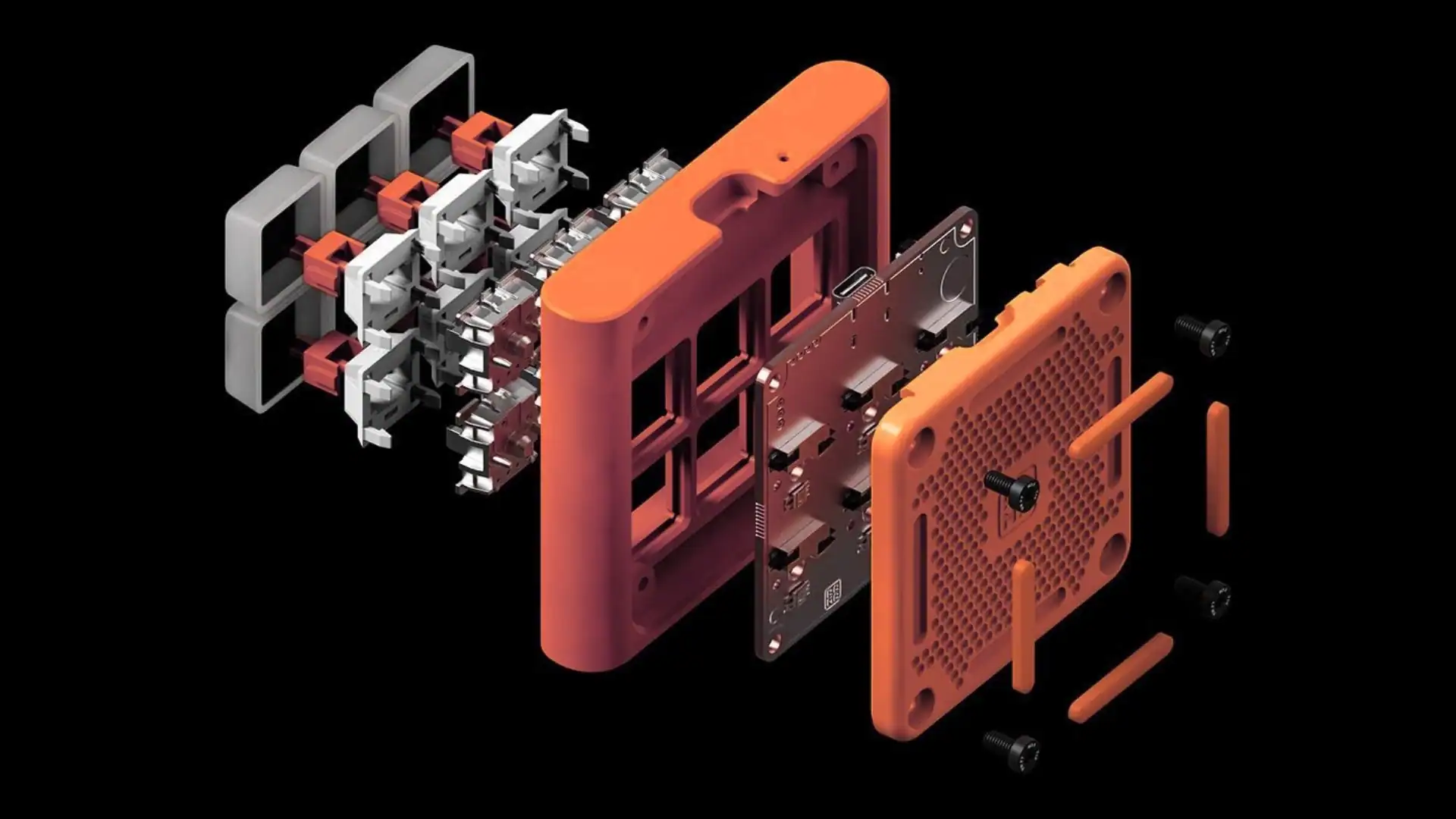
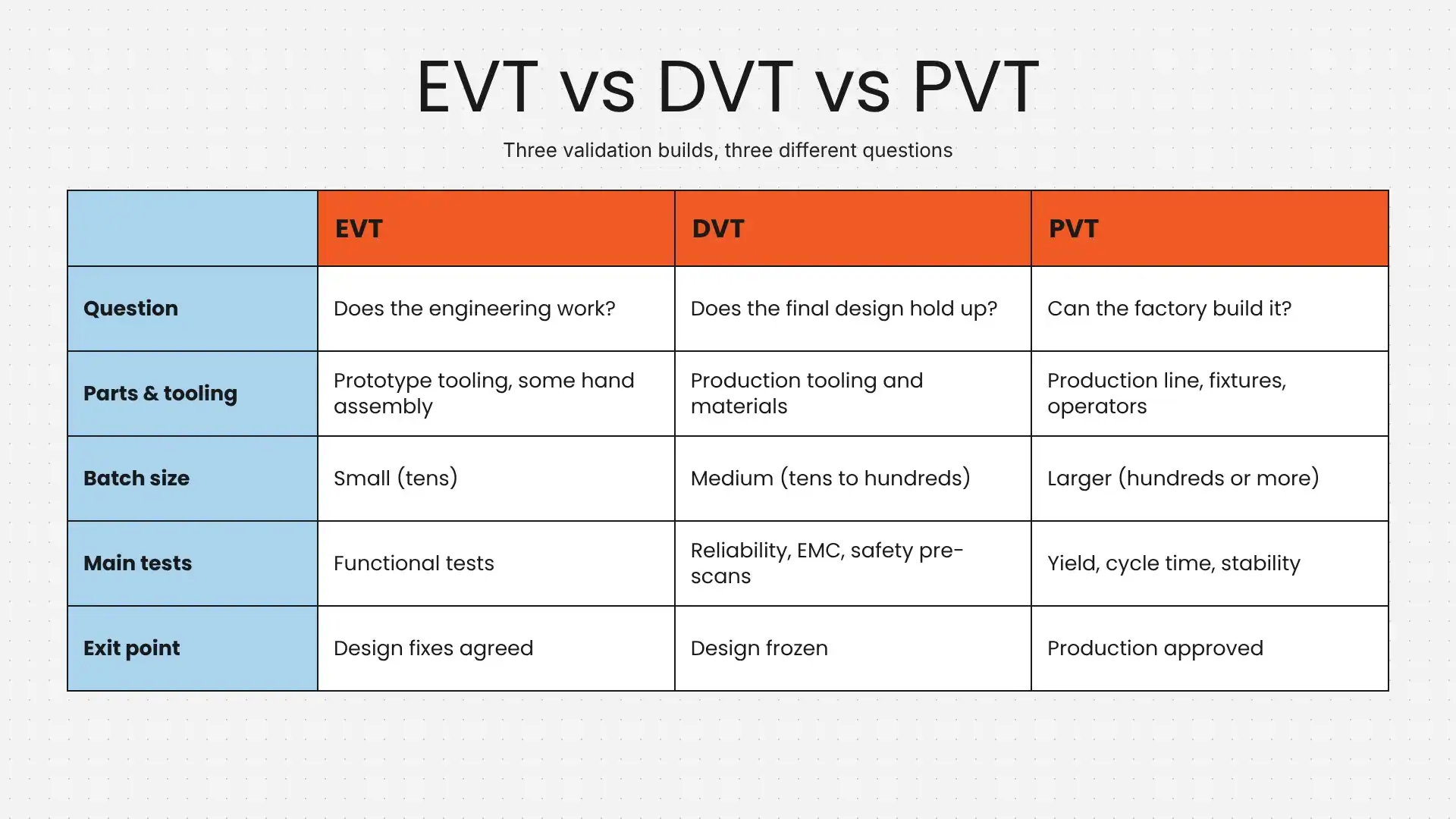
Does engineering work? Does the final design hold up? Can the factory build it?
Answer them in that order and your launch stays on track. Mix them up and you pay for it in rework.
This guide explains each validation build, what changes between them and how to know when you are ready to move on.
What do EVT, DVT and PVT mean?
EVT (engineering validation test), DVT (design validation test) and PVT (production validation test) are the three validation builds in hardware development. EVT proves the engineering. DVT proves the final design. PVT proves the production process.
They sit inside the wider NPI process, between design and mass production.
| EVT | DVT | PVT | |
|---|---|---|---|
| Question it answers | Does engineering work? | Does the final design hold up? | Can the factory build it? |
| Parts and tooling | Prototype tooling, some hand assembly | Production tooling and materials | Production line, fixtures and operators |
| Typical batch size | Small (tens of units) | Medium (tens to hundreds) | Larger (hundreds or more) |
| Main tests | Functional tests against specs | Reliability, environmental, EMC and safety pre-compliance | Yield, cycle time, process capability |
| Exit point | Design fixes agreed | Design frozen | Production approved |
Problems associated with changing, incorrect, and incomplete specifications are a common theme.”
Source: Harry Foster, Siemens EDA
Where EVT, DVT and PVT fit
Most programmes run five steps from idea to volume:
- Proof of concept (POC). A rough build that shows the idea can work.
- EVT. The first build that looks and works like the real product.
- DVT. The final design, built with production parts.
- PVT. The final design, built on the production line.
- Mass production (MP). Full-volume manufacturing.
Each step costs more than the last. That is why each one needs a clear exit decision.
What is EVT (engineering validation test)?
EVT checks that the engineering works.
The team builds a small batch. Some parts come from prototype tooling, 3D printing or machining. Engineers may assemble boards by hand.
Every function gets tested against the product specification. Power, sensors, wireless, firmware and user controls all go through their paces.
Expect problems. EVT exists to find them. A clean EVT often means the tests were not hard enough.
EVT exit criteria
- All core functions meet their specifications
- Known issues have agreed fixes and owners
- The BOM is stable enough to order production tooling
- Long lead-time components are on order

New product introduction prototyping time improved by 30% at a GlobalFoundries site recognised by the World Economic Forum.
What is DVT (design validation test)?
DVT checks that the final design holds up in the real world.
This is the first build with production tooling and production materials. Parts now look, feel and behave like the shipping product.
The team pushes units hard. Typical DVT tests include:
- Reliability: temperature cycling, humidity, vibration and drop tests
- Environmental: ingress protection (IP rating), UV and chemical resistance where needed
- Compliance: EMC and safety pre-scans ahead of formal certification
- User testing: fit, finish and usability with real users
Formal certification often starts during DVT. Our testing labs run EMC, safety, reliability and acoustic testing in house, which shortens this loop.
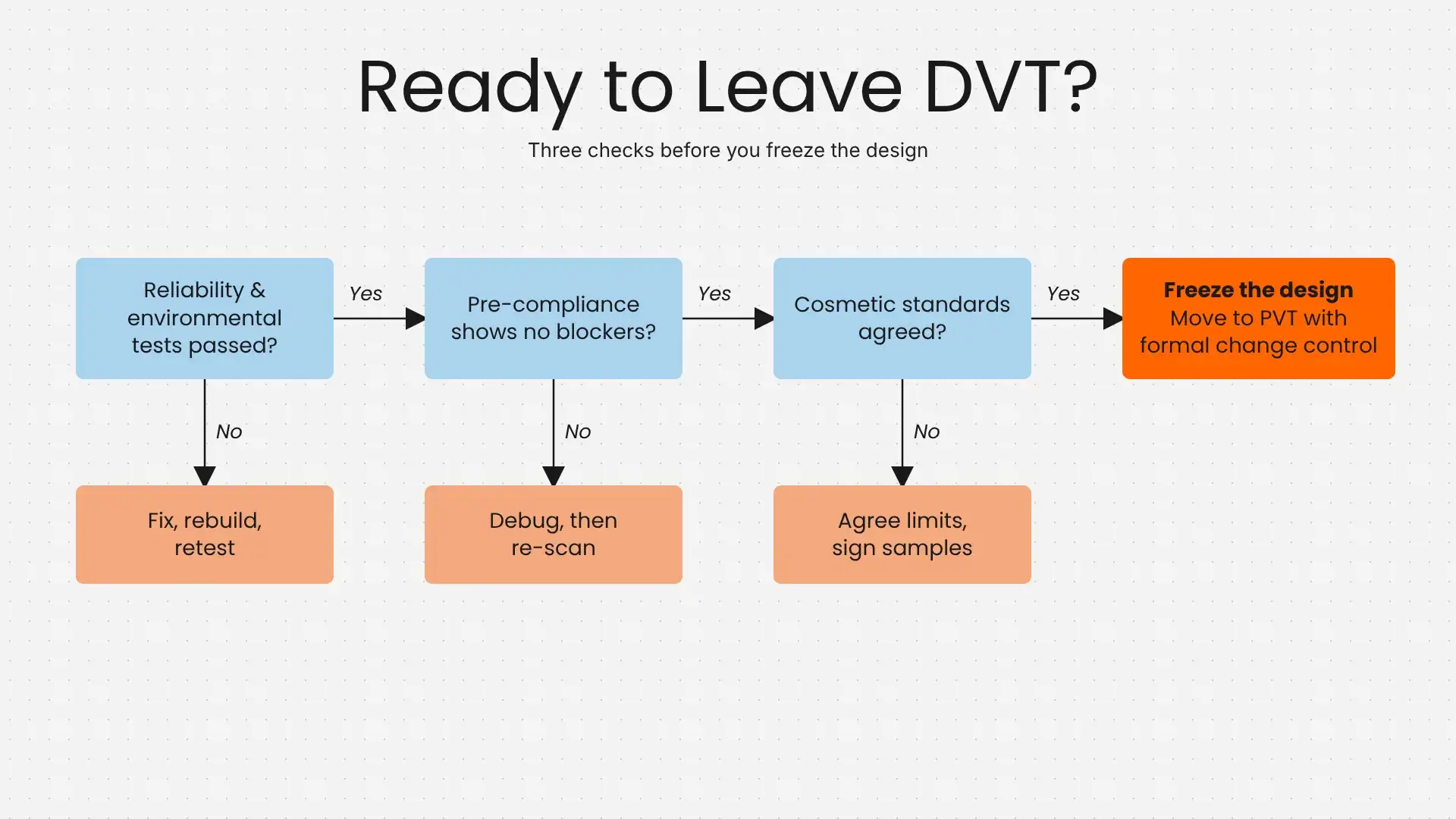
DVT exit criteria
- The design passes reliability and environmental tests
- Pre-compliance results show no blocking issues
- The team agrees and documents cosmetic standards
- The design is frozen, with formal change control from this point
DVT testing carries a high bar for regulated products. Medical devices, for example, need documented design verification and validation under the FDA’s Quality Management System Regulation.

There is a trend for companies to invest more in their own pre-compliance test equipment solutions.”
Source: Bill Wangard, Rohde & Schwarz, The Future of EMC Test
What is PVT (production validation test)?
PVT checks the factory, not the design.
The design should not change in PVT. Instead, the team tests the process. Units come off the real line, at real speed, with real operators, fixtures and test stations.
The team measures:
- First-pass yield. How many units pass every test the first time?
- Cycle time. Can the line hit the target output rate?
- Process stability. Do key measurements stay within limits across the run?
- Test coverage. Do production tests catch the faults they should?
PVT ends with production sign-off. That usually includes a first article inspection and golden samples.
PVT exit criteria
- Yield meets the agreed target
- The line hits its planned output rate
- First article inspection passes
- Customer and factory sign off the golden samples
- The customer signs off on mass production
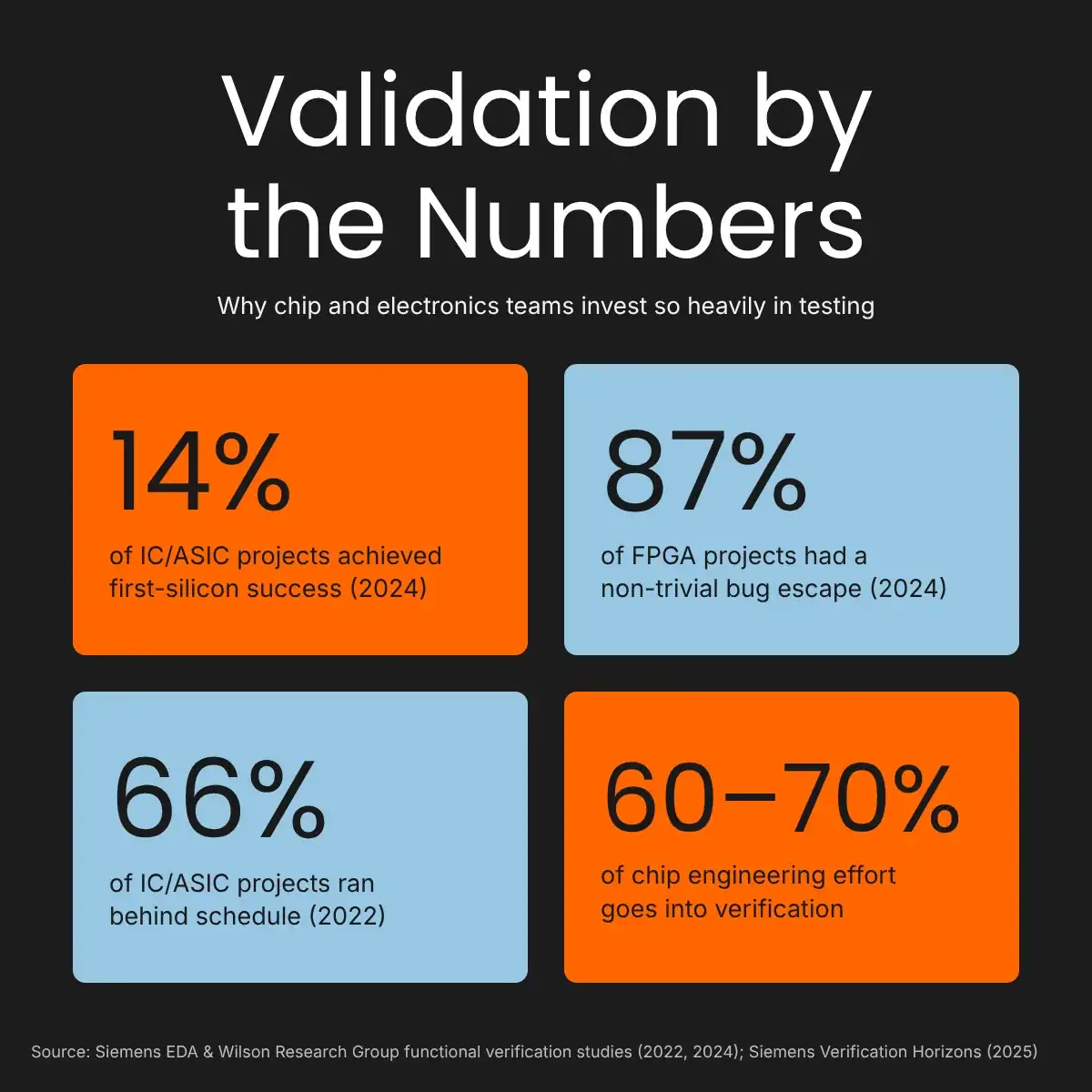
“The data suggest design errors are the leading cause of functional flaws, and the situation is worsening.”
Source: Harry Foster, Siemens EDA
What comes after PVT?
Mass production follows PVT. Most teams ramp volume in steps rather than switching straight to full output. Each step confirms that yield and supply hold before the next increase.
What changes for the factory between builds?
Each build asks more of the factory.
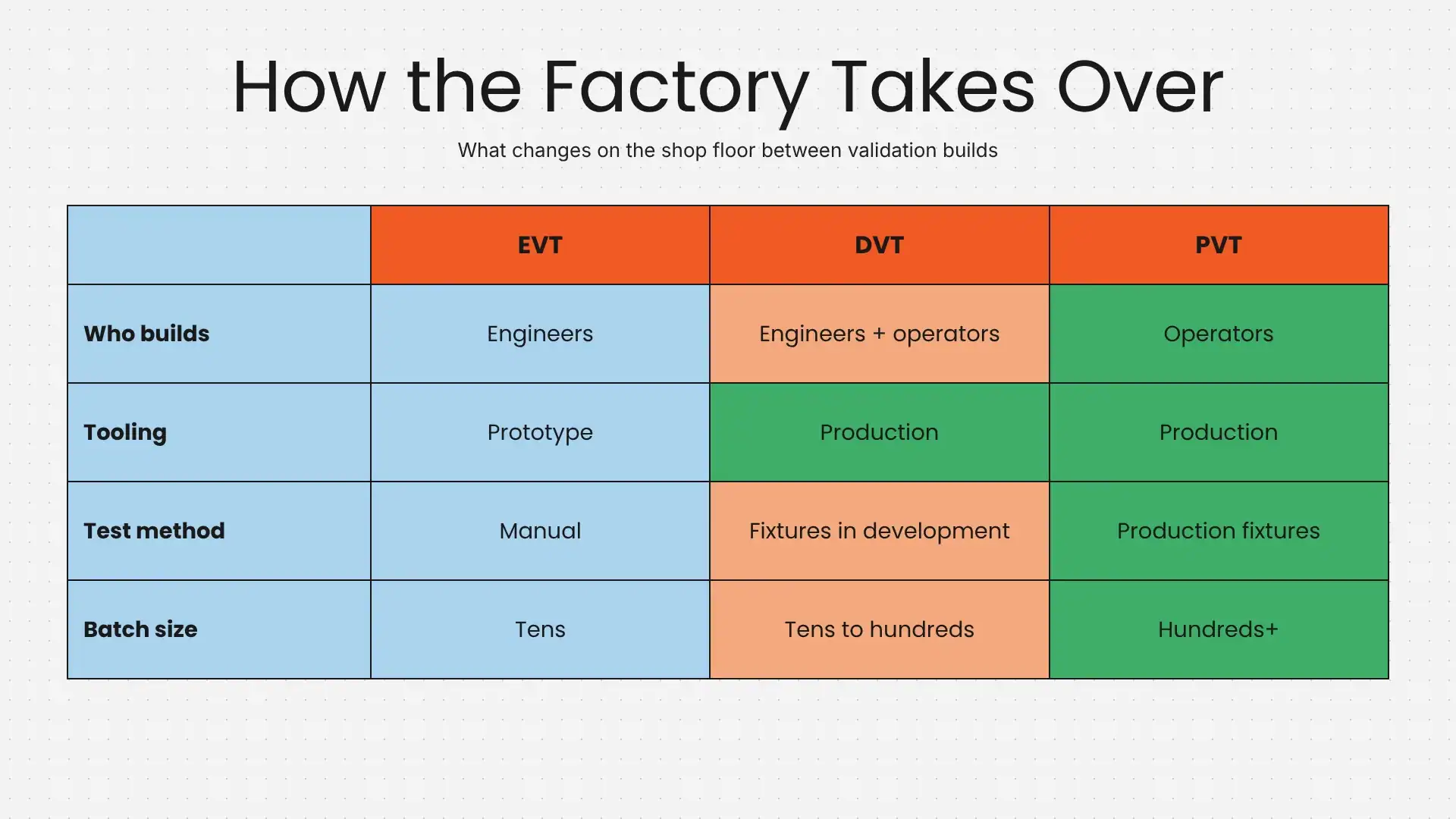
In EVT, engineers do most of the work. They assemble, debug and test by hand. The factory supplies parts and space.
In DVT, the factory starts to take over. Production tools make the parts. Operators begin to learn the assembly steps. Test engineers develop the fixtures and test software the line will use.
In PVT, the factory owns the build. Operators follow work instructions. Fixtures, test stations and quality checks run as they will in mass production. Engineers watch and fix, but they stay off the tools.
That shift matters. If engineers still build the units in PVT, the build proves the engineers, not the line.
Manufacturers may need to fill 2.3 million technician job openings across manufacturing and adjacent industries between 2025 and 2030.
How long does each validation build take?
There is no fixed answer. Timing depends on:
- Tooling lead time. Production moulds often set the pace between EVT and DVT.
- Test duration. Some reliability tests run for weeks.
- Certification queues. External lab slots can add waiting time.
- Fix cycles. Each problem found needs a fix, a rebuild and a retest.
The fastest way to shorten the timeline is to start long tasks early. Order tooling, book lab time and build fixtures before you need them.
Five mistakes that delay validation builds
1. Running DVT on prototype parts
Prototype parts behave differently from moulded ones. Results from soft tooling do not prove the production design. Wait for production tooling, or label results clearly as provisional.
2. Changing the design during PVT
A design change in PVT resets the clock. It often forces new DVT tests too. Freeze the design at the end of DVT and use formal change control after that.
3. Building too few units
Small batches hide rare failures. Size each build for the tests you need to run, with spares for failure analysis.
4. Starting certification late
Certification labs book up. Failing a formal test late in DVT can push launch by months. Run pre-compliance scans early and book lab time in advance.
5. Leaving test fixtures until PVT
Production test fixtures take time to design, build and debug. Start them during DVT so they are ready when the line is.
“Stage gates often provide too little scrutiny into projects.”
Source: Gupta, Smits and Weig, McKinsey & Company
Can you skip a validation build?
Sometimes, but rarely safely.
Some teams merge stages for simple products or minor updates. A colour change on an existing product may not need a full EVT. A new product almost always needs all three builds.
Skipping a stage does not remove its questions. It just means you answer them later, at higher cost.
If time is tight, overlap the builds instead. Start DVT tooling while engineers test the EVT fixes. Build PVT fixtures during DVT. Overlap saves weeks without skipping the checks.
How Intretech supports EVT, DVT and PVT
Intretech runs validation builds as part of our wider NPI support.
Our engineers lead DFM and test planning. Our advanced tooling team builds production moulds in house. Our labs handle reliability and pre-compliance testing. Our production teams then run PVT on the same lines that will build your product.
We follow recognised workmanship standards for electronic assemblies, such as those published by the Global Electronics Association (formerly IPC).

“Over half of software bugs are currently not found until ‘downstream’ in the development process.”
Frequently asked questions
What is EVT, DVT and PVT?
They are the three validation builds in hardware development. EVT (engineering validation test) proves the engineering works. DVT (design validation test) proves the final design holds up. PVT (production validation test) proves the factory can build it at target yield and rate.
How many units do you build in EVT?
EVT batches are usually small, often tens of units. The right number depends on how many tests you need to run, how many units each test destroys, and how many spares you need for failure analysis.
What is the difference between DVT and PVT?
DVT tests the design using production parts. PVT tests the production process using the final design. If the design changes in PVT, you usually need to repeat some DVT tests.
Can you skip DVT?
You can, but it is risky. Without DVT, you find reliability and compliance problems in PVT or after launch, when fixes cost far more.
What comes after PVT?
Mass production. Most manufacturers ramp output in stages, checking yield and supply at each step before moving to full volume.
Plan your validation builds with confidence
Our engineering team can help you set exit criteria, size your builds and get to production without surprises.
Explore more related content
The NPI Process: How to Take Electronics From Prototype to Production
The NPI Process: How to Take Electronics From Prototype to ProductionBuilding one working prototype is hard. Building...
First Article Inspection and Golden Samples: How to Sign Off a New Production Line
First Article Inspection and Golden Samples: How to Sign Off a New Production Line The first unit off a new line tells...

USMCA Rules of Origin: A Practical Guide for Electronics OEMs (2026 Update)
USMCA Rules of Origin: A Practical Guide for Electronics OEMs (2026 Update) USMCA rules of origin used to be a...