

First Article Inspection and Golden Samples: How to Sign Off a New Production Line


The first unit off a new line tells you everything. If it matches the drawing, the process works. If it doesn’t, you have found the problem before it multiplies.
That is the job of a first article inspection. Paired with a golden sample, it gives the factory and the customer one shared answer to a simple question: is this what we agreed to build?
This guide explains how first article inspection works, when you need one, how golden samples fit in and how both compare with PPAP.
What is a first article inspection?
A first article inspection (FAI) is a full, documented check of the first part or product made with production tooling, materials and processes. It confirms that the item meets every requirement on the drawing and specification before regular production starts.
FAI checks the process as much as the part. A pass shows that the line, the tools and the materials can deliver a conforming product.
It is a key step in the PVT stage of the NPI process.
There are 93,713 IATF 16949 certified locations worldwide. Mexico has 2,369, the sixth highest of any country. Source: VDA QMC
When is a first article inspection required?
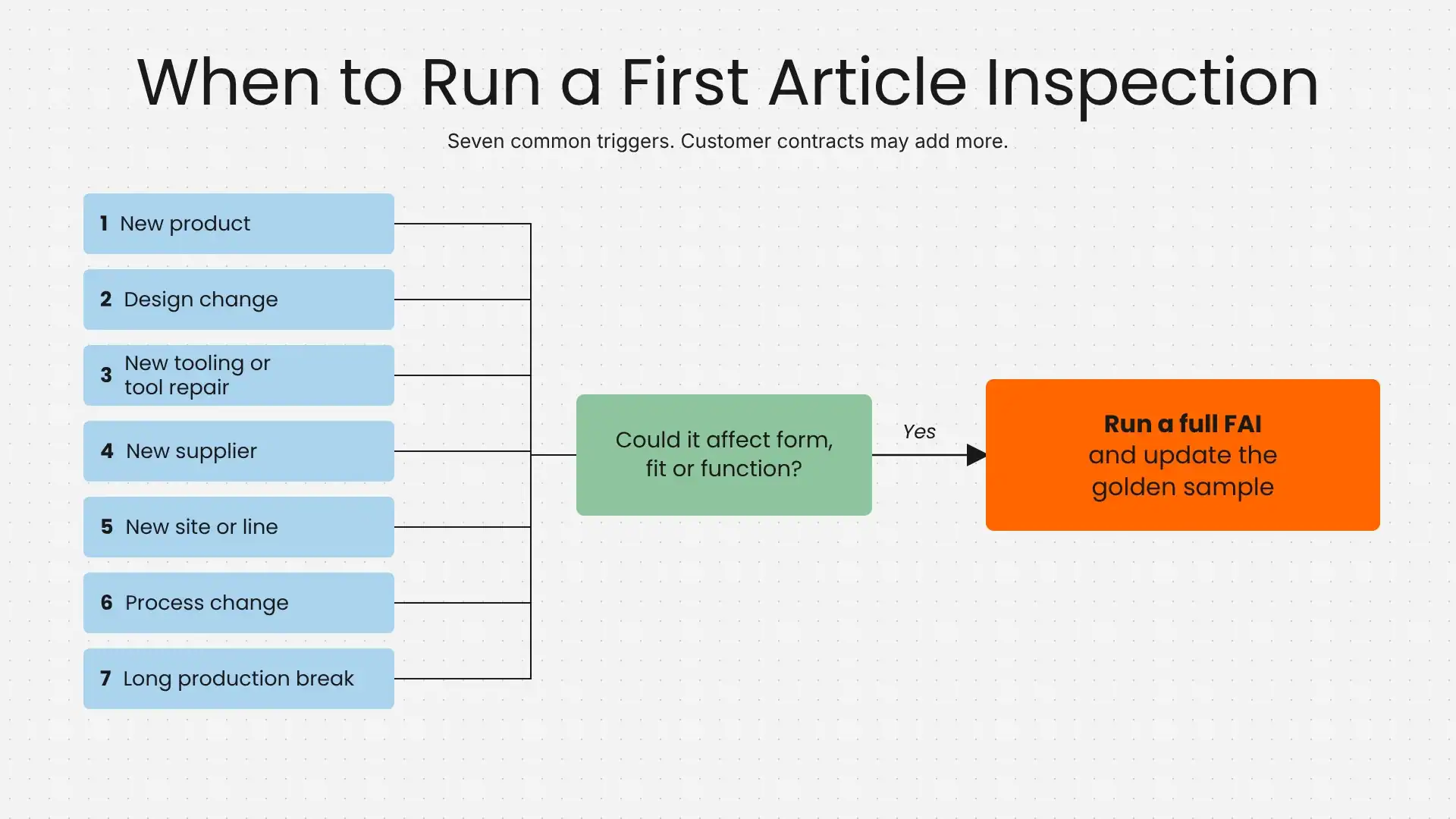
Run an FAI whenever something changes that could affect the product. Common triggers include:
- A new product going into production for the first time
- A design change that affects form, fit or function
- New tooling or major tool repairs
- A new supplier for a critical part
- A new production site or line, such as a production transfer
- A process change, such as a new machine or new material
- A long break in production
Customer contracts often list their own triggers. Check them before you plan the launch.
What does a first article inspection report include?
The aerospace standard AS9102, published by SAE International, sets out a widely used FAI format. Many electronics and industrial customers follow the same structure, even outside aerospace. It has three parts.
1. Part number accountability
This section identifies the part. It records the part number, revision, drawing number and any sub-assemblies included in the inspection.
2. Product accountability
This section covers what went into the part. It lists raw materials, special processes (such as plating or coating) and functional tests, with certificates where needed.
3. Characteristic accountability
This is the measurement record. Every dimension, note and requirement on the drawing gets a number, often marked on a “ballooned” drawing. The inspector records the measured result for each one and marks it pass or fail.
A complete FAI report leaves no requirement unchecked.
First article testing may be appropriate where “there have been subsequent changes in processes or specifications” or “production has been discontinued for an extended period of time.”
First article inspection for electronics assemblies
Electronics add their own checks. For a printed circuit board assembly (PCBA), a first article usually covers:
- Component verification. Every placed part matches the BOM, value and approved manufacturer.
- Polarity and orientation. Diodes, capacitors and ICs sit the right way round.
- Solder joint quality. Automated optical inspection (AOI) checks visible joints. X-ray inspection checks hidden joints, such as those under ball grid arrays (BGAs).
- Workmanship. Joints and assemblies meet the agreed class of a recognised standard, such as IPC-A-610 from the Global Electronics Association.
- Functional test. The board powers up and passes its in-circuit and functional tests.
- Firmware. The board runs the correct, verified firmware version.
For a finished product, the FAI also covers mechanical fit, cosmetics, labelling and packaging. Our testing labs support the electrical and reliability side of these checks.
Who performs a first article inspection?
The manufacturer usually runs the FAI. Its quality team measures the part, completes the report and gathers the material and process certificates.
The customer then reviews and approves it. For high-risk parts, the customer may witness the inspection in person or ask for a second, independent check.
Either way, the inspector should not be the person who built the part. An independent check gives a fairer result.
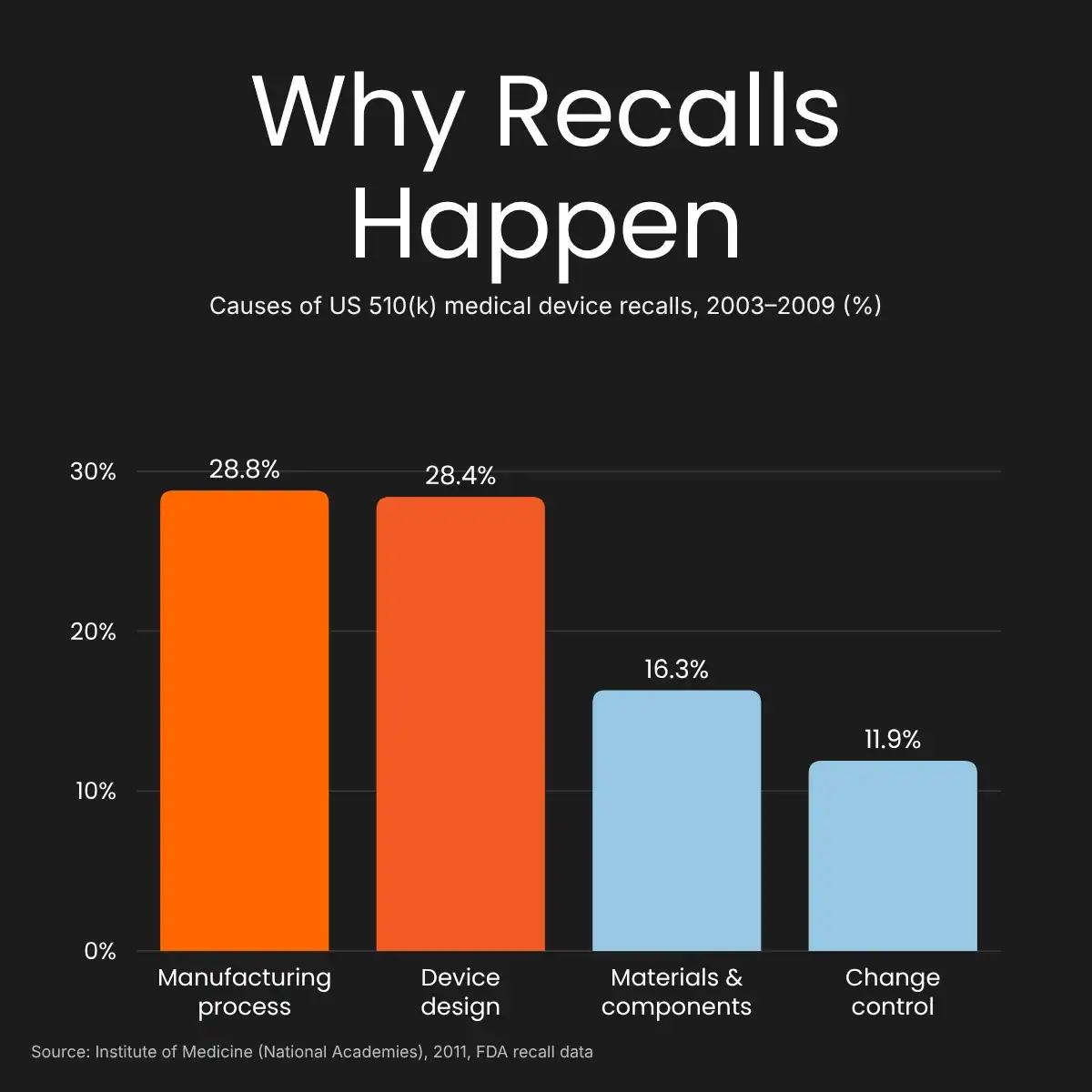
FDA oversees about 900 recalls initiated by device manufacturers each year, and manufacturers identified the problem in 96% of recalls from FY2020 to FY2024.
What is a golden sample?
A golden sample is an approved reference unit that shows exactly what a good product looks and performs like. The customer and the manufacturer both sign it off. Operators and inspectors compare production units against it.
Drawings describe a product. A golden sample shows it. That matters most for things that are hard to measure, such as colour, texture, gloss, sound or the feel of a button.
How to control golden samples
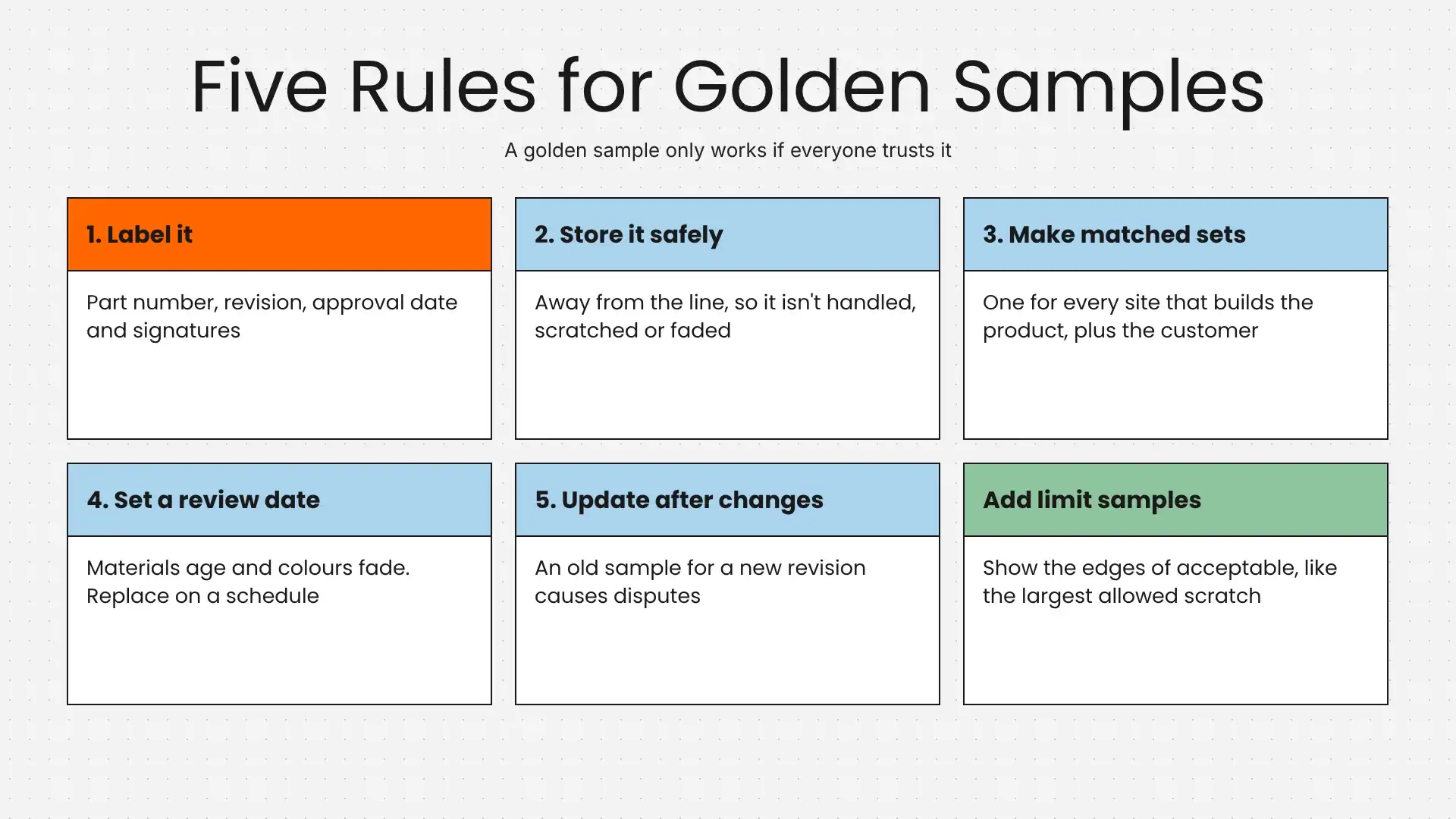
A golden sample only works if everyone trusts it. Keep it under control:
- Label it clearly with the part number, revision, approval date and signatures.
- Store it safely, away from the line, so it doesn’t get handled, scratched or faded.
- Make matched sets for every site that builds the product, including the customer.
- Set an expiry or review date. Materials age. Colours fade. Replace samples on a schedule.
- Update it after any approved change. An old golden sample for a new revision causes disputes.
Limit samples and boundary samples
Many teams add limit samples (also called boundary samples) to the golden sample. These show the edges of what is acceptable, such as the largest allowed scratch or the lightest allowed colour. They help inspectors make consistent calls on cosmetic features.

Only 11% of organisations report a fully automated test strategy, while 75% say the number of tests has increased.
FAI vs PPAP vs golden sample
These three tools often get mixed up. They work together, but they do different jobs.
| First article inspection | PPAP | Golden sample | |
|---|---|---|---|
| What it is | A full inspection of the first production item | A formal approval package for production parts | A physical reference unit |
| Main question | Does the first item meet every requirement? | Can the process keep making good parts? | What does “good” look like? |
| Common in | Aerospace, electronics, industrial | Automotive (and some other sectors) | All sectors, especially consumer products |
| Format | Report with measurements and certificates | Set of documents plus a part submission warrant | Signed, labelled physical sample |
In short, FAI checks the first item. PPAP proves the process. The golden sample shows the standard.
What are the 5 PPAP levels?
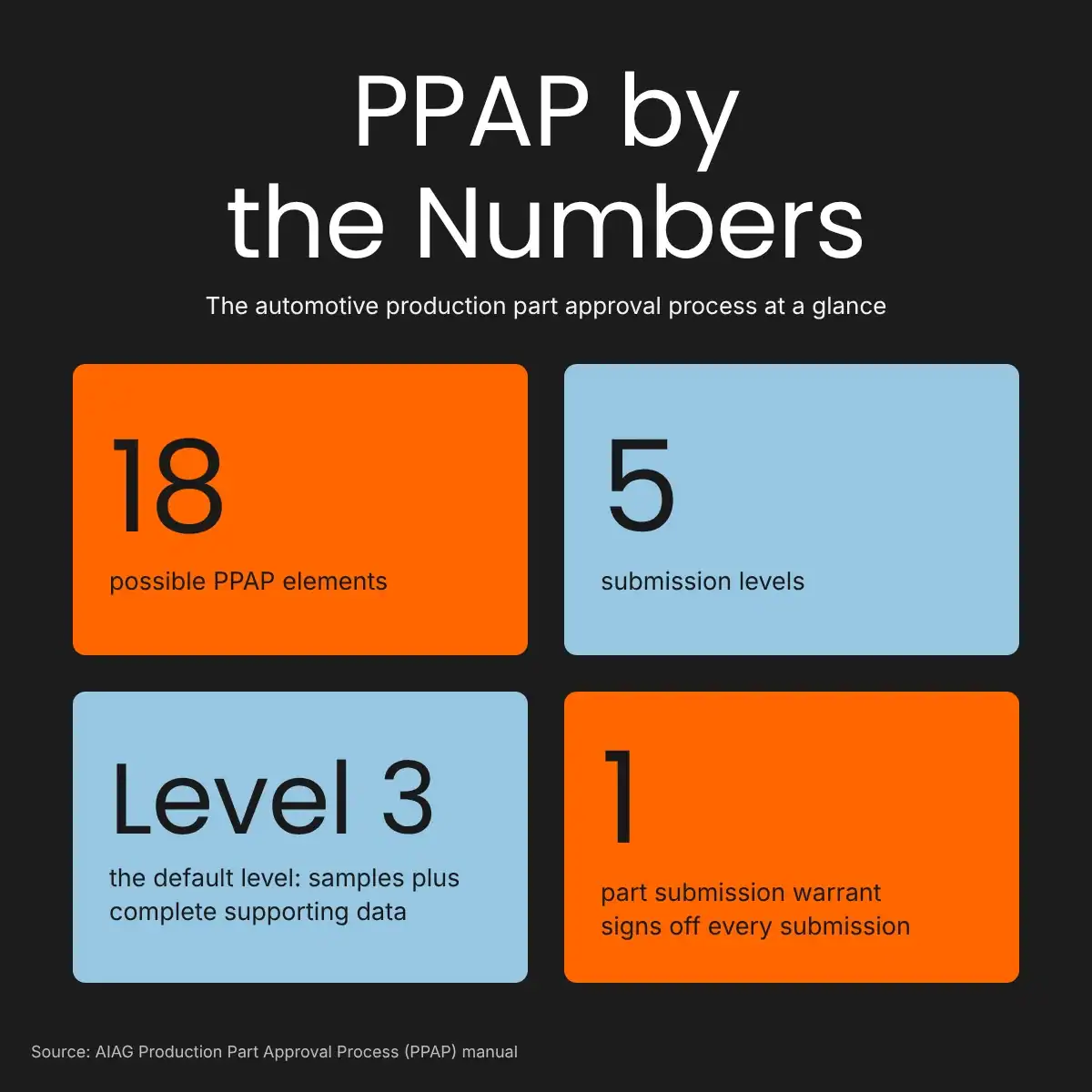
PPAP (production part approval process) comes from the automotive industry. AIAG, the Automotive Industry Action Group, publishes the PPAP manual. It defines 18 possible elements and five submission levels:
- Level 1: part submission warrant only (plus an appearance approval report for appearance items)
- Level 2: warrant with product samples and limited supporting data
- Level 3: warrant with product samples and complete supporting data (the default level)
- Level 4: warrant and other requirements as defined by the customer
- Level 5: warrant with product samples and complete supporting data, reviewed at the supplier’s manufacturing site
Level 3 is the most common. Customers choose the level based on the part’s risk. See our automotive capabilities for how we support automotive programmes.
In a controlled study, inspectors correctly rejected 85% of defective items, but also rejected 35% of acceptable parts.
Using FAI and golden samples in a production transfer
FAI and golden samples matter most when a product moves to a new site.
The new line must match the old one. A golden sample from the original line gives the new site a physical target. A full FAI proves the new line meets the same requirements.
Many transfers also run both sites in parallel for a period. That protects supply while the new line ramps. Our guide to electronics manufacturing in Mexico covers the full transfer process.
Common FAI mistakes
Inspecting a hand-picked part
An FAI should check a part made under normal production conditions. A part built slowly by the best operator proves nothing about the process.
Skipping “minor” characteristics
Every drawing requirement counts. Notes on marking, finish or packaging cause disputes later if nobody checked them.
Running FAI before the process is stable
If machine settings are still changing, the FAI result won’t hold. Lock the process first, then inspect.
Forgetting to repeat it
A design change, tool repair or site move can invalidate an old FAI. Track the triggers and re-run the inspection when they occur.

After a change, it takes 4.7 to 10.3 days, depending on product complexity, to get updated data to the whole team.
Frequently asked questions
What is a first article inspection?
A first article inspection is a full, documented check of the first item made with production tooling, materials and processes. It confirms the item meets every requirement on the drawing and specification before regular production begins.
When is a first article inspection required?
You need one for a new product, and again after changes that could affect it. Common triggers include design changes, new tooling, a new supplier, a new production site, a process change or a long break in production.
What is a golden sample in manufacturing?
A golden sample is an approved reference unit that both the customer and manufacturer sign off. Inspectors compare production units against it, especially for features that are hard to measure, such as colour, texture and finish.
What is the difference between FAI and PPAP?
FAI checks that the first production item meets every requirement. PPAP is a wider automotive approval package that proves the production process can keep making good parts over time. A PPAP submission often includes first article measurement data.
What are the 5 PPAP levels?
The AIAG PPAP manual defines five submission levels, from Level 1 (part submission warrant only) to Level 5 (full data reviewed at the supplier’s site). Level 3, with samples and complete supporting data, is the default.
Launching or moving a production line?
Our quality and engineering teams can plan your first article inspection, set up golden samples and get your line approved.
Explore more related content

The NPI Process: How to Take Electronics From Prototype to Production
The NPI Process: How to Take Electronics From Prototype to ProductionBuilding one working prototype is hard. Building...
EVT vs DVT vs PVT: The Three Validation Builds Explained
EVT vs DVT vs PVT: The Three Validation Builds Explained EVT, DVT and PVT sound like jargon. They are actually three...

USMCA Rules of Origin: A Practical Guide for Electronics OEMs (2026 Update)
USMCA Rules of Origin: A Practical Guide for Electronics OEMs (2026 Update) USMCA rules of origin used to be a...