

Best Practices for Contract Lifecycle Optimization


Most contracts don’t fail at signature. They fail six months later, on a shared drive, when no one remembers the price review clause. Nobody recalls the tooling ownership terms or the auto renewal date.
That’s the real case for contract lifecycle management (CLM). Not the software. Not the dashboards. The discipline of treating a contract as a living operating document, from first draft to renewal or exit, instead of a PDF you file and forget.
In manufacturing, the stakes are high. A single supply agreement can govern pricing, capacity, quality, lead times, IP and liability across a product’s whole life. Get the contract management process right and it protects margin and keeps programs on schedule. Get it wrong and value leaks out quietly, one missed obligation at a time.
This guide breaks down the five stages of the contract lifecycle, the best practices that matter at each one, the CLM features worth paying for, and the metrics that tell you whether any of it is working.
“This report is a warning against mistaking storage for control.” Sally Guyer, CEO, World Commerce & Contracting, on Sirion/WorldCC research
Understanding Contract Lifecycle Management
Definition and Meaning of Contract Lifecycle Management
Contract lifecycle management is the end-to-end process of creating, negotiating, approving, executing, managing and renewing (or ending) contracts. It covers every action and decision a business takes on a contract from the moment someone requests one to the moment it expires.
A simple contract lifecycle management definition: CLM is how an organization makes sure it gets what it agreed to, and delivers what it promised.
You’ll also see it called the contract management life cycle or the contract management cycle. Same idea. “CLM” can refer to the process itself or to the software that supports it. The process comes first. Software only automates a process that already exists.
Best performers lose a little over 3% of contract value; the worst lose more than 20%. World Commerce & Contracting
Importance of the Contract Management Cycle
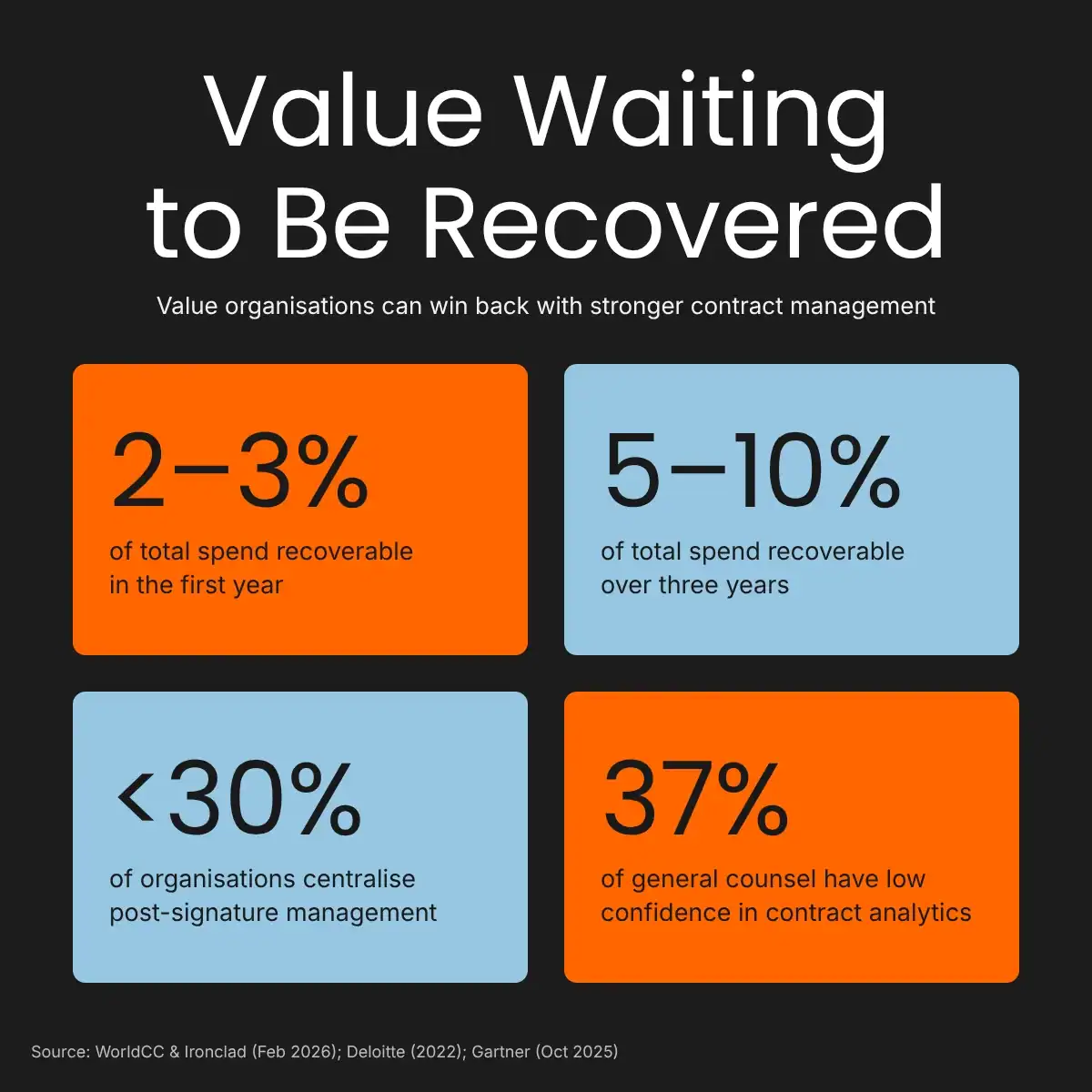
Contracts are where commercial intent turns into legal obligation. When the cycle breaks down, the cost is real. Research from World Commerce & Contracting has long estimated that poor contract management erodes close to 9% of annual revenue through missed obligations, disputes and value that was negotiated but never realized.
The usual culprits:
- Obligations nobody owns (quarterly price reviews, safety stock commitments, audit rights)
- Renewals that roll over on old terms because no one flagged the notice window
- Deliverables mandated by the contract, such as test reports or certifications, that never get tracked
- Slow approvals that push programs back by weeks
A structured contract management cycle fixes this by giving every stage an owner, a standard and a record.
Only 27% of organizations globally store all executed contracts exclusively in CLM
The Stages of Contract Lifecycle Management
Overview of the Contract Lifecycle Process
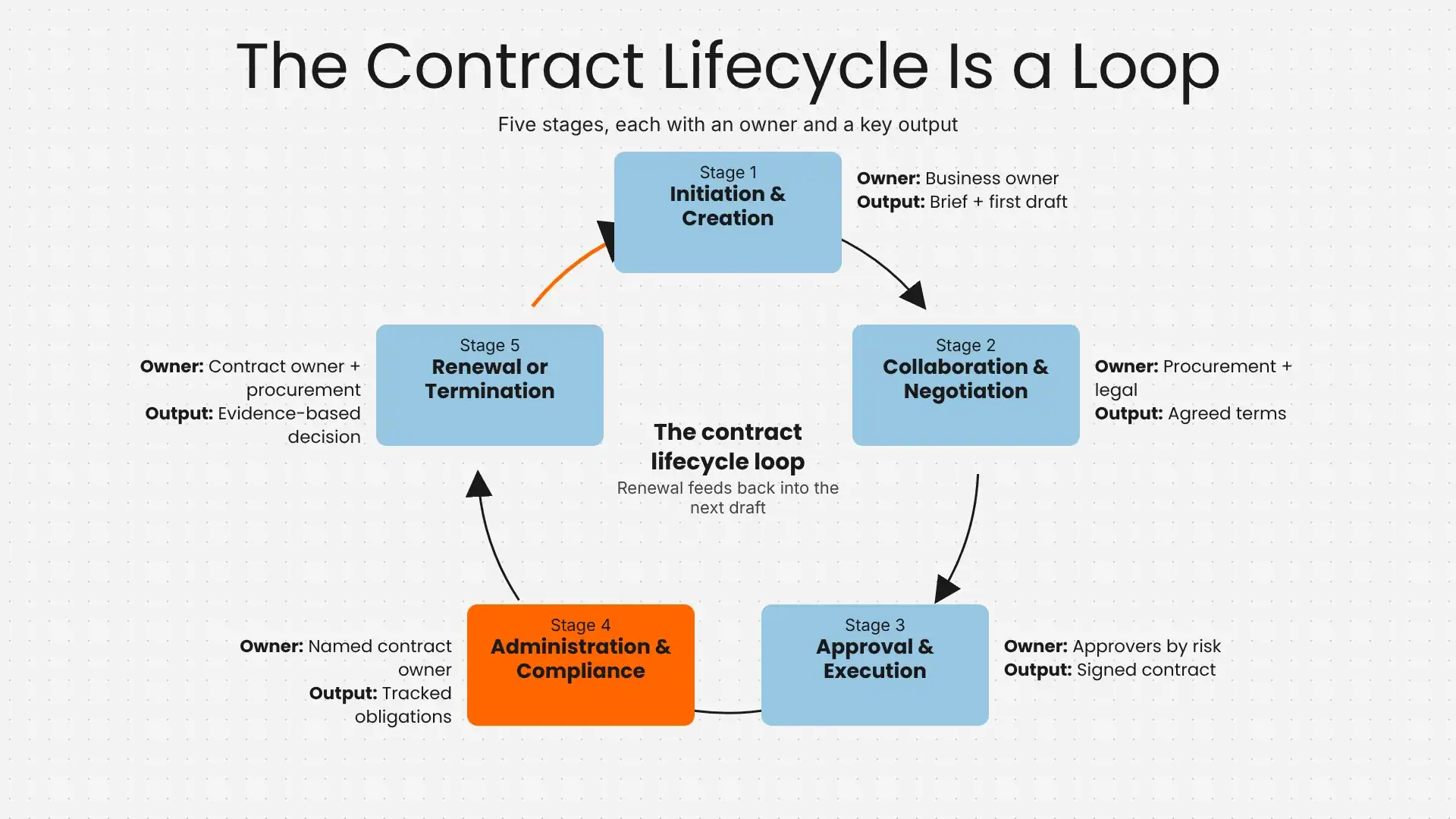
Different sources split the contract lifecycle process into anywhere from five to nine steps. We use five, because they map cleanly to who does what:
- Initiation and creation
- Collaboration and negotiation
- Approval and execution
- Administration and compliance
- Renewal or termination
Think of these as the stages of a contract’s working life. The first three get you a signature. The last two are where most of the value is won or lost.
Detailed Breakdown of Each Stage
Stage 1: Initiation and Creation
Every contract starts with a need: a new supplier, a new product program, a change in scope. This stage captures the business requirement, picks the right contract type and produces the first draft.
In a manufacturing relationship, that may include a master supply agreement. It may also include a quality agreement, an NDA, a tooling agreement, or a statement of work. This may apply to a new product introduction. Each has different risks and needs different clauses.
Stage 2: Collaboration and Negotiation
Both sides review, redline and agree terms. Legal, procurement, engineering, quality and finance all have a stake. The aim is a contract both parties can actually deliver against, not just one that reads well on paper.
Stage 3: Approval and Execution
The final draft goes through internal sign-off, then both parties sign. Execution today is mostly electronic, which speeds things up, but only if the approval routing behind it is clear.
Stage 4: Administration and Compliance
This is the longest stage and the most neglected. It covers tracking obligations, milestones, deliverables, pricing changes, amendments and performance against agreed KPIs. It’s also where CLM systems track expiration and compliance for contracts across the portfolio.
Stage 5: Renewal or Termination
As the end date approaches, you decide: renew, renegotiate, or exit. A good decision depends on what happened in Stage 4. If you haven’t tracked performance, you’re renewing blind.
Organisations that treat contracts as financial intelligence outperform peers by an average of 5.4% of contract value. World Commerce & Contracting and Icertis
Effective Strategies for Each Stage
Best Practices for Contract Creation
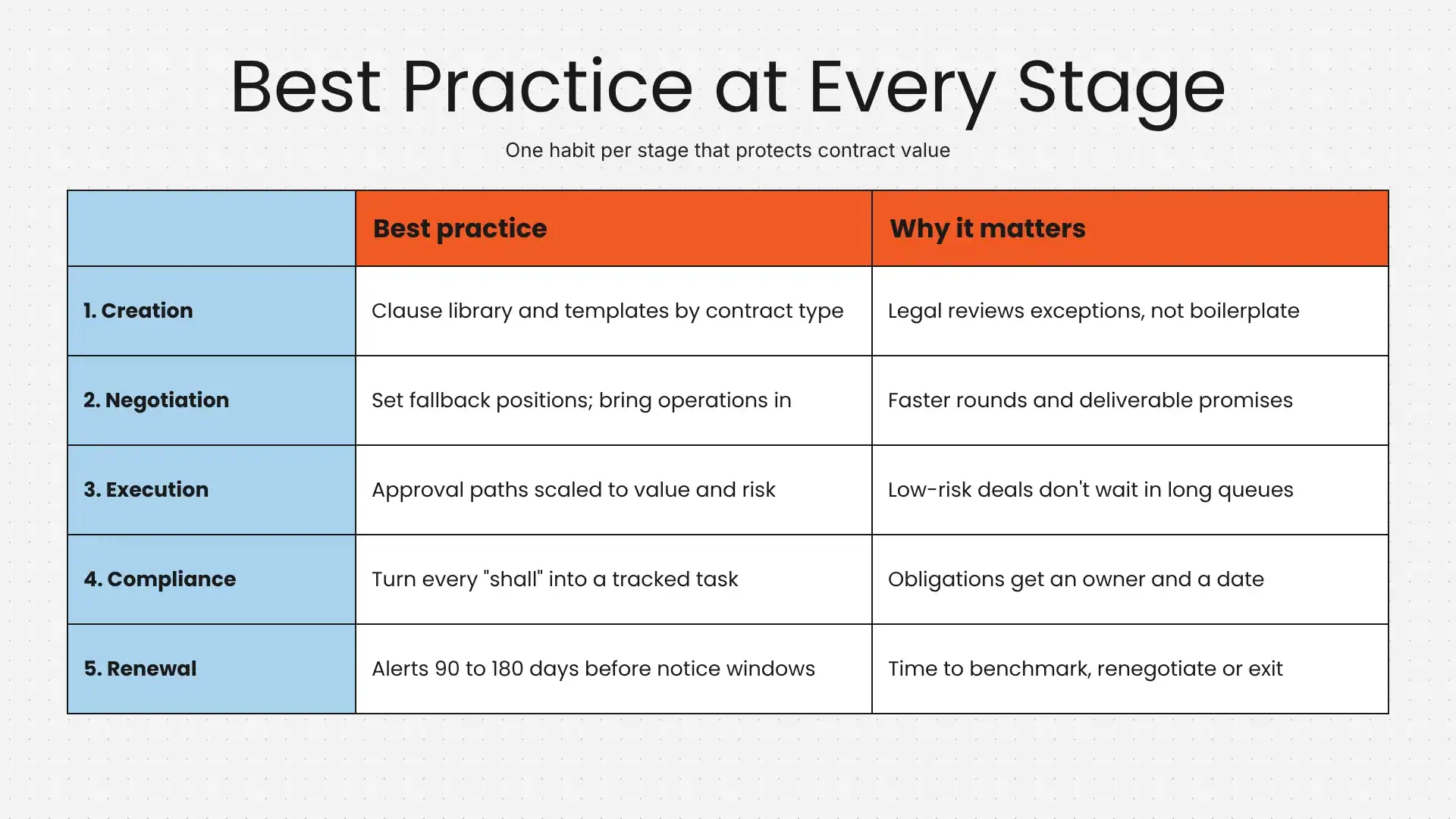
Build a clause library. Pre-approved standard clauses for liability, IP, payment terms, warranty and termination mean nobody starts from a blank page. Legal reviews exceptions, not boilerplate.
Use templates by contract type. A tooling agreement and a quality agreement shouldn’t share the same template. Match the template to the risk.
Capture the commercial intent up front. Before drafting, write down in plain language what the business needs the contract to achieve. Volumes, timelines, service levels, who owns the tooling. That brief becomes the test for every redline that follows.
Define ownership early. Name the person accountable for the contract after signature. If that box is empty at the drafting stage, it will still be empty at renewal.
Streamlining Negotiation Processes
Set fallback positions before you start. Agree internally what you’ll accept on key terms, and what you won’t. Negotiators with clear limits move faster.
Keep one version of the truth. Redlines emailed between six people create version chaos. Use a shared, version-controlled workspace so everyone negotiates on the same draft.
Bring operations into the room. In manufacturing, the people who will run the program should review lead times, capacity commitments and quality terms. A contract that promises what the factory floor can’t deliver is a dispute waiting to happen.
Track where time goes. If most negotiation delays sit in one clause type, such as liability caps, that’s a template problem, not a negotiation problem.
Ensuring Efficient Execution
Map the approval path. Define approval thresholds by contract value and risk level. A low-value NDA should not need the same sign-off chain as a multi-year supply agreement.
Use e-signature with audit trails. Faster signing, plus a clear record of who signed what and when.
Store the executed contract centrally, immediately. Not in someone’s inbox. Not in a regional folder. One repository, searchable, with key data extracted on day one.

An obligation with no named human owner is not an obligation. It’s a hope.” Gene Turner, WorldCC Fellow, World Commerce & Contracting
Managing Compliance and Performance
This is where contract lifecycle management earns its keep.
Turn clauses into tracked obligations. Every “shall” in a contract is a task with an owner and a date. Price reviews, forecast updates, inventory buffers, audit windows, test reports. Load them into a tracker the moment the contract is signed.
Track deliverables mandated by contracts. Quality agreements often require specific documentation: first article inspection reports, certificates of conformance, material declarations, change notifications. If these aren’t tracked, they slip, and that becomes a compliance risk for both sides.
Review performance against the contract, not memory. Quarterly business reviews should use the contract’s own KPIs: on-time delivery, quality yield, cost-down commitments. That keeps conversations factual.
Manage amendments properly. Engineering changes, volume shifts and new sites all change the deal. Every amendment should link back to the master agreement so the full picture is always visible.
Procurement and Legal often work together, but unclear authority and late involvement limit their impact.” World Commerce & Contracting
Effective Renewal Strategies
Set alerts well before notice windows. 90 to 180 days ahead for strategic agreements gives you time to review, benchmark and negotiate. Auto-renewals on outdated terms are one of the most common sources of leaked value.
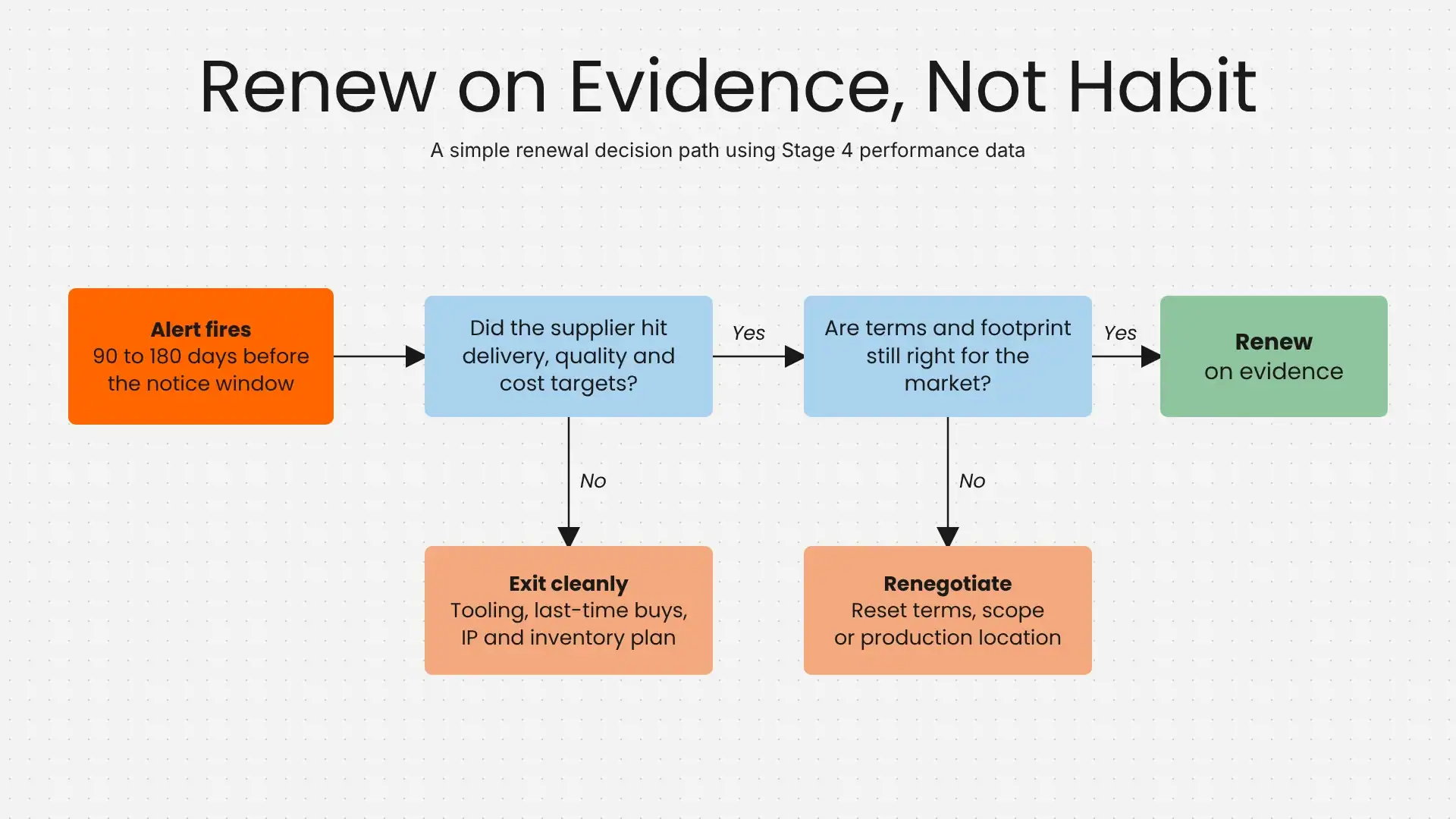
Renew on evidence. Use the performance data from Stage 4 to decide. Did the supplier hit delivery and quality targets? Did costs move as agreed? Has the relationship earned a longer term or a bigger scope?
Use renewal to reset terms. Markets, footprints and supply chains change. For many US OEMs, renewal is a chance to rethink production location. For example, nearshore manufacturing closer to the US market may cut lead times. It may also reduce logistics costs and risk. Build that question into your renewal checklist.
Exit cleanly when it’s time. If you terminate, plan the transition: tooling return, last-time buys, IP handover, inventory and data. A clean exit protects continuity of supply.

54% of organizations report having no automated data flow between systems, while only 9% have bidirectional synchronization.
Tools and Technologies for Optimization
Features of a CLM System
A CLM system is software that supports and automates the contract lifecycle. So how does CLM work in practice? It gives you one place to create, negotiate, sign, store and monitor contracts, with workflows and alerts built around each stage.
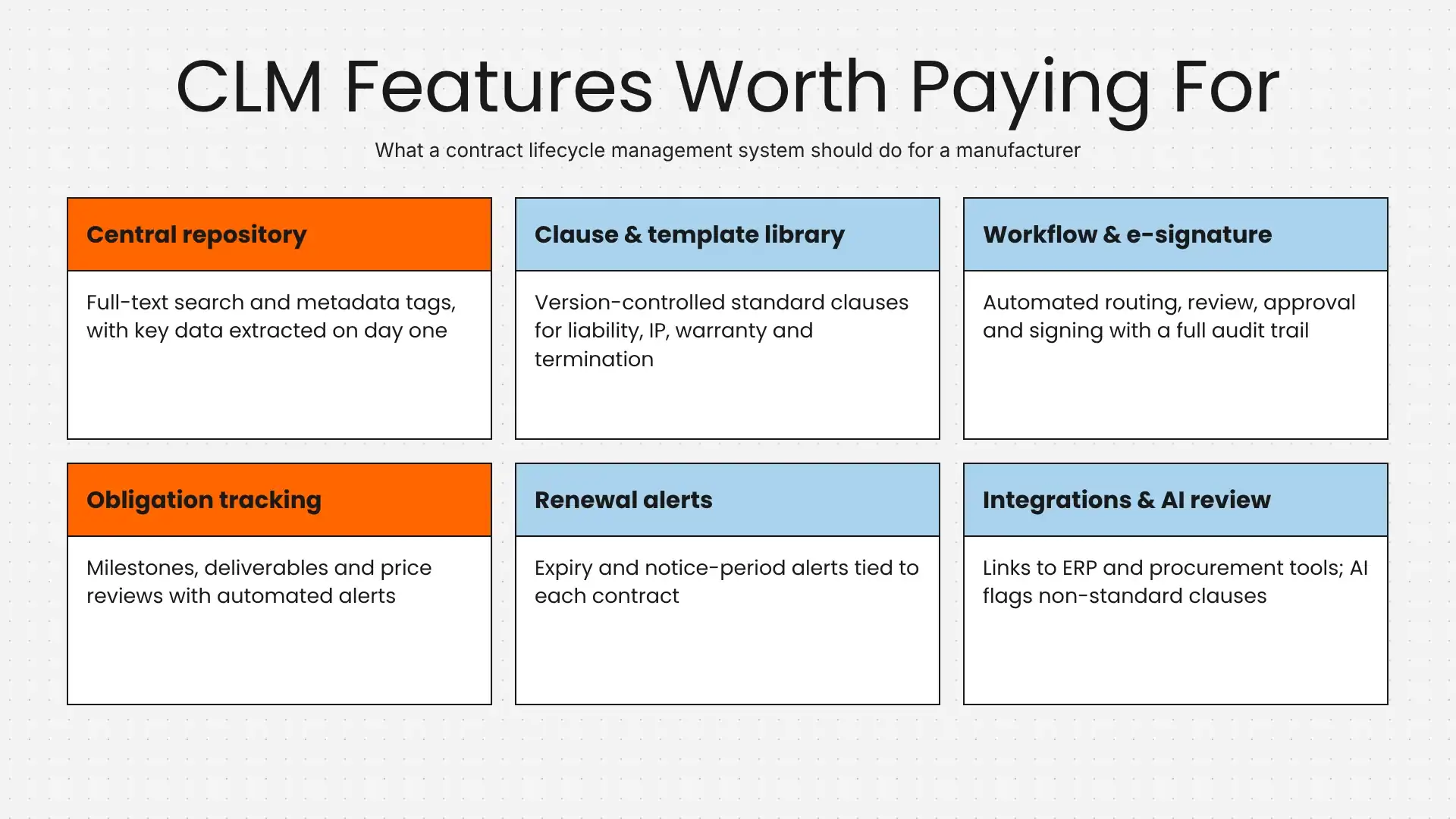
Contract lifecycle management features worth looking for:
- Central repository with full-text search and metadata tagging
- Template and clause libraries with version control
- Workflow automation for routing, review and approval
- Collaborative redlining with a full audit trail
- E-signature integration
- Obligation and milestone tracking with automated alerts
- Renewal and expiration alerts tied to notice periods
- Reporting dashboards for cycle time, risk and compliance
- Integrations with ERP, procurement, CRM and e-signature tools
- AI-assisted review to flag non-standard clauses and extract key terms
Don’t forget CLM system maintenance responsibilities. Someone needs to own the clause library, user access, data quality, integrations and template updates. Software without an owner decays fast.
A note on use cases: CLM for sales focuses on speeding up customer contracts and quote-to-cash. Legal contract lifecycle management focuses on risk and standardization. Procurement-led CLM focuses on supplier obligations and spend. Most manufacturers need all three views of the same system.
Benefits of Automation in Contract Management
- Faster cycle times. Templates, automated routing and e-signature remove days of waiting.
- Fewer missed obligations. Alerts replace memory.
- Lower risk. Standard clauses and exception flags reduce exposure.
- Better visibility. Leaders can see every live contract, its value and its status.
- Stronger negotiating position. Historical performance data makes renewal conversations evidence-based.
Automation won’t fix a broken process. It makes a good one faster. Map the process first, then automate it.
“This research is a wake-up call: contracts are financial instruments.” Tim Cummins, President, World Commerce & Contracting
Key Metrics to Measure Success
Contract Cycle Time
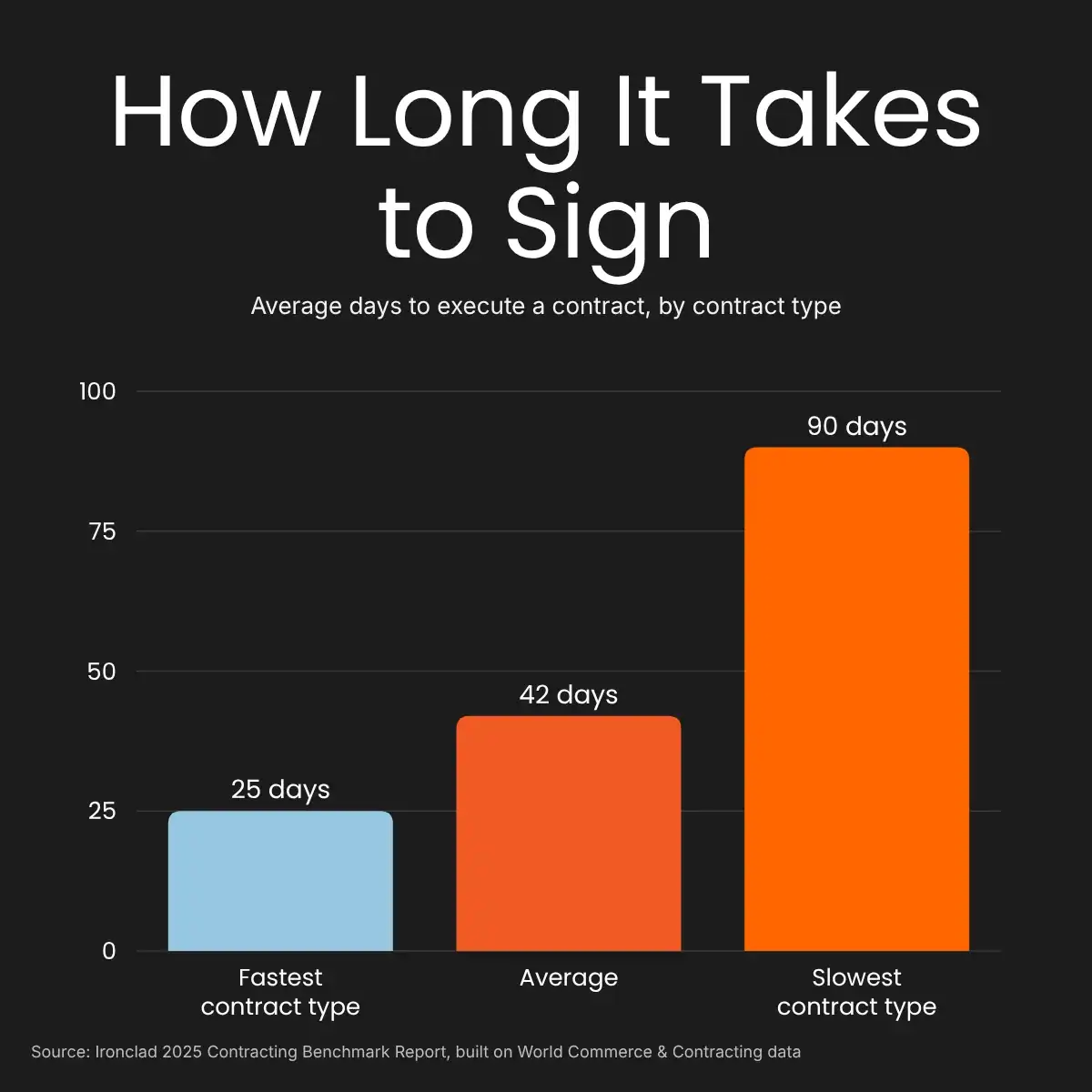
Contract cycle time is the time from contract request to full execution. It’s the clearest single measure of how efficient your front-end process is.
Track it by contract type and by stage. If NDAs take three days and supply agreements take nine weeks, that’s expected. If supply agreements took five weeks last year and nine this year, find out where the extra time sits: drafting, negotiation, or approval.
Related metrics:
- Time spent in each approval step
- Number of negotiation rounds per contract
- Percentage of contracts using standard templates without changes
Compliance and Deliverable Tracking
Speed to signature means little if obligations are missed afterward. Measure:
- Obligation completion rate: percentage of contracted obligations delivered on time
- Deliverable tracking: contract-mandated documents and reports received versus due
- Renewal hit rate: percentage of renewals reviewed before the notice deadline
- Value realization: negotiated savings or price adjustments actually captured
- Dispute rate: number of contract disputes per period
These metrics show whether your contract management process is protecting value or just processing paperwork.

“Average value erosion now stands at 8.6%.” World Commerce & Contracting
Analyzing the Contract Management Lifecycle Diagram
A contract lifecycle management process diagram is usually drawn as a loop, not a line, and that’s the point. Renewal feeds back into initiation. What you learn managing one contract should improve the next draft.
When you map your own CLM process flow, look for three things:
- Handoffs. Every point where a contract moves between teams (legal to procurement, procurement to operations) is where delays and lost information happen. Minimize them and make them explicit.
- Gaps after signature. If your diagram has five boxes before execution and one vague box after it, that’s where your risk sits.
- Feedback loops. Does performance data from Stage 4 actually flow into renewal decisions and template updates? If not, the loop isn’t closed.
A good contract lifecycle management workflow diagram should show the owner of every stage, the system of record, and the trigger that moves a contract to the next step.
Creating a Robust CLM Framework
Contract lifecycle management isn’t a legal back-office function. It’s how a business protects the margin, quality and delivery terms it fought for at the negotiating table.
A robust CLM framework comes down to a few disciplines:
- Standardize creation with templates and a clause library
- Negotiate with clear limits and operations in the room
- Make approval paths proportionate to risk
- Turn every obligation into a tracked task with an owner
- Renew on evidence, not habit
- Measure cycle time and compliance, then improve
The best contracts are the ones both sides can actually deliver. That starts with choosing a manufacturing partner who reads the contract the same way you do.
At Intretech, we work with OEMs in automotive, medtech, consumer electronics, and energy. We support programs from design through volume production across our global manufacturing footprint. This includes our facility in Monterrey, Mexico. We support customers serving the US market.

30% of legal teams already use AI and 54% plan to adopt it within two years. CLOC, 2025 State of the Industry Report (Feb 2025)
Frequently Asked Questions
What is contract lifecycle management in simple terms?
Contract lifecycle management is the process of handling a contract from first request to renewal or termination. It covers drafting, negotiation, approval, signature, tracking obligations and deciding what happens at the end. The goal is to make sure both parties get what they agreed to.
What are the 5 stages of contract lifecycle management?
The five stages are initiation and creation, collaboration and negotiation, approval and execution, administration and compliance, and renewal or termination. The first three get a contract signed. The last two determine whether the value in it is actually delivered.
How does a CLM system track expiration and compliance?
A CLM system extracts key dates and obligations from each contract and stores them as data. It then sends automated alerts ahead of deadlines, notice periods and renewals. Dashboards show which obligations are complete, overdue or at risk.
What is a good contract cycle time?
It depends on contract type and complexity. Simple agreements like NDAs can close in days, while multi-year supply agreements can take weeks. The more useful benchmark is your own trend: track cycle time by contract type and work to reduce delay at the slowest stage.
Why does contract lifecycle management matter in manufacturing?
Manufacturing contracts govern pricing, capacity, quality, tooling, IP and lead times over many years. Missed obligations or outdated terms can hit margin and disrupt supply. Strong CLM keeps both the OEM and the manufacturing partner aligned throughout the program.
Ready to work with a manufacturing partner that delivers to the letter of the contract?
Explore more related content

5 Proven Strategies for Effective Procurement Management in Today’s Market
5 Proven Strategies for Effective Procurement Management in Today's MarketProcurement used to be judged on one number:...

The NPI Process: How to Take Electronics From Prototype to Production
The NPI Process: How to Take Electronics From Prototype to ProductionBuilding one working prototype is hard. Building...

First Article Inspection and Golden Samples: How to Sign Off a New Production Line
First Article Inspection and Golden Samples: How to Sign Off a New Production Line The first unit off a new line tells...