

The NPI Process: How to Take Electronics From Prototype to Production

Building one working prototype is hard. Building ten thousand identical units is harder.
That gap is where most hardware launches slip. A Gartner survey found that 45% of product launches run at least a month late. The prototype usually works fine. The problems start when it meets a production line.
The NPI process exists to close that gap. This guide walks through each stage from the factory side. You will see what happens at each step, who owns it, and the one question every gate should answer.
What is the NPI process?
NPI (new product introduction) is the structured process that turns a working design into a product a factory can build repeatedly, at the right cost and quality. It covers design for manufacture, validation builds, supply chain set-up, line preparation and the ramp to volume.
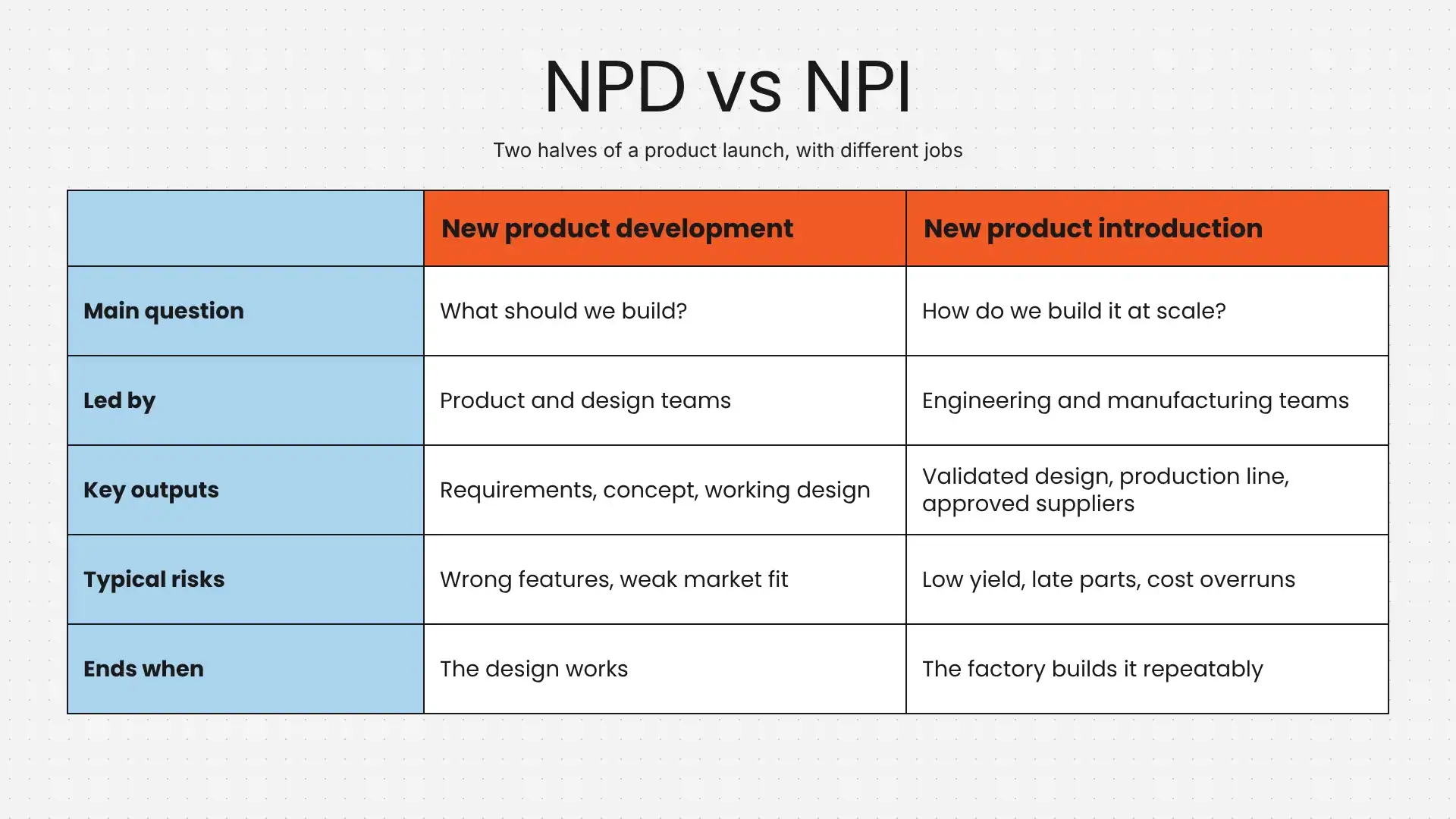
NPI sits at the end of product development. Product development (NPD) asks, “Does the product do what customers need?” NPI asks, “Can we make it the same way every time?”
Both matter. But they need different skills, different tools and, often, different people.
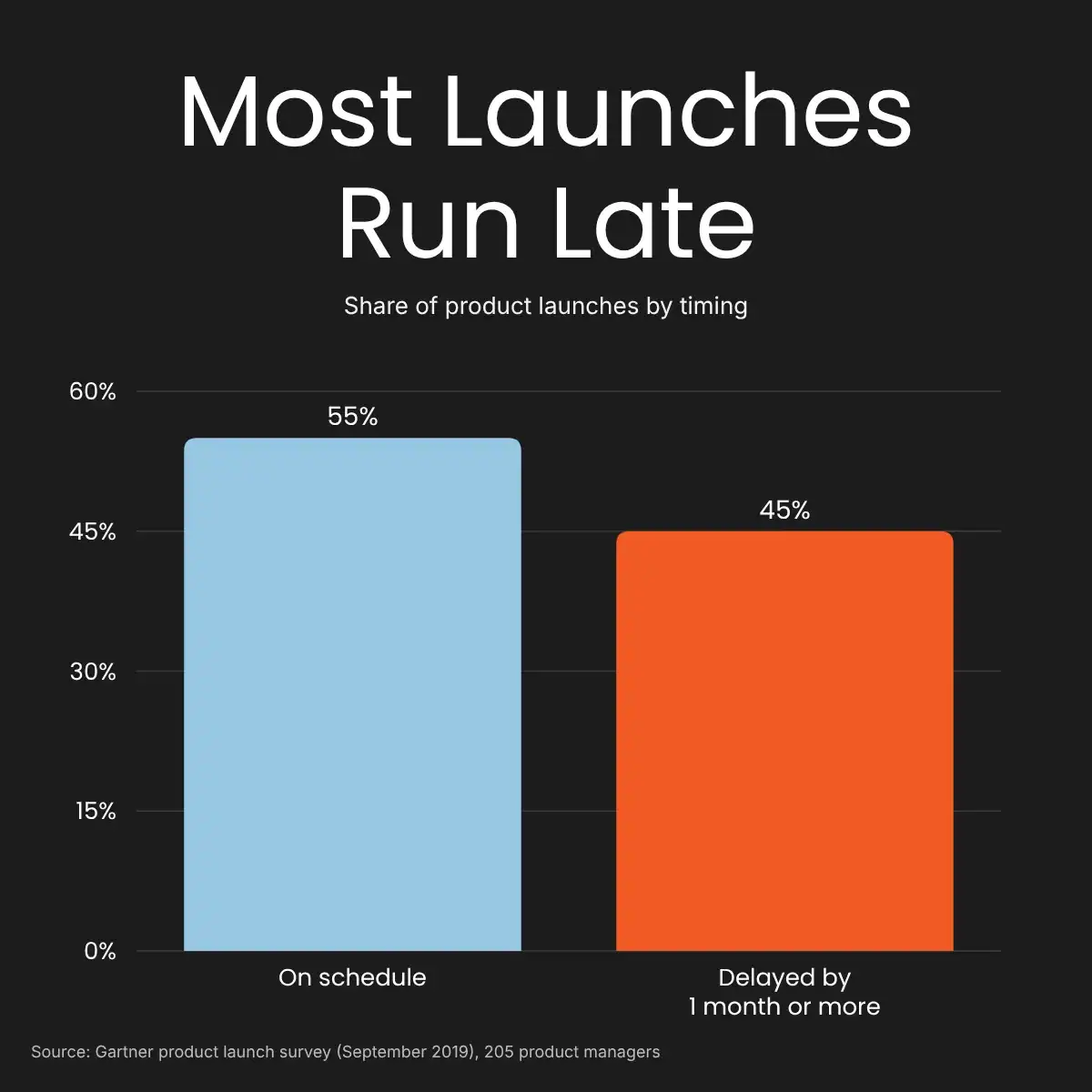
For the 45% of product launches that are delayed, 20%, on average, fail to meet their internal targets.
NPI vs NPD
|
New product development (NPD) |
New product introduction (NPI) |
|
|---|---|---|
|
Main question |
What should we build? |
How do we build it at scale? |
|
Led by |
Product and design teams |
Engineering and manufacturing teams |
|
Key outputs |
Requirements, concept, working design |
Validated design, production line, approved suppliers |
|
Typical risks |
Wrong features, weak market fit |
Low yield, late parts, cost overruns |
Why NPI decides your launch date
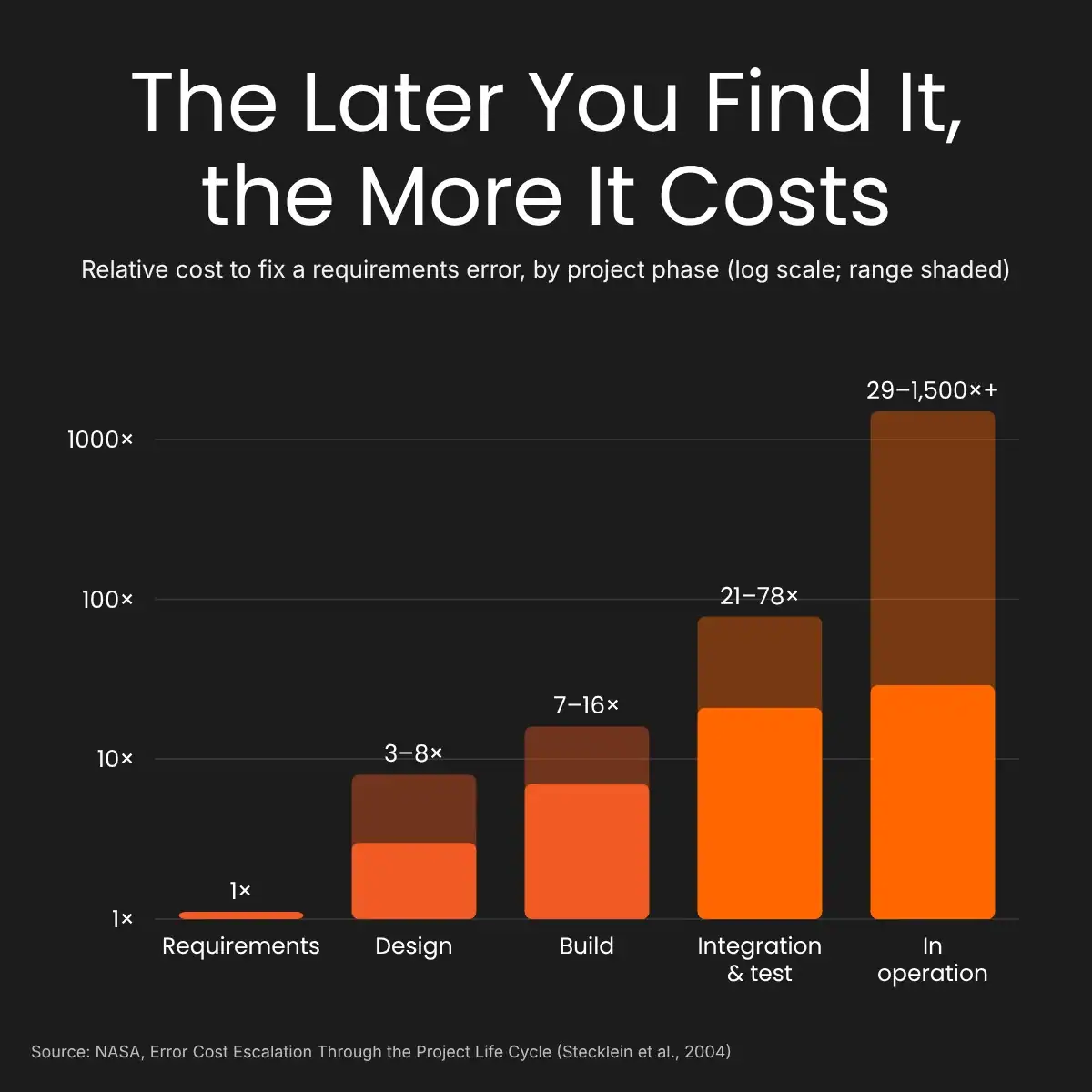
Every design change costs more the later you make it.
A change on screen costs an engineer’s afternoon. The same change after tooling means new steel, new samples and new tests. After launch, it can mean a recall.
Good NPI moves problems forward in time. It finds them while they are still cheap to fix.
It also protects three things buyers care about:
- Cost. Choices made in design lock in most of the unit cost. DFM reviews catch expensive features before they reach the tool.
- Quality. A stable process produces stable parts. Validation builds prove the process, not just the design.
- Time. Long lead-time components, certifications and tooling all need early starts. NPI puts them on the same plan.
Well over half of respondents (56%) cite late-stage design changes as a reason for missed dates.
The six stages of the NPI process
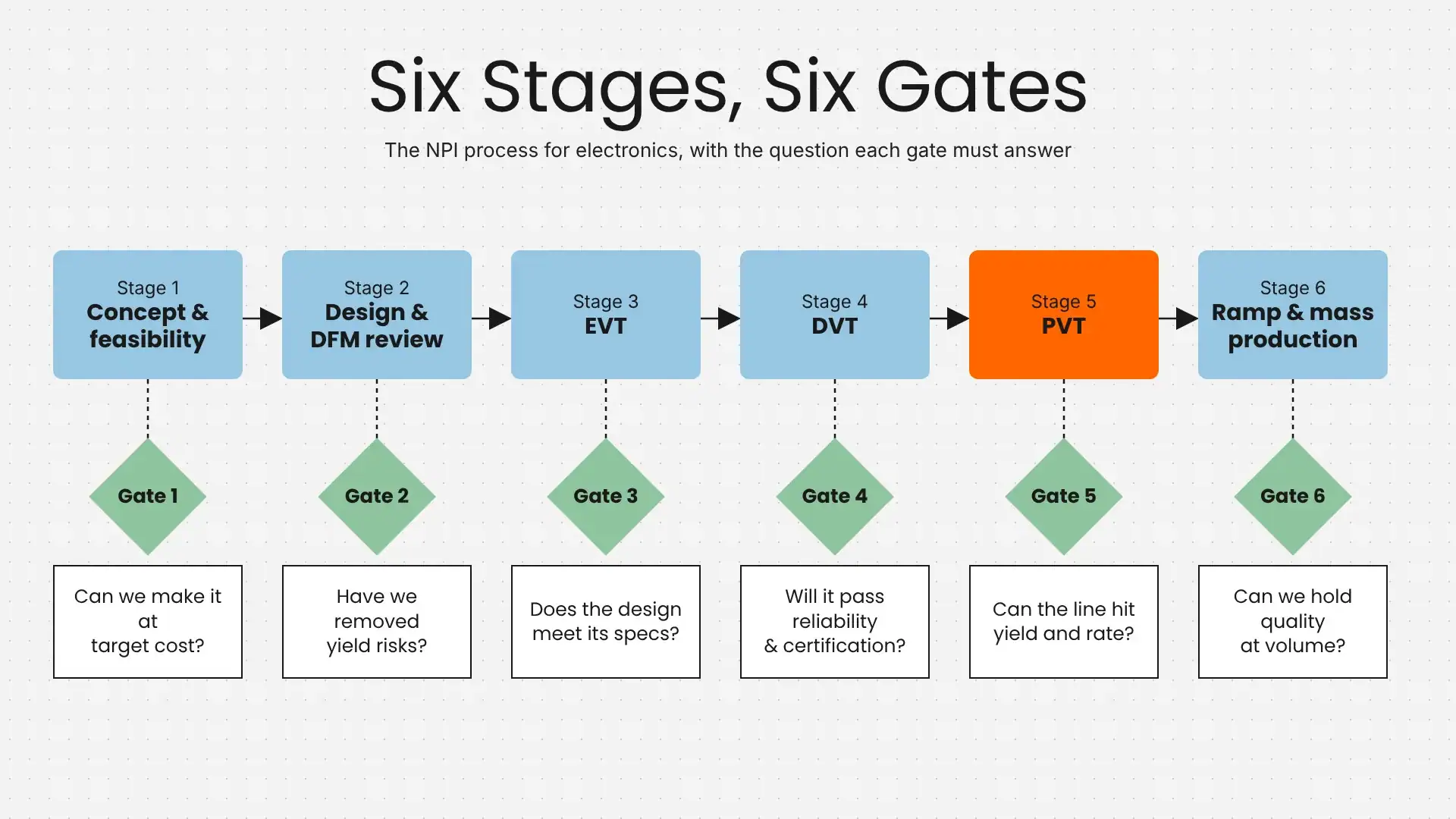
Most electronics programmes follow six stages. Names vary between companies. The logic stays the same.
| Stage | Main goal | Gate question |
|---|---|---|
| 1. Concept and feasibility | Prove the idea can work and be built | Can we make this at the target cost? |
| 2. Design and DFM review | Design for production, not just function | Have we removed the features that will hurt yield? |
| 3. EVT | Test that the engineering works | Does the design meet its functional specs? |
| 4. DVT | Test the full design under real conditions | Will it pass certification and reliability tests? |
| 5. PVT | Test the production process | Can the line build it at target yield and rate? |
| 6. Ramp and mass production | Scale output safely | Can we hold quality as volume grows? |
Stage 1: Concept and feasibility
This stage checks whether the product can exist at the right price.
Engineers review the core technology, key components and target cost. Procurement checks that critical parts are available and not near end of life. The manufacturing team flags any processes the factory cannot run today. The team also lists the certifications the product will need, so the plan includes them from day one.
Output: a feasibility report, a first bill of materials (BOM) and a target cost.

Innovation has remained a top-three priority for 64% to 83% of firms every year.
Stage 2: Design and DFM review
Design for manufacture (DFM) shapes the product around how it will be made.
The team checks wall thickness and draft angles for moulded parts. It reviews PCB layout for assembly and test access. It looks for tolerances tighter than they need to be.
Each fix here saves money later. A redesigned clip costs nothing now. After tooling, it costs a new mould insert.
Output: a design ready for tooling, a DFM report and a test strategy.
Our design and engineering team runs DFM and design for automation reviews at this stage.
Stage 3: EVT (engineering validation test)
EVT is the first build that looks like the real product.
The team builds a small batch, often with prototype tooling or hand assembly. Engineers test every function against the specification. They expect to find problems. That is the point.
Output: a list of design fixes and an updated design.
Stage 4: DVT (design validation test)
DVT proves the final design.
Units now come from production tooling and production materials. The team runs reliability tests, environmental tests and pre-compliance scans for safety and electromagnetic compatibility (EMC). Certification testing often starts here.
Output: a frozen design and certification reports.
Stage 5: PVT (production validation test)
PVT proves the factory, not the design.
The line builds units at production speed, with production operators, fixtures and test stations. The team measures yield and cycle time. Quality runs a first article inspection and signs off golden samples.
Output: an approved production process and customer sign-off.
For a deeper look at stages 3 to 5, read our guide to EVT vs DVT vs PVT.
Stage 6: Ramp and mass production
Ramp-up raises output in steps. Each step checks that yield, quality and supply hold.
Teams watch first-pass yield, scrap and field returns closely in the first weeks. They close any open issues from PVT before full volume.
Output: stable production and a handover from the NPI team to the sustaining engineering team.

“A product launch that meets all internal targets is seldom achieved.”
Source: Adrian Lee, Senior Research Director, Gartner
How to run an NPI gate review
Each stage ends with a gate. A gate is a short, formal decision: go, go with conditions, or stop.
Good gate reviews share four habits.
- Fixed criteria. Agree the exit criteria before the stage starts. Don’t invent them in the meeting.
- The right people. Engineering, quality, supply chain, manufacturing and the customer all attend. Each one signs off their part.
- Evidence, not opinion. Test reports, yield data and open-issue lists decide the outcome.
- Owned actions. Every open issue leaves the room with a name and a date.
A “go with conditions” decision is normal. A “go” with no record of open risks is a warning sign.
Supply chain readiness in NPI
A design is only as ready as its parts.
Supply chain work runs alongside every NPI stage. The team builds an approved vendor list (AVL) for each component. It checks lifecycle status, so you don’t design in a part that is close to the end of life. It qualifies second sources for critical parts where it can.
By PVT, the team should know three things for every line on the BOM:
- Who supplies it, with approved alternatives
- How long it takes to arrive, at production volumes
- How much buffer stock the launch needs
Our supply chain management team runs this planning across regions.
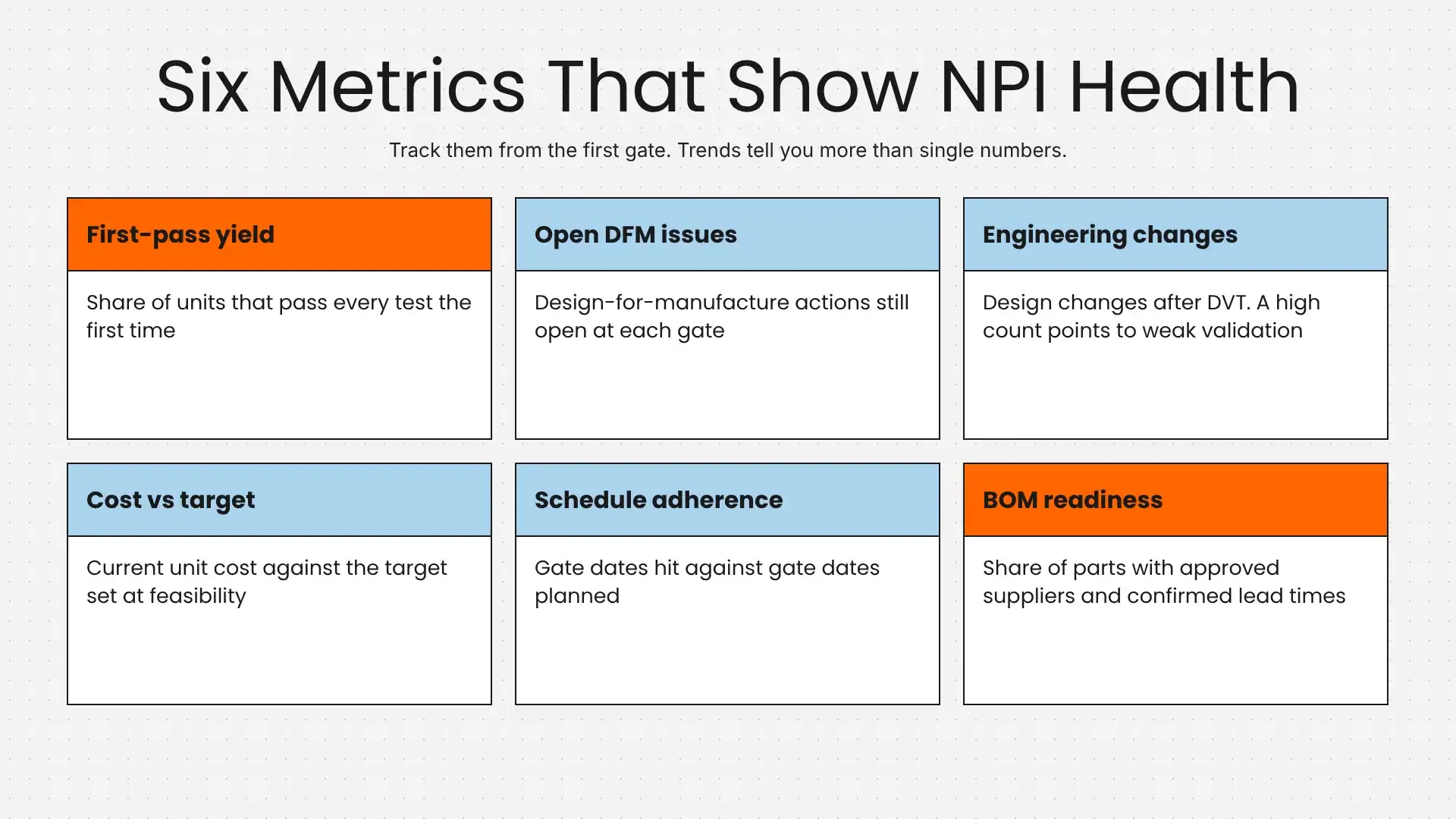
NPI metrics to track
What you measure shapes how the team behaves. These metrics give a clear picture of NPI health:
- First-pass yield (FPY). The share of units that pass every test the first time. It shows how stable the process is.
- Open DFM issues. How many design-for-manufacture actions remain open at each gate.
- Engineering change count. How many design changes happen after DVT. A high number points to weak validation.
- Cost against target. The current unit cost compared with the target set at feasibility.
- Schedule adherence. Gate dates hit against gate dates planned.
- BOM readiness. The share of components with approved suppliers and confirmed lead times.
Track them from the first gate. Trends tell you more than single numbers.
“Decision gates are no-turning-back moments.”
Source: Nitesh Gupta, Sander Smits and Florian Weig, McKinsey & Company (20 Jun 2017)
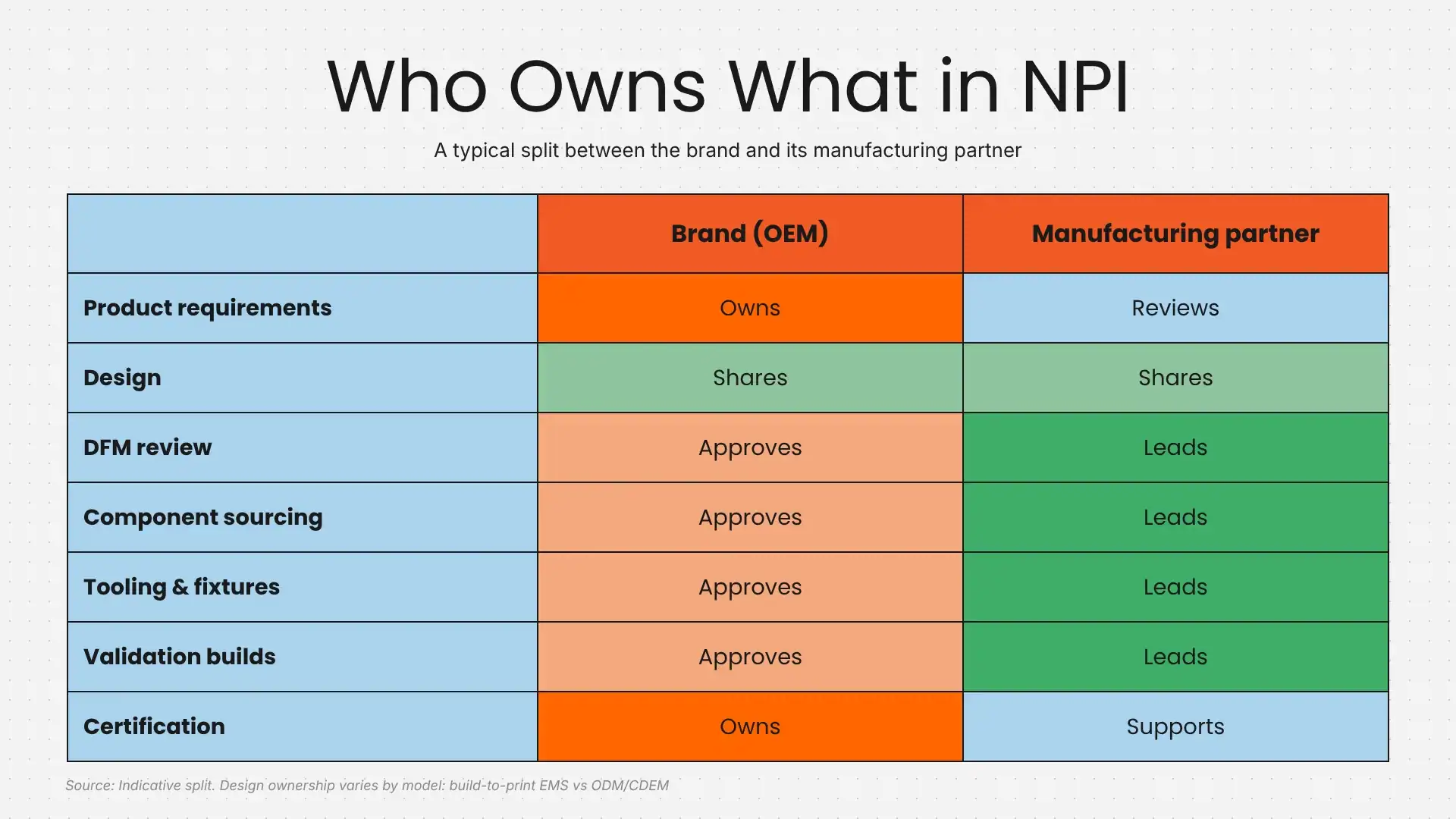
Who owns what in NPI?
Confusion over ownership causes more delays than technical problems do. Agree roles before EVT starts.
| Task | Brand (OEM) | Manufacturing partner |
|---|---|---|
| Product requirements | Owns | Reviews for feasibility |
| Industrial and electrical design | Owns or shares | Supports or leads (ODM/CDEM model) |
| DFM review | Approves | Leads |
| Component sourcing | Approves critical parts | Leads purchasing and supply planning |
| Tooling and fixtures | Approves and often funds | Designs, builds and maintains |
| Validation builds | Approves results | Builds and tests |
| Certification | Owns the outcome | Supports testing and documentation |
| Production sign-off | Approves | Prepares FAI, golden samples and process data |
The split depends on your model. A pure build-to-print EMS provider follows your design. A contract design and electronics manufacturer (CDEM) can take on design work too. Our post on OEM vs ODM sourcing strategy explains the commercial side.
The NPI documents your factory needs
A factory builds from documents, not from conversations. Before PVT, make sure these exist and match the latest revision:
- Bill of materials (BOM) with approved manufacturers and part numbers
- Drawings and 3D models with tolerances and critical features marked
- Assembly work instructions with photos for each step
- Test specifications and test software versions
- Packaging and labelling specifications
- Cosmetic standards and approved golden samples
- Process flow and control plan, showing what gets checked, where and how often
Each document needs an owner and a revision number. When the design changes, the documents change with it.
Handing over from NPI to production
NPI ends with a handover. The launch team steps back and the sustaining team takes over.
Make the handover formal. Hold a final review and close or transfer every open issue. Hand over yield data, known failure modes and supplier contacts. Agree who approves engineering changes from now on.
A clean handover keeps knowledge in the business. A loose one leaves the next team to rediscover old problems.
86% of survey respondents want to share design data more easily with manufacturing.
Source: Michelle Boucher, Tech-Clarity
Prototype to production: five gaps that catch teams out
Moving from prototype to production exposes the same gaps again and again.
1. Prototype parts are not production parts
3D-printed housings and machined parts behave differently from moulded ones. Plastics shrink. Colours shift. Snap fits loose. Test with production materials as early as you can.
2. Hand-built boards hide process problems
An engineer can coax a prototype board into working. A reflow oven cannot. Assembly and test access must work for a machine, not a person.
3. Test coverage is too thin
A prototype gets tested by the person who designed it. Production needs automated tests that catch faults in seconds. Plan test fixtures alongside the design.
4. Component lead times arrive late
Some parts take months to source. If you order them after DVT, they will set your launch date. Lock long lead-time parts during design.
5. Documentation lives in someone’s head
Factories build from drawings, BOMs and work instructions. Missing details turn into guesses on the line. Treat documentation as a deliverable, not a chore.
“The primary constraint today remains capacity and lead time and not demand.”
Source: Dr Shawn DuBravac, Chief Economist, Global Electronics Association
How to manufacture a product for the first time
If this is your first hardware launch, start with these steps.
- Freeze your core requirements. Decide what the product must do before you optimise anything.
- Bring in a manufacturing partner early. Ask for a DFM review before you commit to tooling. It costs far less than fixing tools later.
- Budget for tooling and certification. Moulds, fixtures and compliance testing often cost more than first-time founders expect.
- Plan three validation builds. EVT, DVT and PVT each answer a different question. Skipping one usually means repeating another.
- Agree acceptance criteria up front. Define what “good” looks like before the first unit comes off the line.
- Run a pilot before you scale. A short production run reveals process issues while volumes are still small.
NPI for low-volume vs high-volume products
Volume changes where you spend NPI effort.
High-volume products justify heavy investment up front. Multi-cavity moulds, automated assembly and custom test fixtures pay back over hundreds of thousands of units. Small savings per unit add up fast, so DFM reviews go deep.
Low-volume, high-mix products need flexibility more than speed. Simpler tooling, manual or semi-automated assembly and shared test platforms keep costs sensible. The focus shifts to quick changeovers and tight documentation, because each product runs less often.
Most portfolios include both. Plan NPI for each product on its own numbers, not on a company-wide template.
Factories in the World Economic Forum’s Global Lighthouse Network report, on average, a 40% labour productivity increase and a 48% reduction in lead time.
Source: World Economic Forum
How the NPI process changes by industry
The six stages stay the same. The rules around them change.
Medical devices
Medtech NPI centres on design controls and design transfer. In the US, the FDA’s Quality Management System Regulation (QMSR) took effect on 2 February 2026. It brings US device rules in line with ISO 13485:2016. Every validation step needs documented evidence and traceability.
Automotive
Automotive programmes follow APQP (advanced product quality planning) and finish with PPAP (production part approval process). Suppliers must prove the process can hold quality over long production runs. Quality systems such as IATF 16949 set the bar. See our automotive capabilities.
Consumer electronics
Speed drives consumer NPI. Launch windows tie to retail seasons. Teams often run validation builds in parallel and compress ramp-up. Strong DFM and supply planning keep that speed from turning into rework.
How Intretech runs NPI
Intretech supports NPI from the first concept to mass production.
Our engineering teams cover industrial design, firmware, DFM and industrialisation. Our in-house testing labs run EMC, safety, reliability, electrical and acoustic testing, including a 3-metre anechoic chamber for EMC work. Our automation team designs production lines and fixtures alongside the product.
We then build at the site that fits the market. Our hubs in China and Malaysia handle large-scale production. Our site in Kapuvár, Hungary, serves European customers. Our facility in Monterrey, Mexico, serves North America. With engineering support across these sites, a product can launch in one region and later move to another using the same documentation, test plans and validation data. If you plan to launch in North America, read our buyer’s guide to electronics manufacturing in Mexico.
Frequently asked questions
What are the stages of the NPI process?
Most electronics programmes use six stages: concept and feasibility, design and DFM review, EVT, DVT, PVT, and ramp to mass production. Each stage ends with a gate review before the next one starts.
What is the difference between NPI and NPD?
NPD (new product development) decides what to build and creates a working design. NPI (new product introduction) turns that design into a product a factory can build repeatedly at the right cost and quality.
How long does it take to go from prototype to production?
It depends on complexity, tooling and certification. A simple product with off-the-shelf parts can move faster than one that needs custom tooling, regulatory approval or new production equipment. Early DFM reviews and early ordering of long lead-time parts shorten the timeline most.
Who is responsible for NPI, the brand or the manufacturer?
Both. The brand usually has requirements, design approval and certification. The manufacturer usually leads DFM, tooling, validation builds and production sign-off. Agree the split in writing before EVT starts.
What is the most common reason NPI runs late?
Late design changes. A problem found after tooling forces new tools, new samples and new tests. Thorough DFM reviews and well-planned validation builds catch these problems earlier.
Planning your next product launch?
Our engineers can review your design, plan your validation builds and get your product ready for production.
Explore more related content
First Article Inspection and Golden Samples: How to Sign Off a New Production Line
First Article Inspection and Golden Samples: How to Sign Off a New Production Line The first unit off a new line tells...
EVT vs DVT vs PVT: The Three Validation Builds Explained
EVT vs DVT vs PVT: The Three Validation Builds Explained EVT, DVT and PVT sound like jargon. They are actually three...

USMCA Rules of Origin: A Practical Guide for Electronics OEMs (2026 Update)
USMCA Rules of Origin: A Practical Guide for Electronics OEMs (2026 Update) USMCA rules of origin used to be a...