

Pulp Molding Solutions from Design to Production
We form molded fiber packaging with both dry press and wet press processes, from structural design through tooling to serial production in Europe and China.
The programs run as standalone packaging projects, or alongside a product manufactured inside the group.
- Dry press and wet press molding
- Edge radius below 0.5 mm
- Near-zero draft angles
- Prototype to serial in-house
Two Processes, Selected per Part
The process is chosen before tooling is committed, against protection, finish, handling and volume.
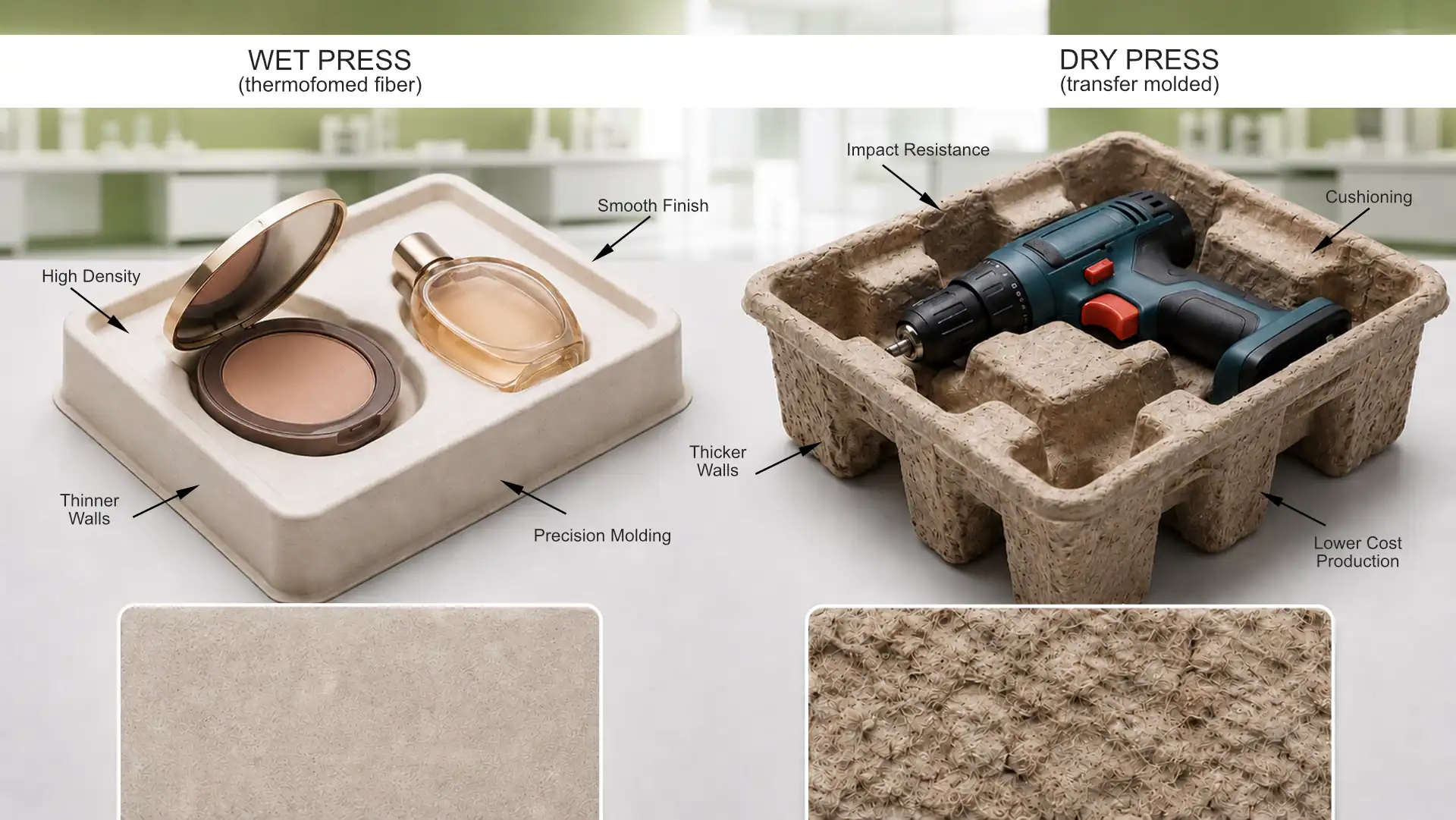
Wet press
Vacuum forming with heated press tooling that dries the part in the mold. Walls from 0.7 mm, tolerance to ±0.5 mm and a controlled show face — presentation trays and retail-facing packaging.
Dry press
Vacuum forming with tunnel drying. Thicker walls at 1.5–6 mm and recycled fiber — protective inserts, cushioning and transport packaging at volume.
Replacing Plastic Under PPWR
PPWR is changing how single-use formats are specified. We develop fiber replacements against the same protection, stacking and line-handling requirements as the plastic part they replace.
- Drop-in geometry for existing lines
- Denesting and handling checks
- Barrier options weighed against recyclability
Tooling and Prototyping
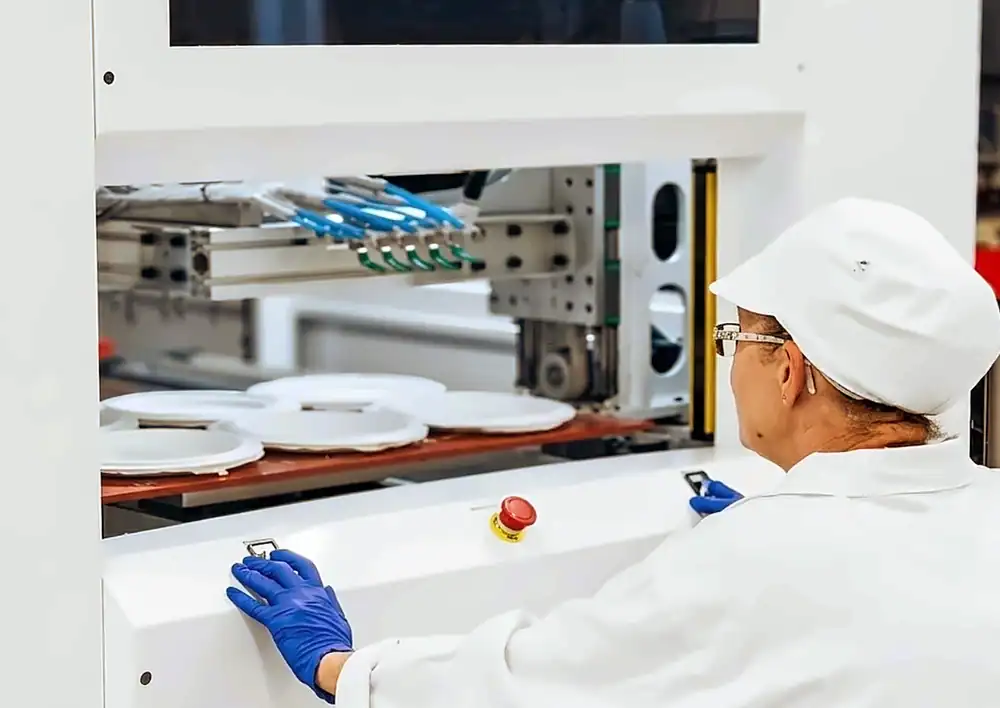
Tool design, machining and debugging sit with one team, so a geometry change stays inside the project instead of travelling through a third party.
Days prototype mold
Days mass production mold
Tooling sets per year
Design to serial production takes about four months for a straightforward product with a fast feedback loop.
Manufacturing and Quality
Production runs in food-contact certified facilities, with QA documentation issued as standard.
- GMP FSSC 22000 certified production
- Dimensional reports, CoC, lot traceability
- In-house lab: drop, vibration, compression
- EU and Asia supply chain, with EU production available

Pulp Molding Inside the Manufacturing Chain
Packaging for Your Industry

Consumer Electronics

Food and Beverage

Beauty and Personal Care

Medical

Energy, Industrial, Building
Let Us Look at Your Part
Send your drawings and requirements. You get a process recommendation, a tooling approach and a cost direction before either side commits.
We like the projects where the geometry is awkward and the packing line is picky.
Which pulp molding process fits my part?
Can molded fiber replace a plastic insert without changing our packing line?
What do you need to start?
Explore more related content

High-Power Wireless Charging: What IFA 2026’s Qi2 and Ki Standards Mean for Manufacturers
High-Power Wireless Charging: What IFA 2026's Qi2 and Ki Standards Mean for Manufacturers Qi2 25W delivers nearly 70%...

USMCA Rules of Origin: A Practical Guide for Electronics OEMs (2026 Update)
USMCA Rules of Origin: A Practical Guide for Electronics OEMs (2026 Update) USMCA rules of origin used to be a...
Nearshoring vs Offshoring: How to Choose Your Manufacturing Footprint and EMS Partner
Nearshoring vs Offshoring: How to Choose Your Manufacturing Footprint and EMS PartnerNearshoring vs offshoring is...