

USMCA Rules of Origin: A Practical Guide for Electronics OEMs (2026 Update)


USMCA rules of origin used to be a paperwork exercise for electronics companies. Many electronic products already entered the US at zero or near-zero duty, so proving North American origin felt optional.
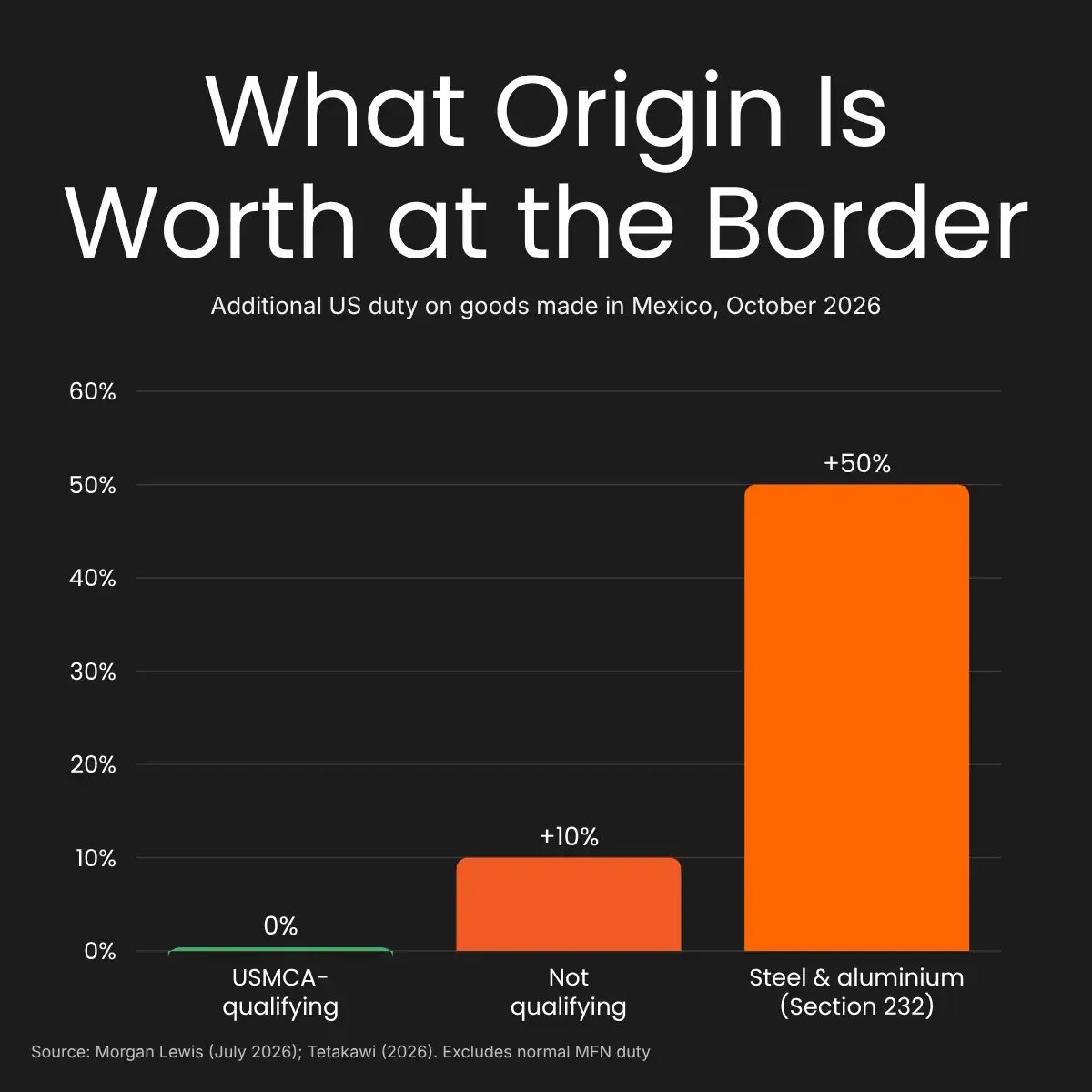
That changed in 2026. With new US tariffs now applying to most imports, USMCA qualification has become the difference between a product that crosses the border tariff-free and one that pays an extra 10% or more. For an OEM building in Mexico, origin is no longer a compliance afterthought. It is a design and sourcing decision.
This guide explains how the rules work, what they mean for products full of imported components, and where engineering choices can make or break qualification.
This article is general guidance, not legal advice. Always confirm the rules for your specific product with a licensed customs broker or trade lawyer.
“Data suggest that in 2025 around 84% of U.S. auto imports from Canada and Mexico met USMCA content rules.” Source: Congressional Research Service, USMCA
What are USMCA rules of origin?
USMCA rules of origin are the tests that decide whether a product counts as “originating” in North America. Only originating goods get the agreement’s preferential tariff treatment when they move between the US, Mexico and Canada.
The rules sit in Chapter 4 of the agreement, with product-specific rules in Annex 4-B. You can read the full text on the USTR website.
The key point for electronics: a product does not have to be made entirely from North American parts to qualify. It has to be transformed enough in the region, in the way its product-specific rule requires.

The US and Mexican trade leads stressed “the urgency of growing North American manufacturing.” – Joint Statement from Ambassador Jamieson Greer and Secretary of Economy Marcelo Ebrard, USTR (23 Jul 2026)
Why USMCA compliance matters more in 2026
Three developments have raised the stakes.
- New US tariffs. After the Supreme Court ruled in February 2026 that emergency (IEEPA) tariffs were not authorised, the US introduced a temporary Section 122 surcharge, then replaced it with Section 301 duties on 24 July 2026. Non-qualifying goods from Mexico face a 10% Section 301 duty. USMCA-qualifying goods are outside it.
- Annual reviews. At the July 2026 joint review, the US did not confirm a 16-year extension. The agreement remains in force, but it is now reviewed every year until 2036 unless extended. Expect more scrutiny of origin claims, not less.
- Mexico’s own tariff changes. Mexico now applies duties of 10–50% to around 1,463 product categories from countries without a trade agreement with Mexico. Temporary imports under IMMEX are exempt, which makes programme status and origin planning even more connected.
The ways a product can qualify
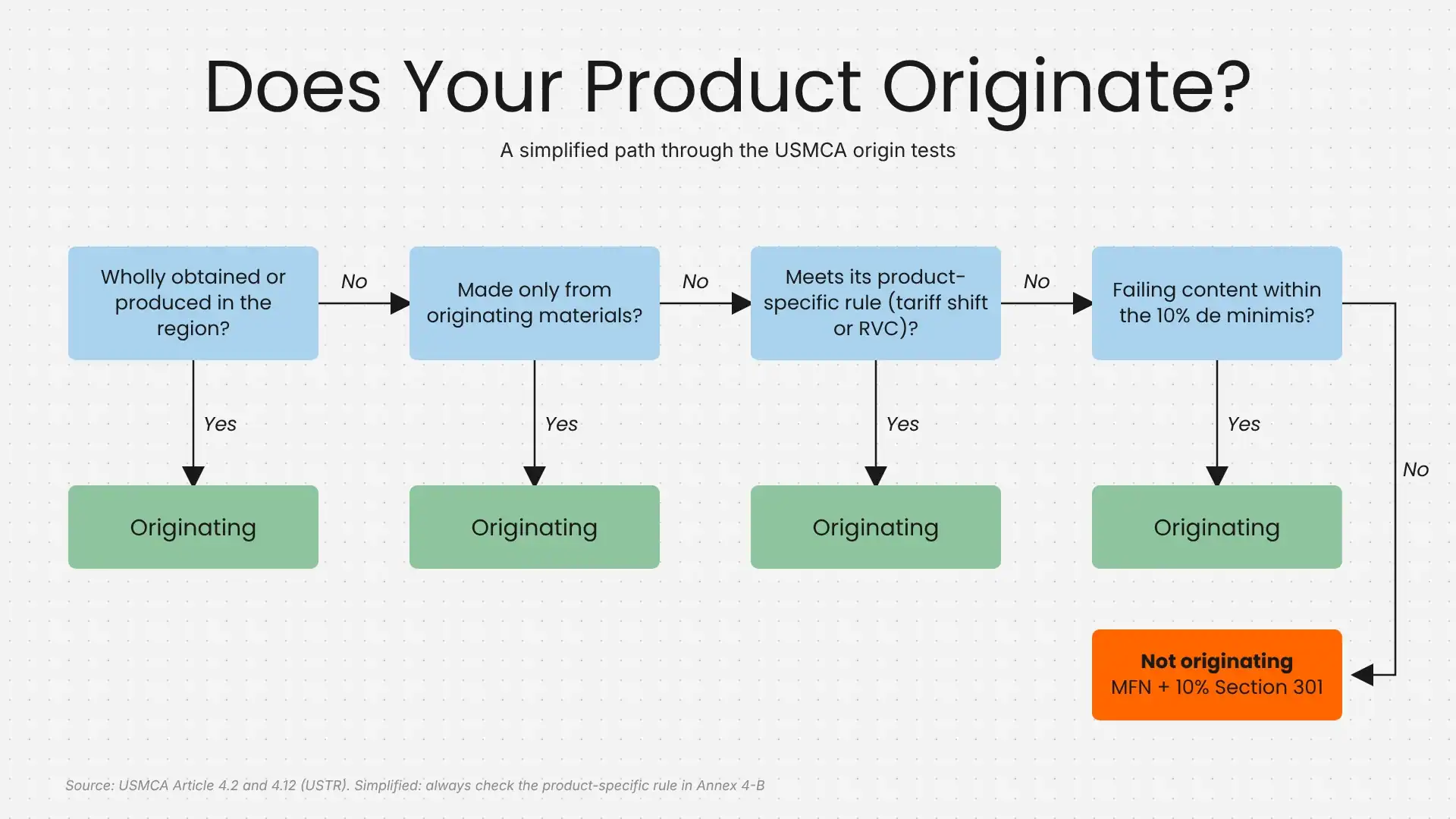
Under Chapter 4, a good is originating if it meets one of these tests.
- Wholly obtained or produced in the region. This rarely applies to electronics.
- Produced exclusively from originating materials. Again, rare for electronics with global component supply.
- Produced from non-originating materials that meet the product-specific rule. This is where most electronics qualify. The rule is usually a tariff shift, a regional value content (RVC) threshold, or both.
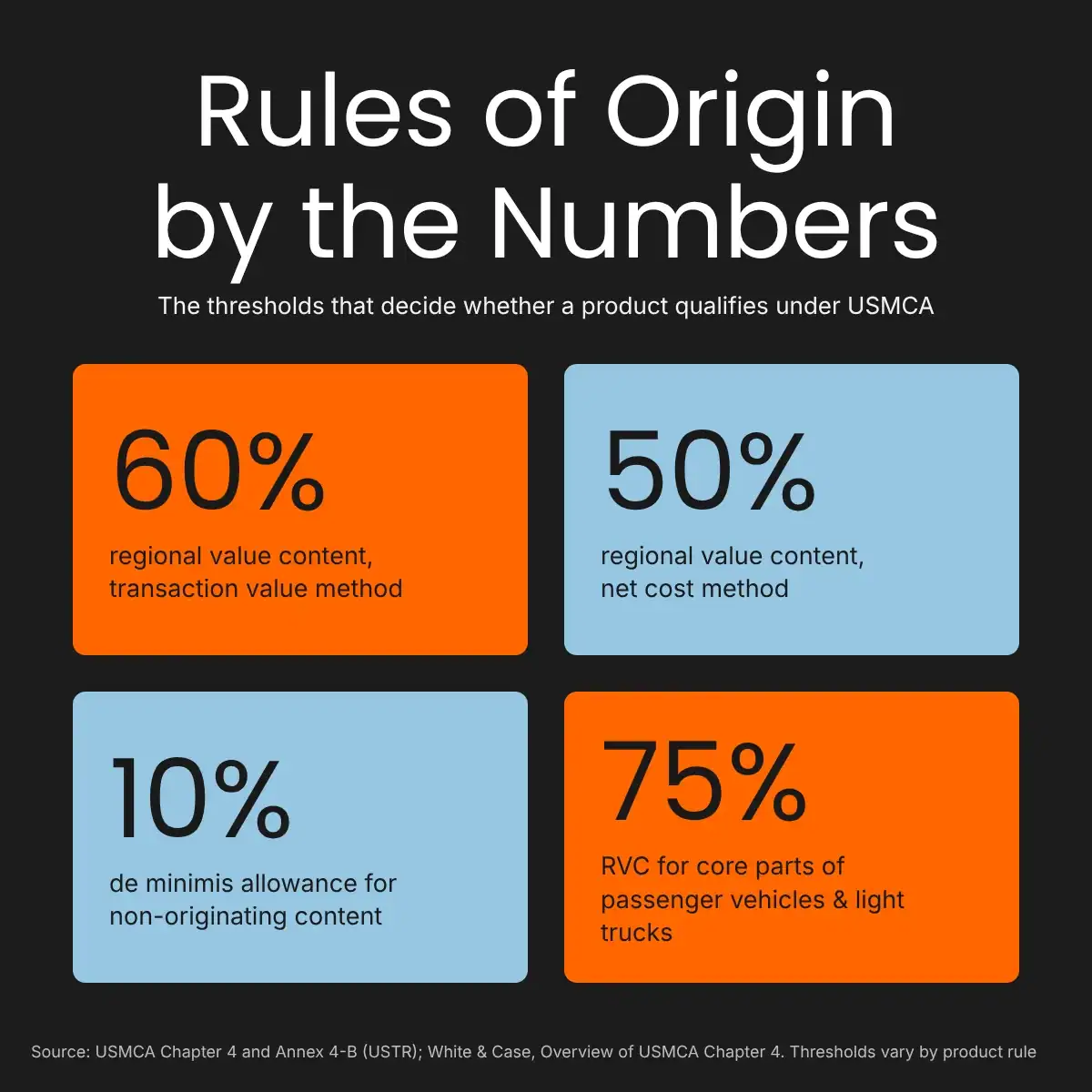
- Unassembled goods or goods classified with their parts that meet a general RVC threshold of 60% (transaction value method) or 50% (net cost method).
“To apply the tariff shift rule to your product you need to make a list of the components used to produce the good.”
Tariff shift, explained
A tariff shift rule says that non-originating materials must change tariff classification when they are processed in the region. Each product’s rule sets how big that change must be, for example a change of chapter, heading or subheading in the Harmonized System.
A simplified example: imagine a smart thermostat assembled in Monterrey. Its microcontroller, sensors and display are imported from Asia. Each of those components has its own HTS classification. If the thermostat’s product-specific rule requires a change of heading, and none of the imported components share the thermostat’s heading, assembly in Mexico may be enough to meet the tariff shift. If a key component already sits in the same heading as the finished good, the shift fails for that component and you may need to rely on RVC or the de minimis rule instead.
(Illustrative only. Classifications and rules vary by product.)
“Additional trade compliance costs, expressed as an ad valorem tariff, can range between 1.4 and 2.5 percent.” (automotive trade) Source: Federal Reserve Board, FEDS Notes
Regional value content (RVC)
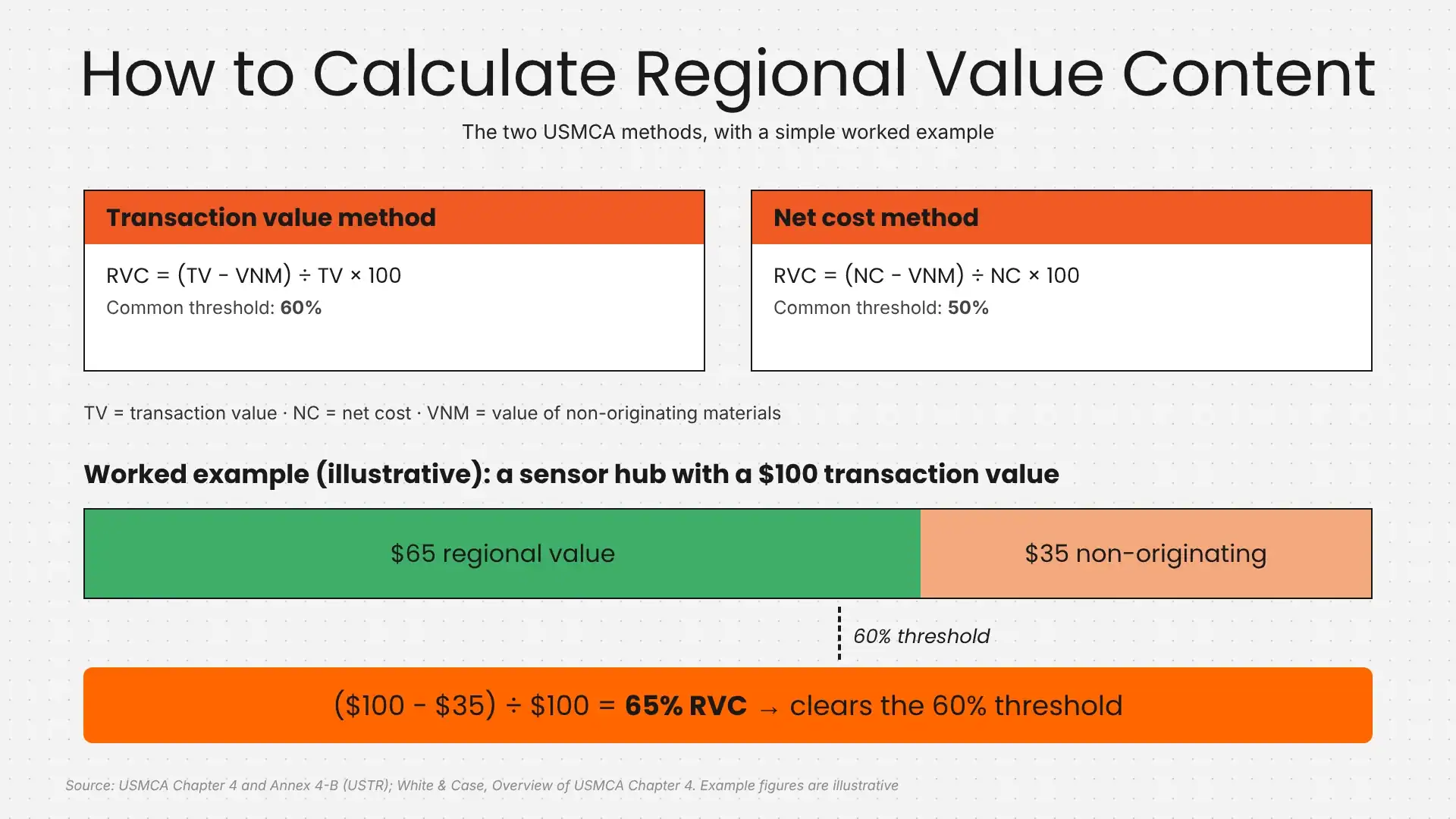
RVC measures how much of a product’s value comes from the region. USMCA allows two methods:
- Transaction value method: (transaction value minus value of non-originating materials) divided by transaction value. A common threshold is 60%.
- Net cost method: (net cost minus value of non-originating materials) divided by net cost. A common threshold is 50%.
Thresholds are set per product, so always check the specific rule. For electronics, RVC is often harder to meet than tariff shift because semiconductors and displays carry a large share of the bill of materials.
De minimis
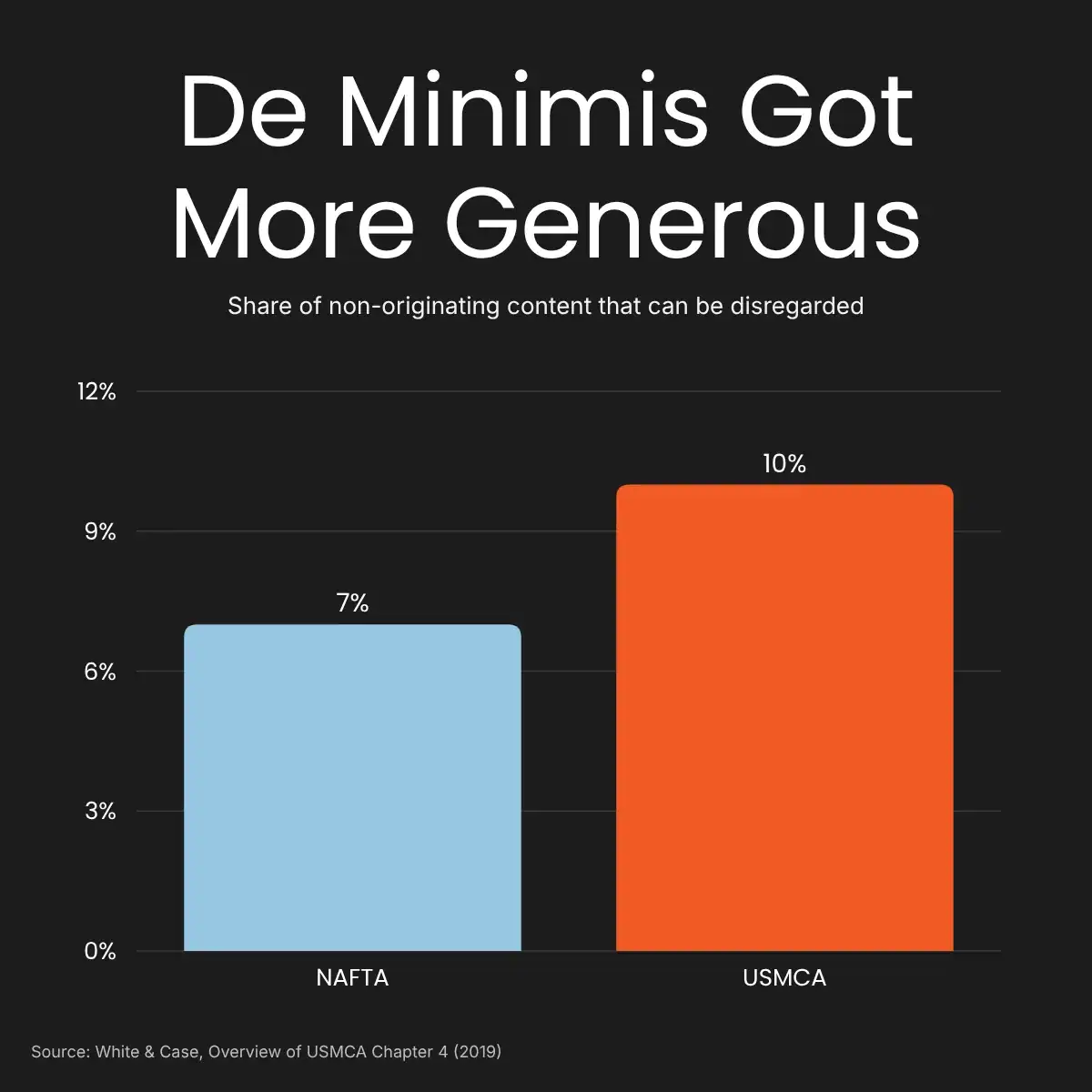
If non-originating materials that fail the tariff shift make up no more than 10% of the product’s value, they can be disregarded. This was raised from 7% under NAFTA and is often the quiet saviour of an electronics origin claim.
Accumulation
Production carried out by different companies anywhere in the US, Mexico or Canada can be combined. A PCBA made by one supplier in Mexico and a housing moulded in Texas can both count toward the final product’s origin.
Computer and electronic products are “the No. 1 U.S. export to Mexico” (21% share) and the No. 2 US import from Mexico, so components cross the border in both directions.
Automotive electronics: stricter rules
Automotive goods follow tougher rules. Core parts for passenger vehicles and light trucks face a 75% regional value content requirement, and vehicles also face labour value content and steel and aluminium purchasing requirements. If you supply electronics into automotive programmes, your customer will usually ask for detailed origin data to support their own vehicle-level calculation.
How design and sourcing decisions affect USMCA rules of origin
This is where most guides stop and where the real savings start. Origin is shaped long before a product reaches customs.
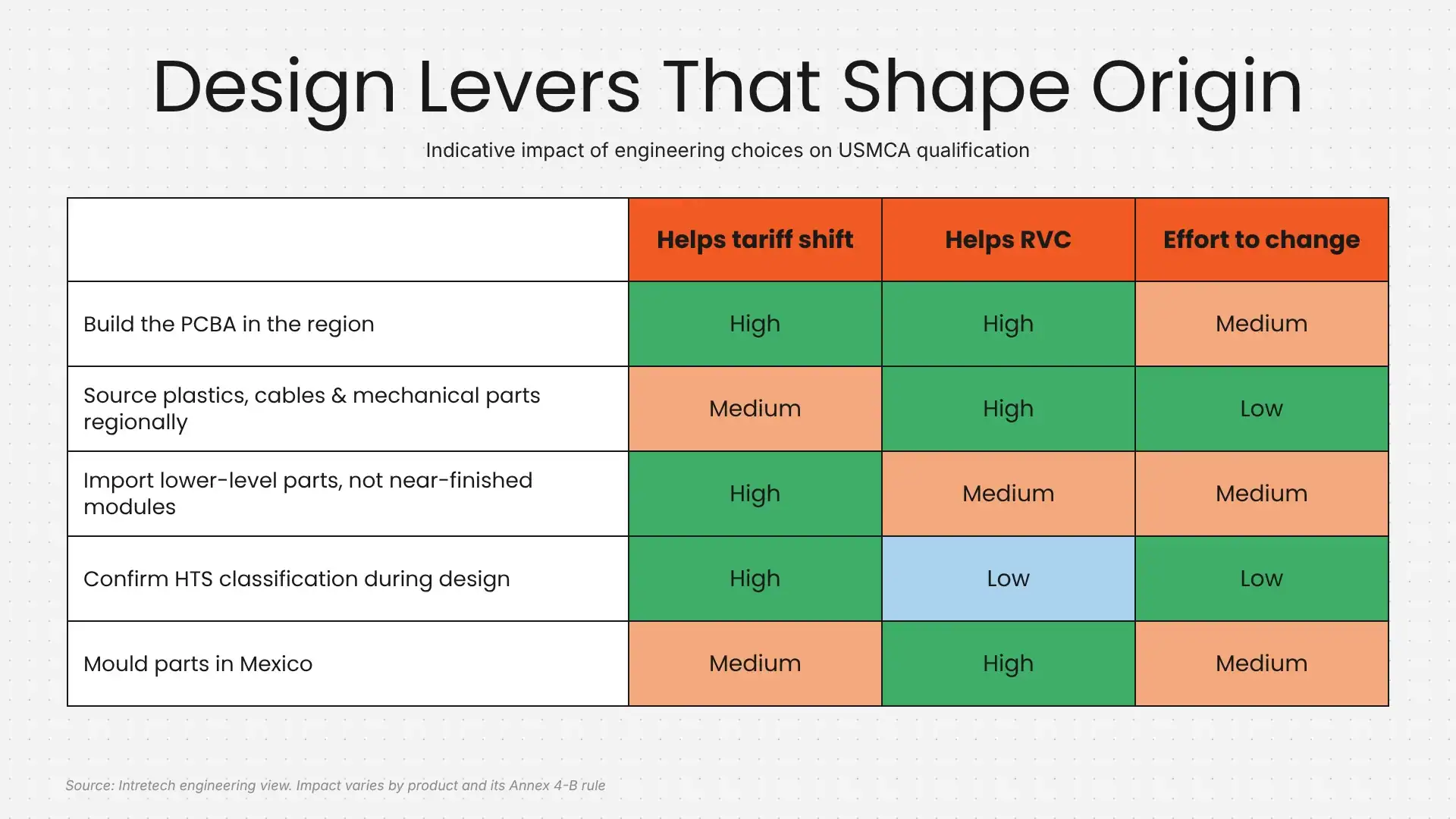
- Where SMT happens. Building the PCBA in the region, rather than importing a finished board, can change which tariff shift test applies and lift regional value.
- How you structure the BOM. Sourcing mechanical parts, cables, packaging and plastics regionally can add RVC without touching the electronics.
- Sub-assembly boundaries. Importing a nearly finished module that already sits in the finished product’s heading can break the tariff shift. Bringing in lower-level parts instead can fix it.
- Product classification. The HTS code drives the rule. Get classification confirmed early, ideally during design.
- Tooling and moulding location. Injection-moulded parts made in Mexico are originating materials, which helps both tariff shift and RVC.
The practical lesson: involve your manufacturing partner and customs adviser at the design stage.
Fixing origin after tooling is cut is expensive. Our design and engineering team works on this alongside DFM.
“Most sourcing changes associated with meeting the ROOs resulted in an increase in production cost.” Source: US International Trade Commission, Publication 5642 (July 2025)
USMCA certification of origin: what you need
USMCA has no mandatory form. A certification of origin can be completed by the importer, exporter or producer, as long as it includes a set of minimum data elements, such as details of the certifier, exporter, producer and importer, a description and HTS classification of the goods, the origin criterion used, and a signature and date.
A few practical points:
- Blanket certifications can cover multiple shipments of identical goods for up to 12 months.
- Records supporting the claim must normally be kept for at least five years.
- Supplier declarations matter. If you rely on a component being originating, you need evidence from your supplier.
U.S. Customs and Border Protection publishes guidance on certification and verification.
“Recent experience suggests that USMCA can cushion tariff shocks, but that cushion is not free.” – Martínez García and Mau, Federal Reserve Bank of Dallas, Dallas Fed Economics (4 Aug 2026)
Common USMCA compliance mistakes
- Assuming “made in Mexico” means “USMCA-qualifying”. It doesn’t. Origin depends on the product rule, not the country of assembly.
- Using the wrong HTS code. A different classification can mean a completely different rule.
- Ignoring BOM changes. A component substitution during a shortage can quietly break your origin claim.
- Missing supplier evidence. Without documentation, you cannot prove originating content in an audit.
- Treating origin as a one-off. With annual reviews and shifting tariffs, origin needs ongoing monitoring.

The US Trade Fraud Task Force “Surpasses $1 Billion in Recoveries and Charged Losses in Less Than One Year.”
Tariff mitigation strategies beyond USMCA
USMCA qualification is the strongest lever, but not the only one.
- IMMEX status can remove Mexican duties on temporarily imported components.
- Multi-region production lets you build each market’s volume in the region with the best trade terms.
- Dual sourcing of critical components reduces exposure to any single country’s tariff changes.
- Regular landed cost reviews catch tariff changes before they erode margins.
For the bigger picture, read our buyer’s guide to electronics manufacturing in Mexico and our comparison of nearshoring vs offshoring. Our supply chain management team supports customers with sourcing strategy across regions.
Frequently asked questions
How do I know if my product qualifies for USMCA?
Start with the product’s HTS classification, then find its product-specific rule in Annex 4-B of the agreement. Check whether your non-originating materials meet the tariff shift or RVC requirement, and whether the 10% de minimis rule helps. A licensed customs broker can confirm the analysis.
Can electronics made in Mexico with Asian components qualify for USMCA?
Yes, in many cases. Most electronics qualify through a tariff shift, where imported components change classification during manufacture in the region. Qualification depends on the specific product rule and how the bill of materials is structured.
What is regional value content under USMCA?
Regional value content is the share of a product’s value that comes from North America. It is calculated using either the transaction value method (commonly a 60% threshold) or the net cost method (commonly 50%), depending on the product rule.
Who completes a USMCA certification of origin?
The importer, exporter or producer can complete it. There is no mandatory form, but it must include the minimum data elements set out in the agreement, and supporting records should be kept for at least five years.
Is USMCA still in effect after the 2026 review?
Yes. The US did not confirm a 16-year extension in July 2026, but the agreement remains in force. It is now subject to annual reviews and runs until 2036 unless the parties agree to extend it.
Design your product for USMCA from day one
Origin is easier, and cheaper, to build in than to fix later. Our engineers can review your design and bill of materials for North American production.
Explore more related content

Nearshoring vs Offshoring: How to Choose Your Manufacturing Footprint and EMS Partner
Nearshoring vs Offshoring: How to Choose Your Manufacturing Footprint and EMS PartnerNearshoring vs offshoring is...
Electronics Manufacturing in Mexico: A Buyer’s Guide to Nearshoring in 2026
Electronics Manufacturing in Mexico: A Buyer’s Guide to Nearshoring in 2026Electronics manufacturing in Mexico is no...

IoT in Smart Agriculture: The Hardware Engineering Decisions That Decide Whether a Sensor Survives the Field
IoT in Smart Agriculture: The Hardware Engineering Decisions That Decide Whether a Sensor Survives the FieldThe top...