

5 Proven Strategies for Effective Procurement Management in Today’s Market


Procurement used to be judged on one number: did you get a lower price than last year?
That number still matters. But anyone who has chased a component on a 40-week lead time, or watched a single-source supplier go quiet a month before launch, knows price is only part of the story. Good procurement management today is about cost, continuity, quality and risk, all at once.
This guide explains what procurement management is, why it matters, and five proven strategies to make it work in a market that keeps changing. We write it from the perspective of a manufacturer that buys thousands of components every week, so the examples are practical, not theoretical.
Definition of Procurement Management
So how do you define procurement management? Procurement management is the process of planning, sourcing, buying, receiving and paying for the goods and services a business needs, while managing the suppliers who provide them.
A simple procurement management definition: getting the right goods and services, of the right quality, from the right suppliers, at the right total cost, at the right time.
To explain procurement management in full, it helps to split it into its main activities:
- Needs planning: working out what the business needs, how much and when
- Sourcing: finding, qualifying and selecting suppliers
- Negotiation and contracting: agreeing price, terms, quality and delivery
- Purchasing: raising and approving purchase orders
- Receiving and inspection: checking that what arrived matches what was ordered
- Payment: matching invoices to orders and receipts, then paying on time
- Supplier management: monitoring performance and building long-term relationships
Procurement is often confused with purchasing. Purchasing is the transaction. Procurement is the whole strategy around it.
53% of electronics manufacturers say supplier lead times got longer in Q2 2026; just 3% say they shortened. Global Electronics Association, Global Sentiment Survey (Aug 2026)
Importance of Procurement in Business
For most manufacturers, purchased materials and services make up a large share of the cost of goods sold. That makes procurement one of the biggest levers on margin in the business.
But the value goes well beyond cost:
- Continuity of supply. No parts, no production.
- Quality. A product is only as reliable as its components.
- Speed to market. Supplier lead times often set the pace of a new product launch.
- Risk. Single-source parts, geopolitical shifts, logistics disruption and supplier financial health all land on procurement’s desk.
- Sustainability and compliance. Material declarations, conflict minerals reporting and environmental standards are now part of the job.
The Institute for Supply Management describes the modern procurement function as strategic, not transactional. The five strategies below show what that looks like in practice.
61% of CPOs name supplier information sharing and collaboration as a top risk strategy. Deloitte Global CPO Survey (Aug 2025)
Strategy 1: Streamline Procurement Operations Management
Procurement operations management is the day-to-day engine of procurement: requisitions, purchase orders, approvals, receiving and invoice matching. When it runs well, nobody notices. When it doesn’t, everyone does.
Tools for Efficient Operations
You don’t need the most expensive platform to run lean operations. You need the right basics, connected properly:
- ERP purchasing module for purchase orders, receiving and inventory
- Approved supplier list with clear status for each supplier (approved, conditional, restricted)
- Purchase order templates with standard terms built in
- Three-way matching of purchase order, goods receipt and invoice
- Shared supplier portal for order confirmations, delivery updates and documents

“60 percent of respondents are acting to regionalize their supply chains.”
Best Practices for Streamlining
Map the process end to end. Follow a purchase request from first idea to payment. Count the handoffs, approvals and waiting time. Most delays sit in a few predictable places.
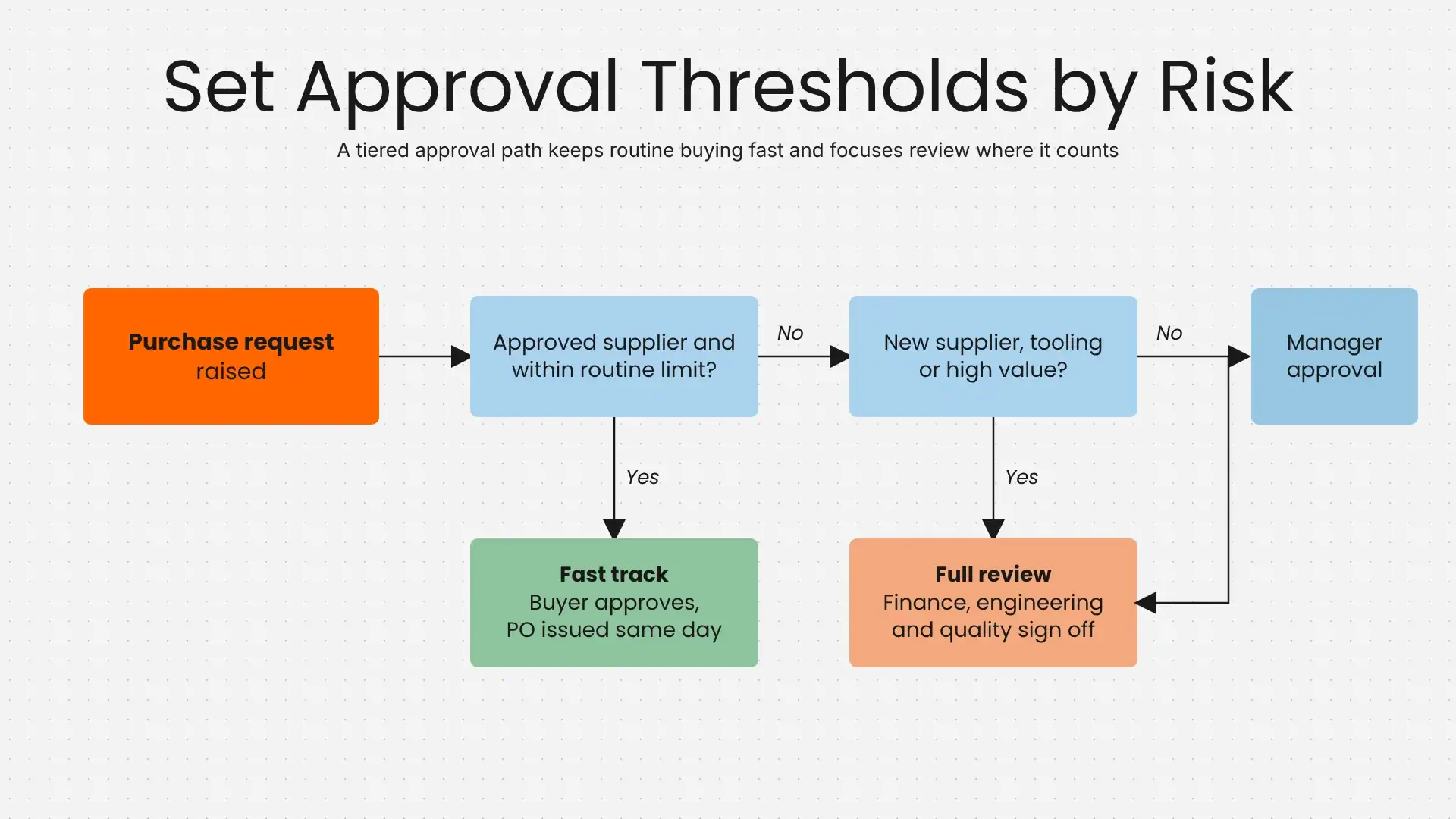
Set approval thresholds by risk, not habit. A routine reorder of consumables shouldn’t need the same sign-off as a new tooling investment. Tiered approval limits speed up low-risk buying and focus attention where it counts.
Standardize part data. Duplicate part numbers and inconsistent descriptions create double orders and missed volume discounts. Clean master data is boring, and it saves real money.
Consolidate spend where it makes sense. Fewer, stronger supplier relationships usually mean better pricing and service. But keep a second source for critical parts. Consolidation without a backup is a risk, not a saving.
Agree lead times and order windows up front. For electronics in particular, build long-lead components into planning early and share forecasts with key suppliers so they can reserve capacity.
“95 percent of respondents now have visibility into at least tier-one supplier risks.” McKinsey, Supply chain risk pulse
Strategy 2: Foster Effective Procurement and Administration Collaboration
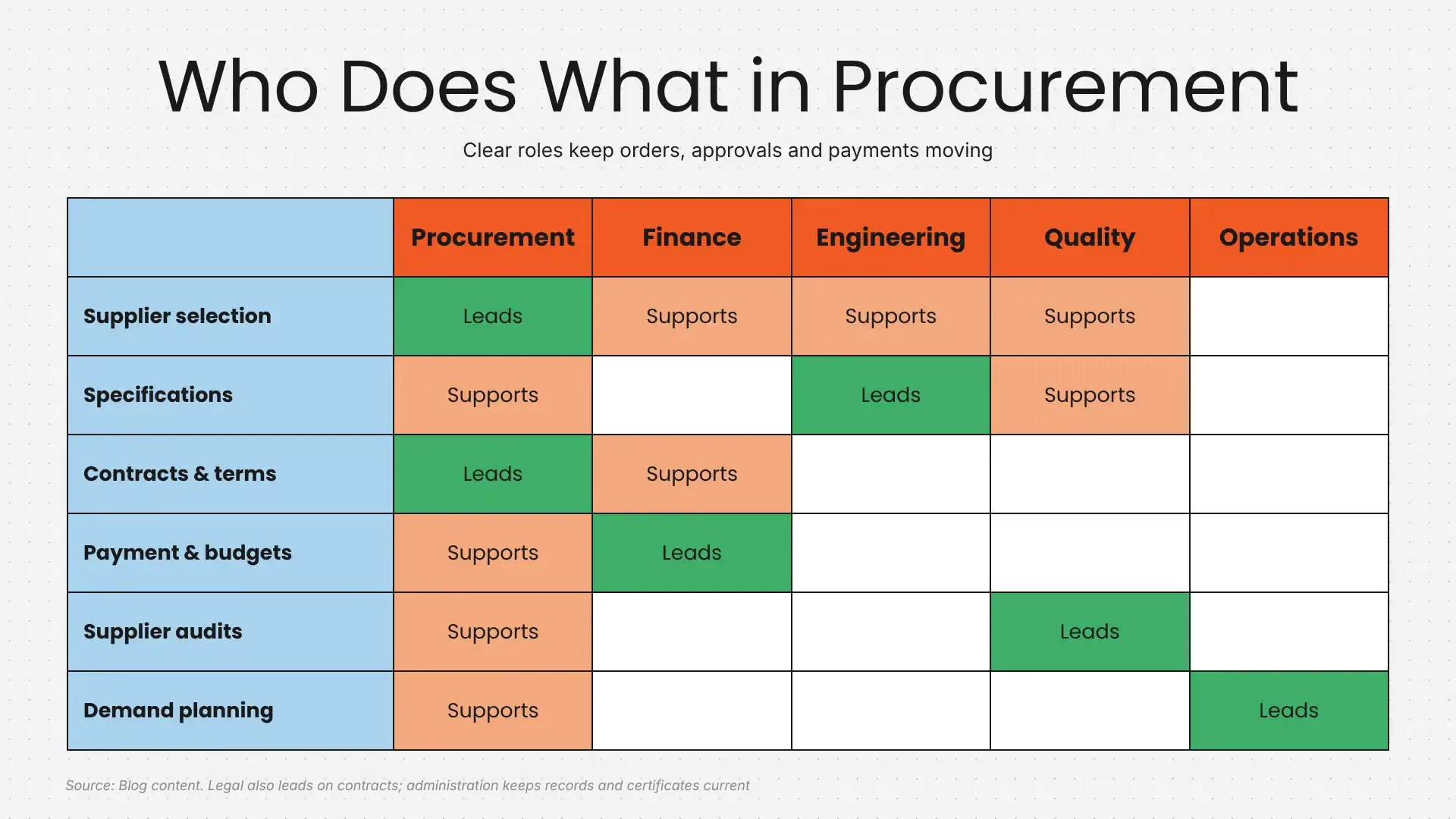
Procurement doesn’t work alone. It depends on finance, legal, engineering, quality, operations and general administration. Procurement and administration need to move in step, or orders stall, invoices go unpaid and suppliers lose patience.
Roles of Procurement and Administration
| Team | Role in procurement |
|---|---|
| Procurement | Sourcing, negotiation, supplier selection and performance |
| Administration | Records, documentation, compliance filing, internal coordination |
| Finance | Budgets, payment terms, invoice processing, cash flow |
| Legal | Contracts, terms and conditions, liability and IP |
| Engineering | Specifications, approved parts, design changes |
| Quality | Supplier audits, incoming inspection, corrective actions |
| Operations | Demand planning, production schedules, stock levels |

“Supply chain leaders are moving away from an overreliance on low-cost networks and are instead focusing on diversified approaches to mitigate risks and enhance performance.” Vicky Forman, Senior Director Analyst, Gartner
Benefits of Collaboration
Faster cycle times. When everyone knows their role in the approval chain, requests don’t sit in inboxes.
Better supplier relationships. Suppliers who get paid on time and receive clear, consistent information give better service and better pricing.
Fewer surprises. Engineering changes shared early give procurement time to qualify new parts before old stock runs out.
Stronger compliance. Administration keeps supplier certificates, contracts and audit records current, which protects the business in an audit or a customer review.
Better decisions. Bringing engineering and procurement together early, at the design stage, means components are chosen for both performance and availability. In manufacturing, this is often where the biggest savings sit.
A practical tip: hold a short monthly review with procurement, finance, engineering and operations on your top suppliers and highest-risk parts. One hour a month can prevent weeks of disruption.
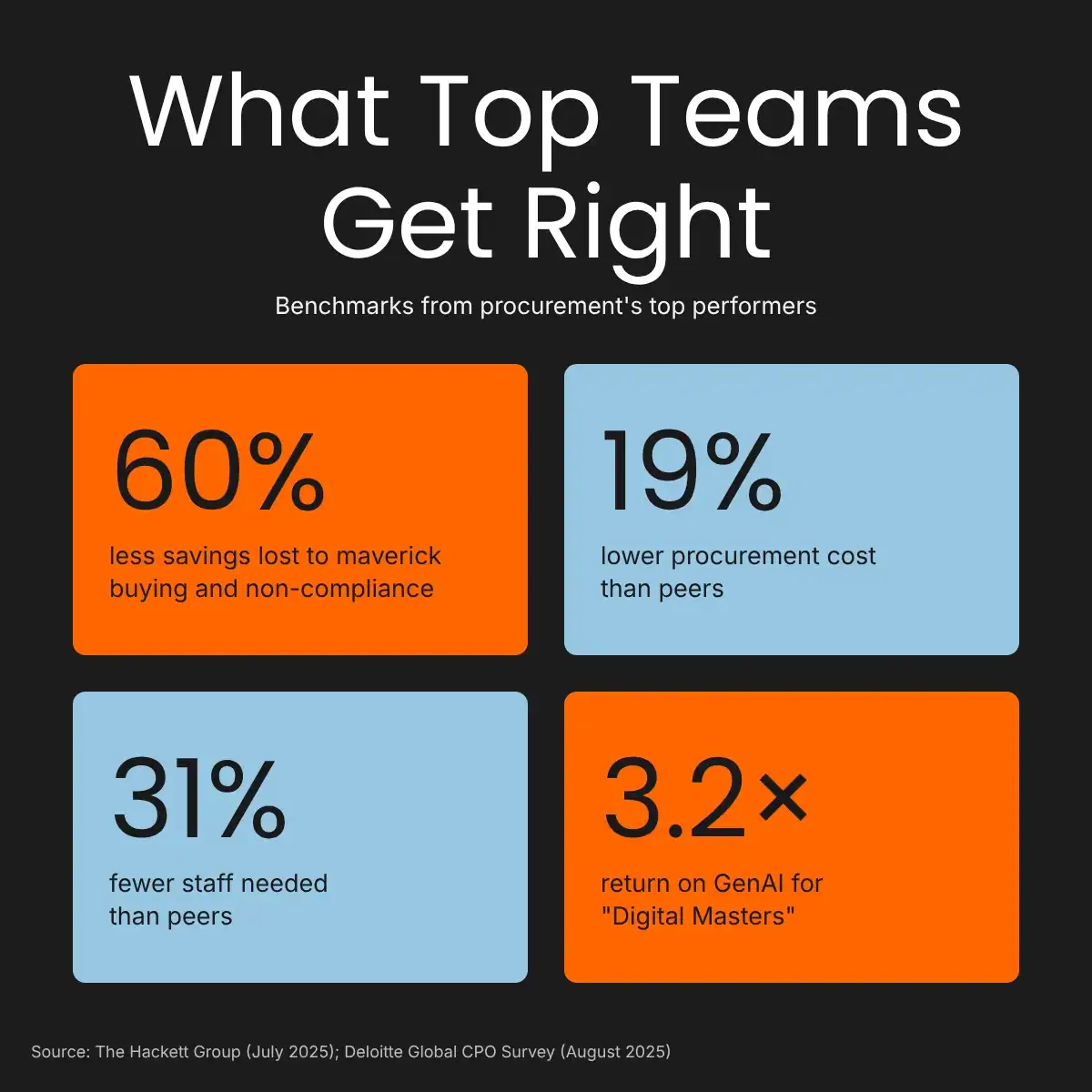
Top procurement teams achieve 2.6x greater return on investment than peers. The Hackett Group
Strategy 3: Implement Procurement Control Measures
Procurement control is the set of policies, checks and measures that make sure buying happens the right way: within budget, with approved suppliers, on agreed terms, and with a clear audit trail.
Strong controls aren’t about slowing people down. They’re about making the right way the easy way.
Identifying Key Performance Indicators (KPIs)
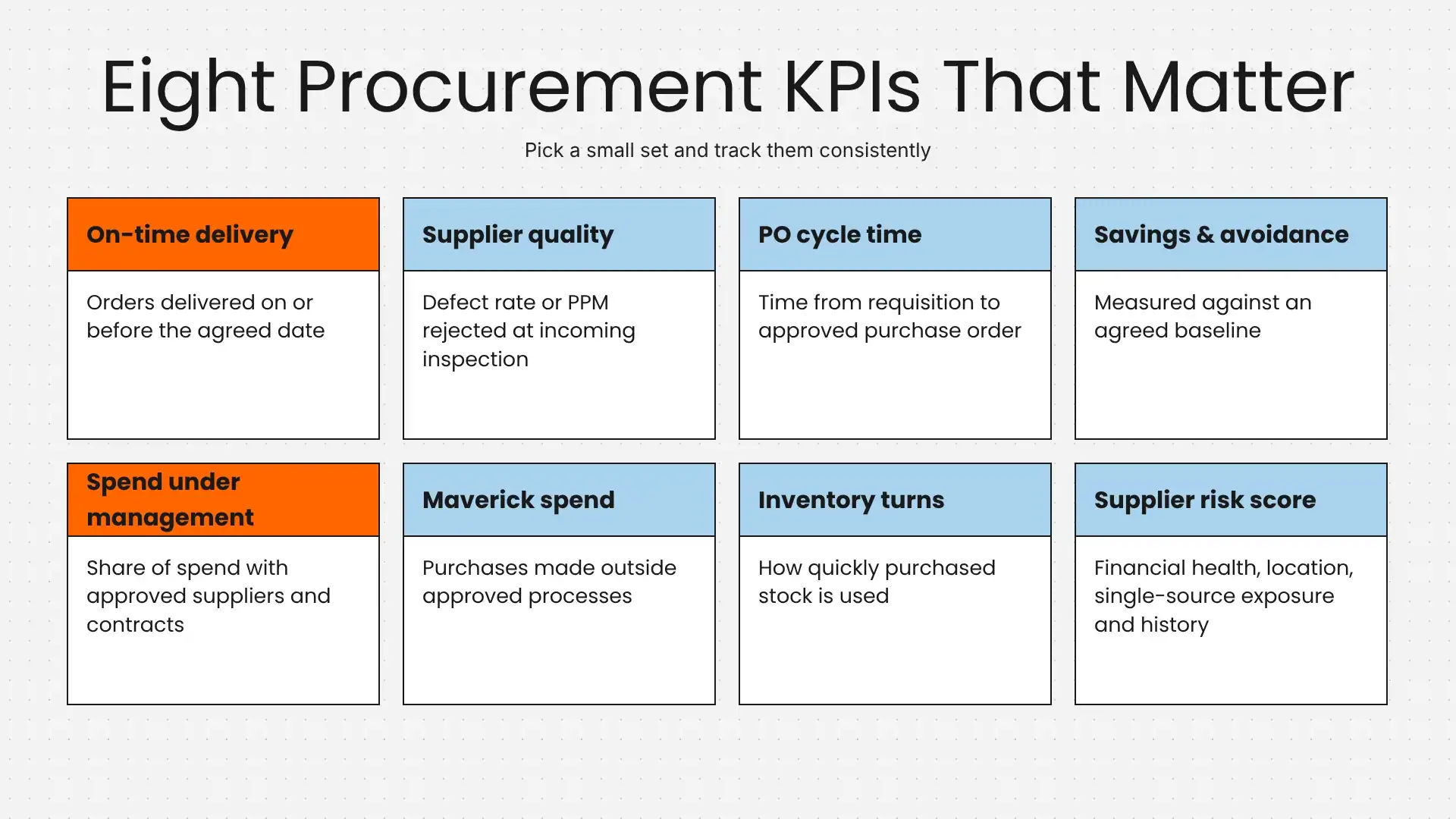
Pick a small set of KPIs and track them consistently. These are the ones that matter most:
- Supplier on-time delivery (OTD): percentage of orders delivered on or before the agreed date
- Supplier quality: defect rate or parts per million (PPM) rejected at incoming inspection
- Purchase order cycle time: time from requisition to approved purchase order
- Cost savings and cost avoidance: measured against an agreed baseline
- Spend under management: percentage of total spend covered by approved suppliers and contracts
- Maverick spend: purchases made outside approved processes or suppliers
- Inventory turns: how quickly purchased stock is used
- Supplier risk score: a combined view of financial health, location, single-source exposure and past performance
Monitoring and Evaluating Procurement Processes
Use a supplier scorecard. Rate key suppliers each quarter on delivery, quality, cost and responsiveness. Share the scorecard with them. Good suppliers want to know where they stand.
Run regular spend analysis. Look at where money goes by category, supplier and site. Patterns jump out quickly: duplicate suppliers, unapproved spend, or categories ready for consolidation.
Audit the process, not just the numbers. Check a sample of purchase orders each quarter. Were approvals followed? Were the right suppliers used? Did the invoice match the order?
Close the loop. When a KPI slips, agree a corrective action with a named owner and a date. Measurement without action is just reporting.
Top procurement teams run 58% shorter requisition-to-purchase order cycle times. The Hackett Group
Strategy 4: Leverage Technology in Procurement Management
Technology won’t fix a broken process. But it will make a good process faster, more accurate and easier to scale.
Software Solutions for Procurement
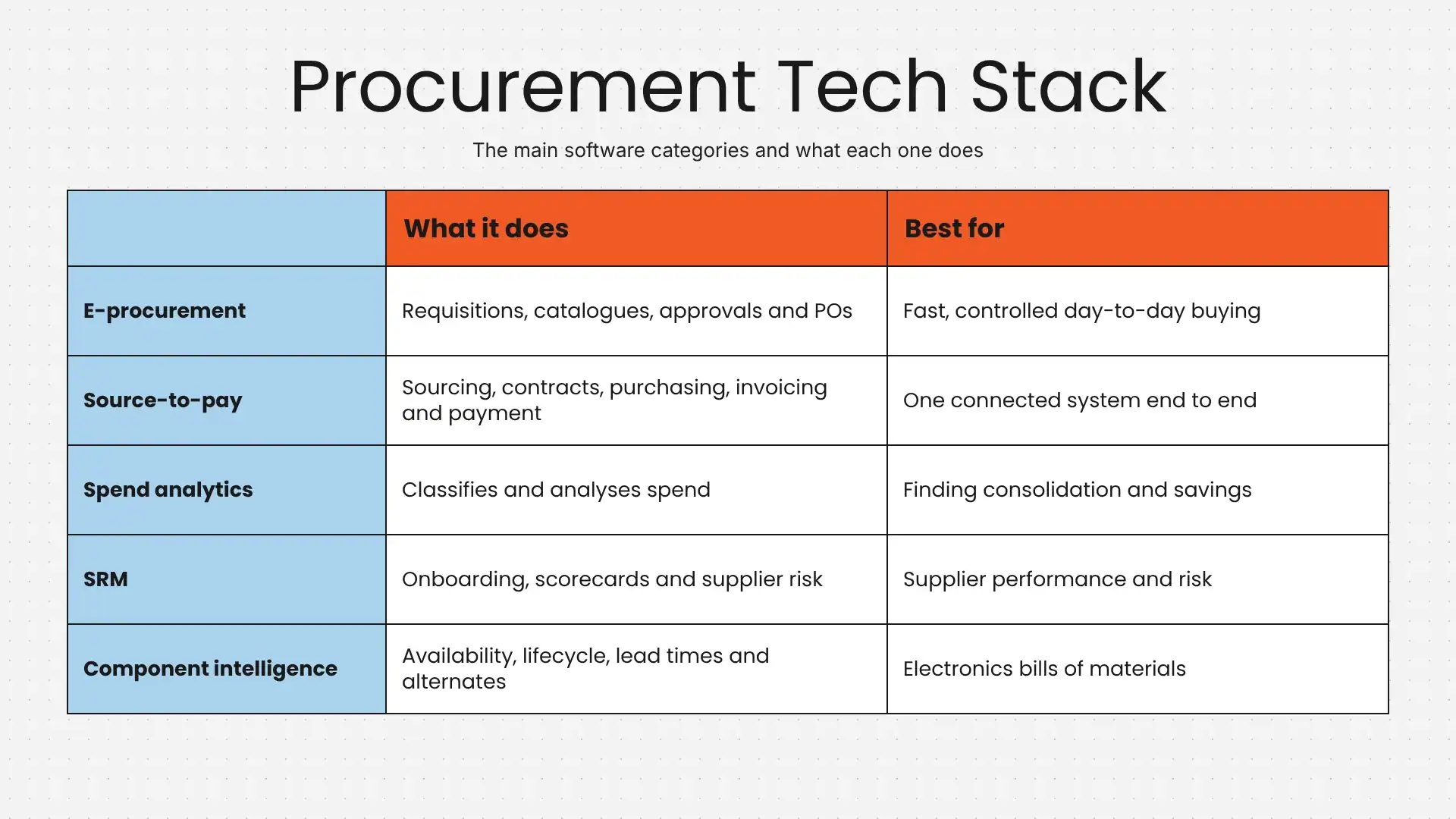
The main categories of procurement software are:
- E-procurement platforms for requisitions, catalogs, approvals and purchase orders
- Source-to-pay (S2P) suites covering sourcing, contracts, purchasing, invoicing and payment in one system
- Spend analytics tools to classify and analyze spend across the business
- Supplier relationship management (SRM) for onboarding, scorecards and supplier risk
- Contract lifecycle management (CLM) for creating, tracking and renewing supplier contracts
- Component intelligence tools for electronics manufacturers, showing part availability, lifecycle status, lead times and alternates across distributors
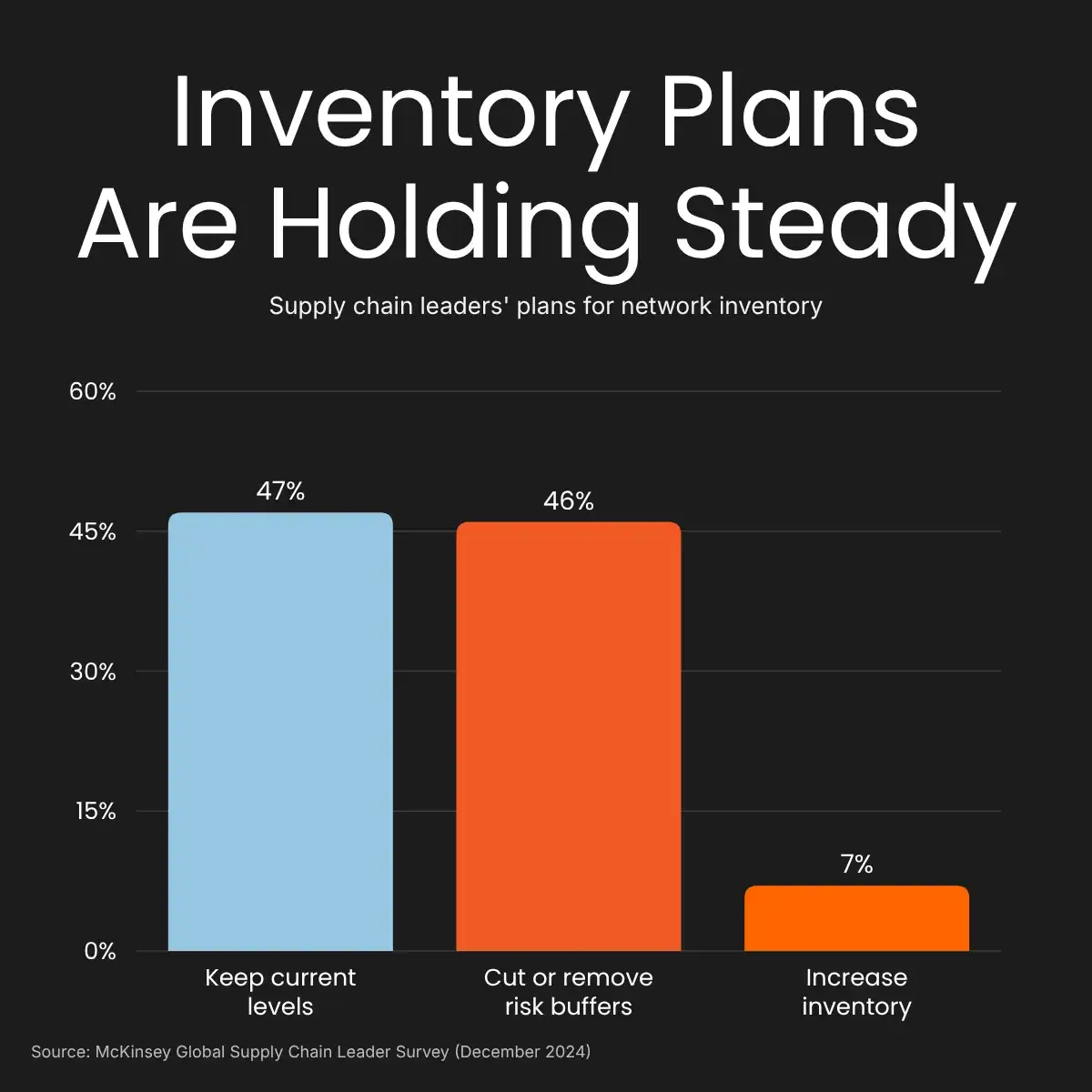
“72% of procurement leaders are prioritizing the integration of GenAI into their strategies.
Impact of Technology on Procurement Efficiency
Less manual work. Automated approvals, invoice matching and order confirmations free buyers to focus on suppliers and strategy.
Better visibility. Real-time dashboards show open orders, late deliveries and spend against budget.
Earlier warning on risk. Component lifecycle data flags parts heading for end-of-life before they become a crisis. Supplier risk tools track financial and geographic exposure.
Smarter sourcing decisions. AI-assisted tools can suggest alternate parts, spot price anomalies and predict lead time changes from historical data.
Stronger control. Built-in rules stop orders going to unapproved suppliers and keep a full audit trail automatically.
The best results come when systems connect. A procurement platform that doesn’t talk to ERP, planning or quality systems just creates another silo.
Strategy 5: Continuous Improvement and Adaptation
The market procurement teams work in has changed fast in recent years: component shortages, freight swings, tariff changes and a big rethink of where products are made. The teams that cope best review their approach regularly, not just when something breaks.
Evaluating Current Procurement Strategies
Run a structured review at least once a year. Ask:
- Where is our risk concentrated? Single-source parts, single regions, single logistics routes.
- Are our top suppliers still the right ones? Use scorecard data, not reputation.
- Is our category strategy current? A category that was low-risk two years ago may not be now.
- What does total cost really look like? Unit price plus freight, duties, inventory holding, quality cost and lead time risk.
- Where are we leaving value on the table? Unconsolidated spend, missed early-payment terms, or design choices that lock in expensive parts.

“Only 36% of chief procurement officers (CPOs) are very confident in their ability to redesign roles and processes around AI.”
Adapting to Market Changes
Build resilience into sourcing. Dual-source critical components where you can. Qualify alternates before you need them.
Think regionally, as well as globally. Many US companies are pairing global supply with production closer to home. A manufacturing partner with facilities near the US market, such as in Mexico, can shorten lead times and reduce logistics risk, while a wider global network adds capacity and flexibility.
Partner earlier. Involve key suppliers and manufacturing partners at the design stage. They can flag availability, cost and manufacturability issues before the design is fixed.
Keep skills current. Procurement now needs data analysis, risk management and negotiation skills alongside category knowledge. Invest in training.
Plan for sustainability requirements. Customers and regulators increasingly ask for emissions data, material declarations and responsible sourcing evidence. Build these into supplier onboarding now.
Recap of Proven Strategies
- Streamline procurement operations management. Map the process, set risk-based approvals and clean up part data.
- Foster procurement and administration collaboration. Clear roles and regular cross-functional reviews prevent delay and surprises.
- Implement procurement control measures. Track a focused set of KPIs, use supplier scorecards and act on what you find.
- Leverage technology. Automate the routine, connect your systems and use data to spot risk early.
- Commit to continuous improvement. Review your strategy regularly and adapt to market changes before they hit.
The Future of Procurement Management
Procurement management is moving from cost center to strategic partner. Three shifts stand out:
- Risk management becomes core. Resilience will sit alongside cost as a headline procurement goal.
- AI moves into daily work. From spend analysis to supplier risk alerts, AI will take on more of the routine analysis, leaving people to manage relationships and make judgment calls.
- Partnerships deepen. The line between buyer and supplier blurs as manufacturers, component suppliers and brands share data, forecasts and design input.
The companies that win won’t just buy cheaper. They’ll buy smarter, with supply chains they understand and partners they trust.
At Intretech, procurement is part of what we do for our customers every day. We source and manage components across our global manufacturing footprint. This includes our facility in Monterrey, Mexico where we support customers that serve the US market.
Frequently Asked Questions
What is procurement management in simple terms?
Procurement management is the process of planning, sourcing, buying and paying for the goods and services a business needs, and managing the suppliers who provide them. The aim is to get the right quality at the right total cost and the right time, with as little risk as possible.
What is the difference between procurement and purchasing?
Purchasing is the transaction of ordering and paying for goods. Procurement is the wider strategy, including needs planning, supplier selection, negotiation, contracts and supplier performance management.
What are the most important procurement KPIs?
Supplier on-time delivery, supplier quality, purchase order cycle time, cost savings, spend under management and maverick spend are the most widely used. Pick a small set and track them consistently.
What is procurement control?
Procurement control is the set of policies, approvals and checks that make sure buying happens within budget, with approved suppliers and on agreed terms. It also creates an audit trail for compliance.
How can manufacturers reduce procurement risk?
Dual-source critical parts, qualify alternates early, share forecasts with key suppliers and review risk concentration regularly. Many US companies also pair global supply with production closer to their end market to shorten lead times.
Want a manufacturing partner that handles procurement as part of the program?
Explore more related content

The NPI Process: How to Take Electronics From Prototype to Production
The NPI Process: How to Take Electronics From Prototype to ProductionBuilding one working prototype is hard. Building...

First Article Inspection and Golden Samples: How to Sign Off a New Production Line
First Article Inspection and Golden Samples: How to Sign Off a New Production Line The first unit off a new line tells...

EVT vs DVT vs PVT: The Three Validation Builds Explained
EVT vs DVT vs PVT: The Three Validation Builds Explained EVT, DVT and PVT sound like jargon. They are actually three...