

Nearshoring vs Offshoring: How to Choose Your Manufacturing Footprint and EMS Partner


That framing is out of date. The hardware brands handling today’s tariffs, shortages and demand swings best aren’t choosing one model. They’re running both, deliberately, and matching each product to the footprint that suits it.
This guide explains the difference between nearshoring and offshoring, when each one wins, and how to choose an electronics manufacturing partner that can support the right mix.
“Supply chain leaders are moving away from an overreliance on low-cost networks and are instead focusing on diversified approaches to mitigate risks and enhance performance.”- Vicky Forman, Senior Director Analyst, Gartner (14 Aug 2024)
Nearshoring vs offshoring: the definitions
- Offshoring means manufacturing in a distant country, usually to access lower costs, scale or a specialised supply base. For North American and European brands, this has traditionally meant Asia.
- Nearshoring means manufacturing in a nearby country, close to the end market. For North America, that is usually Mexico. For Western Europe, it is often Central and Eastern Europe.
- Reshoring (or onshoring) means bringing manufacturing back into the home country.
The difference is not just distance. It is about which trade-off you are optimising for: cost and scale, or speed and proximity.
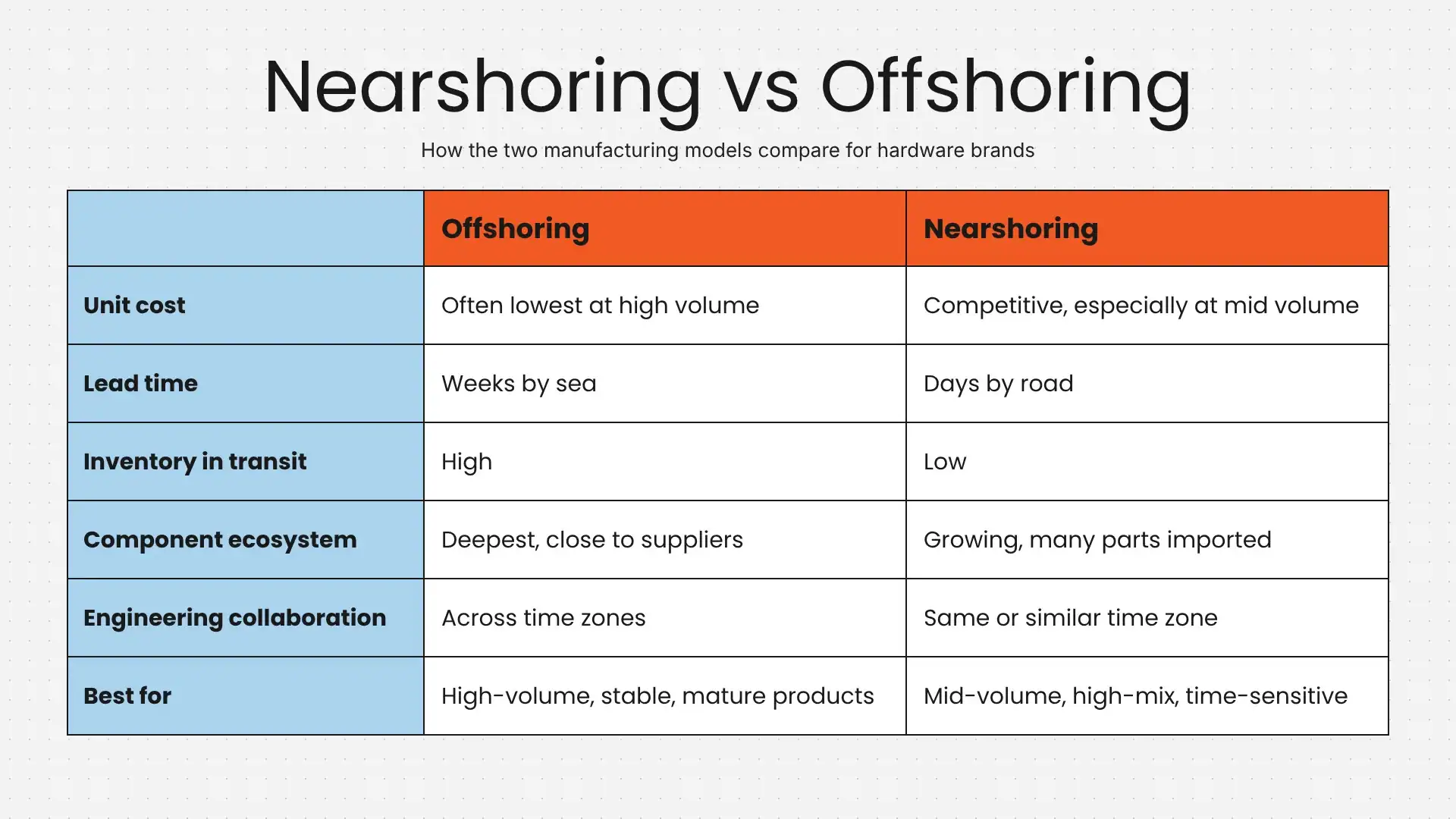
Nearshoring vs offshoring compared
| Factor | Offshoring | Nearshoring |
|---|---|---|
| Unit cost | Often lowest at high volume | Competitive, especially at mid volume |
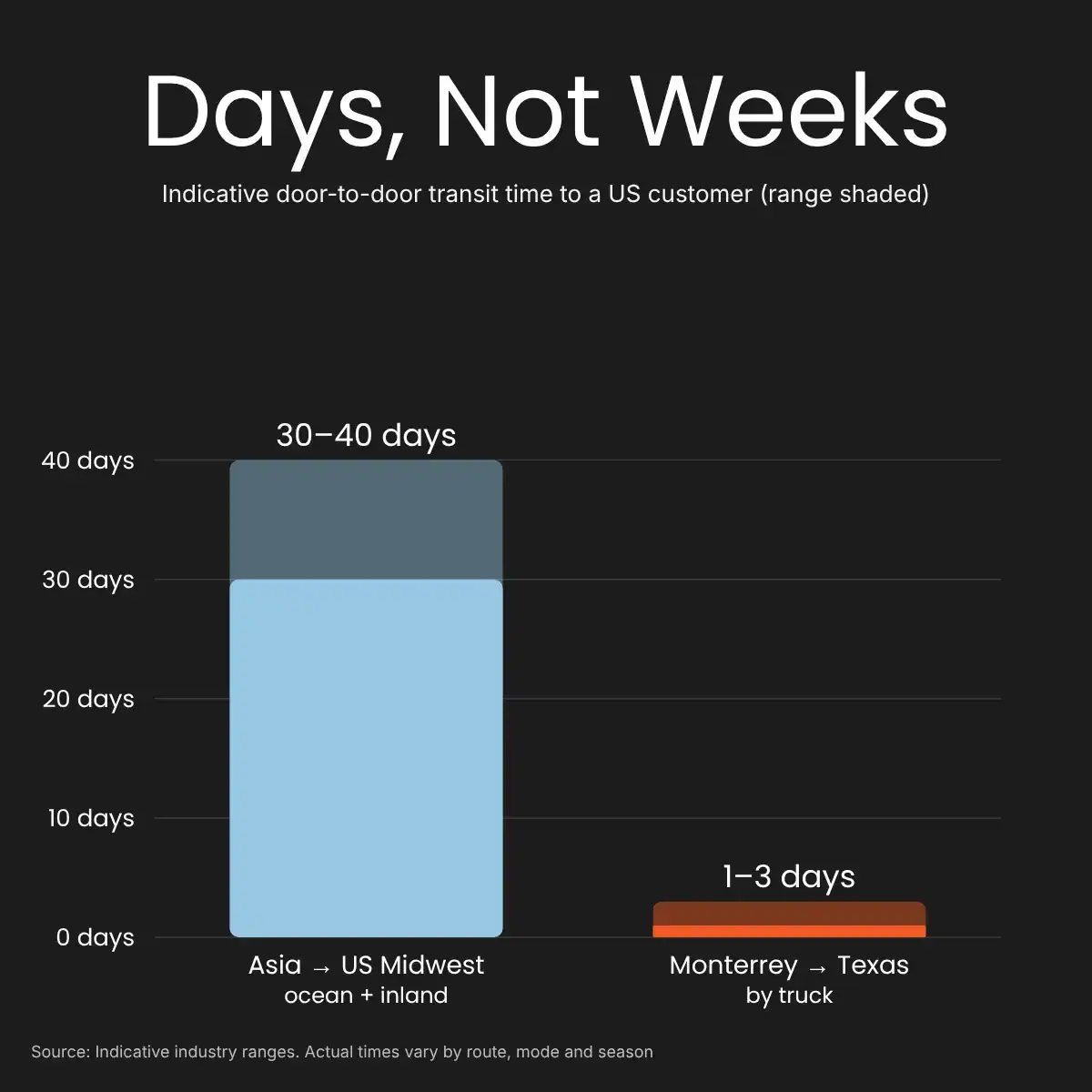
| Lead time to market | Weeks by sea | Days by road |
| Inventory in transit | High | Low |
| Component ecosystem | Deepest, especially in Asia | Growing, but many parts still imported |
| Engineering collaboration | Harder across time zones | Easier, similar time zones |
| Tariff and trade exposure | Depends on trade relations | Often reduced by regional trade agreements |
| Flexibility for design changes | Slower | Faster |
| Best for | High-volume, stable, mature products | Mid-volume, high-mix, time-sensitive or regulated products |
Global container schedule reliability fell to 49.9% in August 2026, and late vessels arrived an average of 6.81 days behind schedule.
When offshoring still wins
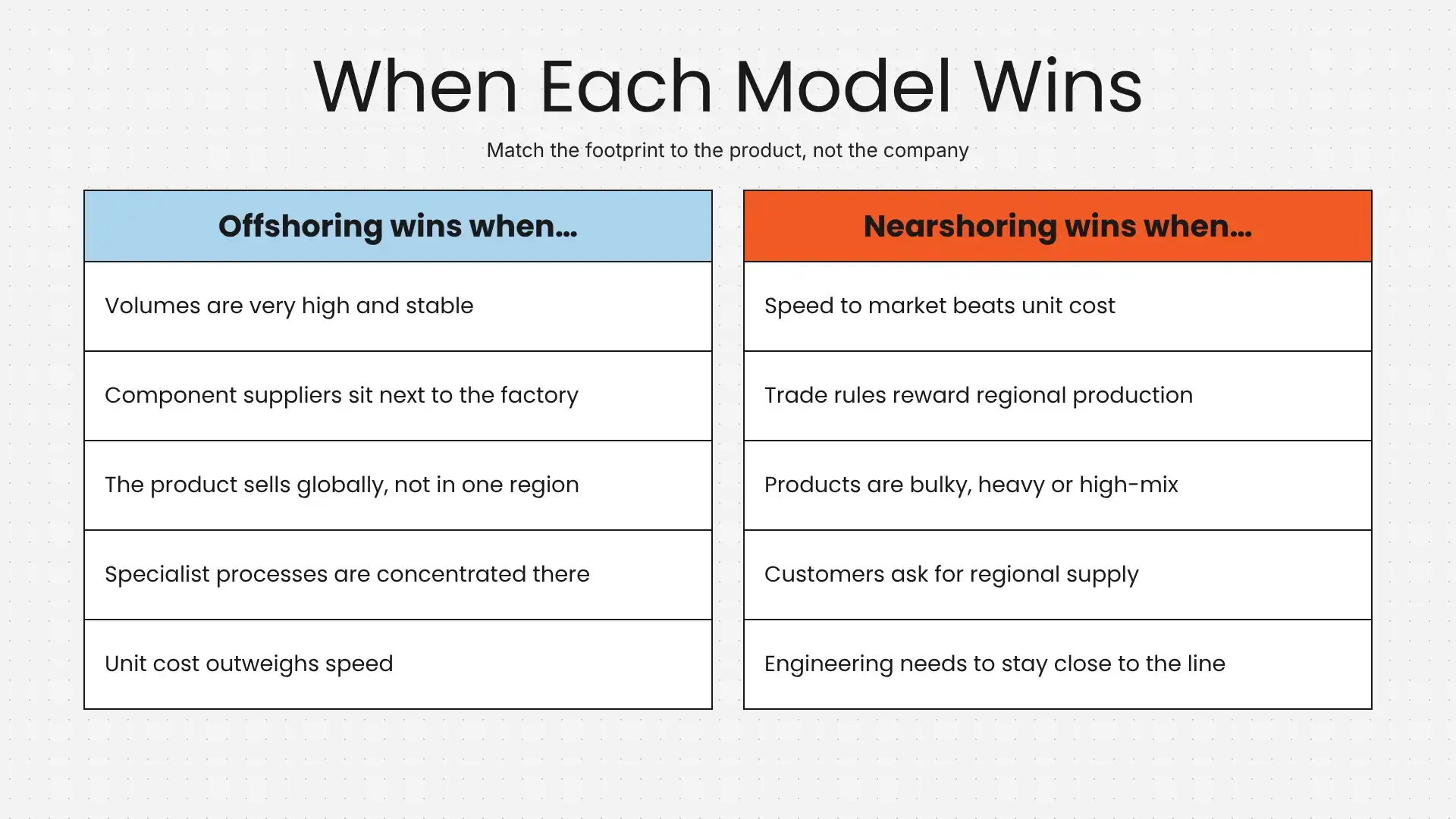
It is fashionable to say offshoring is over. It isn’t. Offshoring still makes sense when:
- Volumes are very high and stable. Scale economies in established manufacturing hubs are hard to beat for mature products.
- The component supply chain is local to the factory. Building next to your suppliers cuts component lead times and logistics cost.
- The product sells globally. If only a fraction of volume goes to one region, building it there may not pay off.
- Specialist processes are needed. Some advanced processes and capacity are concentrated in particular regions.
“Organizations that treat network decisions as adaptable, rather than fixed, are better equipped to protect margins and respond to change.” – Vicky Forman, Gartner (14 Jul 2026)
When nearshoring wins
Nearshoring tends to win when:
- Speed matters more than unit cost. Seasonal products, fast product cycles and custom configurations all benefit from short lead times.
- Trade rules reward regional production. In North America, products that qualify under USMCA currently avoid the Section 301 duties introduced in July 2026. Our guide to USMCA rules of origin for electronics explains how qualification works.
- Products are bulky, heavy or high-mix. Freight cost and complexity rise quickly with size and variety.
- Customers demand regional supply. Automotive, medical and industrial buyers increasingly ask for local or regional capacity as part of their own risk planning.
- Engineering needs to stay close. New product introduction, frequent engineering changes and quality investigations all move faster when the factory is nearby.
The scale of the North American opportunity is clear. According to the Congressional Research Service, Mexico was the largest supplier of goods to the US in 2025, with $534.8 billion in US imports.

Mexico received US$40.9 billion (USD 40,871 million) in foreign direct investment in 2025, 10.8% more than the figure first reported for 2024.
The case for “both”: multi-region manufacturing
Here is the model we see working best:
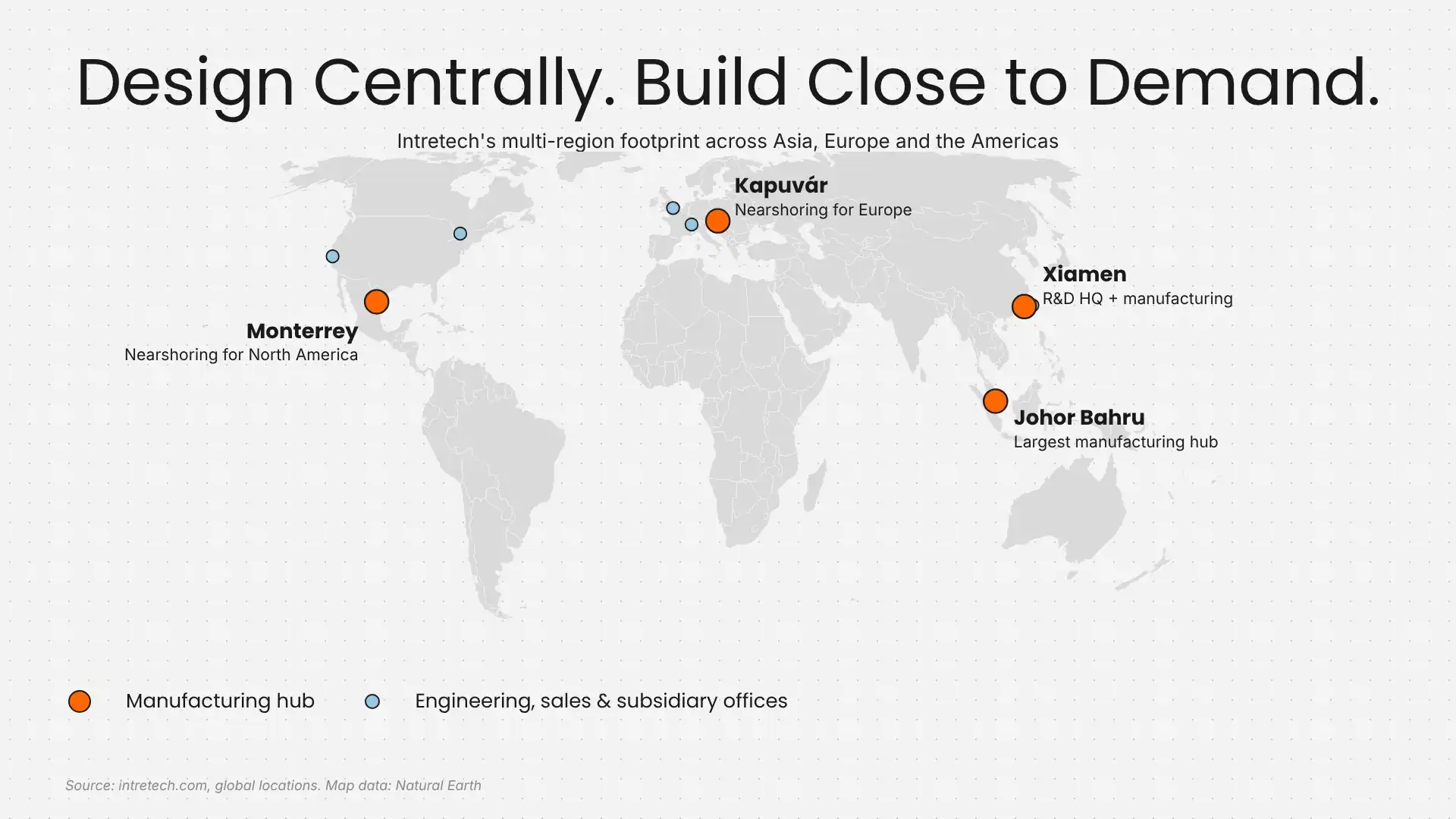
Design centrally. Source globally. Build close to demand.
In practice, that means:
- One engineering core that owns the design, test strategy and manufacturing documentation, so any site can build the product the same way.
- Global component purchasing at scale, because most electronic components are made in a limited number of places regardless of where final assembly happens.
- Regional final assembly in each major market, sized to that market’s demand.
- The ability to shift volume between regions when tariffs, demand or capacity change.
This is not a theoretical model. It is how a growing number of hardware brands now protect themselves against the next disruption, without giving up the cost advantages of established manufacturing hubs. It also builds on the shift from reactive to proactive planning we covered in supply chain management: from reactive to proactive.
“Supply chain footprints are evolving, with 73 percent of survey respondents reporting progress on dual-sourcing strategies.”
Total landed cost: the only fair comparison
Comparing a unit price from one region with a unit price from another is the most common mistake in footprint decisions. Compare total landed cost instead:
- Unit cost (materials, labour, overhead)
- Freight, insurance and brokerage
- Duties and tariffs on finished goods and components
- Inventory carrying cost across the transit time
- Quality cost during ramp-up
- Engineering travel and support
- The expected cost of disruption
Run the numbers at several volume levels and tariff scenarios. The answer often changes with volume, and that is a strong signal that a mix of footprints is right.
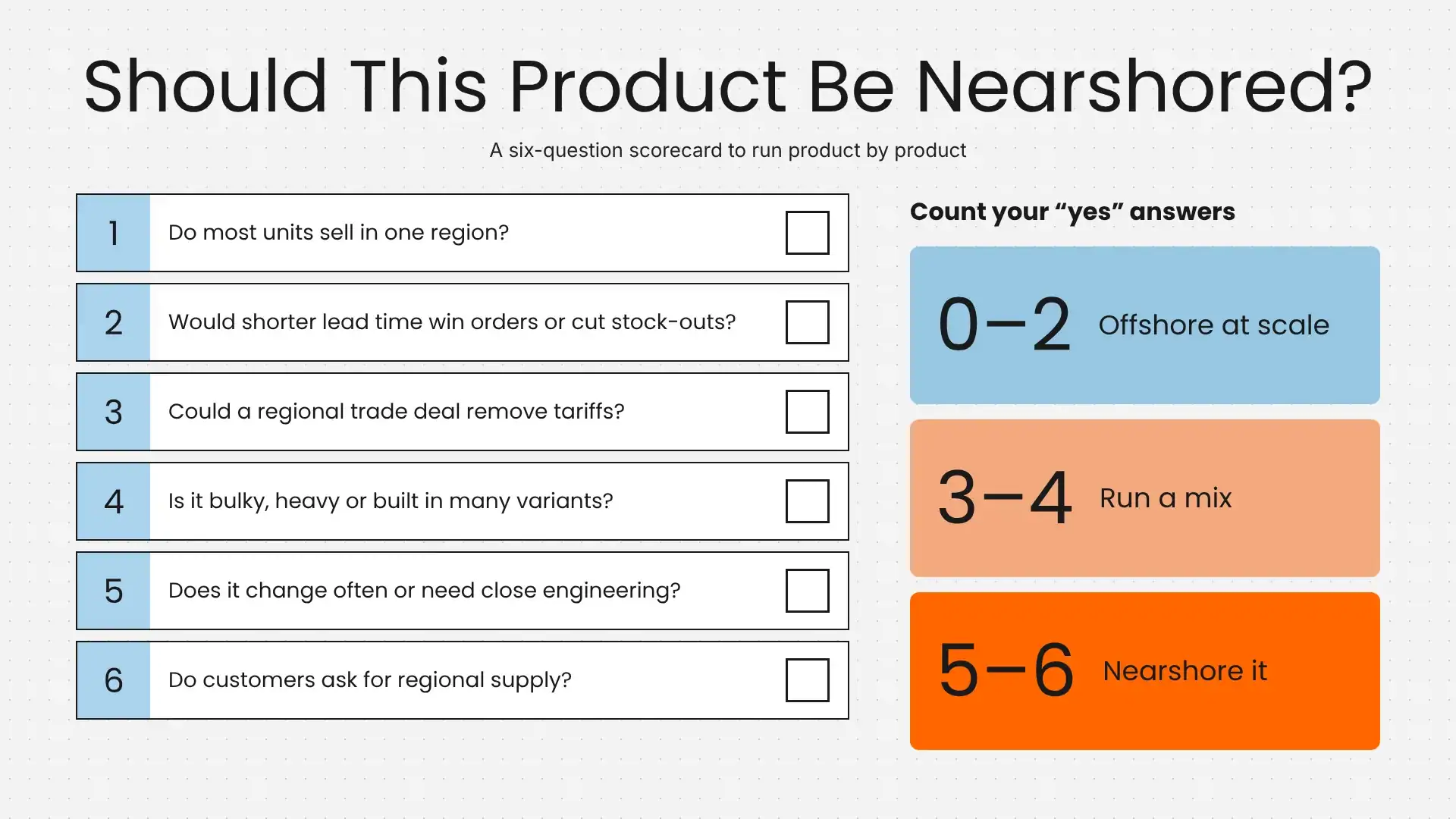
A quick decision checklist
Score each product against these questions. The more “yes” answers, the stronger the case for nearshoring it.
- Do most units sell in one region?
- Would a shorter lead time win orders or reduce stock-outs?
- Does the product face tariffs that a regional trade agreement could remove?
- Is it bulky, heavy or produced in many variants?
- Does it change often, or need close engineering support?
- Do your customers ask for regional supply?
If a product scores low on all six, offshoring at scale is likely still the better fit. Most portfolios end up with a mix, which is exactly why the footprint decision should be made product by product, not company-wide.
“60 percent of respondents are acting to regionalize their supply chains.” Source: McKinsey Global Supply Chain Leader Survey 2024 (14 Oct 2024)
How to choose a contract electronics manufacturer for nearshoring or offshoring
Whichever model you choose, your partner’s capability decides how well it works. Ask these seven questions.
1. Where can they build, today?
Ask for a site-by-site view of live processes: SMT, PCBA, injection moulding, final assembly and testing. Planned capability is not capability.
2. Are certifications site-specific?
ISO 9001 is the baseline. IATF 16949 matters for automotive and ISO 13485 for medical devices. Make sure each certificate covers the site that will build your product.
3. How strong is their component sourcing?
Global purchasing power and supplier relationships protect you during shortages. Ask how they manage allocation and long lead-time parts.
4. Can they move a product between sites?
A documented production transfer process should include golden samples, first article inspection, parallel builds and formal sign-off. This is what makes a multi-region footprint real.
5. Do they offer design and engineering support?
A contract design and electronics manufacturer (CDEM) can help with DFM, test development and design changes that improve cost or trade compliance. An EMS provider that only builds to print may not.
6. Do they understand trade rules?
A good partner can explain how sourcing and process choices affect USMCA origin in North America, or customs status in Europe.
7. Are they financially and operationally stable?
Look at scale, years in operation, customer references and investment in new capacity.
Our guide to OEM procurement strategy for OEM vs ODM sourcing covers how to structure the commercial relationship once you have chosen.
North American EMS bookings rose 53.5% year on year in August 2026, with a book-to-bill ratio of 1.39. Source: Global Electronics Association
How Intretech supports both models
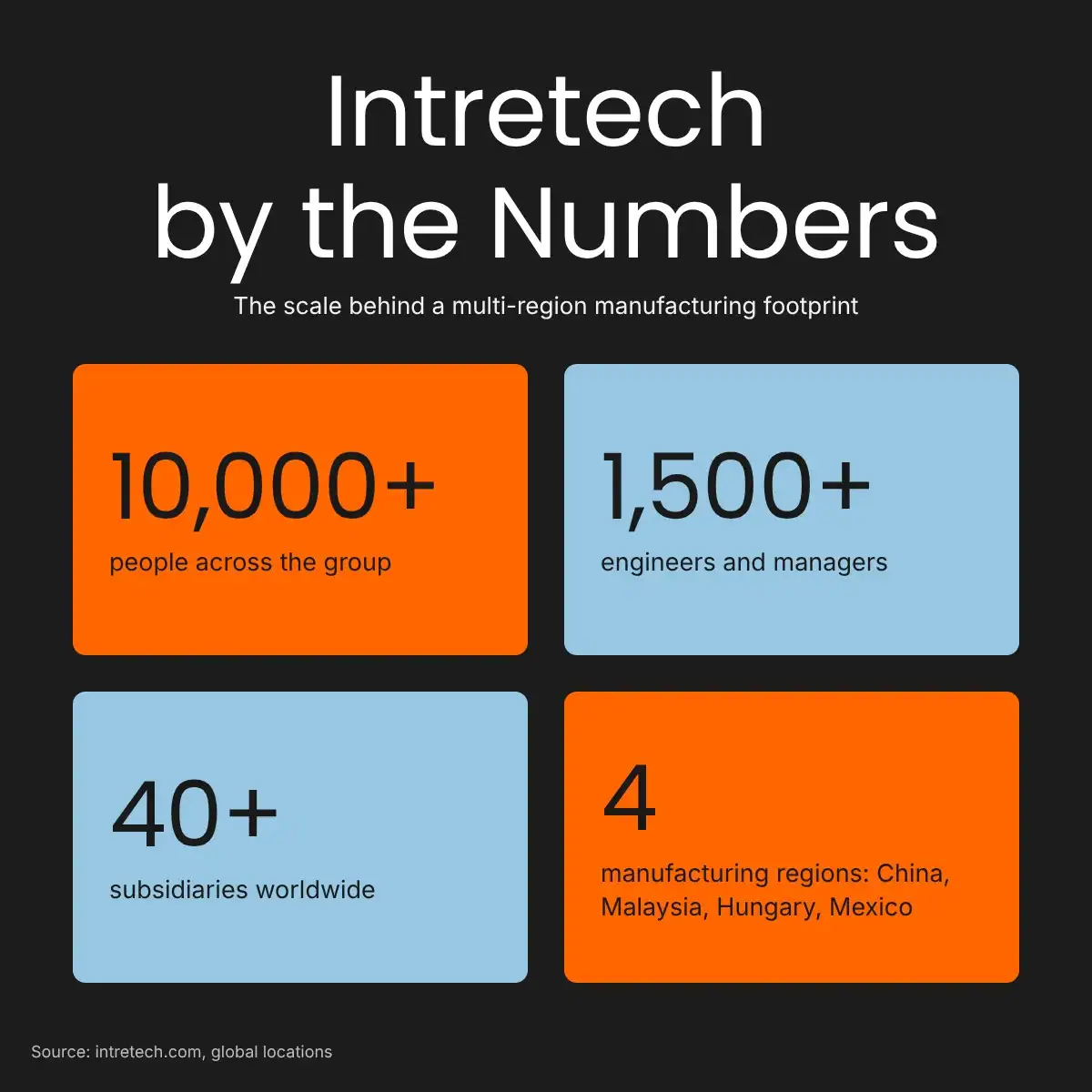
Intretech is a global contract design and electronics manufacturer with more than 10,000 people and over 1,500 engineers and managers. Our manufacturing footprint is built for multi-region production:
- Asia: large-scale manufacturing and R&D in China, and our largest manufacturing hub in Johor Bahru, Malaysia, with over 210,000 m² of manufacturing space.
- Europe: a nearshoring base in Kapuvár, Hungary, serving European markets. See our Hungary facility.
- Americas: our facility in the Monterrey area of Mexico, opened in 2024 to serve North American customers.
That lets customers design once, source at global scale and build in the region that makes sense for each product. Read our full buyer’s guide to electronics manufacturing in Mexico or explore our global locations.

Frequently asked questions
What is the difference between nearshoring and offshoring?
Offshoring means manufacturing in a distant country, usually for cost or scale. Nearshoring means manufacturing in a nearby country, close to the end market, usually for speed, flexibility and lower trade risk.
Is nearshoring cheaper than offshoring?
Not always on unit price, but often on total landed cost. Shorter transit times, lower inventory, reduced tariff exposure and faster engineering support can outweigh a higher unit cost, especially for mid-volume or time-sensitive products.
When should a company nearshore manufacturing?
Nearshoring makes sense when lead time matters, when regional trade agreements reduce tariffs, when products are bulky or high-mix, or when customers require regional supply. Very high-volume, stable products may still be better suited to offshoring.
How do I choose a contract electronics manufacturer?
Check which processes each site runs today, confirm certifications are site-specific, and assess component sourcing strength. Look for a documented production transfer process and engineering support, especially if you plan to build in more than one region.
What is the difference between EMS and CDEM?
An EMS (electronics manufacturing services) provider builds products to the customer’s design. A CDEM (contract design and electronics manufacturer) also offers design and engineering services, helping customers develop, optimise and industrialise products before and during production.
Find the right footprint for your product
There is rarely one right answer for every product. Our team can help you compare regions and build a manufacturing plan that balances cost, speed and risk.
Explore more related content
USMCA Rules of Origin: A Practical Guide for Electronics OEMs (2026 Update)
USMCA Rules of Origin: A Practical Guide for Electronics OEMs (2026 Update) USMCA rules of origin used to be a...
Electronics Manufacturing in Mexico: A Buyer’s Guide to Nearshoring in 2026
Electronics Manufacturing in Mexico: A Buyer’s Guide to Nearshoring in 2026Electronics manufacturing in Mexico is no...

IoT in Smart Agriculture: The Hardware Engineering Decisions That Decide Whether a Sensor Survives the Field
IoT in Smart Agriculture: The Hardware Engineering Decisions That Decide Whether a Sensor Survives the FieldThe top...