

How to Choose a Manufacturing Automation Integrator:
A Vetting Framework That Actually Works

Search “how to choose an automation integrator” and you’ll get the same three sentences rearranged on every page: look for a good track record, find a partner who communicates well, make sure they understand your needs. None of that is wrong. None of it is useful either. It won’t stop you from signing with an integrator who subcontracts the actual engineering, disappears after commissioning, or quotes a number that has nothing to do with what the project actually costs.
Picking the wrong automation integrator is much more than minor inconvenience. It’s a six-figure decision that plays out over months, and the cost of getting it wrong shows up as delay, rework, and a line that never quite hits the throughput you were promised. This is the vetting framework we’d want a client to use on us specific questions, real red flags, and honest cost expectations, not the generic checklist everyone else is publishing.
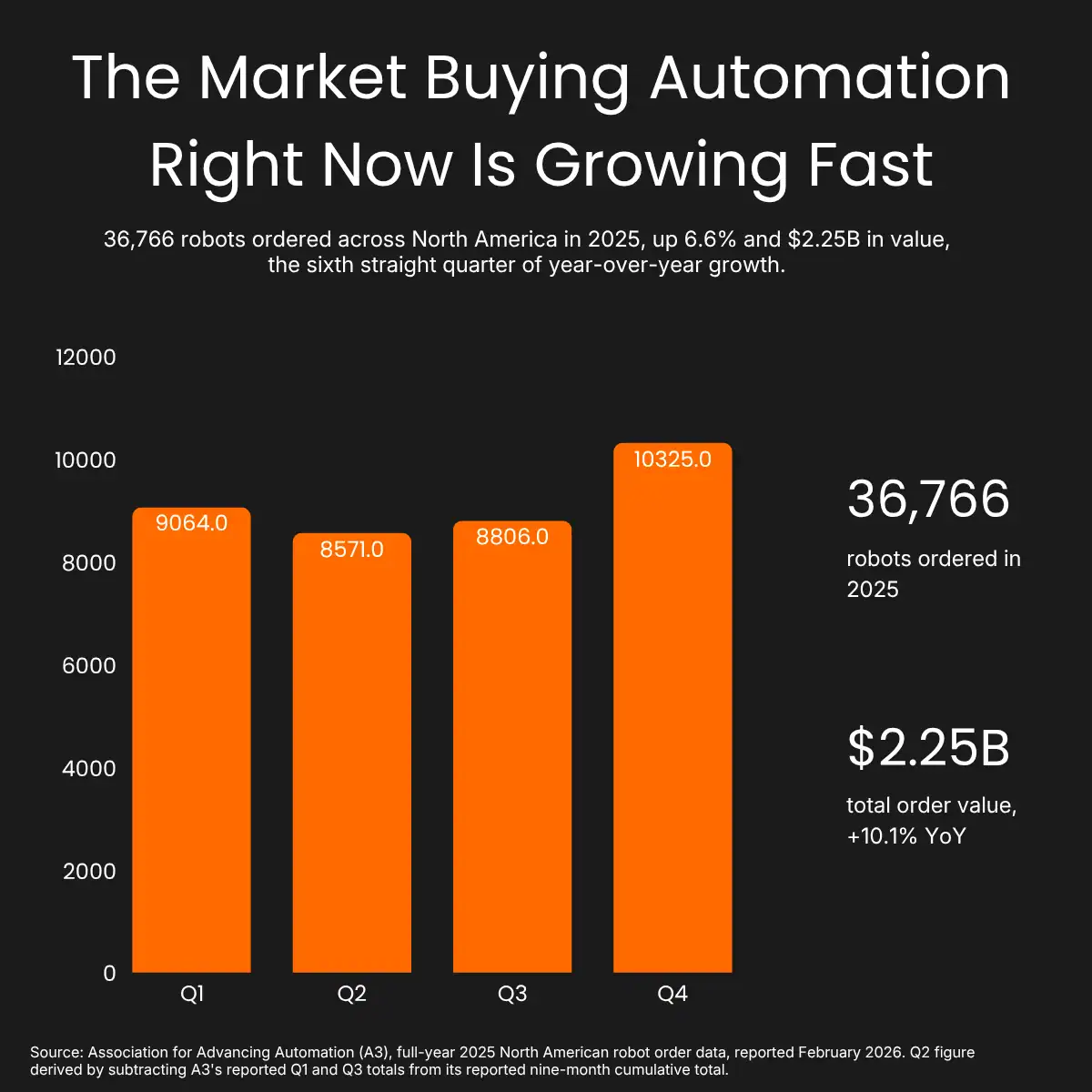
North American companies ordered 36,766 robots worth $2.25 billion in 2025, a 6.6% increase in units and the sixth consecutive quarter of year-over-year growth.” – Association for Advancing Automation (A3), Feb 2026 press release./h6>
What a Manufacturing Automation Integrator Actually Does
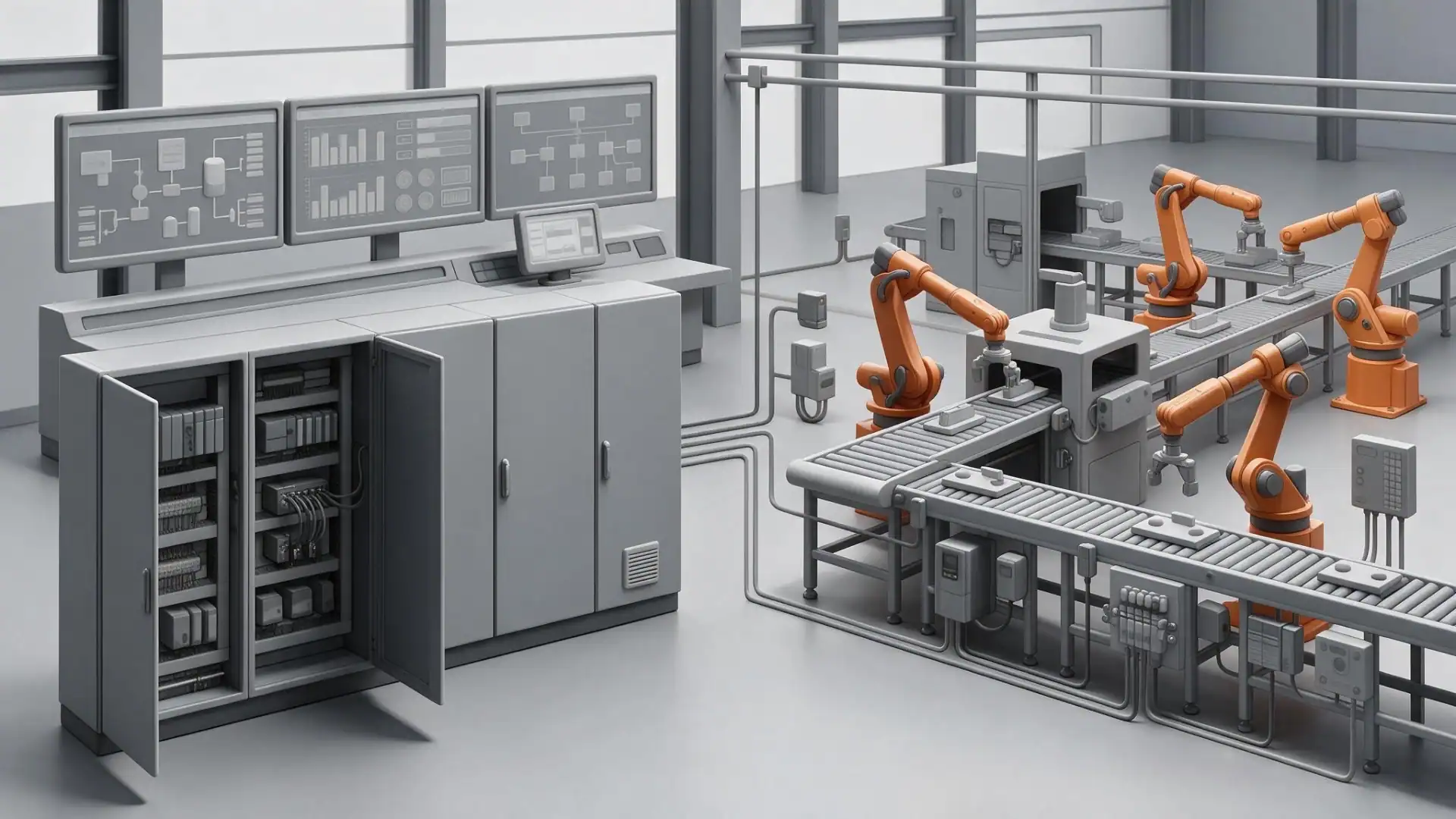
A manufacturing automation integrator designs, builds, and commissions the automated systems that go on your production floor robots, conveyors, vision systems, controls, and the software that ties them together. The integrator’s job is to take your specific process, not a generic one, and turn it into a working system that hits your cycle time, your tolerances, and your budget.
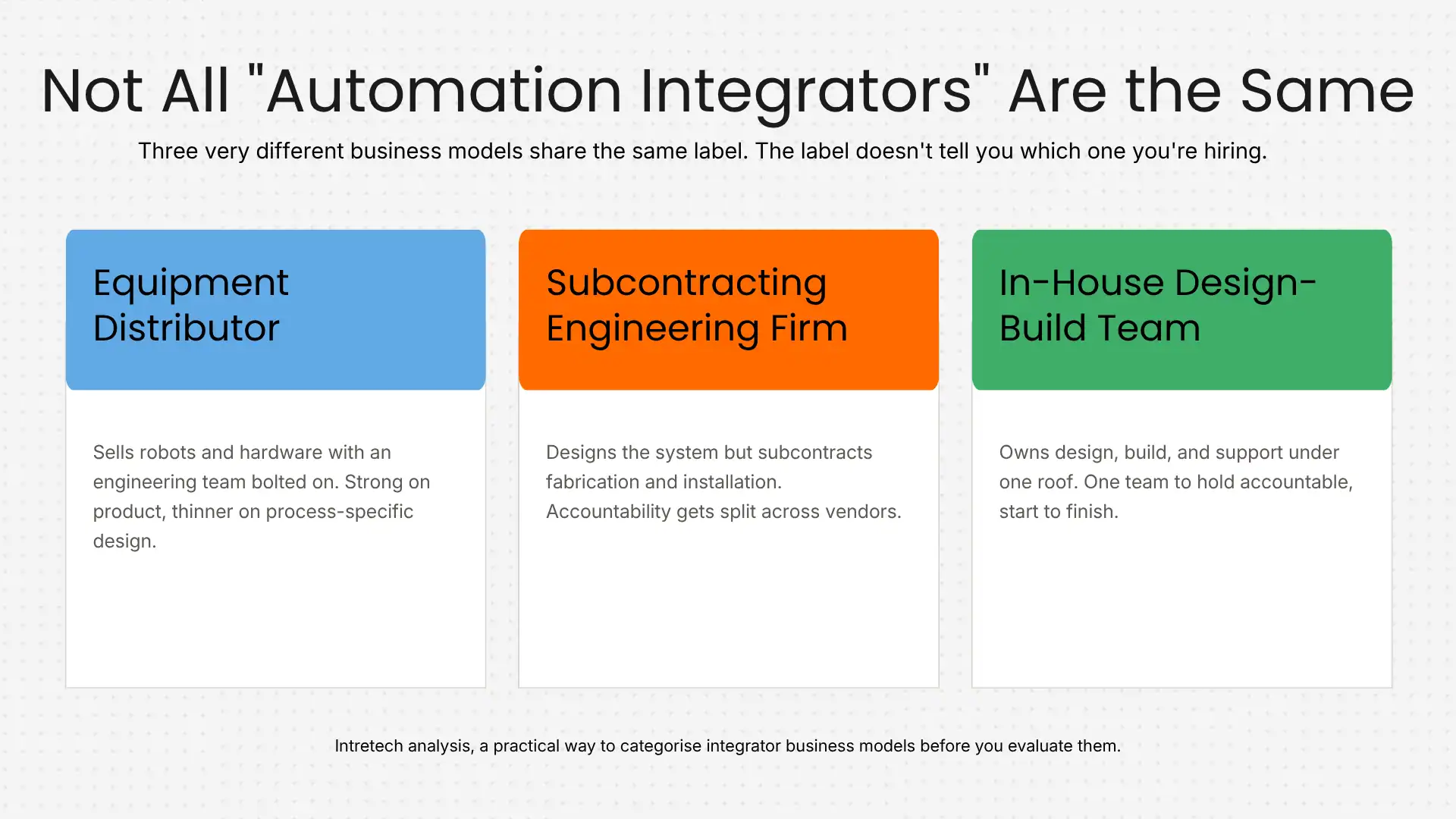
That last part is where the category gets confusing. Some “automation integrators” are equipment distributors with an engineering team bolted on. Some are engineering firms that subcontract fabrication and installation to whoever’s available. Some genuinely do design, build, and support in-house from a single team. The label on the website doesn’t tell you which one you’re dealing with and that distinction matters more than almost anything else on this list.
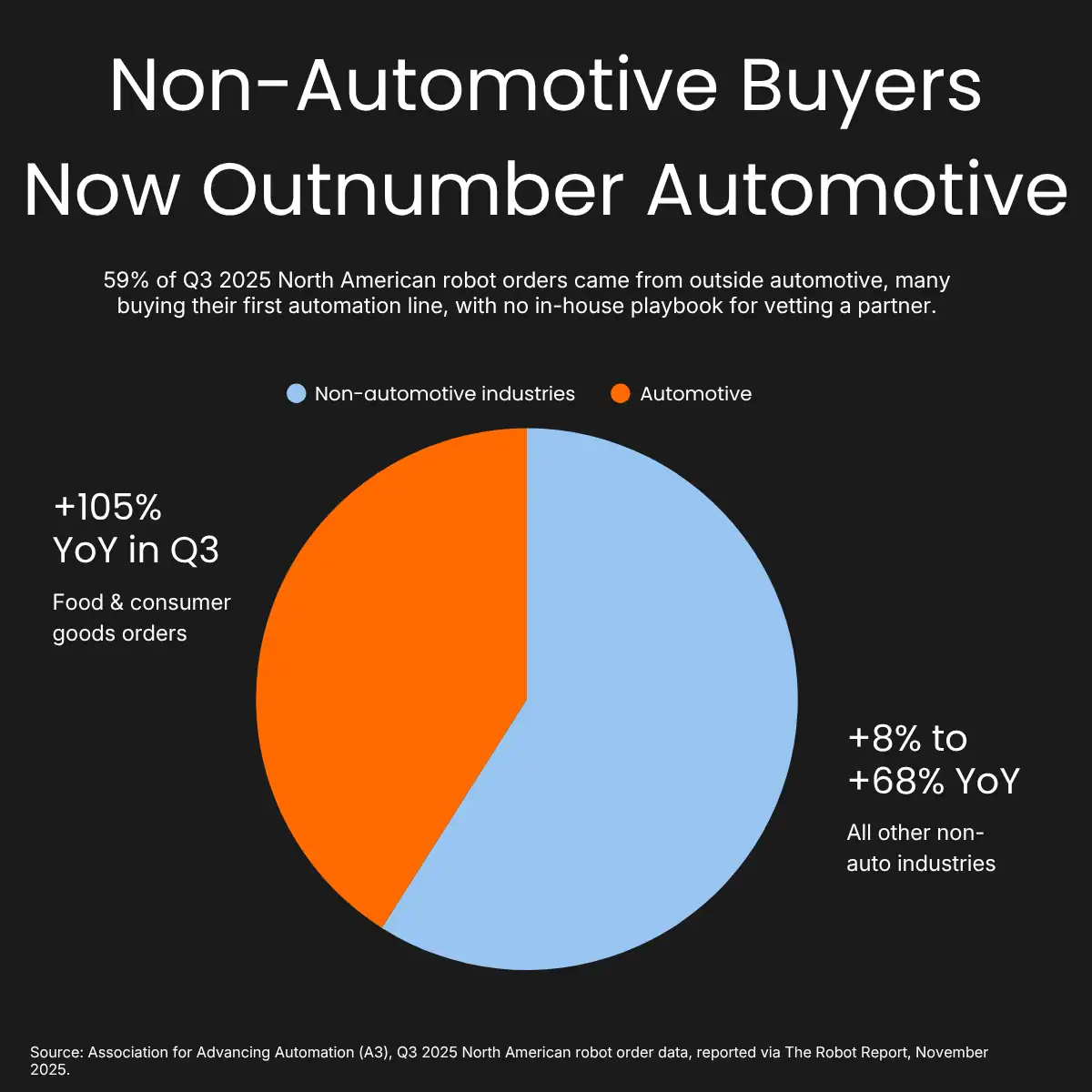
Non-automotive sectors accounted for 59% of all robots ordered in Q3 2025… reflecting accelerating momentum across industries.” — Alex Shikany, EVP, A3
Why the Wrong Automation Integrator Costs More Than a Bad Quote
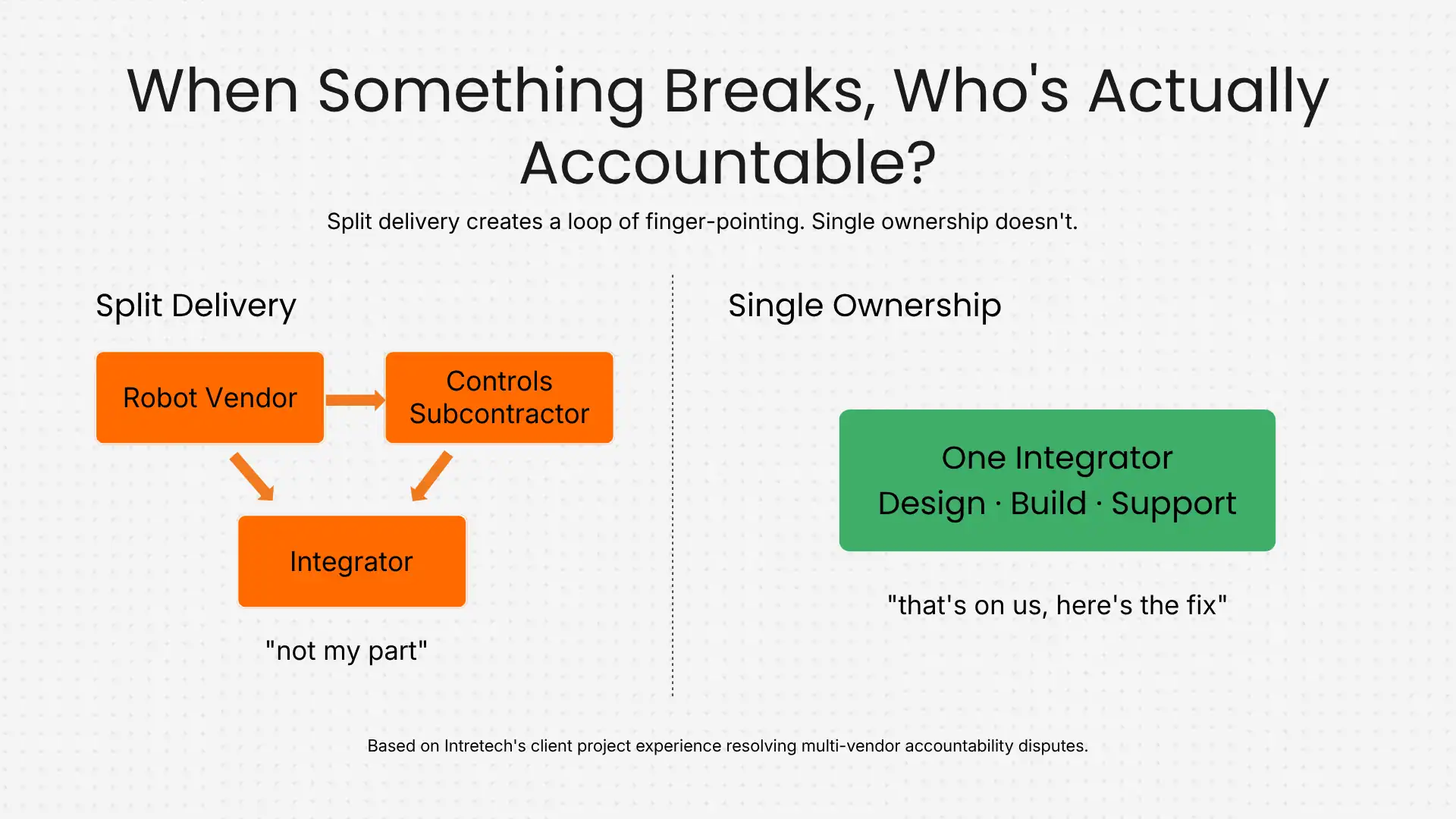
The financial risk of automation isn’t really the equipment. It’s the integrator relationship. A line that’s engineered by a team that doesn’t fully own the process ends up with problems nobody can trace back to a single point of accountability: is it the robot vendor, the controls subcontractor, or the integrator who assembled the pieces? Each one points at the others while your line sits idle.
This is also where a lot of automation ROI cases quietly fall apart. Our earlier piece on the real ROI of automation walked through why payback periods stretch out integration time gets underestimated, maintenance capacity gets ignored, the pilot never happens. All three of those are integrator-selection failures wearing a different name. The right partner catches them before they become your problem.
“System integrators combine components from multiple manufacturers to create a working, integrated system to fit unique customer requirements.” — A3, System Integration overview
The Vetting Questions That Actually Predict a Good Automation Integrator
Generic advice says “check references.” Here’s what to actually ask.
Who does the engineering, specifically? Ask whether the mechanical design, controls programming, and vision or AI work happen in-house or get subcontracted. Subcontracted work isn’t automatically bad, but you need to know who you’re actually accountable to when something breaks eighteen months in.
Have you built this exact process before, or something adjacent? A robotics integrator with twenty years in automotive welding is not automatically qualified to build a vision-guided inspection cell for a medical device line. Ask for a project that’s genuinely comparable to yours, not just “robotics experience” in general.
What does support look like in month thirteen? Most integrators are excellent during the sales process and commissioning. The real test is what happens a year later when a sensor drifts or a part variant changes. Ask for their standard response time on a support ticket, not just their sales pitch.
Can I talk to a reference who had a problem? Every integrator has a glowing case study. Ask instead for a reference where something went wrong mid-project, and how it got resolved. How they handle that question tells you more than the case study does.
Is your team A3-certified, and does it matter here? The A3 Certified Robot Integrator program audits a company’s procedures, technical capabilities, safety practices, and customer support systems before certifying them. It’s not a requirement for every project, but for safety-critical or highly regulated lines, it’s a real signal, not a marketing badge.
“The commissioning engineers leave. Six months later a servo pack fails, or a new part number arrives… and the question becomes who does that. In a lot of plants, the answer is nobody.”- EVST Editorial Team, “Why Automation Projects Fail After the Robot Arrives,” July 2026.
Red Flags to Walk Away From
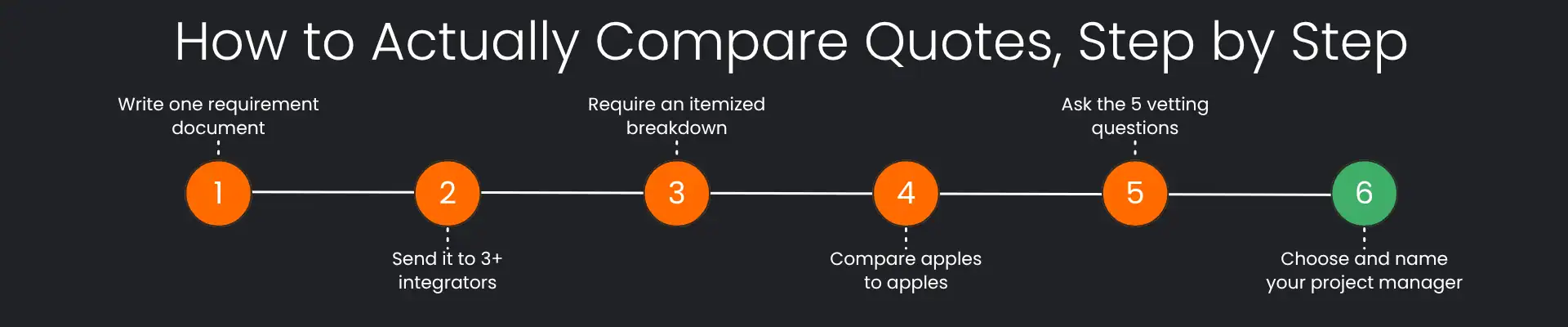
A quote that arrives before a site visit. Automation pricing without seeing your floor, your parts, and your existing equipment is a guess dressed up as a number. Walk away, or at minimum treat it as a rough order of magnitude, not a quote.
Reluctance to name the actual engineers on the project. If a sales rep can’t tell you who specifically will design and commission your system, you’re buying a relationship with a company, not a team and teams are what actually deliver projects.
No clear answer on what happens if a part design changes mid-project. Manufacturing changes. A good integrator has a defined change-order process. A vague answer here usually means an expensive one later.
Pressure to sign before you’ve gotten a second quote. A confident integrator can survive a comparison. Urgency is usually a sign the number won’t hold up next to someone else’s.
No named project manager before the contract is signed. If nobody can tell you who owns your project day-to-day once the deal closes, you’re relying on whoever happens to be free that month. A team that’s confident in its delivery capacity will name the person before you’ve signed anything, not after.
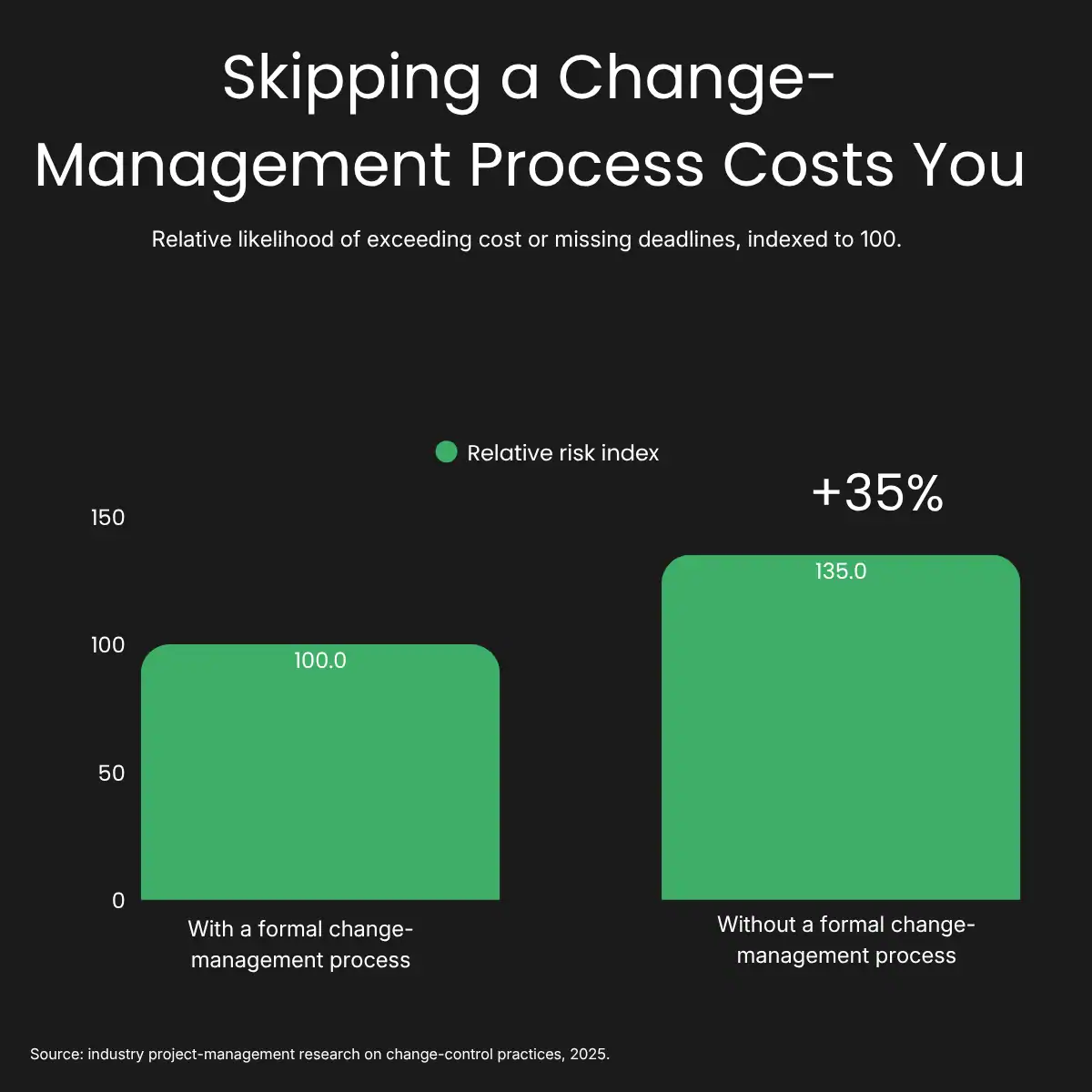
Projects without a formal change-management process are 35% more likely to exceed cost or miss deadlines.
What You Should Actually Expect to Pay
Every “automation integrator cost” article on the internet gives you a range with no context, because the honest answer is that cost depends entirely on scope a single robotic cell and a multi-station line with vision inspection and MES integration are not the same purchase. What you can control is getting quotes you can actually compare.
Get at least three quotes scoped against the identical requirement document, not three different verbal conversations. Ask each integrator to break out equipment cost, engineering and programming hours, installation, and first-year support separately, rather than one bundled number. That’s the only way to tell whether a lower bid is a better deal or a corner being cut on engineering hours you’ll pay for later in downtime.
The lowest bid on a bundled quote is the riskiest number in the whole process, because you can’t see which line item got thin to hit that price. An integrator that trims commissioning time or vision-system training to win on headline cost are shifting the cost onto your first six months of production, in the form of a system that needs more manual correction than it should.
What is the priced lead time for end-of-arm tooling as a separate deliverable; will you guarantee parts per hour at the cell boundary under defined acceptance conditions.
In-House Engineering vs. a Robotics Integrator: When Each Wins
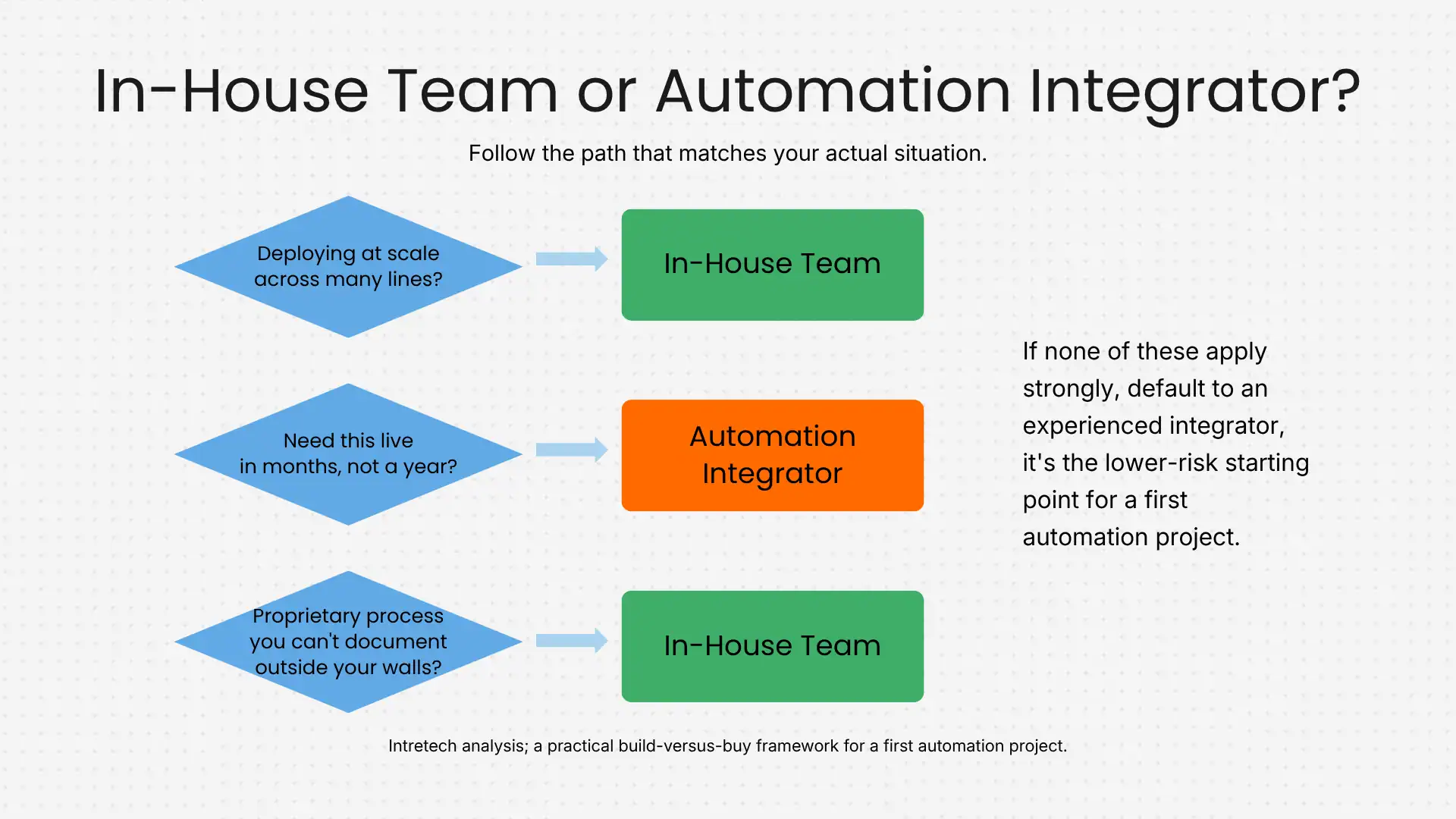
Building an in-house automation team makes sense when you’re deploying similar systems repeatedly across many lines or facilities; the fixed cost of an internal team pays for itself at scale. For most manufacturers automating a specific line or process for the first time, a robotics integrator is the faster, lower-risk path: you’re buying expertise you’d otherwise spend years building, and you’re not carrying that headcount once the project is live.
The decision isn’t purely financial. If your process involves proprietary methods you don’t want documented outside your walls, in-house has an edge. If you need this line running in months, not the year or more it takes to hire and train an internal team, an experienced integrator wins. We’ve laid out the fuller version of this tradeoff in our guide to physical AI versus traditional automation, which covers the same build-versus-buy logic from the technology side.
Intretech works as exactly this kind of integrator partner; engineering, building, and supporting automation lines in-house, live in under six months, with an average client ROI inside twelve. If you’re evaluating integrators right now and want a second opinion on a quote you’ve already received, book a free consultation with our engineering team.
Frequently Asked Questions
What does a manufacturing automation integrator actually do?
A manufacturing automation integrator designs, builds, and commissions automated systems, robots, conveyors, vision systems, and controls; engineered around your specific process, cycle time, and tolerances, rather than selling you generic equipment.
How do I choose the right automation integrator for my facility?
Ask who does the actual engineering in-house versus subcontracted, request a reference project genuinely comparable to yours, and confirm what support looks like well after commissioning; not just during the sales process.
How much does hiring an automation integrator cost?
It depends entirely on project scope, which is why generic cost ranges aren’t useful. Get at least three quotes scoped against an identical requirement document, with equipment, engineering, installation, and support costs broken out separately.
Does it matter if a robot integrator is A3-certified?
For safety-critical or heavily regulated lines, yes; A3 certification means a company’s procedures, technical capabilities, and safety practices have been independently audited. For simpler projects, it’s a positive signal but not a strict requirement.
Is it better to build an in-house automation team or hire an integrator?
An in-house team makes sense if you’re deploying similar systems repeatedly at scale. For a first automation project or a single line, an experienced integrator is typically faster and lower-risk than building that expertise internally.
Explore more related content
USMCA Rules of Origin: A Practical Guide for Electronics OEMs (2026 Update)
USMCA Rules of Origin: A Practical Guide for Electronics OEMs (2026 Update) USMCA rules of origin used to be a...
Nearshoring vs Offshoring: How to Choose Your Manufacturing Footprint and EMS Partner
Nearshoring vs Offshoring: How to Choose Your Manufacturing Footprint and EMS PartnerNearshoring vs offshoring is...
Electronics Manufacturing in Mexico: A Buyer’s Guide to Nearshoring in 2026
Electronics Manufacturing in Mexico: A Buyer’s Guide to Nearshoring in 2026Electronics manufacturing in Mexico is no...