

Robotics Manufacturing: What It Actually Takes to Scale the Robots IFA 2026 Showed Off

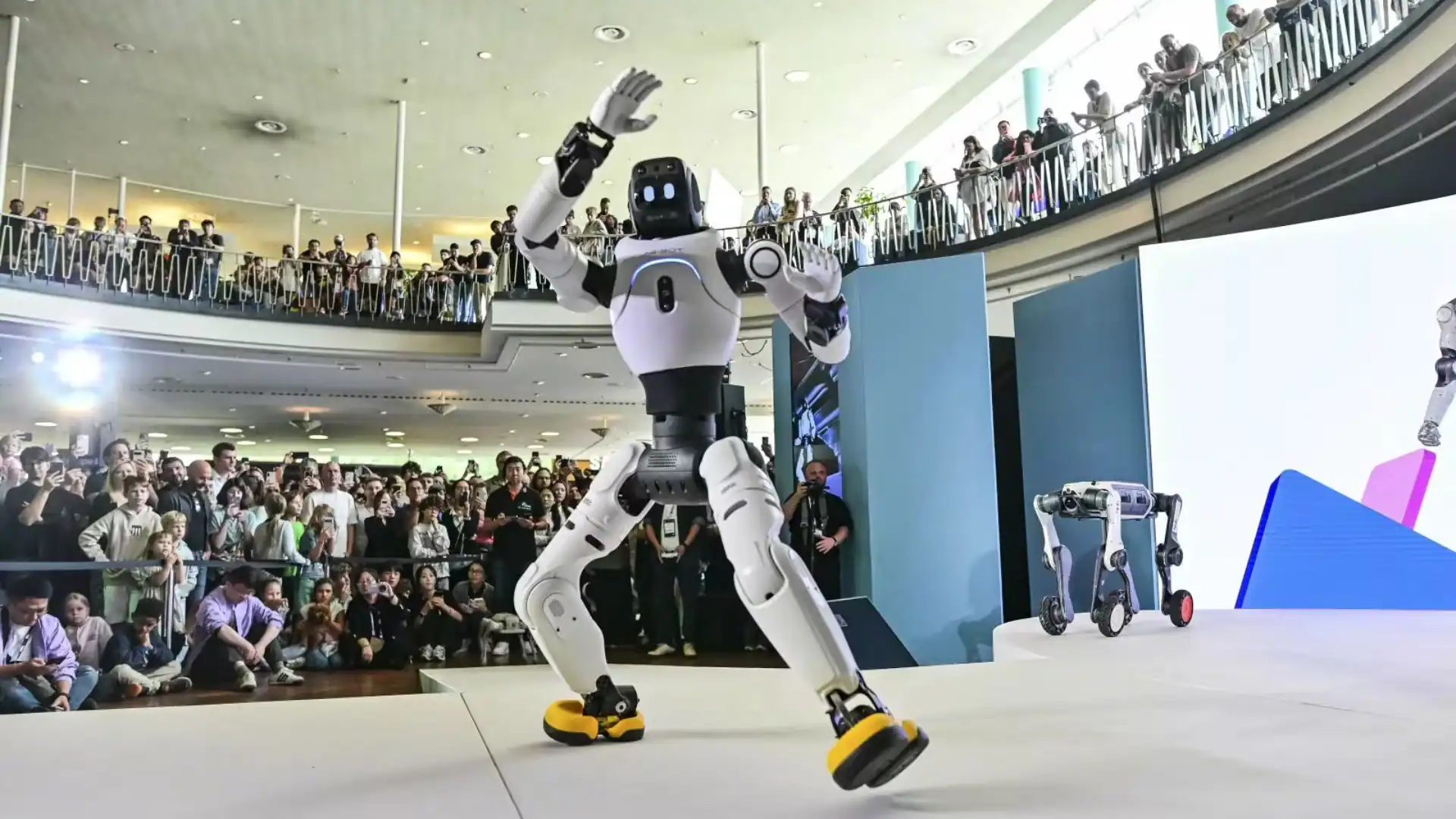
Leif Lindner, CEO of IFA Management GmbH: “we’re seeing more humanoid robots at IFA than ever before.” Source: IFA Berlin 2026, IFA Next press release
IFA Berlin 2026 had a runway show. Not for clothes, for robots. “Robots on the Runway” put humanoid machines from Unitree, AGIBOT, Pudu Robotics and a dozen other companies in front of a live audience. One of the signature moments in an IFA Next show area that hosted close to 300 robotics and AI exhibitors from 25 countries. IFA’s own CEO, Leif Lindner, put it plainly: “we’re seeing more humanoid robots at IFA than ever before.”
It’s an easy trend to get swept up in. It’s also worth remembering that a robot walking confidently across a stage in front of cameras and a robot working reliably in ten thousand customers’ homes are two very different engineering achievements. The distance between them is where robotics manufacturing actually happens, and it’s a lot longer than a demo makes it look.
The robotics category is bigger than humanoids
Humanoid robots got the headlines, but they were only part of what IFA 2026 put on the floor. Household robotics kept advancing on its own track. Dyson alone announced nine new products across floorcare and robotics, Dreame continued pushing stair-climbing capability in its vacuums, and Roborock introduced models aiming past its previous suction benchmarks. The “Outdoor Cooking & Gardening” area extended the same idea outdoors, with autonomous robotic lawnmowers and connected soil and weather sensors on display.
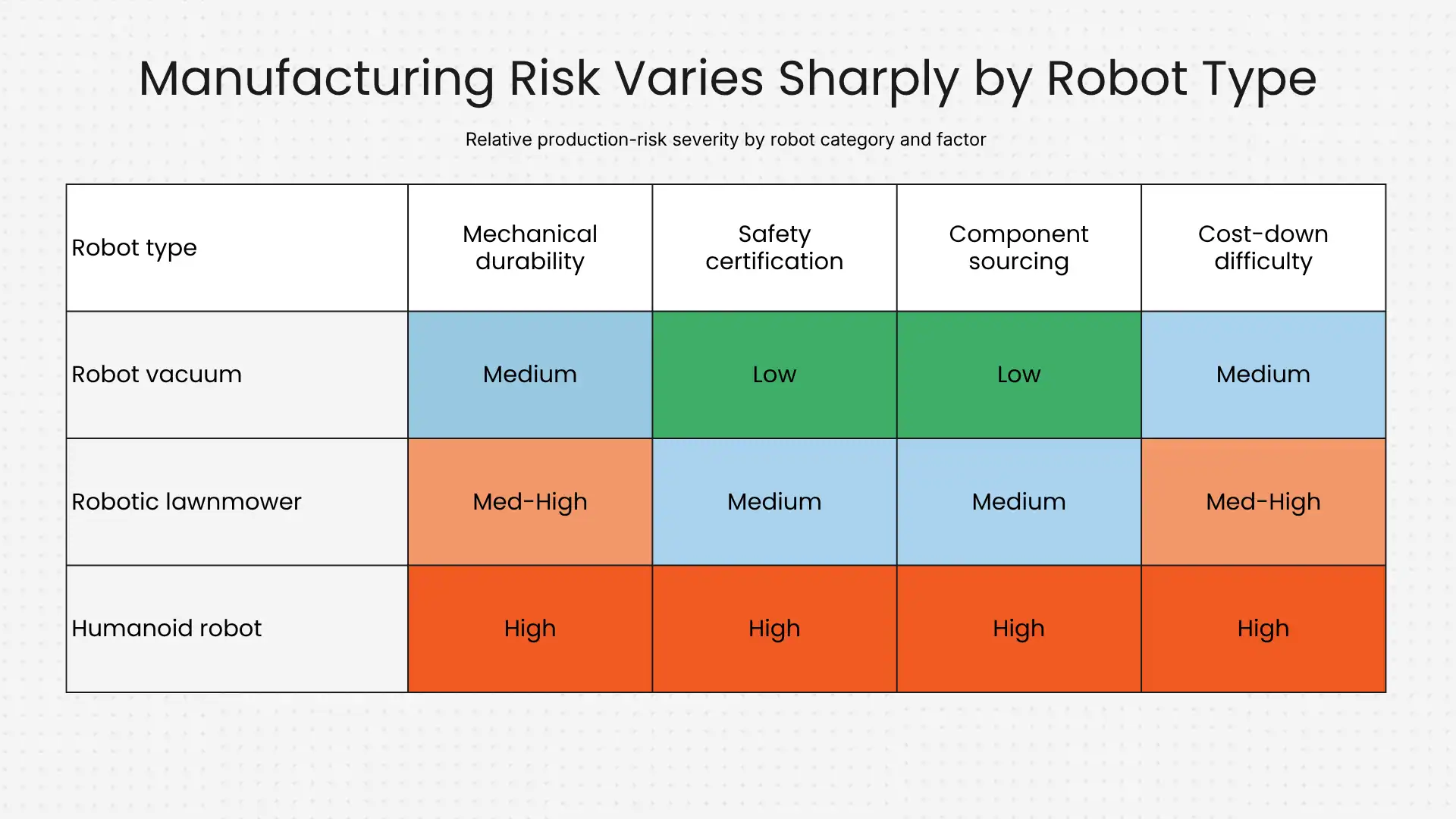
That spread matters, because it means “robotics manufacturing” isn’t one problem with one solution. A humanoid assistant, a robot vacuum and an autonomous lawnmower share some engineering ground, motors, sensors, battery systems, onboard compute. But they face very different duty cycles, environments and safety requirements.
What they all share is the same underlying question. What does it take to turn a working prototype into thousands of units that perform consistently and safely, year after year, in someone’s actual home?
David Reger, Founder and CEO of NEURA Robotics: “Physical AI forms the basis of this development and represents the next stage in the evolution of artificial intelligence.”
What a demo doesn’t tell you
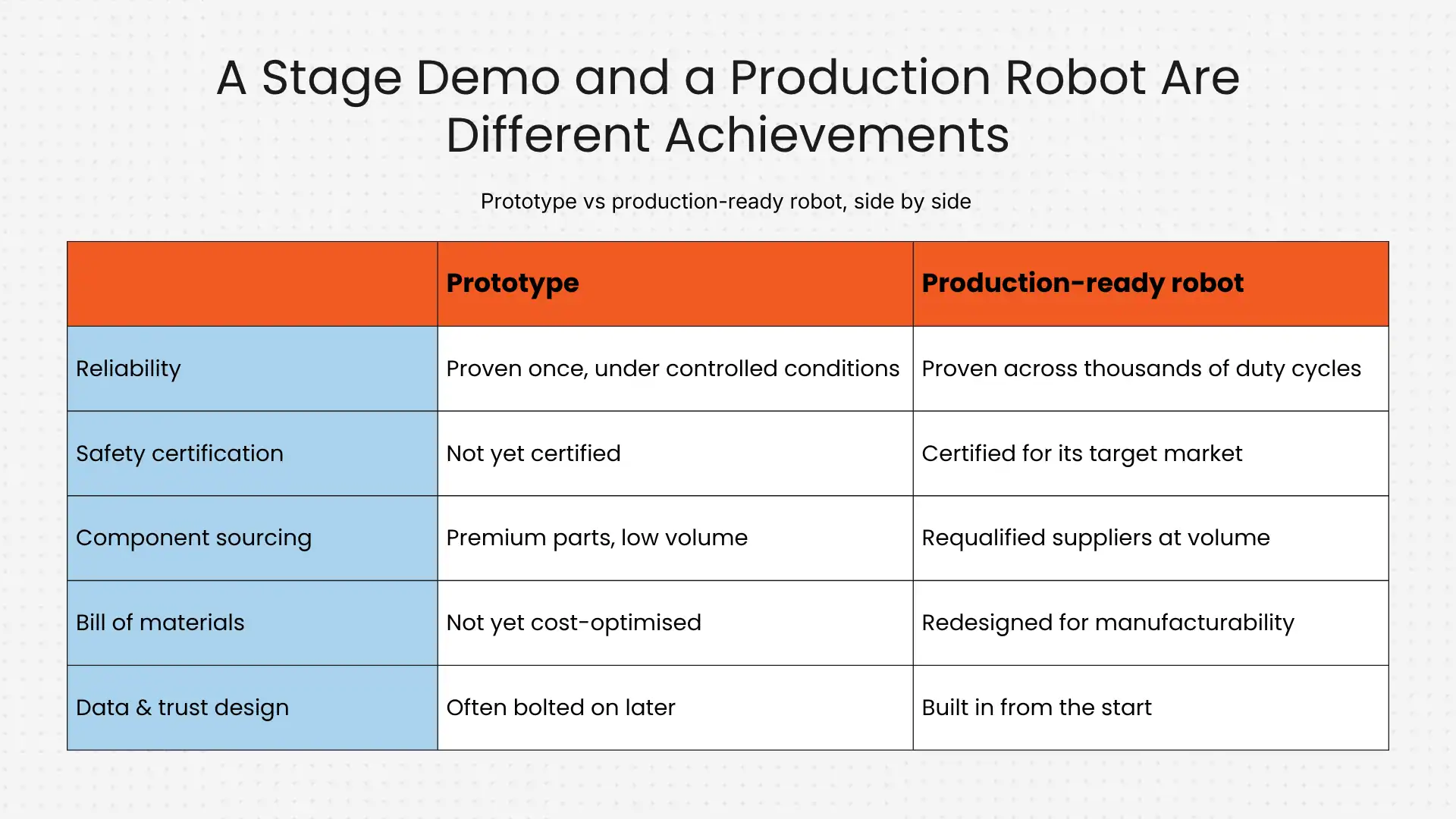
A robot on a stage has been prepared for that stage. It’s had its firmware tuned for that specific routine, its battery freshly charged, its floor swept clear of the debris a real living room accumulates. None of that is dishonest, it’s just not the same test as manufacturing at volume. The gap between the two shows up in a handful of predictable places.
Reliability and duty cycle testing
A demo has to work once, well, in front of an audience. A production robot has to work thousands of times, in conditions nobody controlled. Actuators, joints and motors that perform flawlessly in a five-minute routine need to be tested against the real duty cycle the product will see in service, including the edge cases. A robot vacuum that has to navigate a step it wasn’t shown in the demo, or a lawnmower that has to keep functioning after a season of rain and grass clippings. Reliability testing at this level takes real time and real engineering discipline. It’s one of the first things that gets compressed when a launch date is under pressure.
Safety certification
A robot that moves through a home, especially one with people, pets or small children in it, has to meet safety standards that a demo stage doesn’t test for. That includes mechanical safety around moving parts, electrical safety for the battery and charging system, and increasingly, software safety around how the robot behaves if a sensor fails or a person steps into its path unexpectedly. Certification requirements differ by market and by robot category, and building toward them from the start of the design is far cheaper than retrofitting a robot that’s already been designed without them in mind.
Jensen Huang, CEO of NVIDIA, CES 2026: “The ChatGPT moment for robotics is here… Breakthroughs in physical AI, models that understand the real world, reason, and plan actions, are unlocking entirely new applications.” Source: The Motley Fool, 25 Feb 2026
Sourcing components at volume is a different skill to sourcing them for a prototype
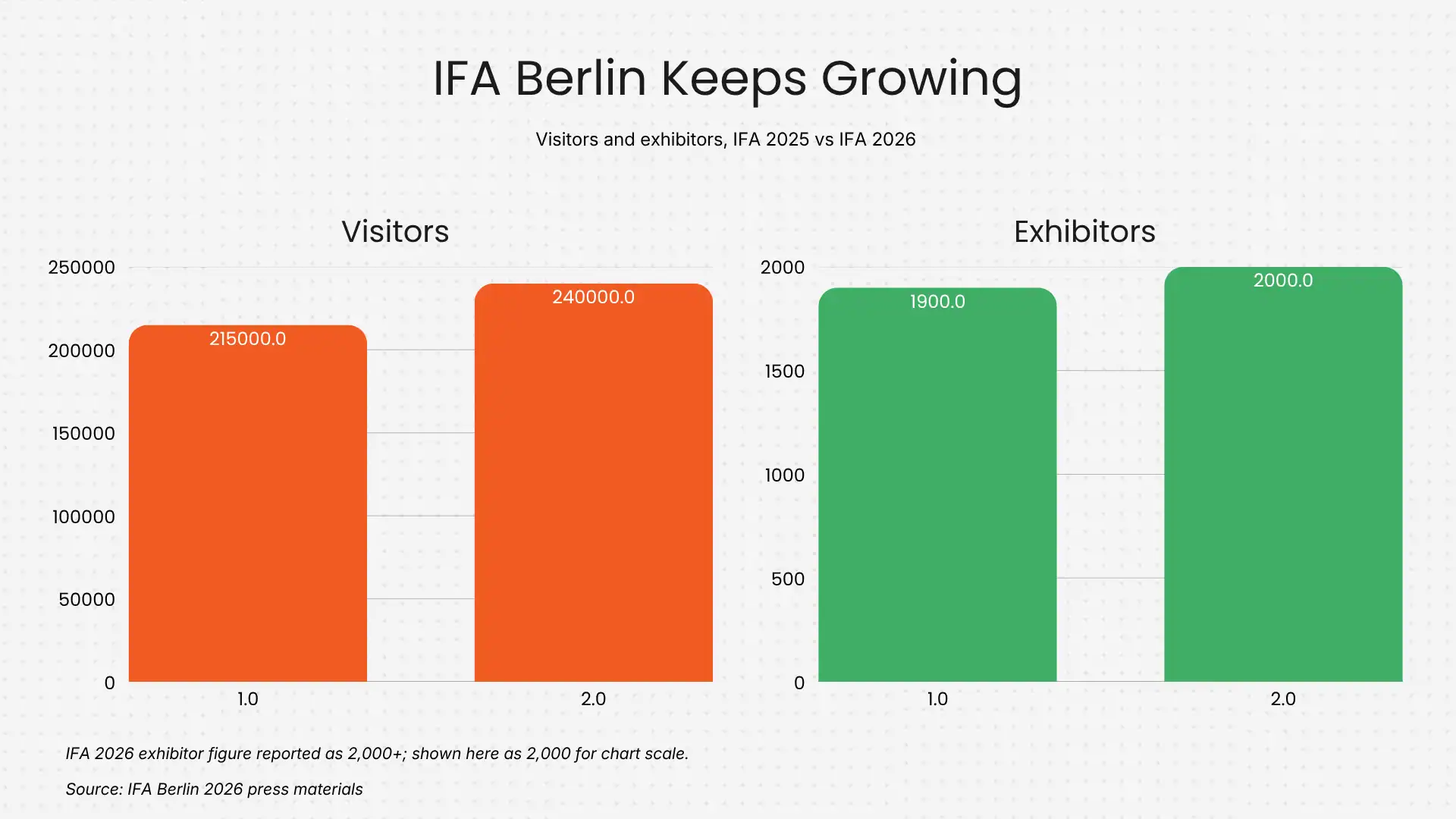
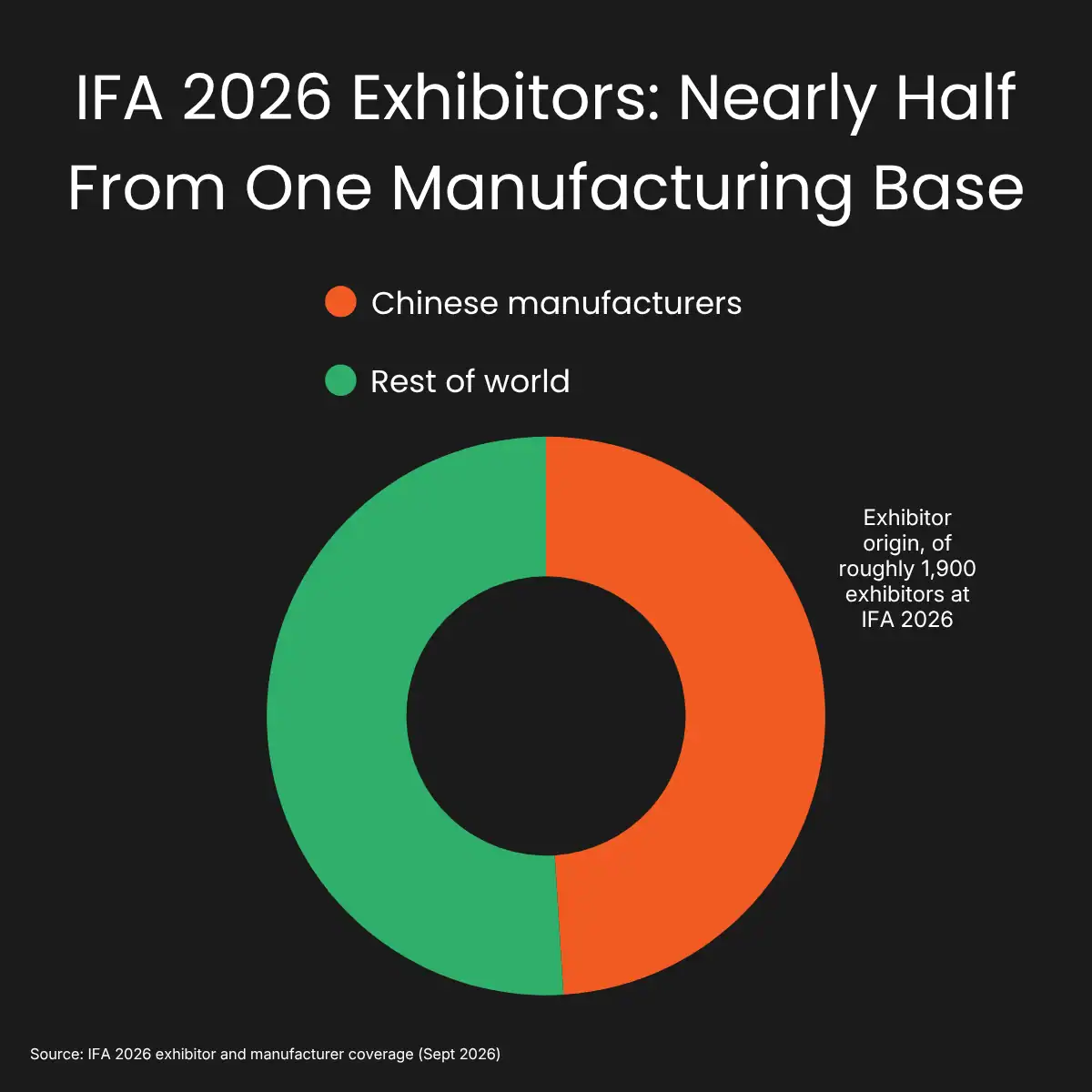
A handful of prototype units can absorb premium component costs and long lead times that simply don’t work at production volume. Scaling a robot from tens of units to tens of thousands means requalifying suppliers for volume, securing components that won’t be discontinued mid-production run, and finding second sources for anything that could become a bottleneck. IFA 2026’s exhibitor numbers give a sense of just how global that sourcing base already is: of roughly 1,900 exhibitors, 931 were Chinese manufacturers.
A large share of the world’s electronics and robotics components now come from that supply base, alongside manufacturing hubs in Europe, North America and elsewhere. A team that hasn’t already built relationships across that supply chain is starting the sourcing conversation later than its competitors.
The cost-down engineering that happens after the prototype works
A working prototype and a commercially viable product rarely share a bill of materials. Getting from one to the other, without losing the reliability or safety margin the prototype was built with, is its own discipline: substituting components, simplifying assemblies, and redesigning for manufacturability, all while keeping the robot doing exactly what it did on stage. This is usually where an in-house team without contract manufacturing experience underestimates both the time and the engineering judgement required.
Humanoid robot market forecast to grow from $5.41B in 2026 to $50.27B by 2035 | 28.1% CAGR.
Trust and acceptance are manufacturing requirements too
IFA’s own panellists on household robotics were candid about this: trust, data privacy and user control aren’t marketing add-ons. They’re prerequisites for people actually letting a robot into their home. That has real manufacturing consequences.
A robot that collects camera or sensor data needs that data pipeline designed and secured from the start, not patched in after a privacy question comes up late in development. And a robot working around people needs to behave predictably enough, visually and physically, that someone feels comfortable sharing a room with it, which is as much an industrial design and motion-control question as it is a safety one. Manufacturing teams that treat trust as an engineering requirement, not a communications problem, tend to avoid the redesigns that come from bolting it on afterwards.
Why on-device intelligence raises the stakes further
Many of the robots at IFA 2026, from humanoid assistants to smarter vacuums, are running more processing locally rather than depending on a constant cloud connection, for the same latency and reliability reasons driving edge AI adoption more broadly (see our piece on the engineering trade-offs behind edge AI hardware). That adds another layer to the manufacturing challenge: the same power, thermal and chip decisions that apply to any edge AI product now have to be solved inside a robot’s enclosure. This is often more space-constrained and mechanically complex than a static consumer device.

Goldman Sachs now forecasts roughly 6.5 million humanoid robot units by 2035, valuing the market at about $138B — a fivefold jump from its own prior estimate. Source: 24/7 Wall St, citing Goldman Sachs
What this means for teams planning a robotics product
If a robotics product is heading from prototype toward production, the manufacturing conversation is worth having earlier than it usually happens. A contract design and electronics manufacturing partner that’s built products for demanding environments before can flag reliability, certification and sourcing risks. While there’s still time to design around them, rather than after a batch of units fails testing.
Ask a prospective partner to walk through how they’ve handled duty cycle testing and safety certification on a previous project, and ask specifically how they source and re-qualify components for volume. Those answers paint you a picture of whether a robot will still be working in a customer’s home a year from now.
Adam Jonas, Head of Global Autos and Shared Mobility Research at Morgan Stanley: “We are not going to see a robot in every home overnight.”
Frequently asked questions
How is a robot manufactured at scale?
Scaling a robot from prototype to production involves requalifying every component for volume sourcing, redesigning assemblies for manufacturability, running duty cycle and reliability testing against real-world conditions, and completing safety certification for the markets the product will sell into. Each stage can reveal issues the original prototype never encountered.
Where are household and service robots manufactured?
Robotics manufacturing is a genuinely global supply chain. At IFA 2026, roughly half of all exhibitors, and a large share of the robotics and electronics categories specifically, were Chinese manufacturers, reflecting how much of the world’s component and robotics manufacturing base is concentrated there alongside hubs in Europe, North America and elsewhere.
What’s the difference between a robotics prototype and a production-ready robot?
A prototype only has to prove a concept works, often under controlled conditions and for a short period. A production-ready robot has to perform reliably across thousands of units, meet safety certification requirements for its market, and be built from components that can be sourced consistently at volume, none of which a prototype is typically tested against.
What safety certification do household or service robots need?
Requirements vary by market and robot category, but typically cover mechanical safety around moving parts, electrical and battery safety, and software safety for how the robot behaves if a sensor fails or a person enters its path unexpectedly. Designing toward these requirements from the start is significantly cheaper than retrofitting them later.
How long does it take to go from a working robot prototype to manufacturing at volume?
It depends heavily on the robot’s complexity and safety requirements. But reliability testing, certification and supply chain qualification typically add months, not weeks, to a timeline. Teams that plan for this from the start of the project consistently launch closer to their original target date than teams that treat it as a final step.
Talk to Intretech about scaling your robotics product
If your robot has proven itself as a prototype and the next question is manufacturing it reliably at volume, that’s exactly the gap our engineering team works in. Book a free consultation with Intretech’s engineering team to talk through your reliability, certification and sourcing plan.
Explore more related content

High-Power Wireless Charging: What IFA 2026’s Qi2 and Ki Standards Mean for Manufacturers
High-Power Wireless Charging: What IFA 2026's Qi2 and Ki Standards Mean for Manufacturers Qi2 25W delivers nearly 70%...

USMCA Rules of Origin: A Practical Guide for Electronics OEMs (2026 Update)
USMCA Rules of Origin: A Practical Guide for Electronics OEMs (2026 Update) USMCA rules of origin used to be a...
Nearshoring vs Offshoring: How to Choose Your Manufacturing Footprint and EMS Partner
Nearshoring vs Offshoring: How to Choose Your Manufacturing Footprint and EMS PartnerNearshoring vs offshoring is...