

High-Power Wireless Charging:
What IFA 2026’s Qi2 and Ki Standards Mean for Manufacturers


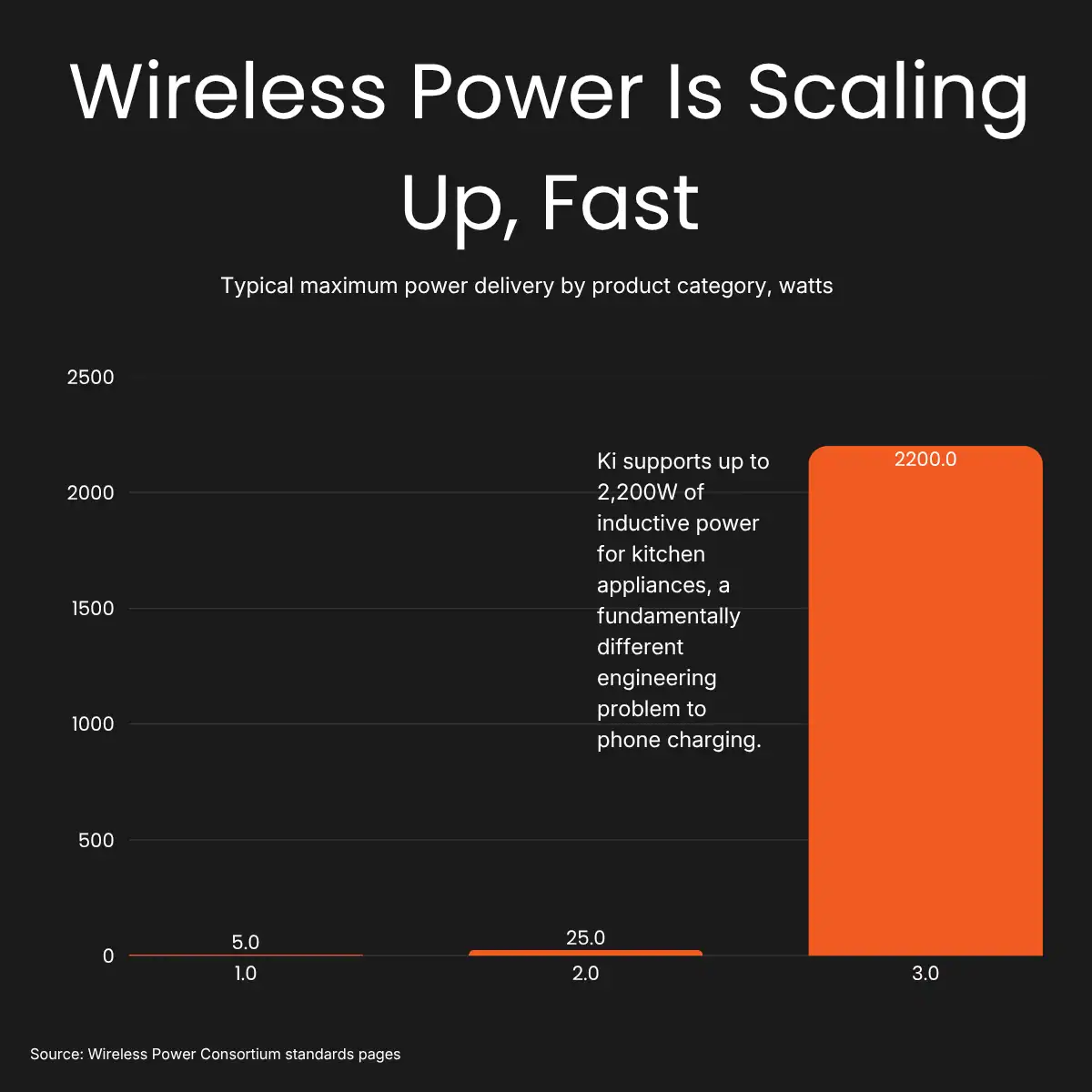
Qi2 25W delivers nearly 70% more power than the original Qi2. Fady Mishriki, WPC Chair: “Consumers will be delighted when they experience Qi2 25W as it delivers nearly 70 percent more power than the original Qi2.”
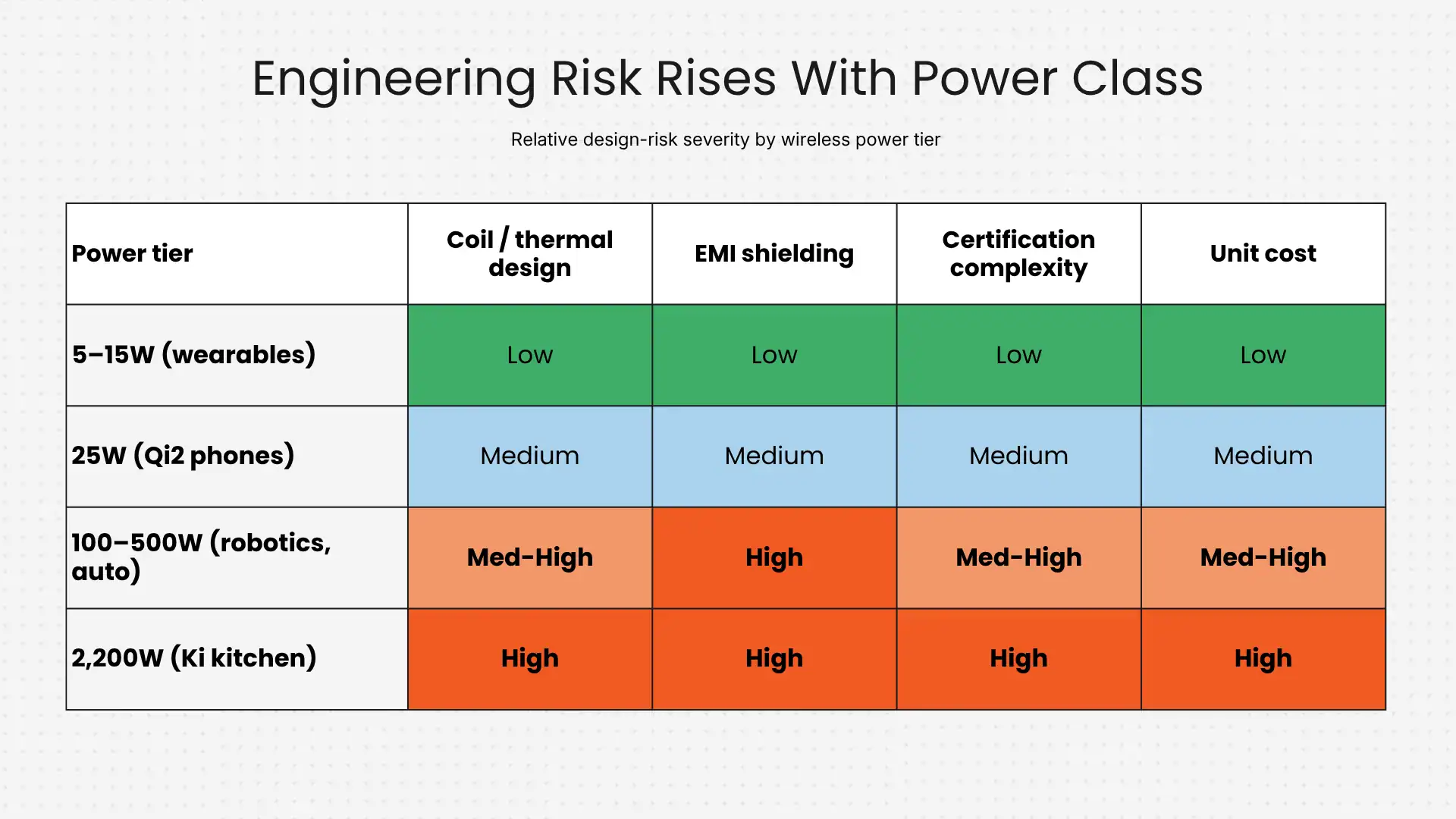
That’s a completely different engineering problem to the one phone charger manufacturers solved a decade ago. Moving from a few watts to a few hundred, or a few thousand, changes the coil design, the shielding, the thermal management and the safety testing a product needs before it can go anywhere near a certification lab. If your product roadmap has “wireless charging” on it for anything bigger than a phone, this is where the real work starts.
Paul Struhsaker, WPC Executive Director: “Qi2 25W’s remarkably fast and efficient wireless charging will encourage increased penetration of wireless charging usage and accelerate the adoption of the new standard.”
Why wireless power jumped so far, so fast
Three things happened at once.
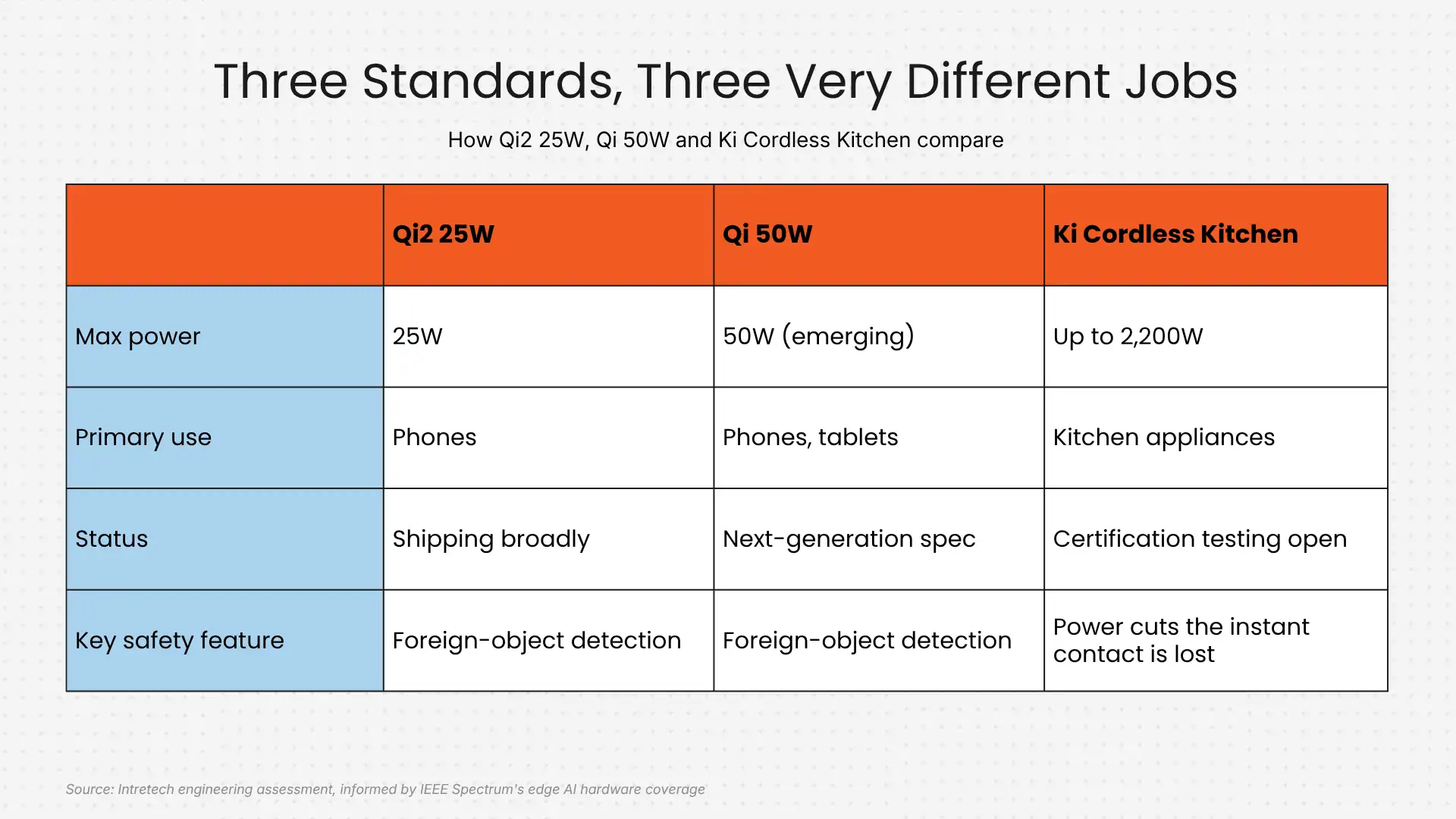
- First, Qi2 25W moved from announcement to broad availability, with the Wireless Power Consortium confirming it delivers nearly 70% more power than the original Qi2 spec, enough to make wireless charging competitive with a cable for phones.
- Second, manufacturers started bundling charging for multiple devices, a phone, a smartwatch and earbuds, into one modular pad rather than three separate ones, which Daily Objects, Anker, Belkin and Zens all showed variations of at the show.
- Third, the Wireless Power Consortium pushed wireless power into a completely different power class with Ki, aimed at kitchen appliances rather than gadgets.
Ki works by placing a transmitter under a countertop or table. An appliance sitting above it draws power; move the appliance off, and the power cuts immediately. This is looking like a deliberate safety design: removing the physical connection removes the hazard the moment contact is lost, which matters a great deal more at 2,200 watts than it does at 15.
Global wireless charging market forecast to grow from $12.28B in 2026 to $57.16B by 2034 | 21.2% CAGR. Source: wireless charging market research report, Jul 2026
The engineering gap between phone chargers and everything else
Coil design and efficiency at scale
A wireless charging coil that works well at 15W doesn’t scale up by using thicker wire. Higher power means managing much larger currents through the transmitter and receiver coils, and even small efficiency losses that were negligible at phone-charging power become real heat and real cost once you’re moving hundreds of watts. Coil geometry, alignment tolerance and the materials used in the core all have to be re-engineered for the power class the product actually needs, not adapted from a reference design built for something smaller.
EMI shielding gets harder, not easier
Every wireless power transfer radiates some electromagnetic interference, and the amount generally rises with the power being transferred. A product that passed EMI testing comfortably at low power can fail it outright once the power level goes up, particularly in categories like automotive cabins and robotics, where the charging system now has to coexist with sensitive electronics it never had to share space with before. Shielding has to be designed in from the start of the layout, not added as a fix once a prototype fails compliance testing.
Ki Cordless Kitchen supports up to 2,200W of inductive power for kitchen appliances. Source: Wireless Power Consortium, Ki Cordless Kitchen standard page
Thermal management becomes a safety issue, not a comfort issue
At phone-charging power, excess heat is mostly an annoyance. At kitchen-appliance power, it’s a safety requirement. Wireless power expanding into higher-wattage categories makes thermal management increasingly critical, and for good reason: a transmitter buried under a countertop has far less opportunity to shed heat than a charging pad sitting in open air. Getting the thermal design wrong here trip the safety mechanisms a certification body will test for, or worse, miss the ones it should have caught.
Certification isn’t optional, and it isn’t quick
Because Ki is a new standard, WPC members can only begin submitting products for certification testing ahead of market launch, which means a manufacturer building toward this standard needs to plan certification timelines into the product roadmap from day one, not treat it as a final checkbox. The same applies to Qi2 25W products entering an increasingly crowded, competitive field. Certification delays are one of the most common reasons a hardware launch date slips, and they’re almost always avoidable with earlier planning.

Paul Struhsaker, WPC Executive Director: “The Ki standard brings unprecedented innovation to the most used room in the house; the kitchen.” Source: WPC Ki certification testing announcement
The multi-device angle.
Not every wireless power design problem at IFA 2026 was about raw wattage. A second, related trend was modular, multi-device charging: pads and stands that charge a phone, a smartwatch and a set of earbuds at once, shown in different forms by Daily Objects, Anker, Belkin and Zens. That sounds like a simpler engineering problem than a 2,200W kitchen transmitter, and in terms of raw power it is. But it introduces a different set of trade-offs: multiple coils sharing one enclosure without interfering with each other, foreign object detection that can tell the difference between an earbud case and a stray coin, and thermal design across several charging zones rather than one. A product team building a multi-device charger needs to plan for that coil-to-coil interaction from the layout stage, not discover it during EMC testing.
What this means for cost and timeline
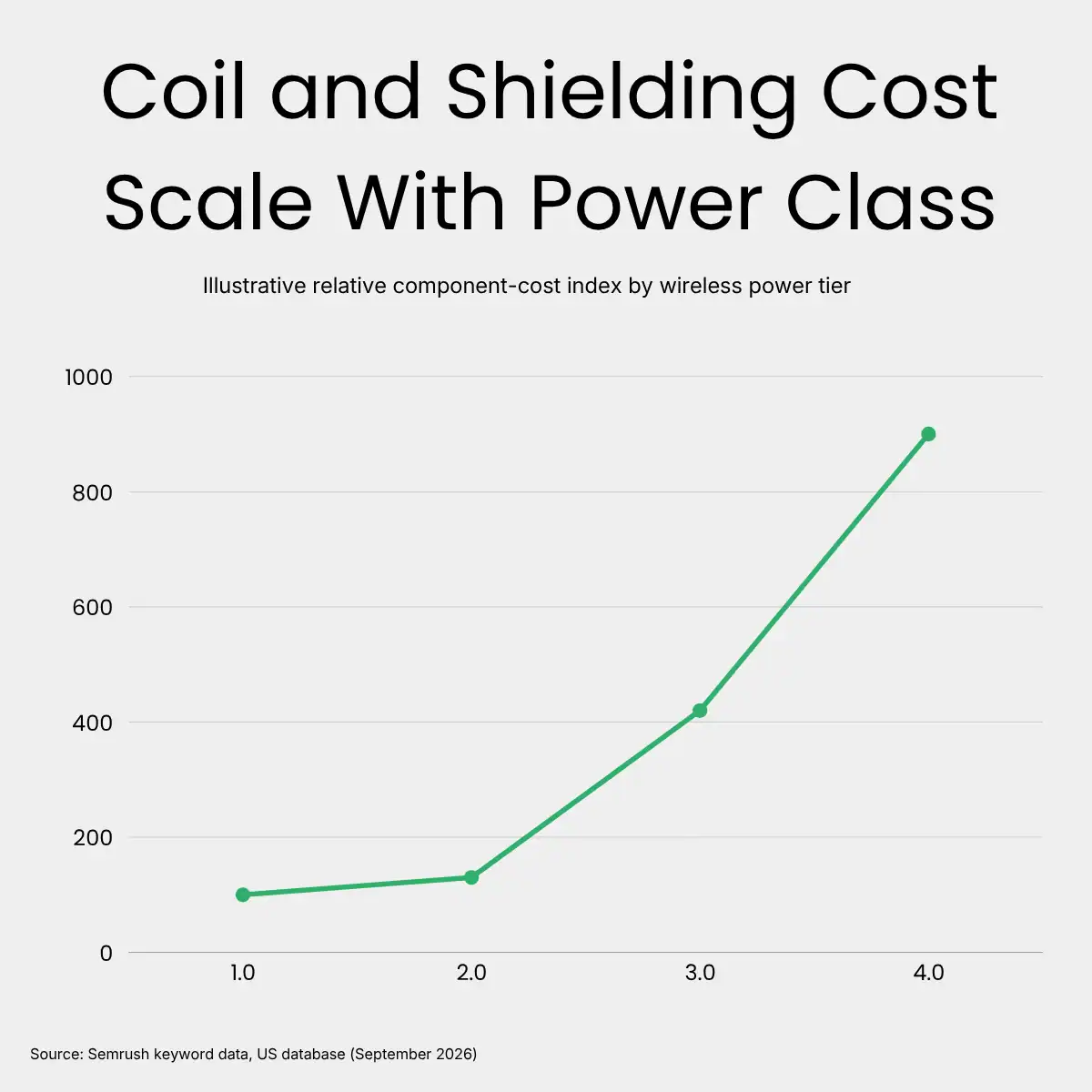
Every one of these engineering decisions shows up in the bill of materials and the schedule. Coil material and shielding add cost that scales with power class, and that cost is easy to underestimate if a quote is based on a 15W reference design rather than the actual target wattage. Certification adds weeks or months depending on the standard and the testing body, and that time has to be planned into the launch date rather than treated as a buffer that appears if needed. Teams that specify the power class and safety requirements clearly at the start of the design process consistently avoid the late-stage redesigns that push launches back, because the coil, shielding and enclosure decisions that would need to change are the ones that are hardest to change once tooling is committed.

At IFA 2026, Anker, Belkin and Zens all showed modular multi-device charging stands and pads bundling phone, watch and earbud charging into one design. Source: Engadget, AppleInsider
What this means for procurement and engineering teams
If wireless power is moving from a nice-to-have feature into a genuine power delivery method for entire product categories, the question for anyone specifying a new product is no longer “can we add wireless charging” but “what power class does this product actually need, and does our manufacturing partner have real experience at that class.” A team that has only ever built 15W phone chargers doesn’t automatically have the coil, shielding and thermal expertise to build a 2,200W kitchen transmitter safely on the first attempt.
This is a good filter question to bring to any manufacturing conversation.
- Ask to see prior work at the power class your product needs.
- Ask how EMI and thermal testing were handled, and at what stage in the design process.
- And ask what certification timeline the partner is actually planning for, rather than assuming it will sort itself out once the hardware works on the bench.
We’ve had procurement teams work through exactly this kind of specification exercise when choosing an electronics manufacturing partner for connected hardware (see our procurement checklist for choosing an electronics manufacturing partner), and power delivery is consistently one of the areas where an early, honest conversation saves months later.
Qi2 wireless charging” gets 2,400 monthly US searches versus just 110 for “high power wireless charging
Frequently asked questions
How does high-power wireless charging work?
It uses the same inductive principle as low-power wireless charging, a transmitter coil creates a magnetic field that a receiver coil converts back into electrical current, but at much higher current levels. That requires larger, more carefully engineered coils, stronger EMI shielding and active thermal management, none of which are needed at typical phone-charging power.
What is Qi2 25W?
Qi2 25W is the Wireless Power Consortium’s updated wireless charging specification, delivering nearly 70% more power than the original Qi2 standard. It’s designed for phones and similar devices and is already shipping in products from manufacturers including Motorola and UGREEN.
What is the Ki Cordless Kitchen standard?
Ki is a Wireless Power Consortium standard built specifically for kitchen appliances, supporting up to 2,200 watts of inductive power. A transmitter installed under a countertop powers an appliance placed above it, and power cuts off the moment the appliance is moved away, which is a deliberate safety feature at this power level.
Is wireless charging safe at higher power levels?
It can be, but it requires design work that low-power wireless charging doesn’t. Standards like Ki build in automatic shutoff when contact is lost, and certification testing checks thermal performance and EMI compliance specifically for the power class the product operates at. Safety at higher power comes from deliberate engineering, not from scaling up a low-power design.
What should a hardware team ask a manufacturer before building a high-power wireless charging product?
Ask for direct experience at the specific power class the product needs, evidence of how EMI and thermal testing were handled during design rather than only at the end, and a realistic certification timeline. Wireless charging experience at 15W does not automatically transfer to a 500W or 2,200W product.
Talk to Intretech about your next wireless power design
If your product is moving beyond phone-level wireless charging, the coil, shielding and certification decisions are easiest to get right before the design is locked. Book a free consultation with Intretech’s engineering team to talk through your power class and timeline.
Explore more related content
Robotics Manufacturing: What It Actually Takes to Scale the Robots IFA 2026 Showed Off
Robotics Manufacturing: What It Actually Takes to Scale the Robots IFA 2026 Showed Off Leif Lindner, CEO of IFA...
Edge AI Hardware: The Engineering Trade-Offs Behind IFA 2026’s Biggest Trend
Edge AI Hardware: The Engineering Trade-Offs Behind IFA 2026's Biggest TrendGlobal edge AI hardware market at $33.3B...

Physical AI vs Traditional Automation: How to Know Which One Your Production Line Actually Needs
Physical AI vs Traditional Automation: How to Know Which One Your Production Line Actually NeedsEvery automation...