

The JDM Advantage: Build It Together or Pay for It Later

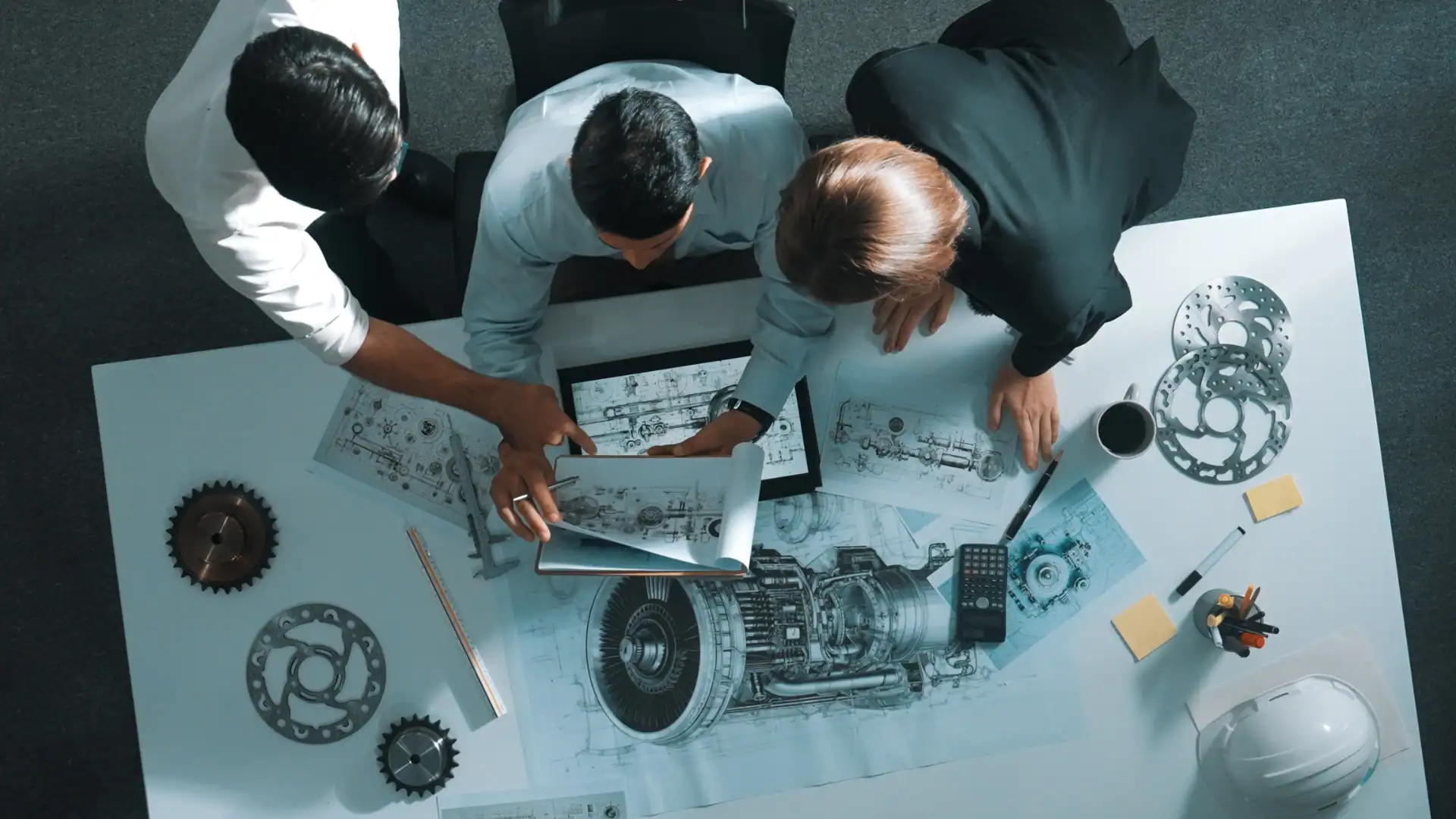
Joint design manufacturing is how leading manufacturers build products their competitors can’t copy – and it starts before the first prototype.
The problem isn’t the supplier. The problem is when you brought them in.
Joint design manufacturing is the model that changes this. It pulls suppliers into the product development process at the design stage – not the production stage – and treats them as contributors to the outcome, not just executors of the plan. Companies that do this build products faster, with fewer surprises, at lower total lifecycle cost. And because their supply chain helped design the product, it actually understands it.
This isn’t a trend. It’s a response to a failure mode that some manufacturers quietly live with and rarely fix.
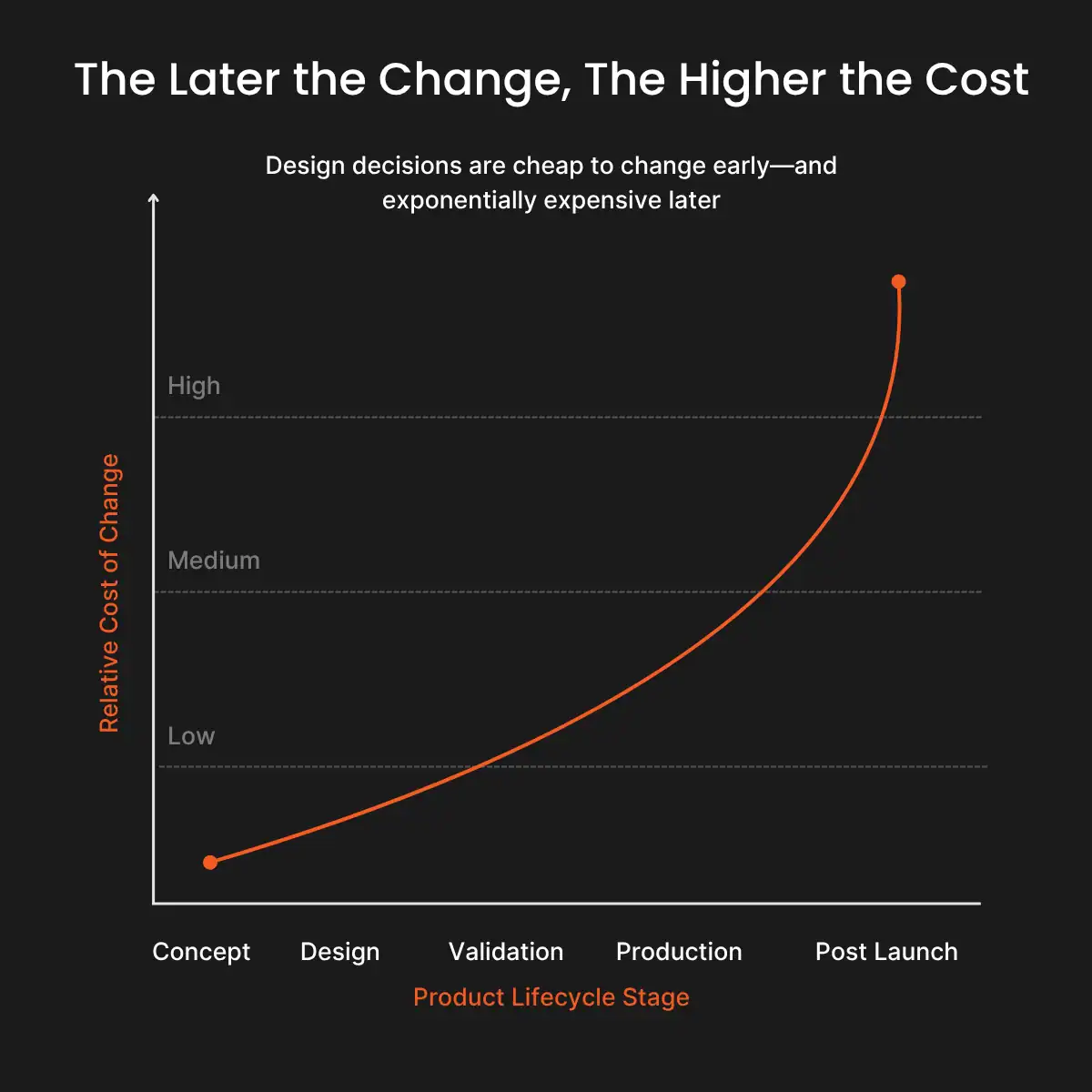
Over 70% of product quality and cost outcomes are determined at the design stage.
Joint Design Manufacturing Isn’t Outsourcing. It’s Co-Ownership.
There’s a version of joint design manufacturing that gets confused with outsourcing, and it’s worth clearing that up immediately. Outsourcing means you hand a problem to someone else. Joint design manufacturing means you solve a problem together.
In practice: your suppliers aren’t just receiving your drawings. They’re shaping them. They’re in the room or on the call when design decisions are made. They flag when a tolerance is manufacturable in theory but painful in reality. They suggest materials you hadn’t considered. They catch the interference between two components that your team modeled in isolation.
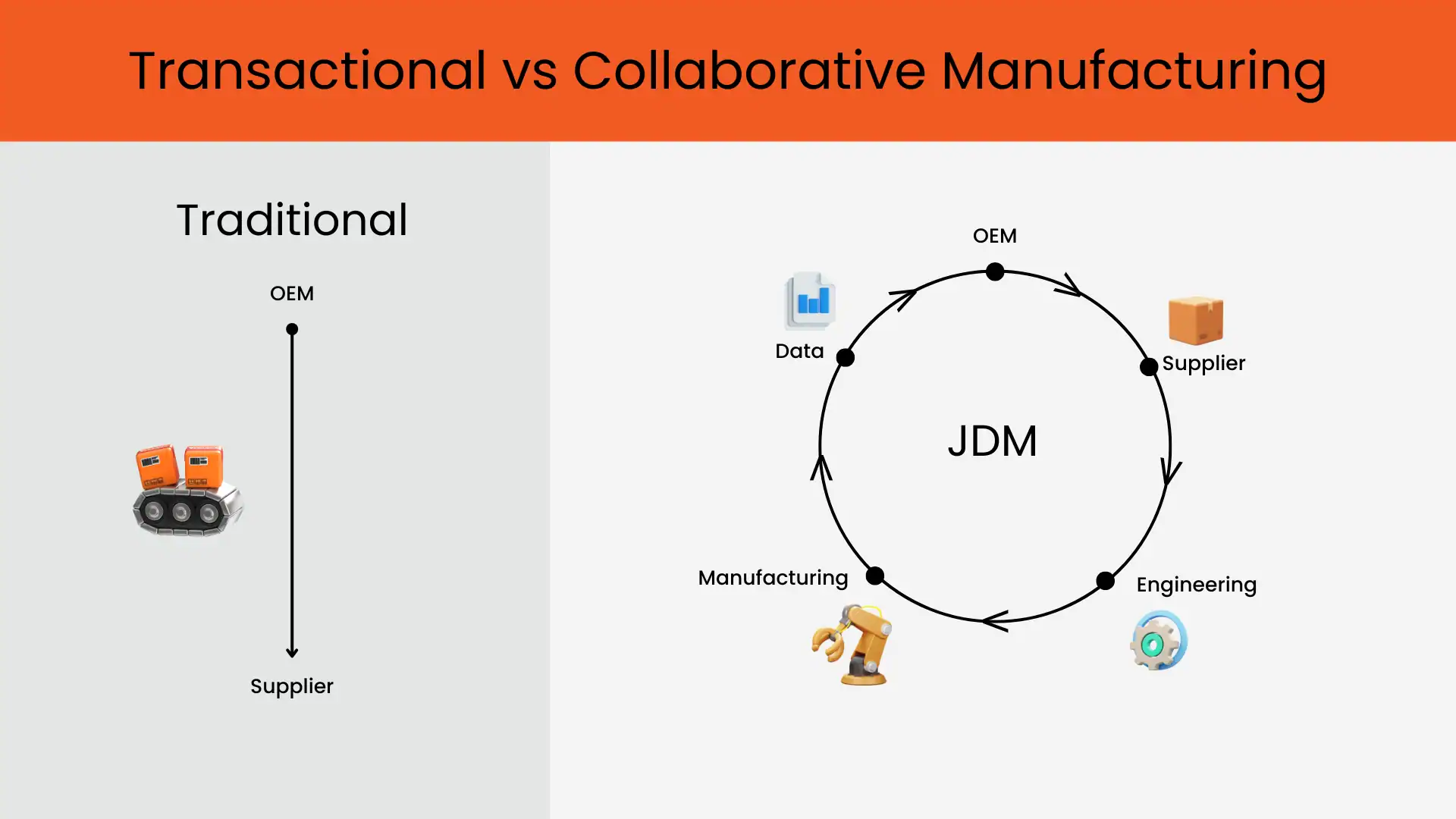
Traditional vendor relationships are transactional by design. You write a specification, the vendor quotes to it, you award the business. The vendor’s job is to hit the spec, not to improve it. That model works fine when the product is simple, the supply chain is stable, and nothing ever changes. Which is to say, it works fine in a world that doesn’t exist anymore.
Real manufacturing partnerships look different. The supplier has skin in the outcome. Their knowledge of what’s actually buildable at scale influences the product before it’s frozen. And because product innovation strategies built on supplier insight compound over time – each program teaching both parties something they bring to the next one – the relationship gets more valuable the longer it runs.
“The supplier who quotes to your drawing is a vendor. The supplier who challenges your drawing is a partner. The gap between those two things is where product programs succeed or fail.”
Almost all quality improvement comes via simplification of design.” — Tom Peters
The Lifecycle Cost You’re Missing Is Locked in the First 20% of Design
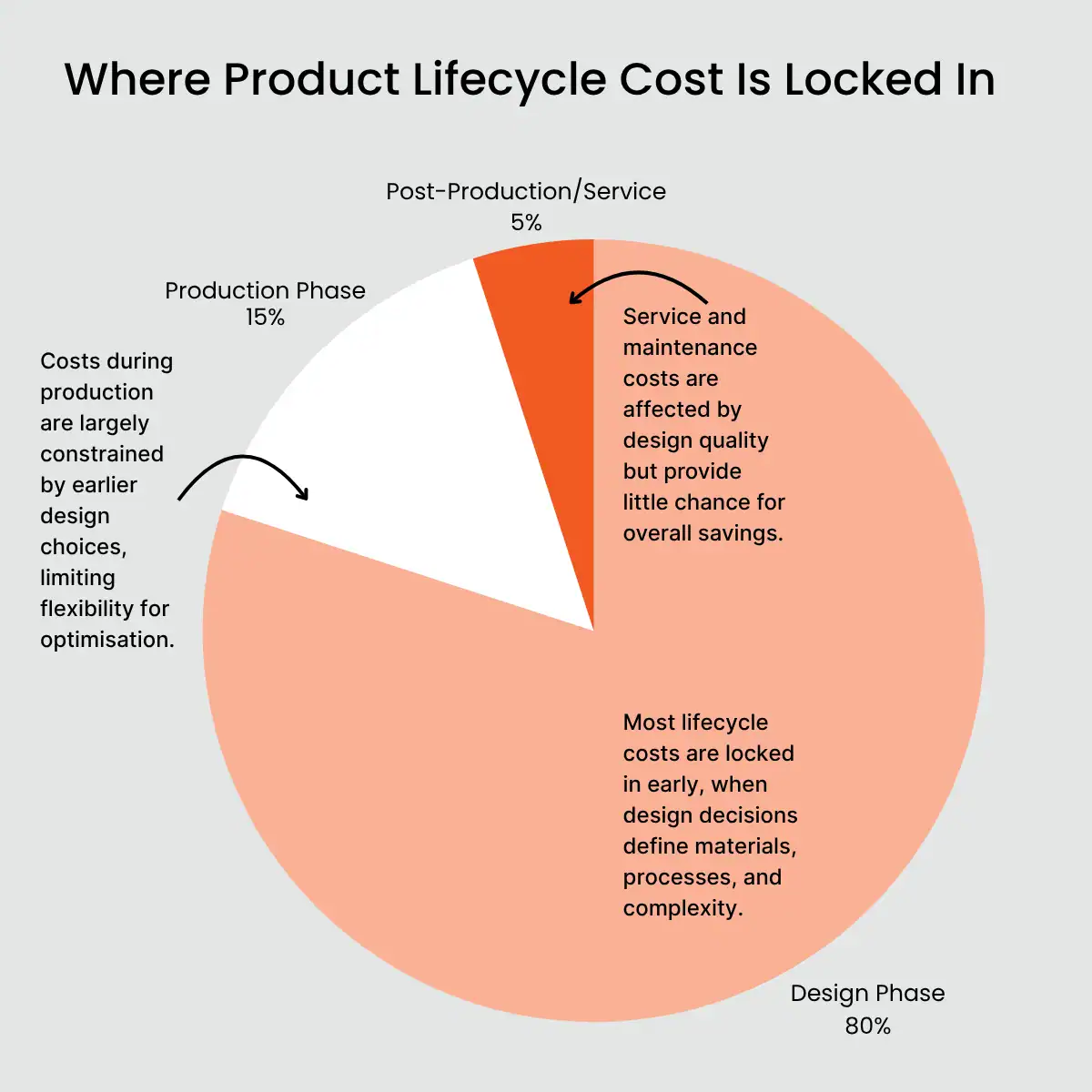
Here’s the number that should change how every product development conversation starts: roughly 70% – 80% of a product’s total lifecycle cost is determined during the design phase. Not during production. Not during sourcing. During design – when most suppliers haven’t been consulted yet.
That means by the time your bill of materials is finalized and your supply chain integration begins, the major cost and quality outcomes of the product are largely already decided. What looks like a procurement problem or a manufacturing problem is usually, when you trace it back, a design decision that nobody with manufacturing knowledge was in the room to question.
What you pay for when suppliers are excluded from the design stage:
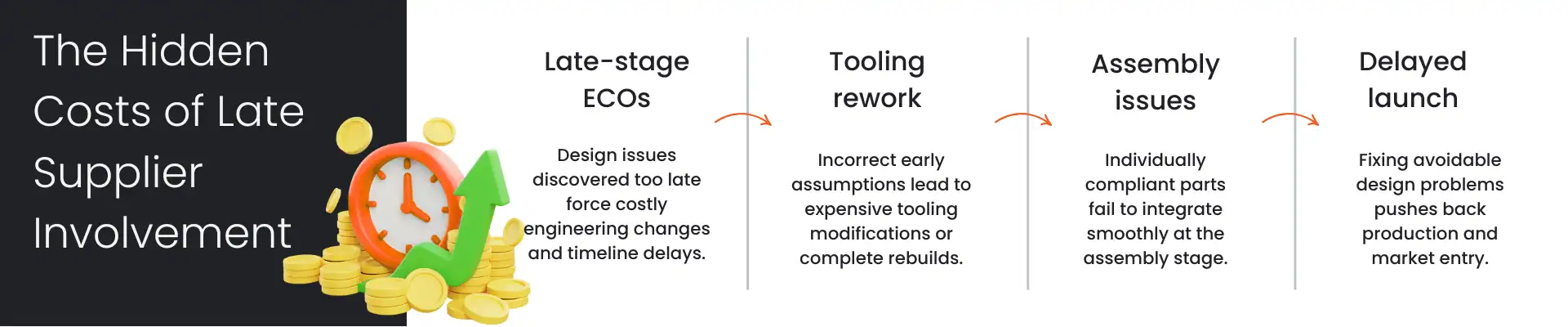
- Engineering change orders late in development. A supplier reviews the drawing two weeks before tooling release and flags that the wall thickness makes consistent injection molding nearly impossible. You’ve known for six months. They’ve known for two weeks. The ECO is expensive and it slips the program.
- Parts that exist in isolation. When components are designed without supplier input, you get parts that meet their individual specifications but create problems at assembly. Tolerances stack. Fit issues emerge. Each component passed quality control perfectly and the assembly still doesn’t work.
- Rework costs that never appear in the original business case. These are the costs that live in the gap between the project plan and the post-launch review. They’re real, they’re substantial, and they’re almost always traceable to design decisions that were made without the right people at the table.
This is where product lifecycle management either pays off or becomes a documentation exercise. Shared design data, synchronized timelines, and supplier access to the same product information your engineering team works from – these aren’t nice-to-haves. They’re how you close the gap between what the design assumed and what production actually requires.
Front-load the intelligence. The alternative is back-loading the cost.
Wasted time is the hardest waste to correct.” — Henry Ford
Built Together. Harder to Break.
The supply chain resilience conversation usually starts in logistics. Lead times, inventory buffers, multi-sourcing strategies, geographic risk. These are real and worth managing. But there’s a dimension of supply chain resilience that almost never gets discussed: whether your suppliers actually understand the product they’re building.
When a supplier helped design something, they know it differently than a supplier who received a finished drawing. They understand why the product is the way it is. They know which dimensions are critical and which have room to breathe. They know where the design is fragile and where it has margin. That knowledge is operational.
Consider what supply chain integration looks like under both models:
- WITHOUT JDM: A design change is issued in week 14. The supplier learns about it when the revised drawing arrives. Tooling has been underway for three weeks based on the previous revision. The change order is raised. The tooling cost is disputed. The timeline slips by six weeks.
- WITH JDM: The supplier is in the design review in week 3. They flag that the proposed change affects a feature that’s already driven tooling investment decisions. The design is adjusted before tooling begins. The timeline holds. The cost is avoided.
Advanced manufacturing technologies make this operationally realistic at a scale that wasn’t possible ten years ago. Digital twin environments let suppliers model manufacturability before a single piece of tooling is cut. Cloud-based collaborative design tools mean a supplier’s engineering team in one location can mark up, question, and respond to design decisions asynchronously. Shared PLM platforms mean both the OEM and supplier see the same product data, updated in real time.
The technology enables the relationship. But the relationship is what makes the supply chain resilient.
The Partnership Sounds Great. The Implementation Is Where It Gets Honest.
Every manufacturer says they want better partnerships. Far fewer have done the structural work that partnerships actually require. This is where joint design manufacturing separates from the aspirational language that surrounds it.
What makes a manufacturing partnership real, rather than a vendor relationship with a nicer name:
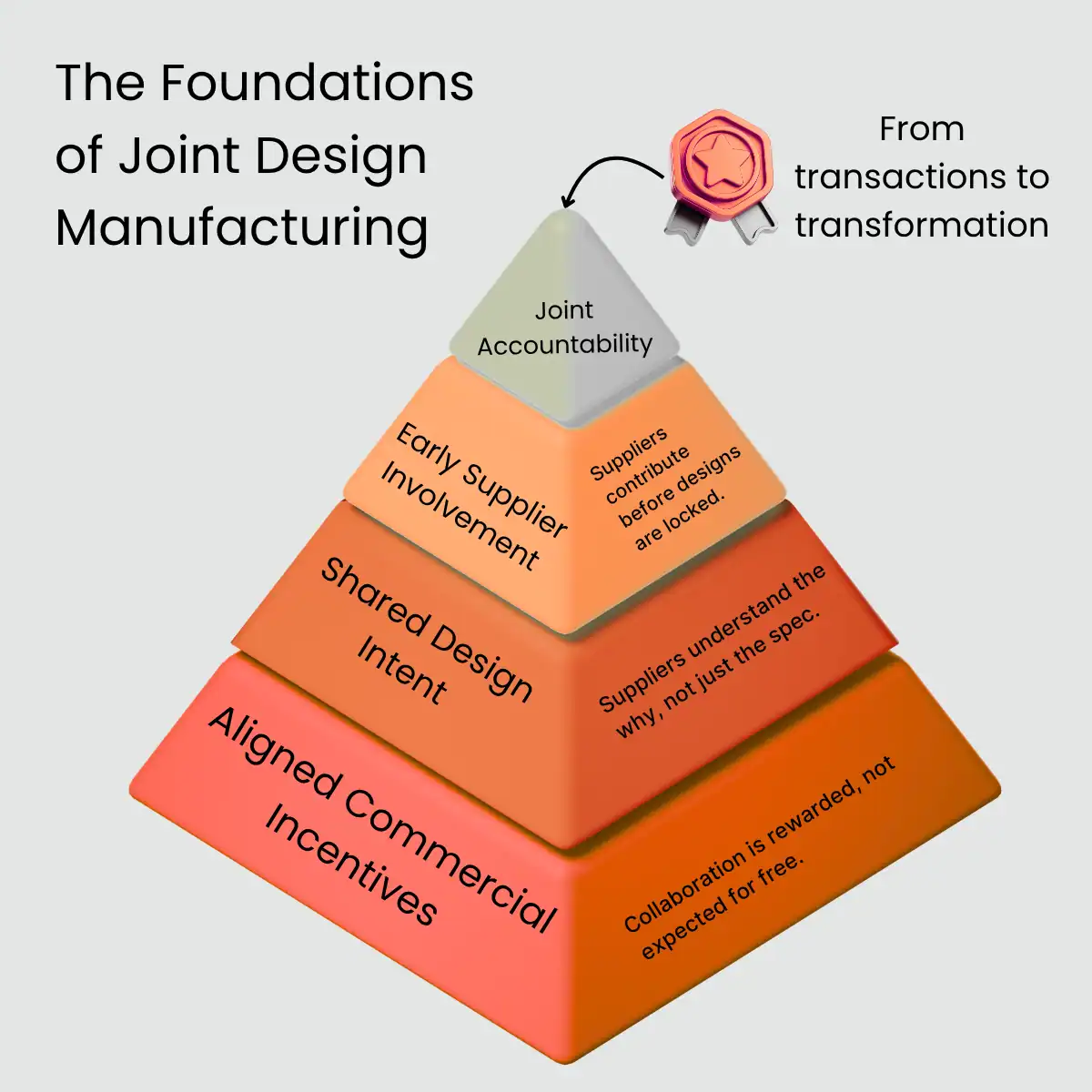
- Shared access to design intent, not just specs. A specification tells a supplier what to build. Design intent tells them why it needs to be that way – and why it can’t be another way. That distinction matters when they’re evaluating options or flagging a concern. If they only have the spec, their input is constrained to execution. If they have the intent, they can contribute to the solution.
- Agreed paths for design conflicts. Joint design means joint opinions, and joint opinions produce disagreement. This is healthy. But it needs a governance structure — who has the final call, how are cost implications of supplier-suggested changes evaluated, what happens when the supplier’s preferred approach and the OEM’s preferred approach are in direct tension? These conversations need to happen before the first design review, not during it.
- Commercial structures that reward contribution, not just compliance. This is the one most companies skip. If a supplier’s early-stage input saves $400,000 in tooling costs, how is that reflected in the commercial relationship? If the honest answer is ‘it isn’t,’ you’re not building a partnership — you’re asking suppliers to contribute expertise for free. That dynamic doesn’t sustain.
- Defined ownership when design changes create cost. Shared design responsibility means shared accountability when things change. The program where this is figured out in advance is the one that runs cleanly. The program where it gets worked out during an escalation is the one that strains the relationship.
Product innovation strategies that compound over time where each development program builds on the supplier intelligence from the last – require this infrastructure. Without it, you’re starting from scratch every time. With it, the relationship becomes a genuine competitive asset.
“Most companies say they want partners. Fewer are willing to share the decision-making that partnership requires.”
The Technology Isn’t the Strategy. But Without It, the Strategy Doesn’t Scale.
Three categories of advanced manufacturing technologies make joint design manufacturing operationally viable at scale – not as an experiment on one program, but as a repeatable model across your product portfolio.
- Shared PLM platforms. When your OEM engineering team and your supplier’s engineering team are working from the same product data in real time, the information gap that drives late-stage surprises disappears. A drawing revision doesn’t have to be communicated — it propagates. A supplier who’s always working from the current version isn’t the supplier who shows up to the design review having prepared comments on the previous one. ‘Working from version 4 of a drawing that’s now on version 9’ is not an unusual story. In joint design manufacturing, it’s an unacceptable one.
- Digital twin and simulation environments. Suppliers can model manufacturability before any physical investment is made. Failure modes that would previously have been discovered on the production line — or worse, in the field — get caught in simulation. This compresses the feedback loop between design and manufacturing reality from weeks to hours. It also means the design decisions that suppliers flag in early reviews are grounded in data, not just intuition.
- Collaborative design environments. Cloud-based tools that allow cross-company teams to annotate, mark up, and respond to design decisions asynchronously have changed what co-design actually looks like in practice. A supplier’s engineer in one time zone can review a CAD model, add comments, attach a manufacturability concern, and flag it for the OEM’s design lead – without a meeting, without a travel expense, without a version attached to an email chain that no one can find six weeks later.
One honest note: the technology enables the relationship, it doesn’t substitute for it. You can give a supplier access to your PLM system on day one. That doesn’t make them a design partner. The work of partnership is still human – built on aligned commercial incentives, shared accountability, and the kind of trust that comes from a few programs run together.
The tools remove the friction. The relationship creates the value.
The supplier who quotes your drawing executes.
The supplier who challenges it improves it.
You Don’t Need to Redesign Your Entire Supply Chain. Start With One Program.
Joint design manufacturing isn’t a company-wide transformation that requires a restructured procurement function, a new supplier tiering model, and eighteen months of organizational change management before anything gets built. That version exists – and it’s worth working toward – but it’s not where you start.
You start with one program.
Identify an upcoming product development program with a long enough horizon – ideally 18 months or more from concept to production release. Pick one or two suppliers who already have strong technical capability in a part or system that’s genuinely complex. Bring them in during Phase 0 or Phase 1, before the design is frozen, and run a structured co-design process with them.
A few things to define before that first session:
- What does ‘input’ mean commercially? If the supplier’s early contribution changes the product in a way that saves cost, how is that recognized?
- Who in the supplier’s organization needs to be in the room, and what authority do they have? A supplier engineer who can observe but can’t commit is not a design partner.
- What’s the escalation path when the supplier’s recommendation conflicts with the OEM’s preference?
The goal in the first program isn’t perfection. It’s proof of concept. You’re building the operating model – the cadence, the governance, the commercial language – that you’ll refine and scale. If it works, and it demonstrably will if you run it properly, the results are visible: fewer ECOs, a lower cost-to-market, a supply chain that understood the product before it was launched rather than after.
Companies that pilot joint design manufacturing on one program almost always expand it. Not because someone mandated it, but because the people who ran the pilot don’t want to go back.
You don’t fix product problems in production.
You pay for them.
The Companies Pulling Ahead Aren’t Working Harder. They’re Working With More People Who Have Skin in the Game.
Here’s the thing about product differentiation in manufacturing: the product itself is rarely enough. The market is full of well-engineered products that lost to competitors who got to market faster, built with fewer surprises, at better total cost. The difference, more often than not, was the ecosystem behind the product – not just what was built, but how, and with whom.
Joint design manufacturing is how you turn supply chain integration from a logistics conversation into a competitive advantage. It’s how product lifecycle management becomes a tool for decision-making rather than documentation. And it’s how manufacturing partnerships stop being commercial transactions and start being the kind of structural advantage that’s genuinely hard to replicate.
This isn’t new technology. It’s a proven model. The question worth asking is simple: are your competitors doing it, and are you?
Ready to explore what joint design manufacturing looks like for your programs?
Explore more related content

IoT in Smart Agriculture: The Hardware Engineering Decisions That Decide Whether a Sensor Survives the Field
IoT in Smart Agriculture: The Hardware Engineering Decisions That Decide Whether a Sensor Survives the FieldThe top...

How to Choose a Contract Electronics Manufacturer for Agricultural Technology
How to Choose a Contract Electronics Manufacturer for Agricultural Technology"China has re-entered the chat, after not...

Inside the GLP-1 Injector Pen Boom: What It Actually Takes to Manufacture a Smart Drug Delivery Device
Inside the GLP-1 Injector Pen Boom: What It Actually Takes to Manufacture a Smart Drug Delivery DeviceFixing a signal...