

IIoT in Smart Manufacturing:
A Practical Guide for Manufacturers Who’d Rather Skip the Buzzwords

The global IIoT market hit $514 billion in 2025. Half the manufacturing industry still hasn’t deployed it at the facility level. So who’s actually winning — and what does that tell you about what matters?
Let’s be honest about something. If you’ve sat through more than three “digital transformation” presentations in the last year, you’ve probably developed a mild allergy to phrases like connected factory ecosystem and unlocking the power of data. Fair. Most of that content is written by people who’ve never stood on a factory floor at 2am trying to diagnose why a line went down.
This isn’t that kind of article.
IIoT — the Industrial Internet of Things — is genuinely one of the most important technology shifts in manufacturing in a generation. But it’s also one of the most oversold. So let’s cut through the fog: what IIoT actually does in a real manufacturing environment, why it matters for your specific operation, and what the gap between promise and practice actually looks like.
What Is IIoT, Actually? (And Why the Standard Definition Misses the Point)
The textbook answer: IIoT is the network of interconnected sensors, machines, and devices embedded into manufacturing operations that collect, exchange, and act on data across the production floor and supply chain.
The real answer: IIoT is the difference between knowing your equipment is about to fail and finding out when it already has.
At its core, IIoT connects physical machinery to digital intelligence. A sensor on a CNC machine doesn’t just tell you it’s running, it tells you it’s running at 94% of nominal torque, that vibration has increased 12% over 48 hours, and that based on that pattern, you have roughly six days before a bearing failure. That’s not a software feature. That’s the difference between a planned maintenance window and a £40,000 unplanned shutdown.
TechTarget’s IIoT definition covers the technical architecture well. But what the definitions always leave out is the operational consequence of having all that data and what it means when you don’t.
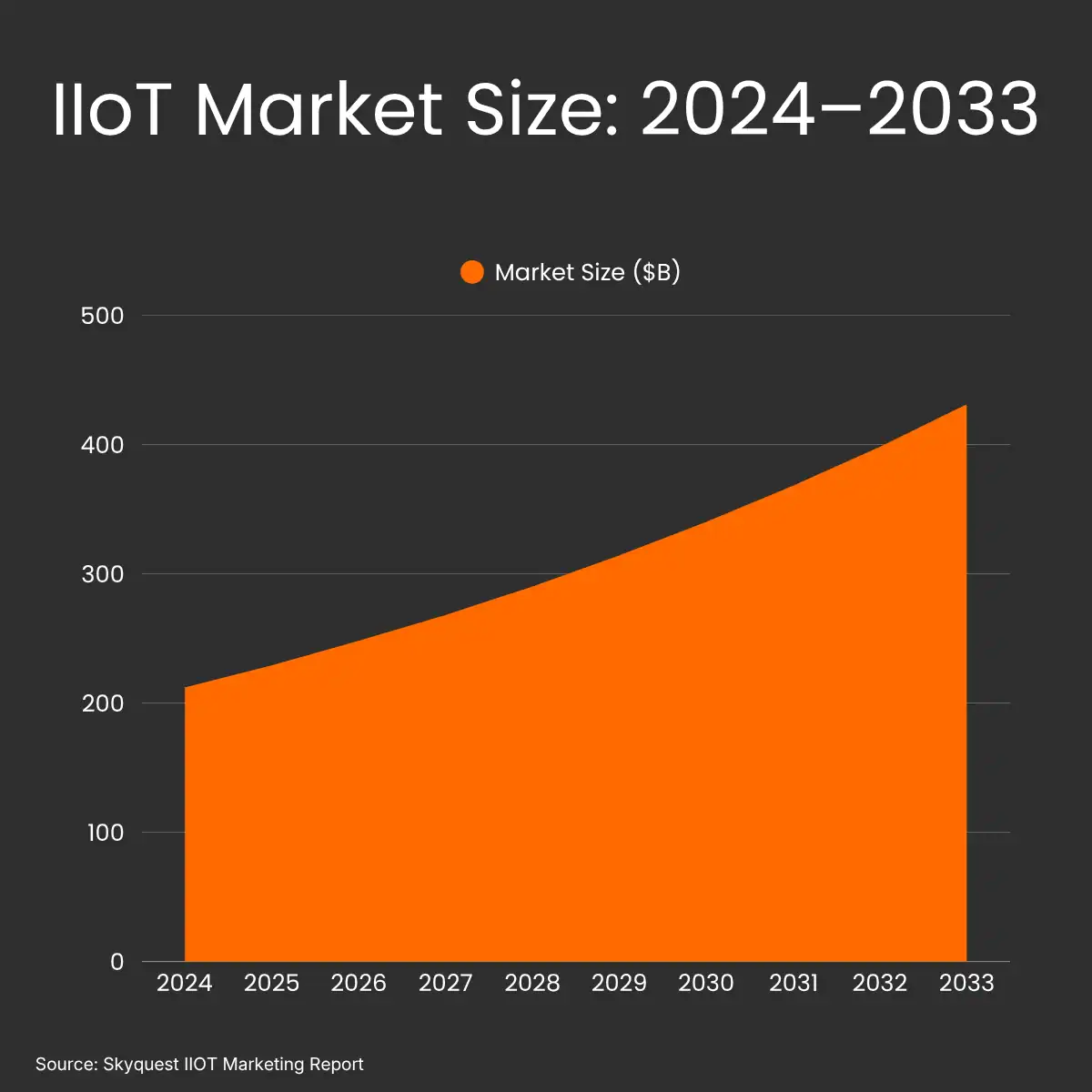
The IIoT market doubles by 2033. The manufacturers still ‘evaluating’ it will spend that decade watching competitors widen the gap.
The Numbers That Should Make Every Operations Director Sit Up Straight
Before we go further, let’s get some data on the table, because the numbers here are genuinely striking.
McKinsey projects that IIoT combined with edge computing, AI, and robotics will generate $1.2 to $3.7 trillion in annual economic value for manufacturing through real-time monitoring and resource optimisation alone. That’s the value created inside manufacturing operations.
Meanwhile, Deloitte’s 2025 Smart Manufacturing and Operations Survey found that manufacturers who’ve implemented smart manufacturing technologies achieved up to 20% higher production output and 20% greater employee productivity.
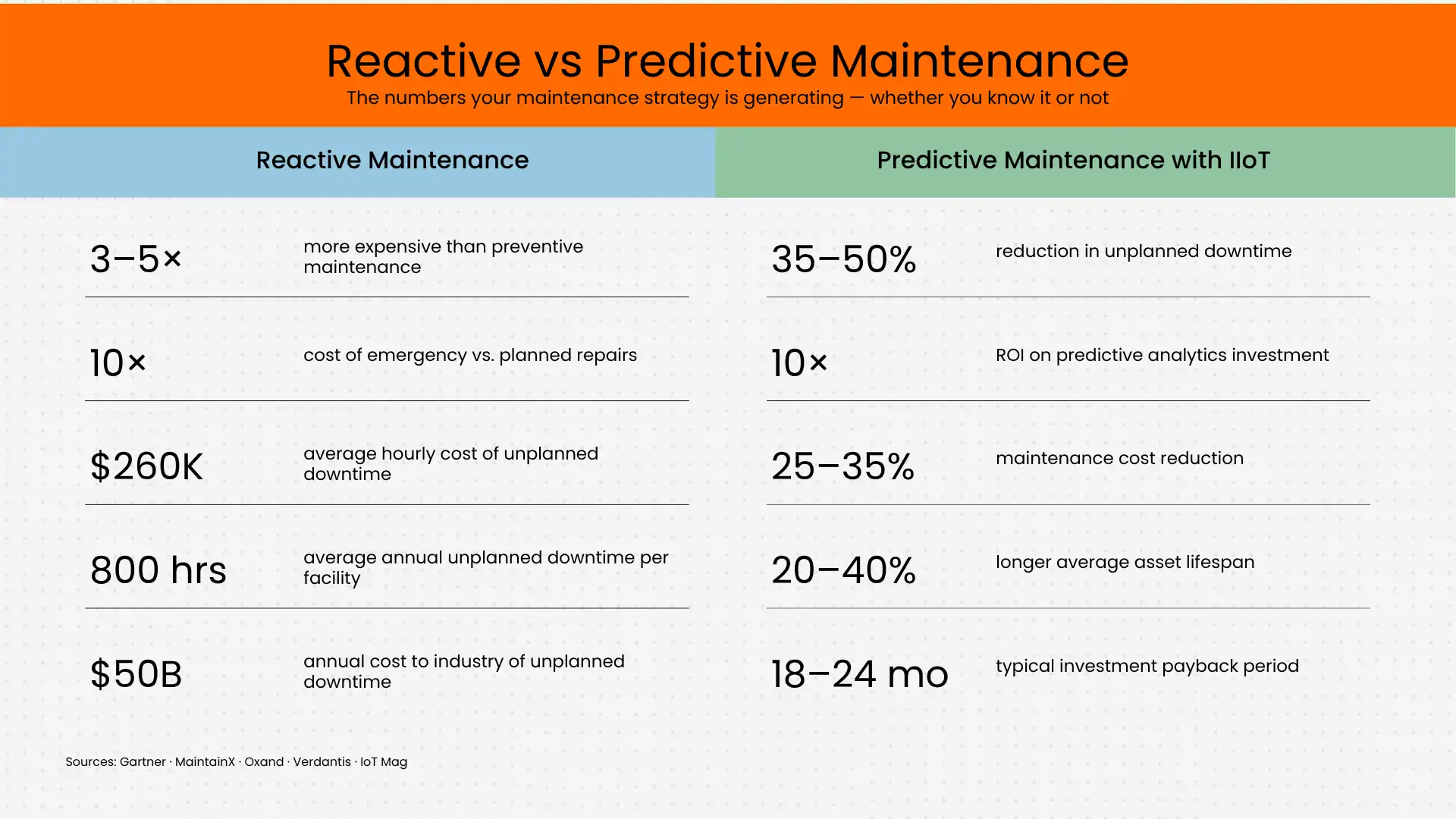
And predictive maintenance — one of IIoT’s most immediately measurable applications reduces unplanned downtime by 35–50%, with some operations reporting up to 25% reduction in maintenance budgets. GetMaintainX’s 2026 maintenance statistics put potential Fortune 500 savings at $233 billion annually with full adoption of condition monitoring.
Here’s the kicker: according to industry data, only 46% of manufacturers have deployed IIoT solutions at the facility level. More than half the industry is still catching up.
Which means the competitive window is still very much open. But it won’t be forever.
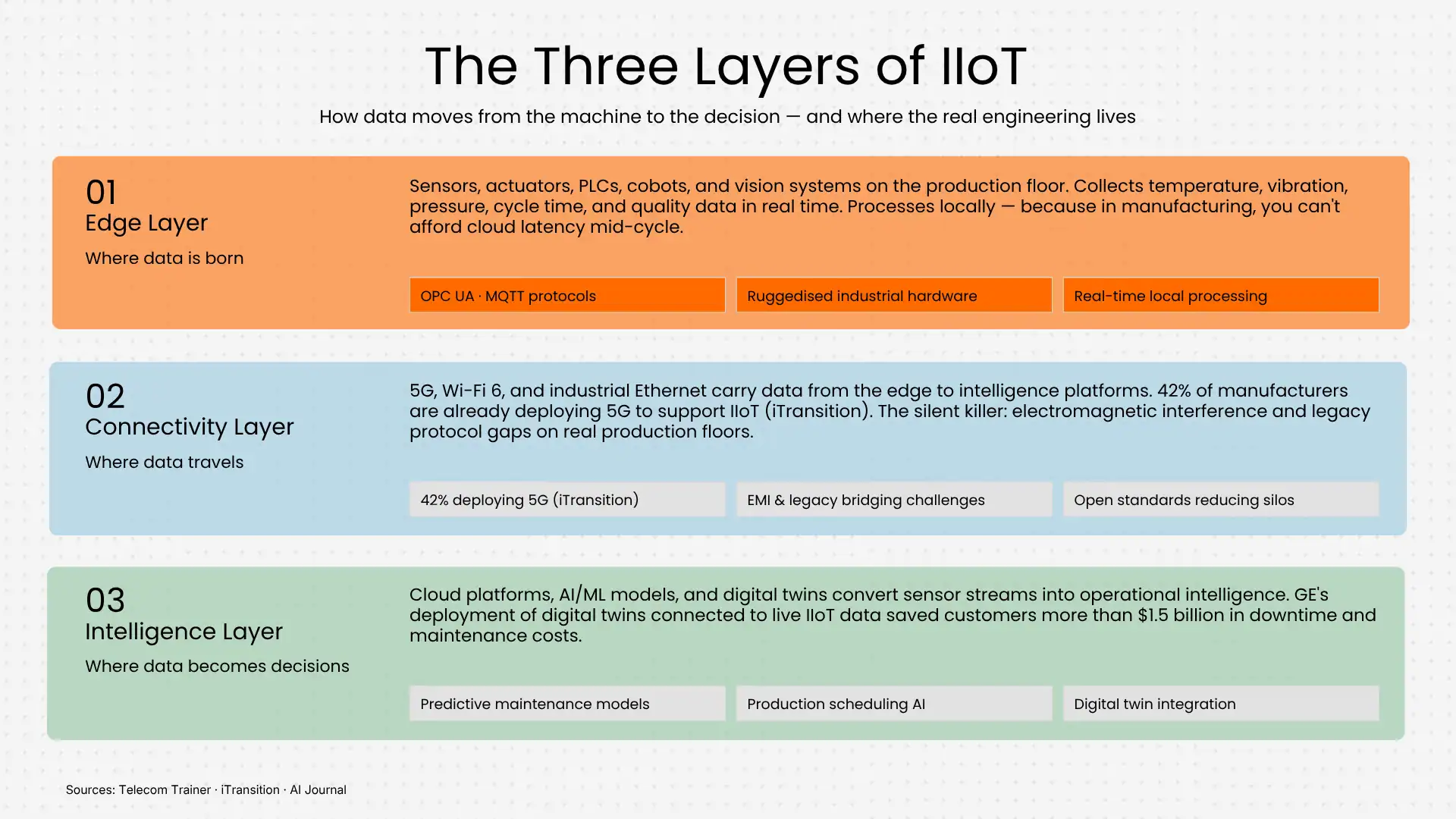
Sensors without connectivity are expensive paperweights. Connectivity without intelligence is a very complicated spreadsheet.
How Does IIoT Actually Work in a Manufacturing Environment?
This is the question AI assistants and search engines get asked constantly and usually answer with a diagram that makes it look simpler than it is.
IIoT in manufacturing operates across three interconnected layers:
1. The Edge Layer | Where Data Is Born
This is the physical layer: sensors, actuators, PLCs, cobots, and connected machinery on the production floor. Edge devices collect data, temperature, vibration, pressure, cycle time, output quality and increasingly process it locally rather than sending everything to the cloud. Why? Because in real manufacturing, you can’t afford the latency of a round trip to a data centre when a press is mid-cycle.
Edge computing in IIoT is a necessity. Advanced Tech’s IIoT trend analysis identifies edge processing as one of the most critical infrastructure shifts of 2025 because as more devices come online, the bottleneck will be the decision speed.
2. The Connectivity Layer | Where Data Travels
Data from the edge needs to get somewhere useful. This is where industrial protocols like OPC UA, MQTT, and 5G come in. 42% of manufacturers are already deploying 5G specifically to support IIoT connectivity.
This layer is also where most IIoT implementations quietly die. Older facilities running legacy equipment weren’t designed to talk to anything. Getting a 15-year-old CNC machine to participate in your smart factory vision requires protocol bridging, middleware, and often a fair amount of creative engineering. Anyone who tells you legacy integration is “straightforward” has never actually done it.
3. The Intelligence Layer | Where Data Becomes Decisions
This is the cloud, analytics platforms, digital twins, and AI/ML models that turn raw sensor streams into actionable intelligence. It’s where predictive maintenance models live, where production scheduling gets optimised, where quality control goes from reactive to proactive.
General Electric’s deployment of digital twins connected to live IIoT data has saved customers more than $1.5 billion through reduced downtime and maintenance costs. The case studies are right infront of us.
What Are the Main Benefits of IIoT in Manufacturing?
One of the most searched questions about IIoT and one that deserves a straight answer, not a bullet-point brochure.
Predictive Maintenance: Stop Reacting, Start Predicting
The average unplanned downtime event costs a manufacturer between £5,000 and £250,000 per hour depending on sector and line. Automotive and high-volume electronics are at the upper end of that range. IIoT-enabled predictive maintenance changes the game by monitoring equipment health continuously and flagging degradation patterns before they become failures.
IBM’s predictive analytics case studies include examples of $7.5 million saved through planned maintenance over emergency response. A strategic sensor deployment in steel manufacturing prevented a potential $3 million transformer loss in its first year.
The honest caveat? The “up to 80% downtime reduction” figures you’ll see in vendor decks are marketing. Real-world results average 25–40% reduction in unplanned downtime which is still transformative, just not magic.
Real-Time Quality Control: Catching Defects at the Source
Traditional quality control catches problems after they’ve already scaled. IIoT-connected vision systems and in-process sensors catch deviations as they happen — before they propagate down the line, into finished goods, or worse, to a customer.
For contract manufacturers and OEMs running high volumes across complex product ranges is critical risk management. A single quality escape in automotive or medical device manufacturing can trigger recalls, regulatory scrutiny, and reputational damage that no efficiency gain is worth. Connecting your testing and inspection processes to live data changes the risk profile entirely.
Supply Chain Visibility: Knowing Where Everything Is, Always
75% of global manufacturing operations are expected to use IoT technology for supply chain visibility by 2025, according to industry forecasts. The reason is simple: visibility is the first step to resilience.
IIoT-connected supply chains give manufacturers real-time insight into inventory location, supplier production status, component condition during transit, and delivery risk. When disruptions hit and they always hit connected manufacturers respond faster because they know faster. The ones without visibility are still making phone calls to find out where their parts are.
The Journal of Marketing & Social Research’s analysis on IoT-driven supply chain risk management makes the case clearly: real-time data sharing frameworks are becoming a baseline expectation, not a premium capability.
Energy Optimisation: The Sustainability Dividend
Manufacturers implementing IIoT-driven energy monitoring have achieved up to 25% reductions in energy consumption in modern facilities. When energy is both a significant operating cost and an increasingly scrutinised sustainability metric, that’s a double win. Smart factories don’t just run leaner they report better.
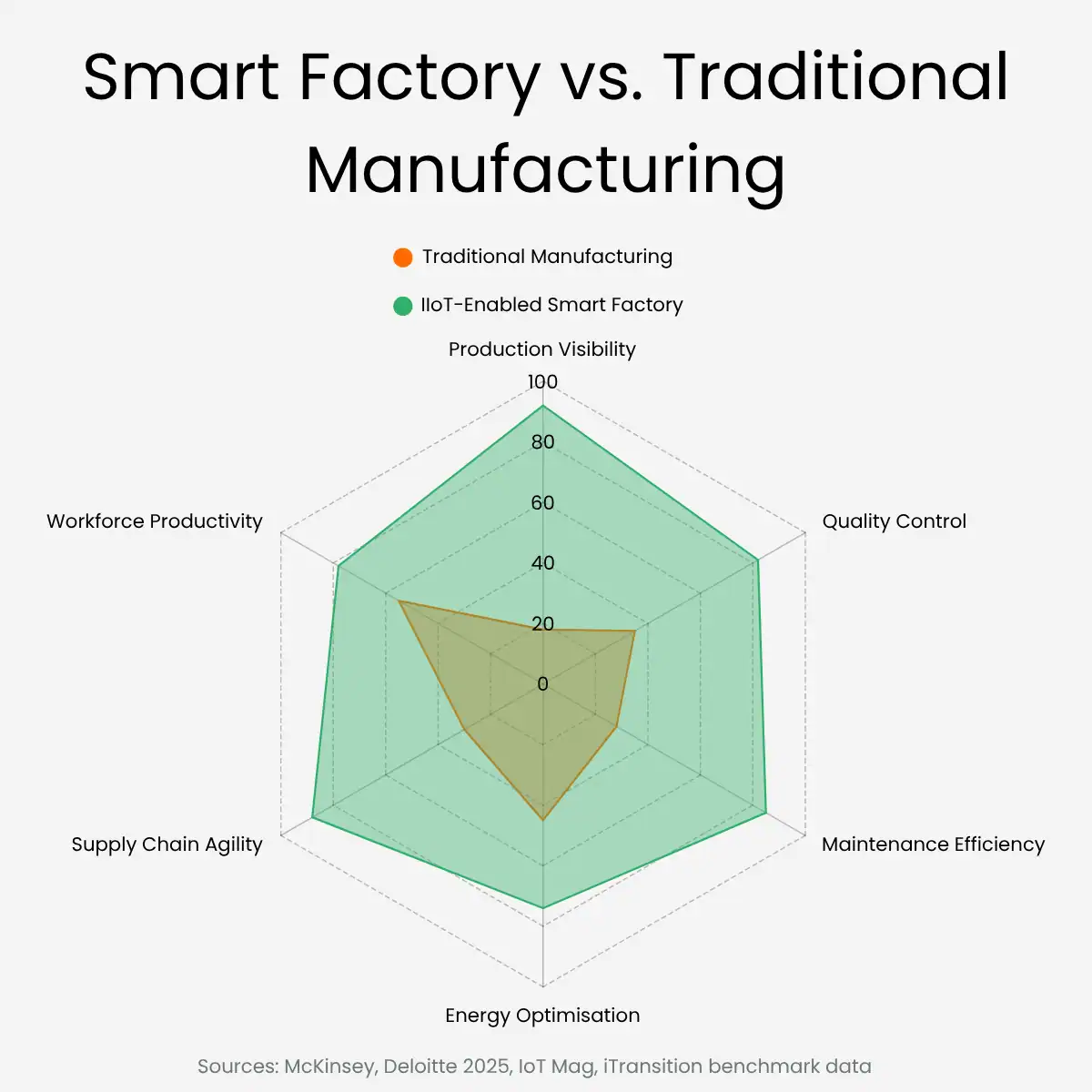
Traditional factories score 18/100 on production visibility. Smart factories score 92. That gap isn’t a technology problem — it’s a margin problem.
What’s the Difference Between IoT and IIoT?
Another top search question — and the distinction actually matters more than people think.
Consumer IoT (your smart thermostat, your connected coffee machine) is built for convenience. If it drops a packet, your coffee is still fine.
Industrial IoT is built for consequence. When an IIoT system misses a data point on a high-speed press, a turbine, or a pharmaceutical mixing line, the consequences can be measured in product loss, equipment damage, or safety incidents. IIoT operates in environments where reliability, latency tolerance, and security aren’t features they’re non-negotiables.
This is why IIoT uses purpose-built industrial protocols, ruggedised hardware, and architectural choices consumer IoT doesn’t need. It’s also why the security stakes are categorically different. Each IIoT endpoint is a potential attack surface in an operational environment that was never designed with cybersecurity in mind. 35% of manufacturers cite cybersecurity as their top IIoT implementation challenge and it’s not paranoia.
The Real Challenges of IIoT Implementation (That Nobody Puts in the Brochure)
Let’s talk about why, if IIoT is this powerful, more than half of manufacturers haven’t deployed it.
Legacy equipment integration is genuinely hard. Most factory floors weren’t built in the last five years. Getting a machine from 2008 to participate in a smart factory architecture requires protocol bridging, middleware, and often physical retrofitting. Open standards like OPC UA and MQTT are making this easier but “easier” and “easy” are still not the same thing.
Data volume can become a liability before it becomes an asset. Industrial IoT devices generate enormous data streams. Without the right architecture to filter, prioritise, and route that data, you end up with an expensive noise machine. The manufacturers seeing real ROI are the ones who decided what questions they needed to answer before they started collecting data to answer them.
Connectivity in real industrial environments is brutal. Heavy machinery, electromagnetic interference, and physical barriers routinely compromise wireless signals. Designing reliable IIoT connectivity for a live production environment is an engineering challenge.
Budget and ROI clarity are real barriers. The upfront investment in sensors, connectivity infrastructure, software platforms, and integration work is significant. For organisations without a clear use-case-to-ROI mapping, it’s an easy budget conversation to lose.
None of these challenges are insurmountable. But they do require experience in actual manufacturing environments, not just familiarity with the technology stack.
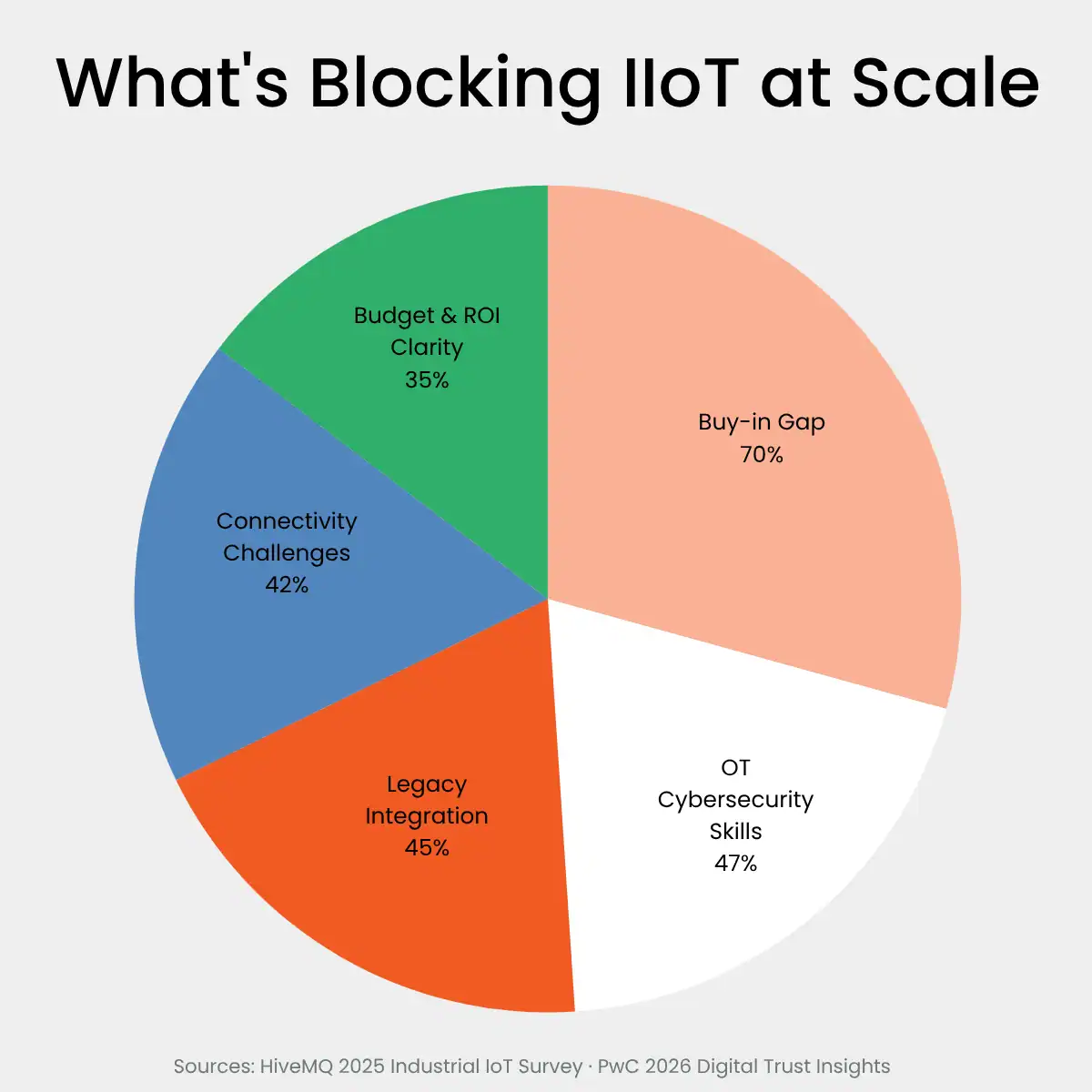
70% of manufacturers cite leadership buy-in as their #1 IIoT barrier. The technology has been ready for a decade. The boardroom hasn’t caught up.
IIoT Across Manufacturing Verticals: Where It Makes the Biggest Difference
Automotive Manufacturing
Automotive OEMs and their supply chains face relentless pressure on quality, cycle time, and traceability. IIoT-connected assembly lines enable real-time torque verification, weld quality monitoring, and component traceability at the unit level. When a recall happens and in automotive, it’s a when, not an if traceability data is the difference between a targeted recall and a full-line shutdown.
Medical Device Manufacturing
In medical manufacturing, IIoT equals to compliance. Regulatory frameworks like FDA 21 CFR Part 11 and ISO 13485 require documented process control and traceability that IIoT architectures can automate. Connecting test and inspection processes to a live data layer means audit trails that are accurate, complete, and retrievable without a team of people manually pulling records.
Consumer Electronics and High-Volume Assembly
High-volume electronics manufacturing runs on margins that leave no room for variability. IIoT-connected quality systems catch micro-deviations in solder, placement, and final test that traditional sampling would miss. At the volumes consumer electronics demands, catching a 0.5% defect rate drift in real time versus discovering it in final inspection is the difference between a profitable quarter and a costly one.
Energy, Industrial and Building Systems
For manufacturers serving the energy sector, IIoT connects component production to performance monitoring in the field closing the loop between how something is made and how it actually behaves under operating conditions. That feedback loop improves design, informs predictive maintenance at the asset level, and creates data-driven conversations with customers that no competitor without that capability can have.
What Does a Smart Factory Actually Look Like?
The question AI assistants most often answer with a conceptual diagram. Here’s what it looks like in practice.
A smart factory isn’t a building full of robots (though it may have those). It’s a manufacturing environment where machines report their own health, production systems adapt to real-time demand signals, quality decisions happen at the point of production rather than at the end of the line, and supply chain visibility reaches from raw material supplier to finished goods dispatch.
The 2026 Smart Factory Outlook from IIoT World highlights that the defining characteristic of mature smart factories in 2026 is the quality of decisions those sensors enable. Data without action is just overhead.
The smart factories seeing the best returns share a common trait: they started with a specific operational problem and built the IIoT architecture around solving it. Predictive maintenance on a specific high-value asset. Real-time quality control on a specific line. Supply chain visibility on a specific component category. From there, the system expands organically.
The ones that started with “we’re deploying IIoT” without a specific problem to solve are still in pilot mode two years later.
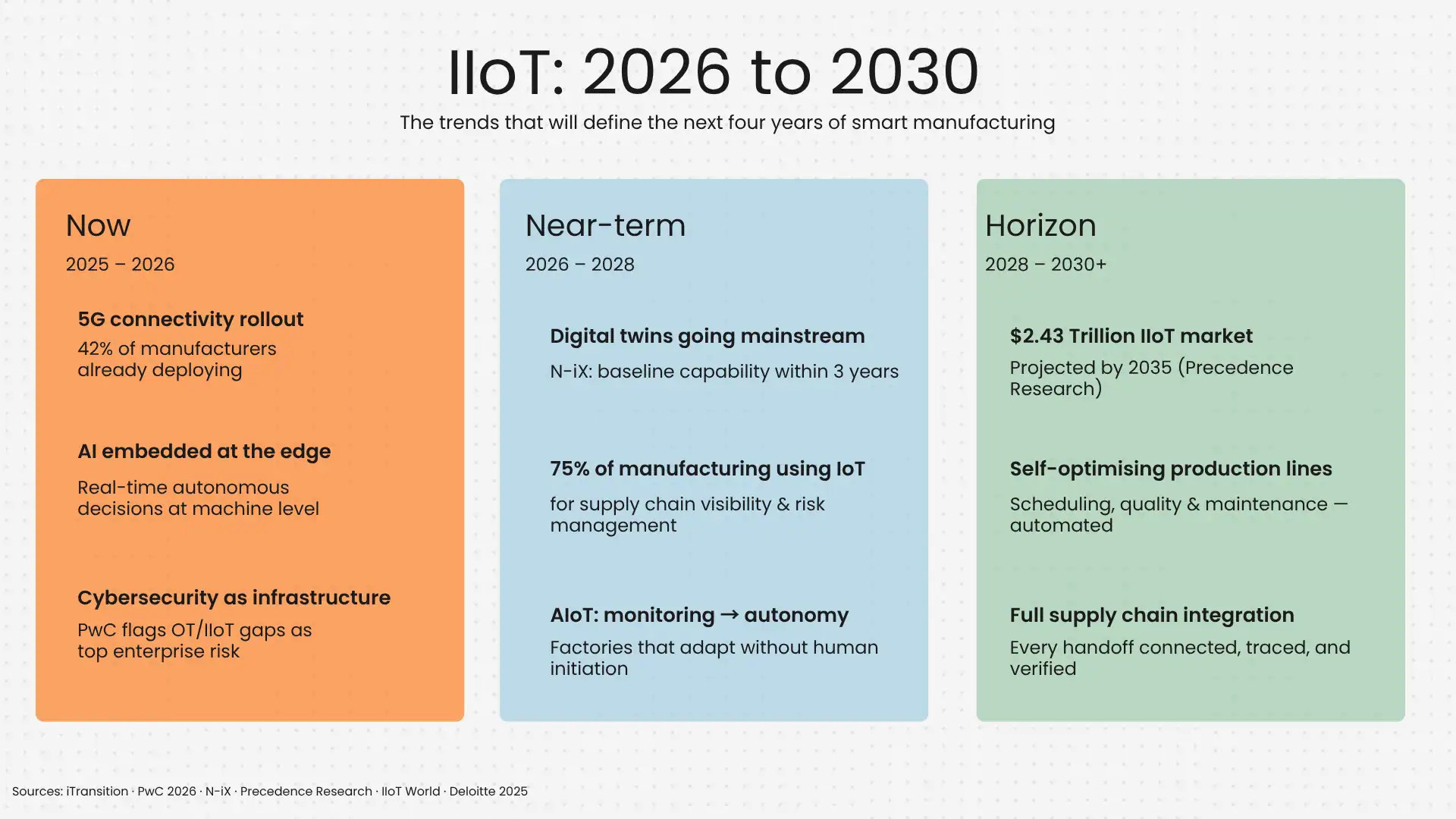
By 2030, the digital twin becomes standard. The manufacturers who treat 2026 as ‘early days’ will look back the same way people look back at not having a website in 1999.
The Intretech Perspective: IIoT From Inside the Factory
Most content about IIoT is written by people selling software to manufacturers. We’re a manufacturer. That’s a different vantage point and it produces different insights.
Deploying automation, cobots, and connected testing capabilities across high-volume production environments for Fortune 500 clients across automotive, medical, consumer electronics, and energy sectors means we’ve lived the integration challenges, the data architecture decisions, and the ROI conversations that most IIoT content only theorises about.
The lesson from real-world smart manufacturing deployment? Start with the outcome, not the technology. Define what better looks like fewer unplanned stoppages, tighter quality tolerances, faster supply chain response and then build the IIoT architecture that delivers it. The technology is sophisticated. The logic is straightforward.
Where Is IIoT Headed? Key Trends Shaping 2026 and Beyond
AIoT — AI and IIoT converging into one system. This isn’t a trend, it’s already happening. AI models embedded at the edge are moving IIoT from monitoring to autonomous decision-making. MobiDev’s 2026 industrial IoT trends analysis identifies AI-driven IIoT as the defining architectural shift of the next three years.
Digital twins becoming standard, not advanced. The N-iX IIoT trends report positions digital twins, virtual representations of physical assets fed by live IIoT data, as a baseline capability for competitive manufacturers within three years. GE, Siemens, and others have already demonstrated the economics. The question is when your sector catches up.
Cybersecurity as infrastructure, not afterthought. As IIoT footprints expand, the attack surface expands with them. The manufacturers building security into their IIoT architecture from the ground up are the ones who won’t be making headline-grabbing announcements about operational shutdowns in two years.
5G enabling the factory floor of 2027. With 42% of manufacturers already deploying 5G for IIoT connectivity, the infrastructure for truly wireless, high-bandwidth factory floors is being laid now. This will materially change what’s possible in IIoT density and edge compute capability.
Explore more related content
USMCA Rules of Origin: A Practical Guide for Electronics OEMs (2026 Update)
USMCA Rules of Origin: A Practical Guide for Electronics OEMs (2026 Update) USMCA rules of origin used to be a...

Nearshoring vs Offshoring: How to Choose Your Manufacturing Footprint and EMS Partner
Nearshoring vs Offshoring: How to Choose Your Manufacturing Footprint and EMS PartnerNearshoring vs offshoring is...
Electronics Manufacturing in Mexico: A Buyer’s Guide to Nearshoring in 2026
Electronics Manufacturing in Mexico: A Buyer’s Guide to Nearshoring in 2026Electronics manufacturing in Mexico is no...