

Key Steps in the Strategic Sourcing Process


Most companies don’t have a strategic sourcing process. They have a procurement habit dressed up in a PowerPoint deck.
There’s a difference. And that difference is why McKinsey has repeatedly found that the average company captures less than half of the savings potential locked up in their supplier base. It’s why your CFO keeps asking why margins aren’t moving. It’s why your “preferred supplier list” is a graveyard of relationships nobody remembers signing.
Strategic sourcing isn’t procurement with a thesaurus. Done right, it’s one of the few levers left in a mature business that can move EBITDA by double digits without firing anyone or shipping a new product. Done wrong – which is most of the time – it’s a compliance exercise that quietly costs you market share.
Let’s get into what actually works.
Introduction to Strategic Sourcing
What strategic sourcing actually is (and isn’t)
Strategic sourcing is the disciplined process of analyzing what an organization buys, who it buys from, and how those decisions affect competitive position – then redesigning the supply base to maximize long-term value rather than short-term price.
That definition matters. Notice what’s missing: the word “savings.”
Cost reduction is an outcome of strategic sourcing. That is not the point. The moment you make it the point, you’ve turned procurement into a hostage negotiation and your suppliers will start treating you accordingly.
The textbook strategic sourcing definition usually reads something like “a systematic approach to optimizing an organization’s supply base.” Fine. But strip out the consultant-speak and what you actually have is this: deciding what’s worth buying from whom, and building relationships that compound in your favor over years, not quarters.
“Purchasing must become supply management. Top management has not yet recognised that what it really requires is a complete change in the nature of purchasing’s role.” — Peter Kraljic
Why it matters for supply chain management
Here’s the uncomfortable part. Your supply chain isn’t a logistics problem. It’s a strategy problem disguised as a logistics problem.
When Apple sources a custom component, they aren’t running a procurement process. They’re locking in a competitive moat. When a tier-one automotive supplier consolidates spend with a single titanium fabricator, they’re not just negotiating a discount – they’re betting that supplier becomes capacity-constrained for everyone else. That’s strategic sourcing in supply chain management. Everything below that level is just buying.
Most organizations operate two to three tiers below that. Their “sourcing strategy” is whoever the last buyer set up in SAP. The result: fragmented spend, redundant suppliers, no leverage, and a procurement team that spends 80% of its time chasing POs instead of building advantage.
Key benefits of strategic sourcing
The brochure version of the benefits looks like this:
- Lower total cost of ownership
- Reduced supplier risk
- Better quality and reliability
- Stronger innovation pipeline
- Improved compliance
All real. All boring. The actual benefit – the one that gets undersold – is optionality. A mature strategic sourcing function gives leadership choices it didn’t have before. Want to enter a new market? Your suppliers can scale. Want to launch a product six months early? Your partners have the engineering bandwidth. Want to weather a tariff spike or a geopolitical shock? You have multi-region capacity already qualified.
Companies that treat strategic sourcing as a cost function get savings. Companies that treat it as a capability function get resilience. Guess which ones outperformed during 2020-2023.
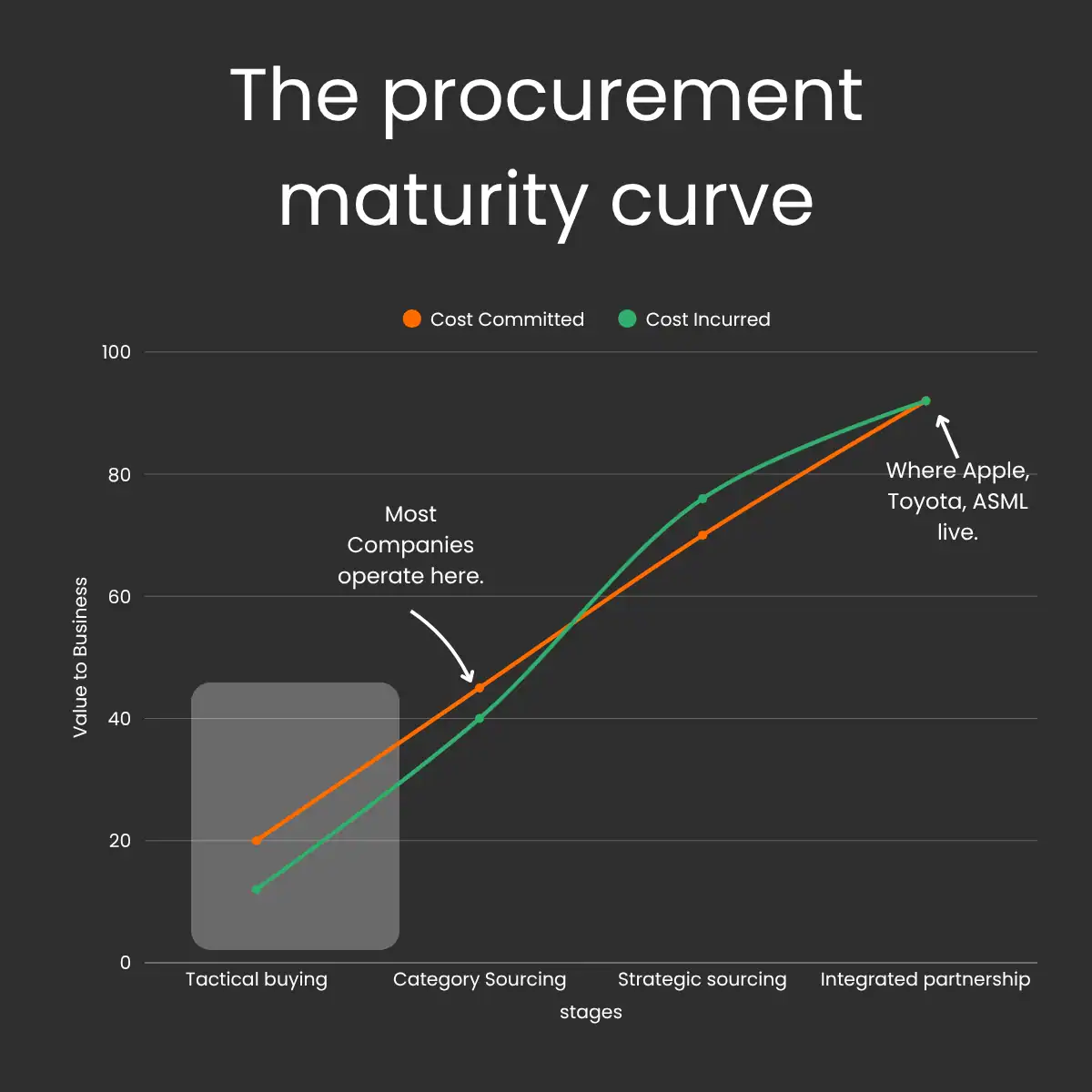
In Hackett Group’s World-Class Procurement benchmarking, the top-quartile procurement organizations generate roughly 2x the savings per dollar of procurement spend compared to the median — and operate with 18% lower procurement cost.
The Seven Step Strategic Sourcing Process
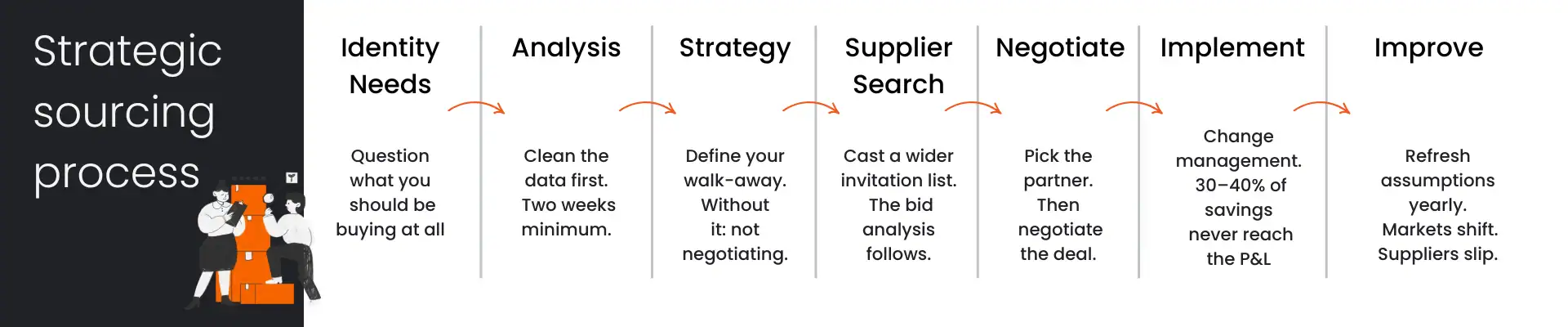
Every consulting firm sells a slightly different version of the seven step strategic sourcing process. The labels move around. The substance doesn’t. Here it is, with the contrarian take baked in.
Step 1: Identify needs
The naive version: figure out what you’re buying.
The real version: figure out what you should be buying. There’s a difference.
Most “needs identification” exercises are just transcribing what’s already in the system. That’s an audit, not a strategy. The actual work is asking the heretical questions: Why are we buying this category at all? What are we buying because of habit, not because of value? What’s specified in our drawings that no engineer has questioned in eight years?
If you can’t list three categories where the answer is “we don’t actually need this,” you haven’t done step one. You’ve just made a list.
Step 2: Conduct sourcing analysis
This is where most teams turn to the spreadsheet and lose the plot.
Sourcing analysis isn’t a spend cube. It’s a diagnostic that answers three questions: Where does our spend actually go (not where finance says it goes)? What’s the supply market doing? And where is our leverage strongest and weakest?
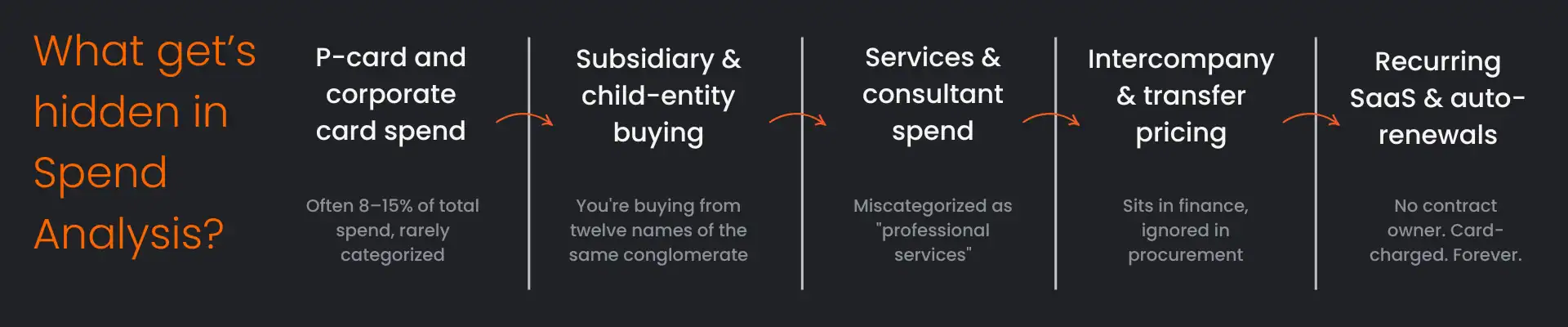
You’d be amazed how often the answer to question one is “we don’t know.” Spend data sits across ERPs, p-cards, AP files, and the rogue invoices nobody categorizes. Until you’ve spent two weeks cleaning that data, every downstream conclusion is suspect.
Step 3: Define sourcing strategy
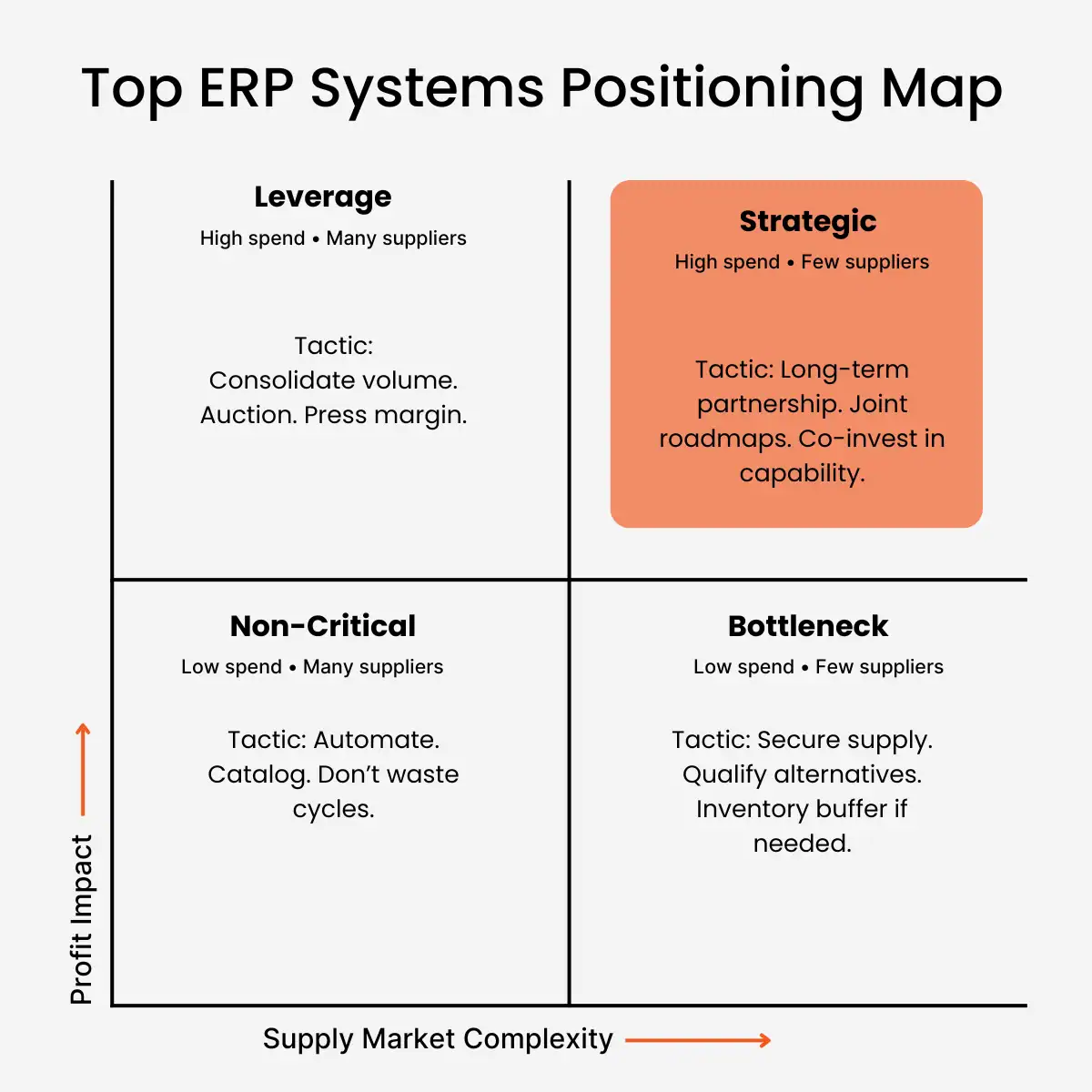
Here’s where consultants love to draw a 2×2: high spend / low spend on one axis, complex / simple supply market on the other. Kraljic’s matrix, if you’ve been around long enough.
The matrix isn’t wrong. It’s just too clean. Real categories don’t fit neatly into “leverage” or “strategic” boxes. A category that looks like a commodity (steel) becomes strategic the moment your only qualified mill goes offline. A category that looks strategic (custom electronics) becomes a commodity once three credible alternatives qualify.
A useful sourcing strategy answers four questions per category:
- Who do we want to buy from in three years?
- What does our spend need to look like to get there?
- What capabilities do we need that supplier to develop?
- What’s our walk-away?
If your sourcing strategy doesn’t answer the fourth question, you’re not negotiating. You’re hoping.
“You can’t manage what you can’t measure. And in procurement, most organizations have spent so much on systems and so little on data quality that they’re managing a fiction of their own spend.” — Christopher Sawchuk, Global Procurement Advisory Practice Leader, The Hackett Group
Step 4: Conduct supplier sourcing process
This is the part everyone thinks is the whole job. RFIs, RFPs, RFQs. Issue, collect, evaluate.
Fine. But the supplier sourcing process is only as good as the suppliers you invite. And here’s where most teams get lazy: they invite the incumbent, two competitors who look identical to the incumbent, and one wildcard. Then they’re shocked when the bids cluster within 4%.
Real supplier sourcing strategies cast a wider net. They include suppliers from adjacent industries who could enter your category. They include geographic alternatives – not because offshore is cheaper, but because optionality has value. They include the supplier nobody invited because they’re “too small” but happen to have a capability nobody else does.
Spend the time on the invitation list. The bid analysis takes care of itself.
Step 5: Negotiate and select suppliers
The negotiation phase is where strategic sourcing either earns its name or becomes a haggling exercise.
The contrarian truth: the suppliers who give you the deepest discount in negotiation are usually the ones who’ll quietly extract margin back through change orders, scope creep, and quality slippage over the contract term. Total cost of ownership matters. So does the question of whether your supplier still wants to take your call in year three.
Pick the partner. Negotiate the deal. Not the other way around.
Step 6: Implement contracts
Where good sourcing strategies go to die.
Industry research consistently shows that a substantial chunk of negotiated savings – often estimated at 30-40% – never makes it to the P&L because of poor contract implementation. People keep buying off-contract. Specs drift. The savings exist on paper and nowhere else.
Contract implementation isn’t an admin task. It’s a change management problem. If your stakeholders don’t know about the new contract, don’t trust it, or have a reason to bypass it, your sourcing project failed the moment the ink dried.
Step 7: Continuous improvement
The seventh step is the one most companies skip. They run the process, declare victory, and move on to the next category.
Then two years pass, market conditions change, the supplier gets complacent, and you’re back where you started. Strategic sourcing isn’t a project. It’s an operating model. The categories you sourced last year need a refresh this year – not a full reset, but a check on assumptions, a review of supplier performance, and a recalibration of the strategy.
Companies that treat sourcing as a one-and-done eventually rediscover the same opportunity they “captured” three years prior. The category never changed. They just stopped paying attention.
A.T. Kearney’s Assessment of Excellence in Procurement benchmarks consistently show that fewer than 20% of organizations execute all seven steps of the strategic sourcing process with measurable rigor, even among those that claim to have a “strategic sourcing function.” — A.T. Kearney AEP study
Strategic Sourcing Methodologies
Overview of sourcing strategies
There’s no one-size-fits-all sourcing strategy, and anyone selling you one is selling you a hammer for a screw.
Common methodologies include:
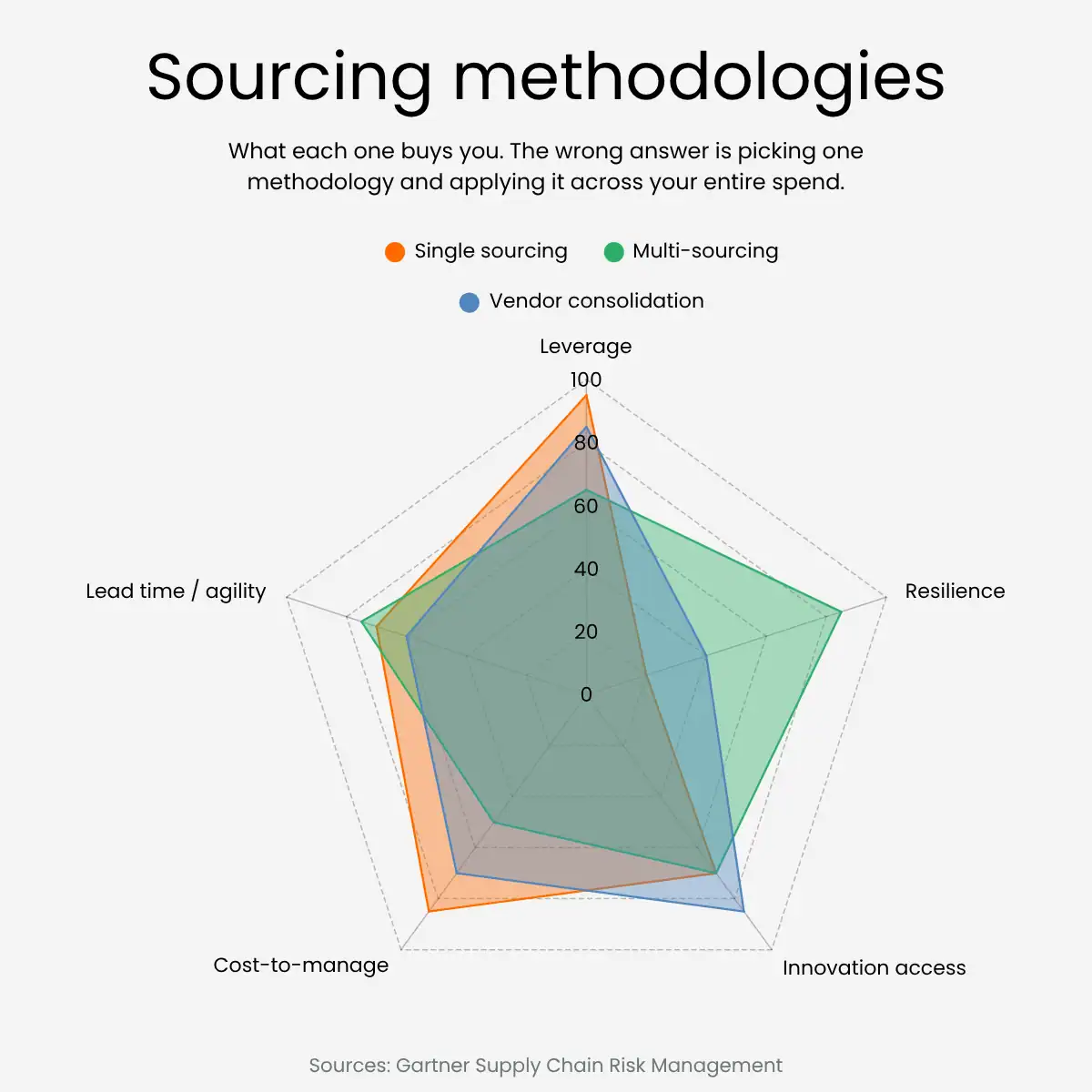
- Single sourcing: one supplier per category. Maximum leverage, maximum risk.
- Dual or multi-sourcing: two-plus qualified suppliers. Less leverage, more resilience.
- Global sourcing: chasing the best capabilities anywhere on the planet.
- Local or regional sourcing: prioritizing proximity for lead time, agility, or geopolitical reasons.
- Vendor consolidation: fewer, deeper relationships with strategic partners.
- Vendor diversification: broader base to mitigate concentration risk.
The right answer depends on the category, the market, and your risk tolerance. The wrong answer is picking one methodology and applying it across your entire spend.
Elements of strategic sourcing
Strip strategic sourcing down to its load-bearing elements and you get five:
- Data: clean, current, and granular enough to make decisions.
- Market intelligence: knowing what suppliers can and can’t do, and what they cost others.
- Cross-functional alignment: engineering, operations, finance, and procurement on the same page.
- Negotiation discipline: getting what’s worth getting, walking away from what isn’t.
- Governance: making sure the deal you negotiated is the deal you actually live with.
Skip any of those and the rest of the process gets thinner. Most failures map back to one of these five.
CIPS research consistently finds that total cost of ownership across a contract typically runs 25–40% higher than the original purchase price — and that the gap is widest for suppliers selected primarily on lowest bid.
Best practices in procurement strategic sourcing
The list of strategic sourcing best practices in most articles reads like wallpaper. Here are the ones that actually move the needle:
- Stop sourcing in isolation. If engineering isn’t in the room when you’re sourcing engineered components, you’re guessing.
- Build supplier scorecards before the contract, not after. If you can’t tell the supplier exactly how you’ll measure them on day one, you’ll be arguing about it on day 200.
- Treat your top suppliers like partners. Share forecasts. Co-invest in tooling. Bring them into product roadmaps. The 5% you “lose” in negotiation comes back tenfold in capability.
- Walk away occasionally. Suppliers who never see you walk away will stop offering their best price.
- Audit your own demand. Half the savings in any category come from buying smarter, not negotiating harder.
Sourcing Analysis Techniques
Spend analysis
Spend analysis is the foundation. Done well, it answers: where is the money going, who’s it going to, and what categories does it fall into?
Done badly – which is most of the time – it produces a Pareto chart that nobody acts on.
The unglamorous truth: 70% of the value of a spend analysis is in the data cleansing. Mapping suppliers to parents (so you realize you’re buying from twelve subsidiaries of the same conglomerate). Normalizing categories. Reconciling what AP records with what’s actually being delivered. Until that’s done, every chart you produce is decorative.
Market analysis
Market analysis tells you what’s happening outside your four walls. Are raw material prices rising? Is supplier capacity tight? Are new entrants disrupting incumbents?
The mistake: assuming your suppliers will tell you any of this voluntarily. They won’t. Their job is to manage your perception of the market. Yours is to develop independent intelligence through industry reports, supplier site visits, trade publications, and conversations with peers.
Supplier assessment
Supplier assessment is where most teams default to a one-page questionnaire and a credit check.
A serious assessment looks at financial health, operational capability, quality systems, geographic footprint, customer concentration (are you 60% of their revenue? 0.6%?), innovation pipeline, sustainability practices, and cultural fit. The last one matters more than people admit. A technically capable supplier with a transactional culture will never be a real partner, no matter how good the spec sheet looks.
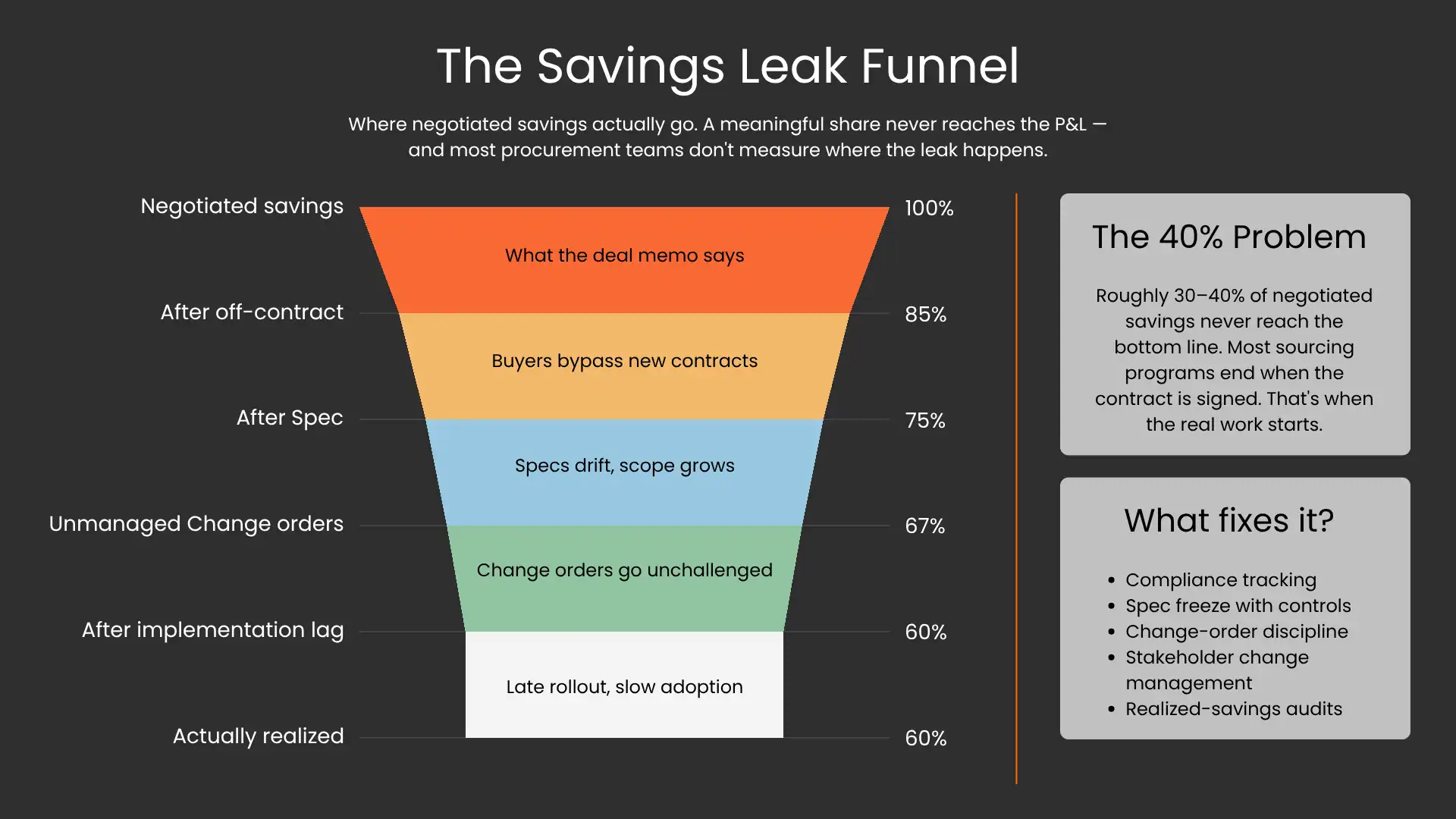
“Roughly 30–40% of negotiated procurement savings fail to reach the P&L due to contract leakage, off-contract spend, specification drift, unmanaged change orders, and weak compliance tracking.” — Aberdeen Group
Enhancing the Strategic Sourcing Process
How to improve strategic sourcing
If you want to improve your strategic sourcing function, the lever isn’t more process. It’s better questions.
Start here:
- What percentage of our addressable spend is actually under management today? (If the answer is “I’m not sure,” start there.)
- How many of our top 50 suppliers have we visited in the last twelve months?
- What contracts expire in the next ninety days that nobody is actively re-sourcing?
- Where are we paying for capabilities we don’t use, or paying twice for capabilities we already have internally?
Most procurement organizations are starved for time, not for ideas. The improvements aren’t hidden. They’re just deprioritized.
Role of technology in sourcing
The procurement tech stack has exploded over the last decade. Sourcing platforms, spend analytics tools, contract lifecycle management, supplier risk monitoring, e-auctions, AI-driven negotiation support. Some of it is genuinely transformative. Most of it is expensive shelfware.
Here’s the honest read: technology amplifies the maturity you already have. If your processes are sound, the right platform makes you faster and sharper. If your processes are broken, software won’t fix them and it’ll just produce broken outputs at higher velocity.
Buy tools when you’ve outgrown spreadsheets and your team can articulate exactly what they’ll do differently with the new system. Buy them earlier and you’re paying for digital theater.
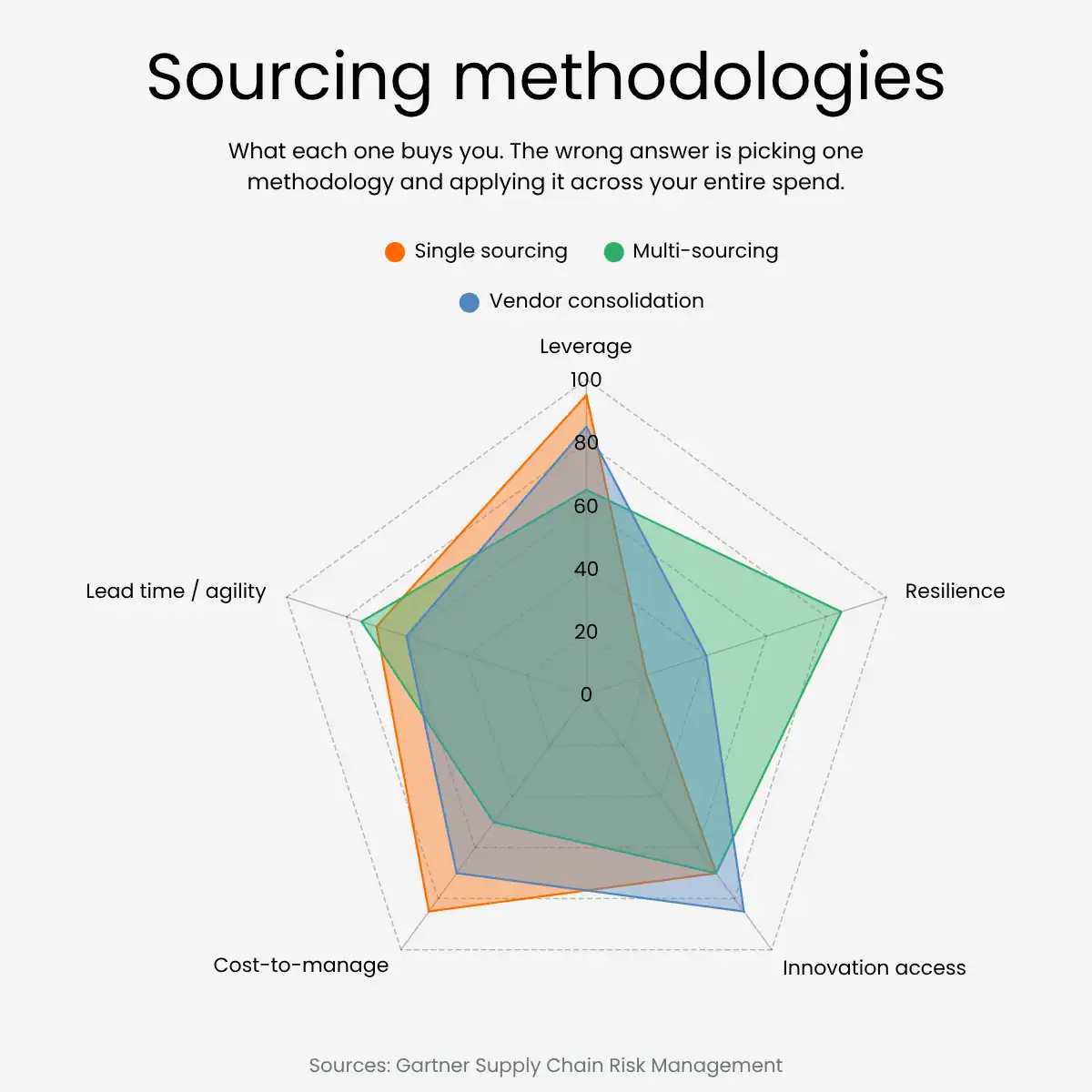
Single sourcing concentrates risk in exchange for leverage. Multi-sourcing distributes risk in exchange for management cost. The right answer is portfolio-level, not category-level and almost never a single strategy across all spend.
Strategic sourcing and vendor management
Strategic sourcing and vendor management are often treated as the same function. They’re not. Sourcing decides who you buy from. Vendor management runs the relationship after the contract is signed.
A great sourcing decision badly managed becomes a terrible relationship. A merely okay sourcing decision well managed becomes a great relationship. The handoff between the two – the moment when the deal goes from a contract to an operating reality – is where most of the negotiated value either gets realized or quietly evaporates.
The teams that win at this build sourcing and vendor management as one continuous loop, not two siloed handoffs. Performance data flows back into the next sourcing cycle. Issues caught in vendor management become inputs to the next round of supplier assessment. The seventh step of the strategic sourcing process – continuous improvement – only works if vendor management is feeding it real data.
The bottom line
The 7 steps of strategic sourcing aren’t the point. Anyone can run a process. The point is using sourcing to build a supply base that gives your business optionality, resilience, and competitive advantage that competitors can’t easily replicate.
That requires treating sourcing as strategy, not as paperwork. It requires letting go of the assumption that the cheapest quote is the best deal. And it requires giving the function the time, the data, and the cross-functional authority to do the job properly.
Most companies won’t. Which is exactly why the ones that do will keep pulling ahead.
Explore more related content
USMCA Rules of Origin: A Practical Guide for Electronics OEMs (2026 Update)
USMCA Rules of Origin: A Practical Guide for Electronics OEMs (2026 Update) USMCA rules of origin used to be a...

Nearshoring vs Offshoring: How to Choose Your Manufacturing Footprint and EMS Partner
Nearshoring vs Offshoring: How to Choose Your Manufacturing Footprint and EMS PartnerNearshoring vs offshoring is...

Electronics Manufacturing in Mexico: A Buyer’s Guide to Nearshoring in 2026
Electronics Manufacturing in Mexico: A Buyer’s Guide to Nearshoring in 2026Electronics manufacturing in Mexico is no...