

Box Build Assembly Explained:
What’s Included, When to Outsource and How to Choose a Partner


Box build assembly is everything that happens after the PCBA is finished: fitting the board into its enclosure, adding cables, displays and batteries, loading firmware, testing the complete unit and packing it for shipment.
Many teams treat it as a footnote to PCB assembly. Then the first production run arrives, and the footnote turns out to be where the schedule slips. A board that passes every bench test can still fail as a product. A cable pinches. A connector will not mate. A screw boss cracks. Box build is where electronics meet mechanics, suppliers and people, and it needs its own plan.
This guide covers what box build assembly includes, how it differs from PCBA and turnkey manufacturing, when to outsource it, what to ask a partner, and where the cost really comes from.

“Genuine resilience and cost reductions do not have to be contradictions.” Christoph Solka, Global Electronics Association
What box build assembly includes
Box build assembly covers every step between a tested PCBA and a packed, shippable product. The exact scope varies by product, but most programmes follow the same run.
- Sub-assemblies. Boards, daughter cards, displays, battery packs and sensor modules are built and tested as units before final assembly.
- Cable and harness assembly. Cables are cut, crimped, routed and secured. Acceptance criteria for this work are set by standards such as IPC/WHMA-A-620.
- Mechanical integration. Boards go into enclosures with screws, clips, adhesives, gaskets, heat sinks and shielding.
- Firmware and configuration. Software is loaded, serial numbers and calibration data are written, and the unit is set up for its market.
- Final test. The assembled product is tested the way your customer will use it, not as a bare board on a bench.
- Labelling and packaging. Labels, manuals, accessories and protective packaging go in, and the unit leaves the line ready to ship.
Output. A finished product that behaves like the one your customer will unbox.
Terms vary between suppliers. Some use “box build” for enclosure integration only and “system integration” for the full scope above. Agree the scope in writing before you compare quotes.
The top ten EMS providers account for 71.6% of total industry revenue in a $638.2bn market (2023 data). New Venture Research
Box build vs PCBA vs turnkey manufacturing
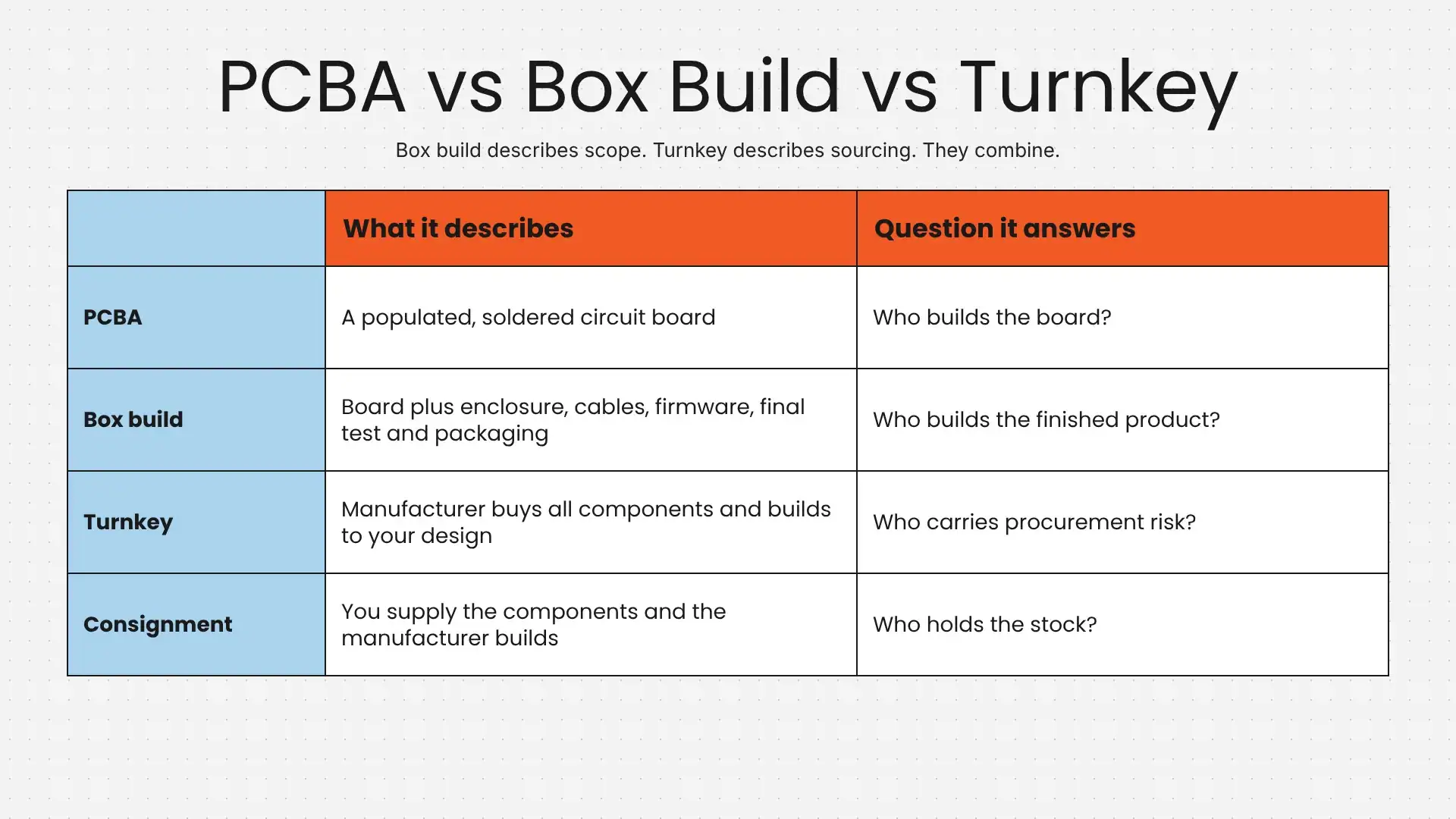
Box build and turnkey are not alternatives. They describe different things. Box build describes scope: how much of the product the manufacturer builds. Turnkey describes sourcing: who buys the materials. Mixing the two up is how teams end up comparing quotes that do not match.
|
Term |
What it describes |
Question it answers |
|---|---|---|
|
PCBA |
A populated, soldered circuit board |
Who builds the board? |
|
Box build |
The board plus enclosure, cables, firmware, final test and packaging |
Who builds the finished product? |
|
Turnkey |
The manufacturer buys all components and builds to your design |
Who carries procurement risk? |
|
Consignment |
You supply the components and the manufacturer builds |
Who holds the stock? |
The terms combine. Turnkey electronics manufacturing with full box build means one supplier buys the parts, builds the boards, assembles the product and ships it. Consigned PCBA with box build leaves you holding the stock risk while the supplier handles assembly.
Most teams compare suppliers on PCBA price and treat box build as a small add-on. It rarely is. Mechanical fit, cable routing and final test often decide whether a unit ships on time, and a PCBA-only supplier has not seen any of them.
If you are still choosing a partner overall, our guide to choosing the right EMS partner covers the wider decision.
“The transition of many industries into the digital and automated age has been marked by a huge surge in demand.” Takayuki Ito, President, International Federation of Robotics
When to outsource box build assembly
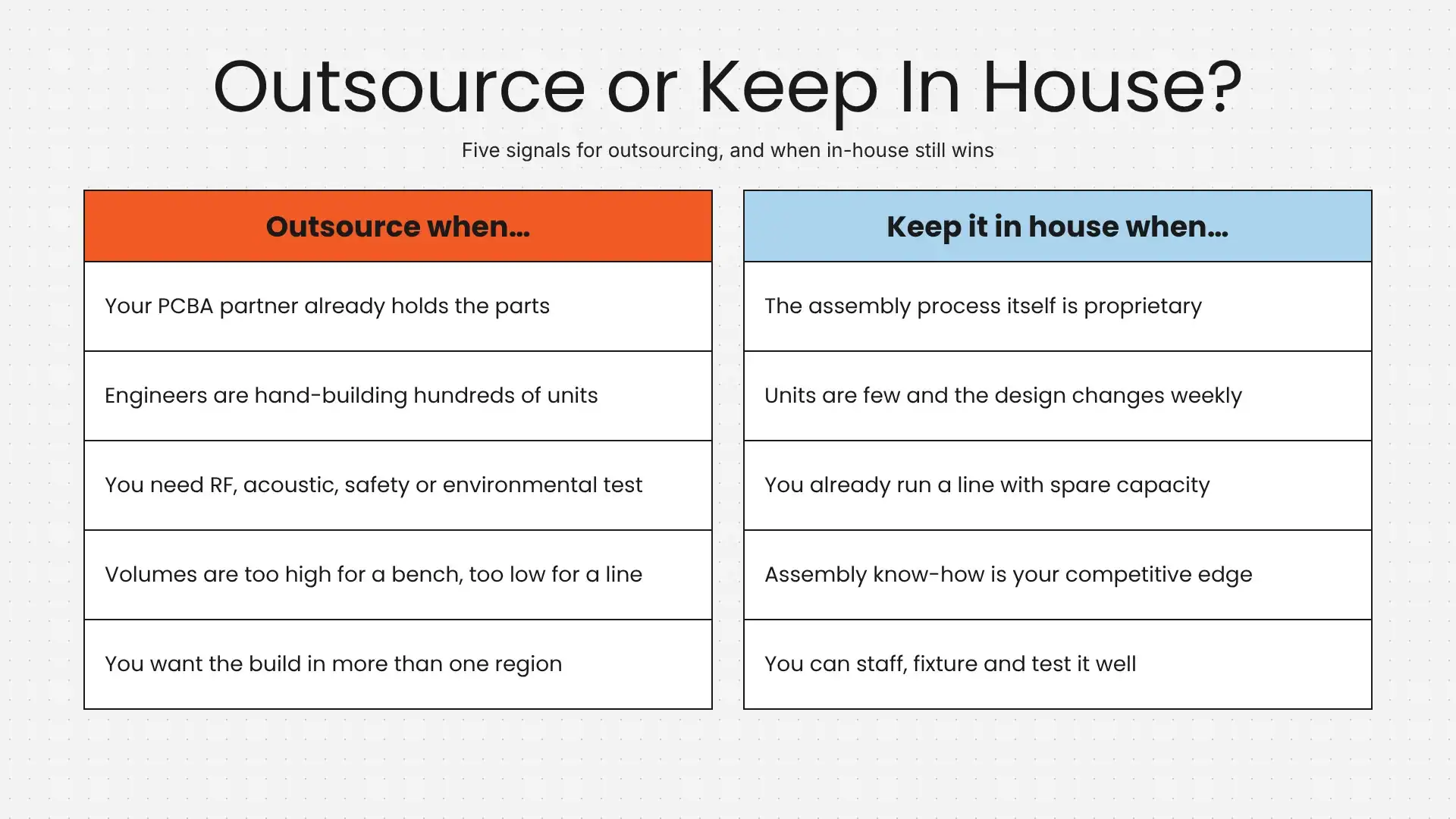
Outsource box build when the work no longer fits your team, your volumes or your test needs. Keep it in-house when assembly itself is your edge. Five signals point towards outsourcing.
- Your PCBA partner already holds the parts. Splitting PCBA and final assembly across two suppliers adds a handover, a second freight leg and a place for blame to land when a unit fails.
- Your engineers are building prototypes by hand. That works at ten units. At a few hundred it pulls the people who should be designing off the product.
- You need specialist test. RF, acoustic, safety or environmental testing needs rooms and instruments that few product teams own.
- Volumes are too high for a bench and too low for your own line. In this zone a manufacturer’s existing line and operators beat anything you can set up.
- You want the same product built in more than one region. A partner with several sites can transfer the build, the documentation and the test data together.
Keep it in-house when the assembly process is itself proprietary, when units are few and the design changes weekly, or when you already run a line with spare capacity. Outsourcing a product that changes every week mostly buys you change orders.
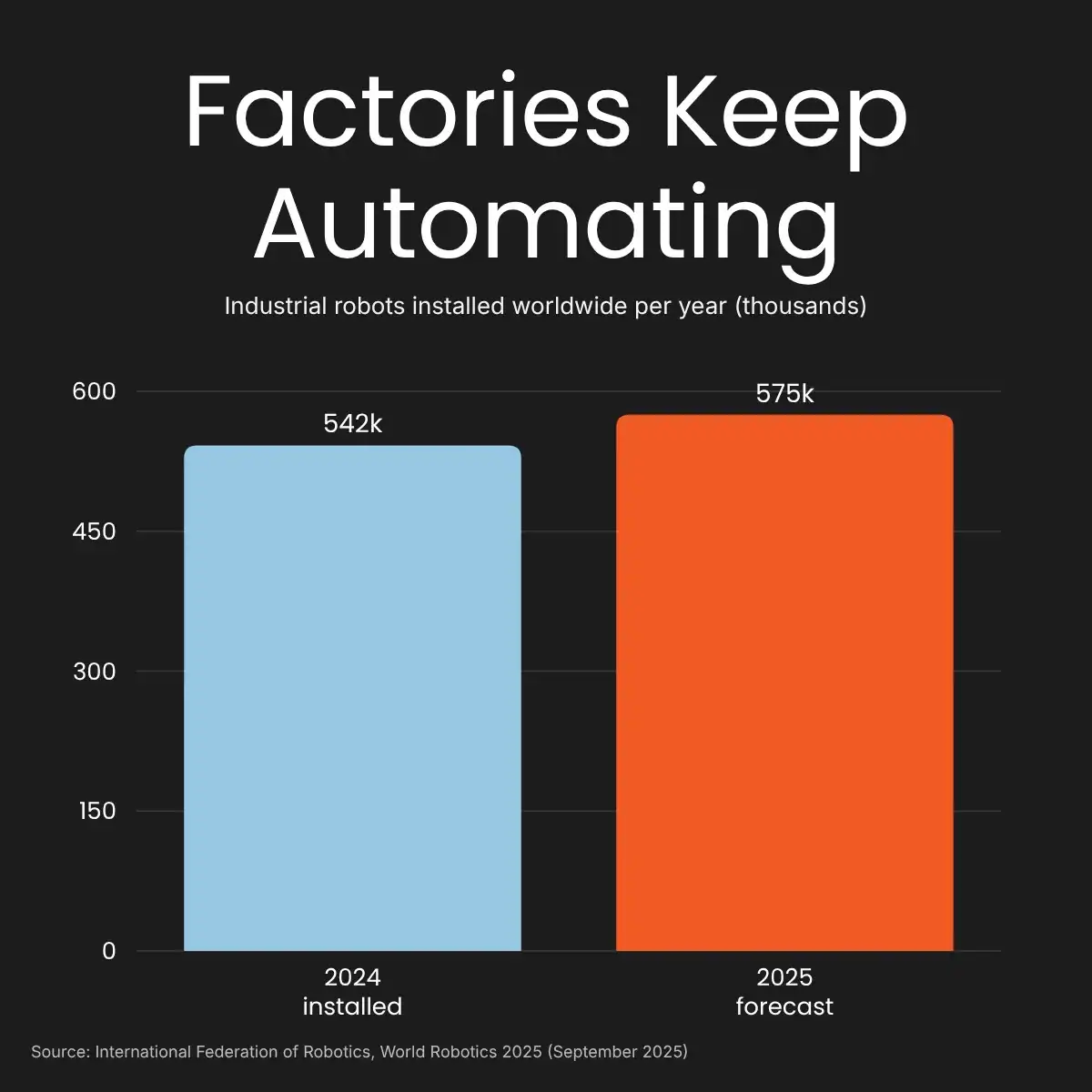
“The transition of many industries into the digital and automated age has been marked by a huge surge in demand.” Takayuki Ito, President, International Federation of Robotics
What to ask a box build partner
A good box build partner answers these questions with specifics. Vague answers are the warning.
- Who reviews the design for assembly? Ask for a DFA review before the enclosure and cable design are released, not after. Our DFM, DFA and DFT checklist shows what a good review covers.
- How do you control cable and harness quality? Look for defined crimp and routing standards, pull tests and operator training, and ask which acceptance standard they build to.
- Can you run my final test? The partner should run your test as written, and explain how fixtures are built, calibrated and maintained.
- How is each unit traced? A serial number should link to the board lot, firmware version, test result and station.
- How do you handle engineering changes? Ask who approves a change and how the new revision reaches the line.
- Where can the product be built, and can it move? If a second region matters, ask how documentation and validation data transfer.
- How do you protect units in packaging and freight? Damage in transit is a box build failure too.
Ask to see a line building a similar product. A finished-goods shelf tells you more than a capability slide.

63% of employers cite the skills gap as the main barrier to transforming their business.
What drives box build cost and how to control it
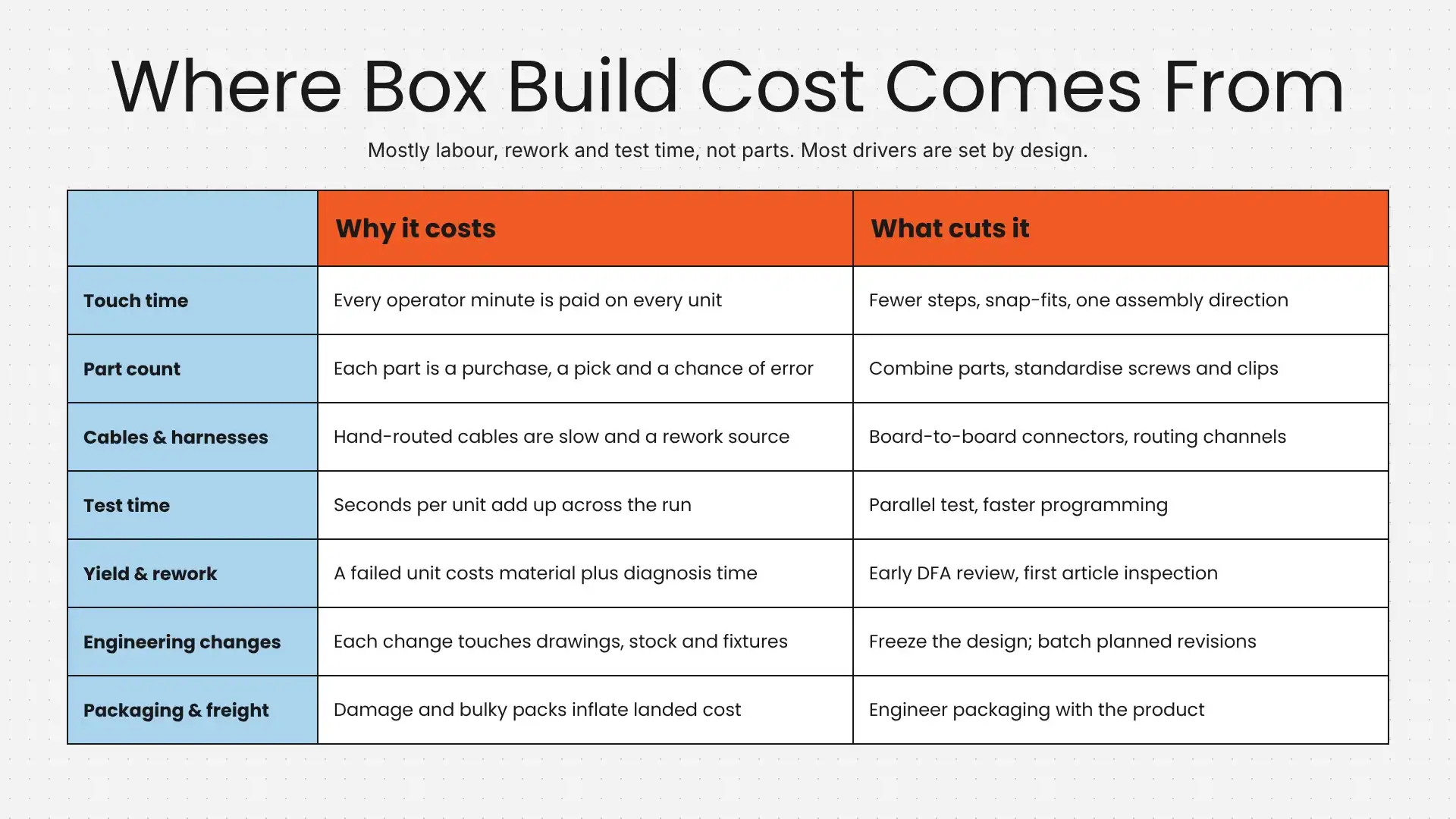
Box build cost is mostly labour, rework and test time, not parts. Seven drivers account for most of it, and most of them are set by design.
|
Cost driver |
Why it costs |
What cuts it |
|---|---|---|
|
Touch time |
Every operator minute is paid on every unit |
Fewer steps, captive fasteners and snap-fits, one assembly direction |
|
Part count and fastener variety |
Each part is a purchase, a pick and a chance of error |
Combine parts, standardise screws and clips |
|
Cable and harness complexity |
Hand-routed cables are slow and a common source of rework |
Fewer and shorter cables, board-to-board connectors, routing channels and strain relief |
|
Test time |
Seconds per unit add up across the run |
Parallel test, faster programming, testing only what earlier stages cannot |
|
Yield and rework |
A failed unit costs its material plus the time to diagnose it |
Early DFA review, clear work instructions, first article inspection |
|
Engineering changes |
Each change touches drawings, work instructions, stock and fixtures |
Freeze the design before the build and batch changes into planned revisions |
|
Packaging and freight |
Damage and bulky packs inflate landed cost |
Engineer the packaging with the product and test shipping early |
The biggest saving is rarely a lower price from the supplier. It is a design that takes fewer minutes to assemble.
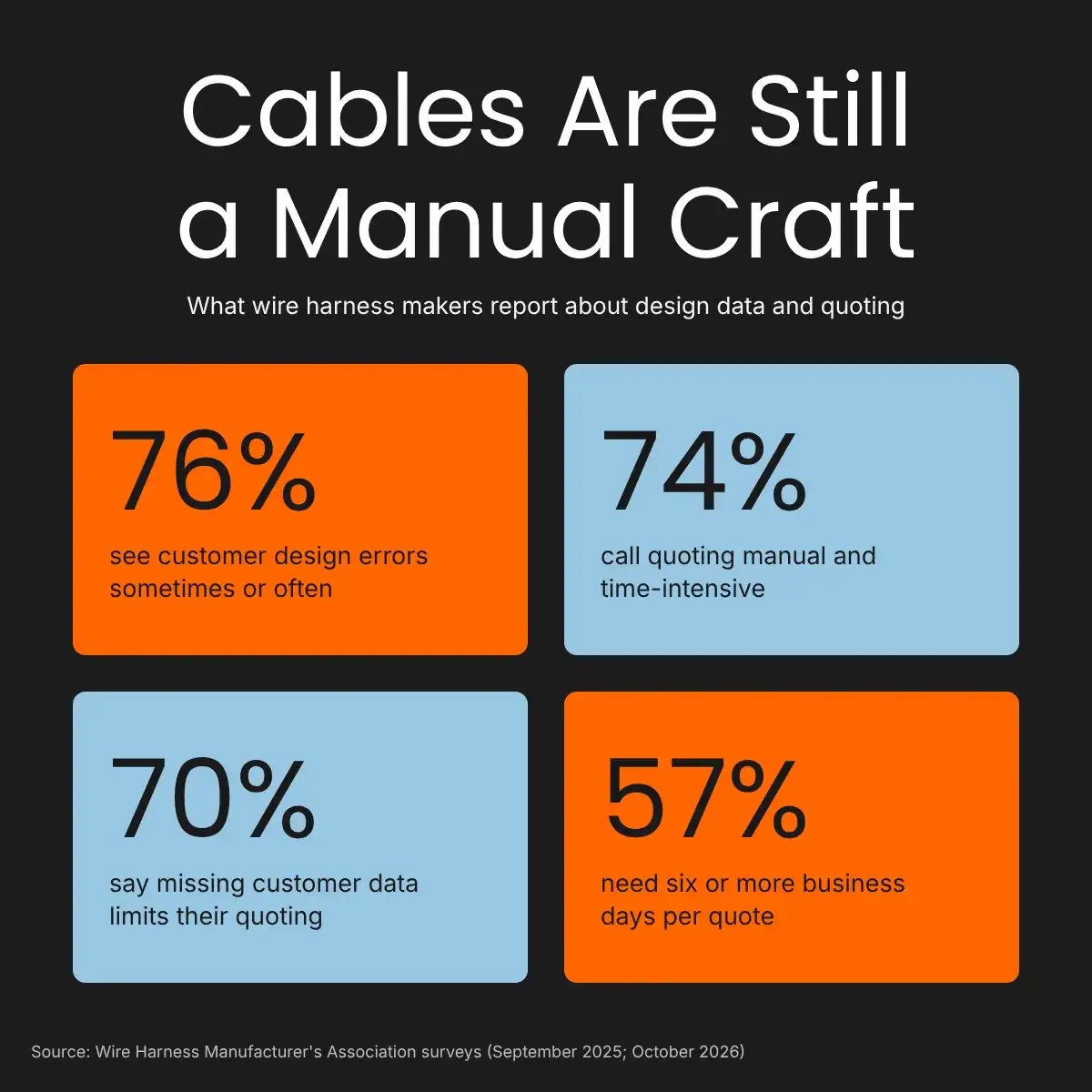
“The estimating work itself is rarely what holds up a quote.” George Jacob, E-Tron Systems, in the WHMA survey release
Testing, quality and traceability in box build
A box build is only as good as its final test. The board was already tested at PCBA stage. This test asks a different question: does the product work the way your customer will use it?
Typical box build checks include:
- Functional test of the whole unit. Power-up, firmware version, every input and output, display, wireless link, battery and charging behaviour.
- Safety checks where required. For mains-powered products, electrical safety tests such as insulation and earth continuity before shipment.
- Enclosure integrity. Seal and ingress checks for products with a dust or water rating, plus a visual and dimensional check of fit and finish.
- Burn-in or stress screening for products where early failures are costly. Our guide to end of line testing compares the methods.
- Label and serial verification. The right unit, the right firmware, the right market label.
Traceability ties these together. Each unit should carry a serial number that links to its board lot, sub-assembly lots, firmware version, test results and the station that built it. When a field issue appears, that record is the difference between pulling back a handful of units and pulling back a whole quarter’s production.
Workmanship standards set the visual bar. Acceptability criteria for electronic assemblies come from the IPC standards published through the Global Electronics Association, and cable work from IPC/WHMA-A-620. Agree which class applies before the first build.

Europe recorded a record 15,608 product recall events in 2025.
How Intretech approaches box build
Intretech takes products from design through to production within one group. These are the parts of that process that matter most to a box build.
- Assembly input at design stage. Our engineers lead DFM and test planning as part of NPI, so assembly issues can be raised before tooling is released.
- Tooling in house. Our advanced tooling team builds production moulds in house, which keeps enclosure design and mould design in the same conversation.
- Test in house. Our testing capabilities include a 3-metre EMC anechoic chamber, safety testing against UL, ETL, EN/IEC and CCC standards, reliability testing, and an acoustic anechoic chamber.
- More than one region. Intretech has production sites in China, Malaysia, Hungary and Mexico, so a product can launch in one region and move to another with the same documentation and validation data.
Open question for Intretech operations (remove before publishing): confirm which sites run full box build and system integration, and for which product categories, then add that scope here. The site does not currently describe box build as a named service.
“80% of executives are planning to maintain or increase investment in third-party outsourcing.” Deloitte Global Outsourcing Survey 2024.
Frequently asked questions
What is box build assembly?
Box build assembly is the process of turning a tested PCBA into a finished product. It includes fitting the board into its enclosure, adding cables and other components, loading firmware, running a final test and packaging the unit.
What is the difference between box build and PCBA?
PCBA is a populated, soldered circuit board. Box build covers the board plus everything needed to make a complete product: enclosure, cables, sub-assemblies, firmware, final test and packaging.
Is box build the same as system integration?
Not always. Some suppliers use box build for enclosure integration and system integration for the full scope, including software and final test. Agree the scope in writing before you compare quotes.
When should you outsource box build assembly?
Outsource it when your volumes outgrow hand assembly, when your PCBA supplier already holds the parts, or when you need specialist test. Keep it in-house if assembly is itself proprietary or the design is still changing every week.
How is box build assembly priced?
Suppliers usually quote a per-unit price built from material, labour time, test time and packaging, plus one-off costs for fixtures and tooling. Ask for these split out so you can see which ones your design affects.
Ready to plan your box build?
Explore more related content
Design for Manufacturability in Electronics: A DFM, DFA and DFT Checklist
Design for Manufacturability in Electronics: A DFM, DFA and DFT ChecklistDesign for manufacturability (DFM) is the...

The Top 3 Myths About JDM ODM OEM Explained
The Top 3 Myths About JDM ODM OEM ExplainedAsk three people in hardware what JDM, ODM and OEM mean and you'll often...
The 7 Steps of the Procurement Process: A Practical Guide for Manufacturing Teams
The 7 Steps of the Procurement Process: A Practical Guide for Manufacturing TeamsImportance of Procurement in Business...