

Electronics Manufacturing in Mexico:
A Buyer’s Guide to Nearshoring in 2026


Electronics manufacturing in Mexico is no longer a back-up plan. In 2025, Mexico was the United States’ largest trading partner and its biggest source of imported goods. Computer equipment was the single largest import category, worth $90.8 billion. If you sell hardware into North America, you are almost certainly already competing with products built in Mexico.
But most nearshoring guides are written by people who have never run a production line. They tell you about labour costs and border crossings. They rarely tell you what happens when your first PCBA build in a new country fails its functional test, or where your microcontrollers will actually come from.
This guide is written from the factory floor. It covers what nearshoring to Mexico solves, what it doesn’t, how the trade rules work in 2026, and how to choose a manufacturing partner without inheriting someone else’s problems.

“Freight between the U.S. and Mexico was $872.8 billion in 2025, up 3.9% from 2024.” Source: US Bureau of Transportation Statistics
Why electronics manufacturing in Mexico is growing so fast
Three forces have pushed Mexico to the front of the queue.
- Proximity to the world’s largest consumer market. Trucks from northern Mexico reach US distribution centres in days, not weeks. That changes how much inventory you hold, how quickly you can respond to demand, and how fast engineers can be on site.
- A trade agreement that rewards regional production. The United States-Mexico-Canada Agreement (USMCA) lets qualifying goods move across North American borders duty-free. In a year of shifting US tariff policy, that qualification has become far more valuable. USMCA utilisation for Mexican exports rose to around 85% in January 2026, up from roughly 45% a year earlier, as importers rushed to document compliance.
- An established industrial base. Mexico is not a greenfield bet. Its northern and central states have decades of experience in automotive, aerospace, medical device and electronics production, with supplier networks and technical talent to match.
According to the Congressional Research Service, US goods imports from Mexico reached $534.8 billion in 2025. Motor vehicles, auto parts, electrical equipment and medical instruments sit alongside computer equipment among the top categories. These are exactly the sectors where electronics content keeps rising.
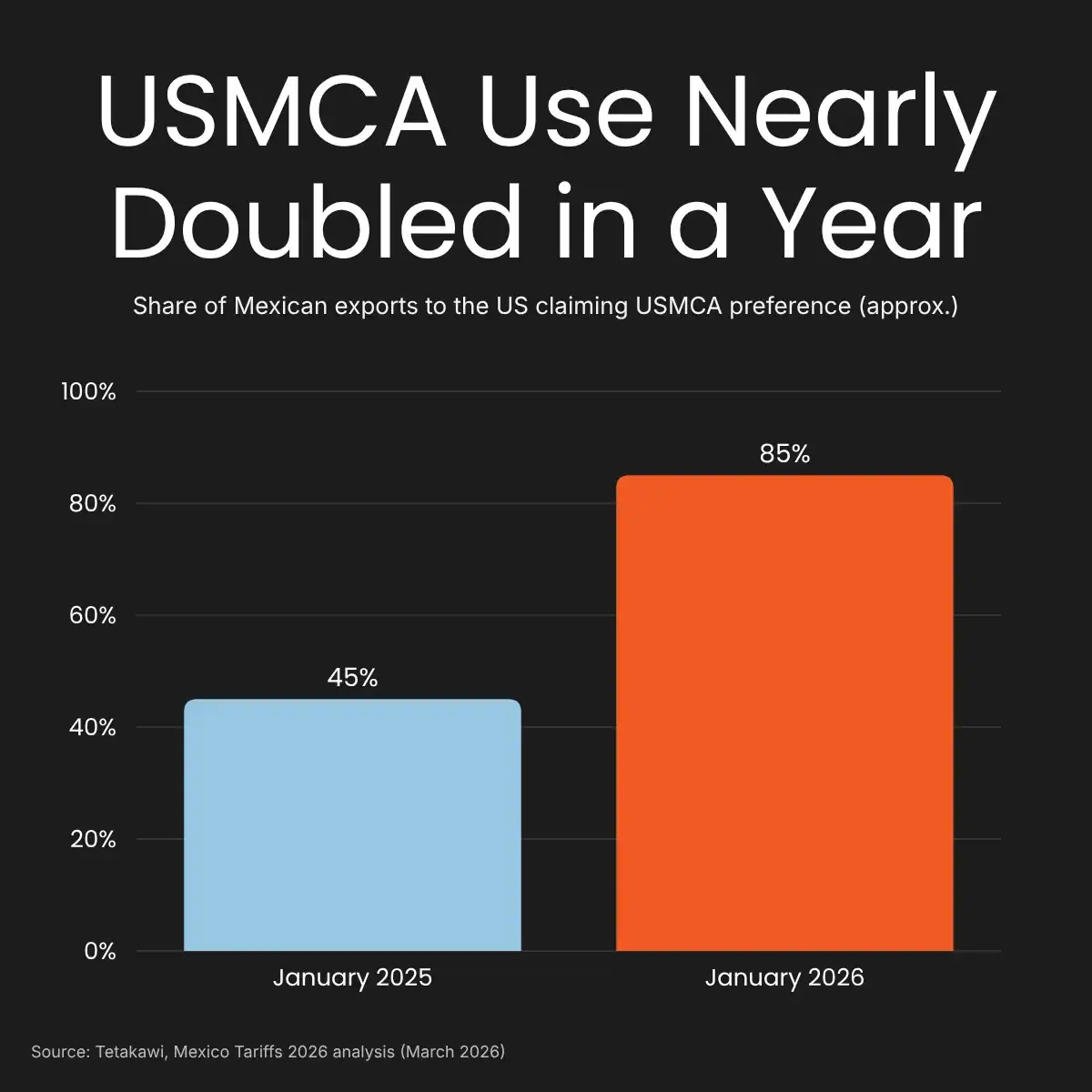
“From January through May 2026, 88% of U.S. imports from Mexico were compliant” with USMCA, which exempts them from the 10% Section 301 tariff.
What nearshoring to Mexico actually solves (and what it doesn’t)
Nearshoring is the practice of moving production closer to the end market. For North American brands, that usually means Mexico. It solves some problems brilliantly and leaves others untouched.
What it solves
- Lead time. Weeks of ocean freight become days of road freight. Fewer goods in transit means less working capital tied up.
- Responsiveness. Engineering changes, design tweaks and quality investigations happen faster when your team can visit the line in a short flight, in a similar time zone.
- Tariff exposure. Goods that qualify under USMCA currently sit outside the latest US tariff measures. More on that below.
- Customer perception. Many North American buyers now ask suppliers to show regional production capacity as part of their own risk planning.
What it doesn’t solve
- Component sourcing. A product assembled in Mexico still needs semiconductors, passives, displays and connectors. Most of the world’s electronic component capacity sits in Asia. Nearshoring the final build does not nearshore the bill of materials.
- Engineering maturity. Moving a product that isn’t ready for manufacture will move the problems too. Design for manufacture (DFM) issues travel well.
- Cost, automatically. Labour may be competitive, but the full picture includes logistics, duties on imported parts, ramp-up time and yield. You need a total landed cost model, not a wage comparison.
This is the uncomfortable truth most guides skip: the best Mexico strategy is a global supply chain strategy. The winners are manufacturers who can build locally while buying components globally at scale.
The trade framework in plain English: USMCA, IMMEX and tariffs
You don’t need to be a customs expert, but you do need to know the three building blocks. Rules change quickly, so treat this as a snapshot as of October 2026 and confirm details with a licensed customs broker.
USMCA
USMCA replaced NAFTA in 2020. Goods that meet its rules of origin can move between the US, Mexico and Canada at preferential (usually zero) duty rates. Qualification depends on the product’s tariff classification, where its materials come from, and how much value is added in the region.
At the July 2026 joint review, the US did not confirm a 16-year extension. That does not end the agreement. USMCA stays in force, with annual reviews through 2036 unless the three countries confirm an extension sooner. The full agreement text is published by the Office of the US Trade Representative.
We break down how qualification works for electronics in our companion guide, USMCA rules of origin for electronics OEMs.
IMMEX
IMMEX (Industria Manufacturera, Maquiladora y de Servicio de Exportación) is Mexico’s programme for export manufacturing. It allows approved companies to import materials, components and equipment temporarily without paying Mexican import duties or VAT, as long as the finished goods are exported. It is the modern successor to the maquiladora programme. Mexico’s Secretaría de Economía administers it.
For electronics, IMMEX matters because so many components are imported. Without it, those parts would attract Mexican duties before they ever reach the line.
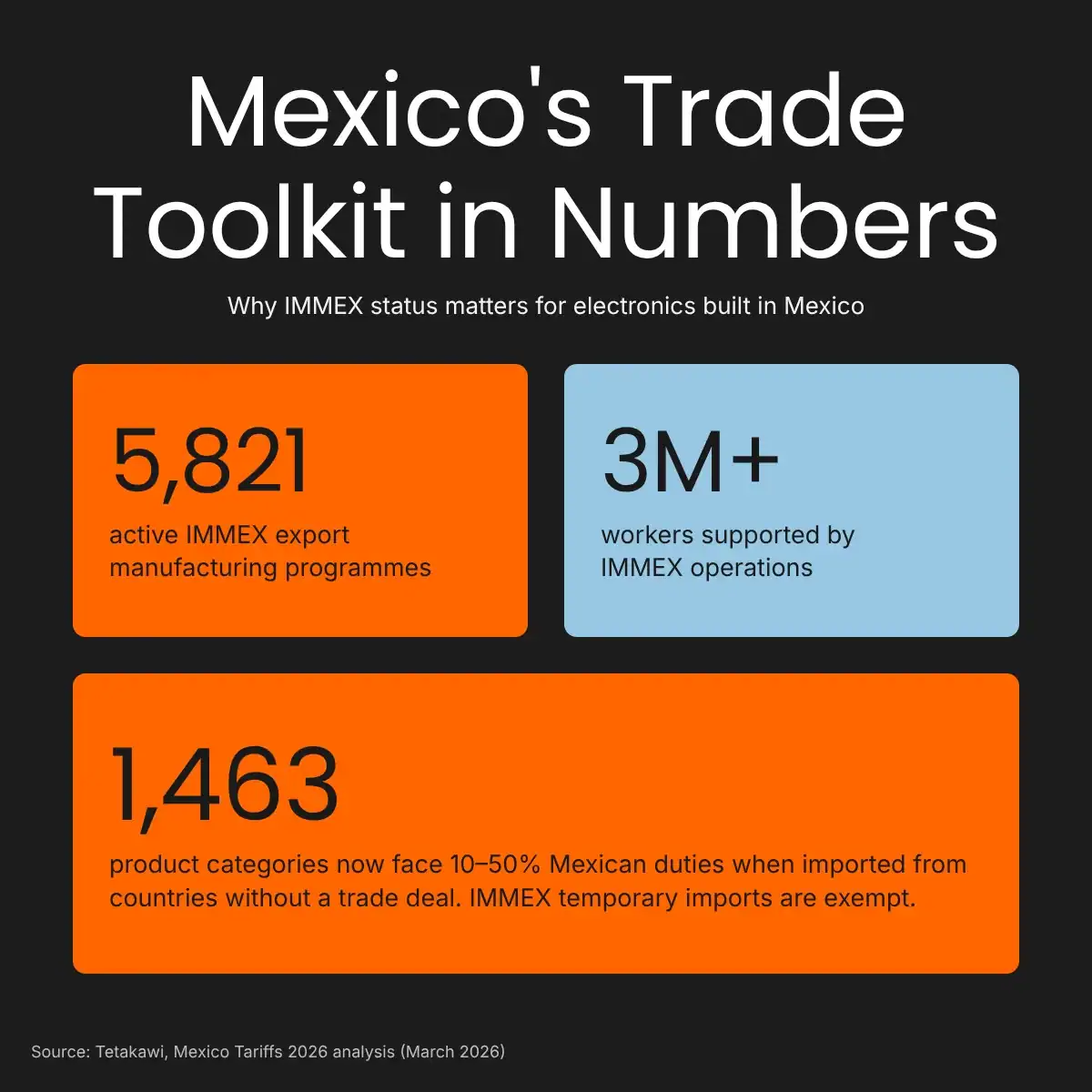
Of the 6,516 establishments registered in IMMEX in July 2026, 5,211 were manufacturing operations.
The current tariff picture (October 2026)
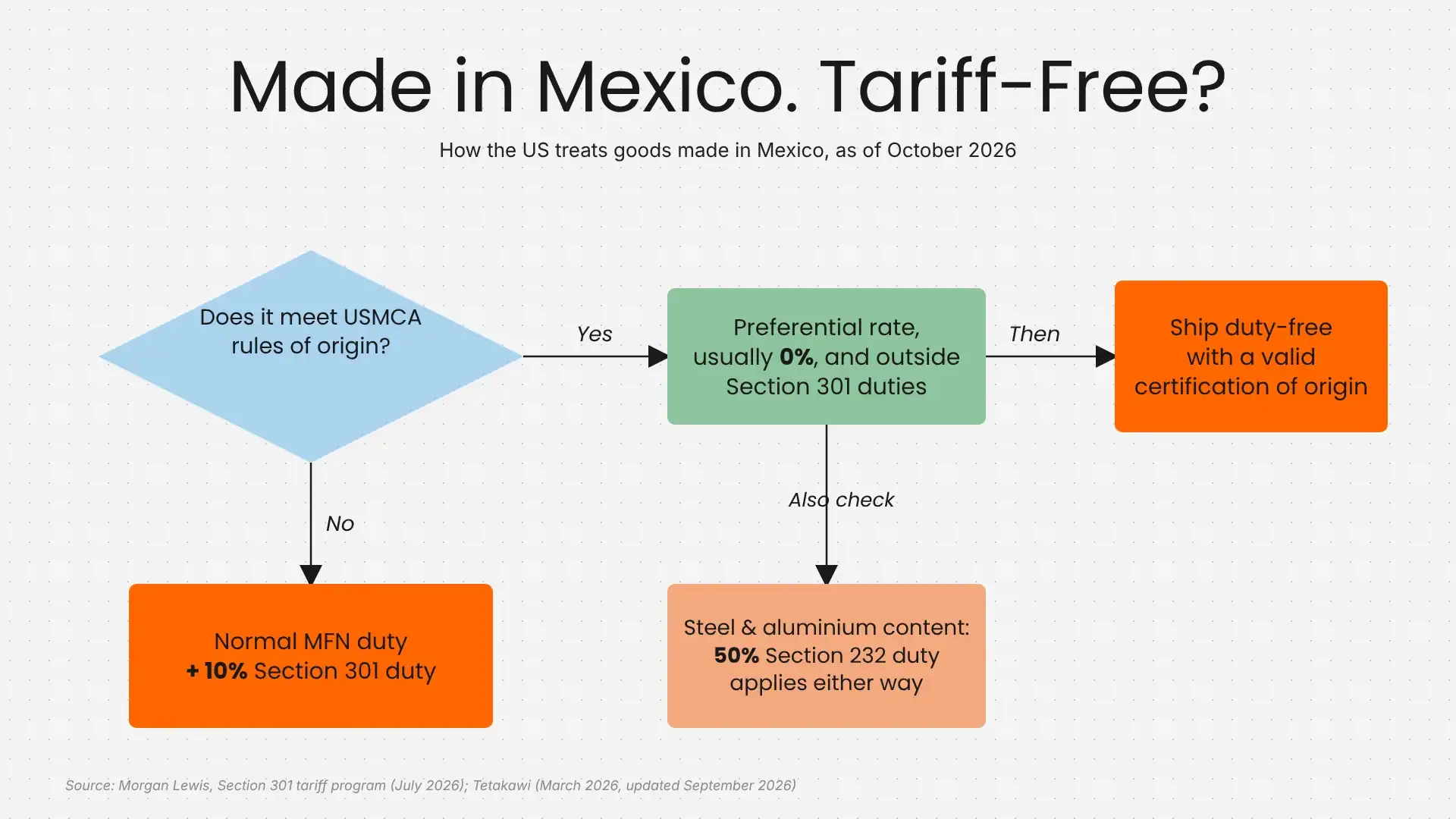
- USMCA-qualifying goods from Mexico remain outside the Section 301 duties that took effect on 24 July 2026.
- Non-qualifying goods from Mexico face a 10% Section 301 duty on top of normal duty rates.
- Section 232 duties of 50% on steel and aluminium apply regardless of USMCA status.
- Mexico’s own tariffs of 10–50% now apply to around 1,463 product categories imported from countries without a trade agreement with Mexico. IMMEX temporary imports and USMCA goods are exempt.
The takeaway: USMCA qualification is now the line between a tariff-free product and a taxed one. Design, sourcing and manufacturing decisions all affect which side of that line you land on.
“We know it is very difficult to think that tariffs will disappear. What we are looking for is how to reduce them.” Source: Marcelo Ebrard, Mexico’s Secretary of Economy, Reuters (22 Apr 2026)
Mexico’s main electronics manufacturing clusters
Mexico’s electronics industry is concentrated in a handful of regions, each with its own strengths.
- Guadalajara, Jalisco. Often called Mexico’s Silicon Valley. Strong in computing, telecoms and semiconductor-related design and test, with a deep pool of engineers.
- Tijuana, Baja California. Close to California. Known for consumer electronics, medical devices and televisions.
Ciudad Juárez, Chihuahua. Opposite El Paso. A long-standing base for automotive electronics, wiring and computing hardware. - Monterrey, Nuevo León. One of Mexico’s most important industrial centres, with strengths in automotive, appliances, metals and electronics. Around three hours by road from the Laredo crossing, the busiest land port for US-Mexico trade.
- Reynosa, Tamaulipas. On the Texas border, with established electronics and automotive component production.
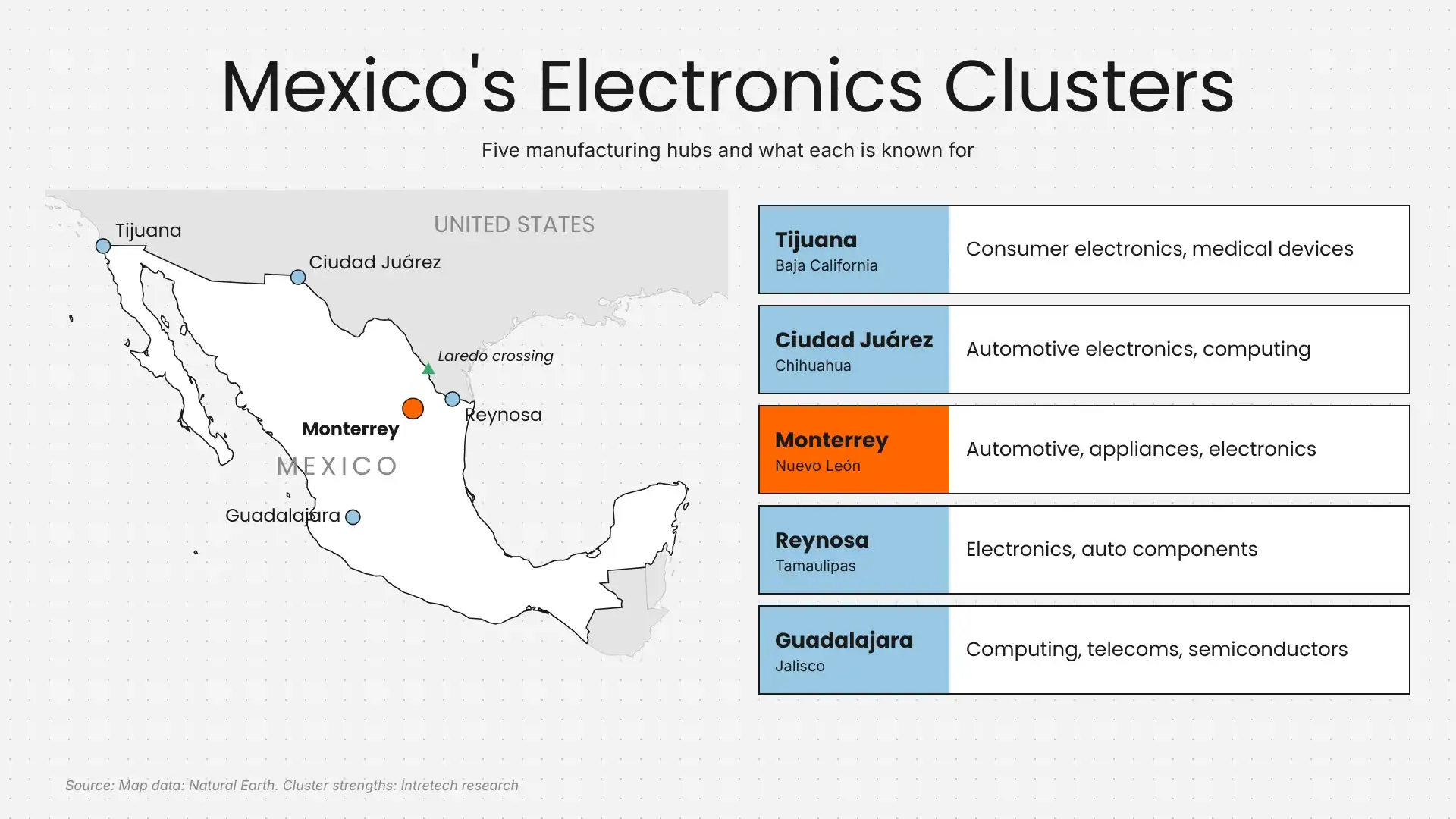
Mexico’s exports of computer, communication, measuring and other electronic equipment reached US$37.8 billion in Q3 2025, up 59.2% year on year. Chihuahua (43.6%), Jalisco (26.5%), Baja California (12.6%), Tamaulipas (5.8%) and Nuevo León (5.6%) led the way. – INEGI 2025
Why Monterrey stands out for electronics
Monterrey combines a mature automotive supply chain, strong universities and direct road and rail links into Texas. For electronics, that matters twice over. Automotive electronics are one of the fastest-growing categories in the region, and the quality systems demanded by automotive customers (such as IATF 16949) raise the bar for every other product built nearby.
Three ways to manufacture in Mexico
There is no single route in. Most companies choose between three models.
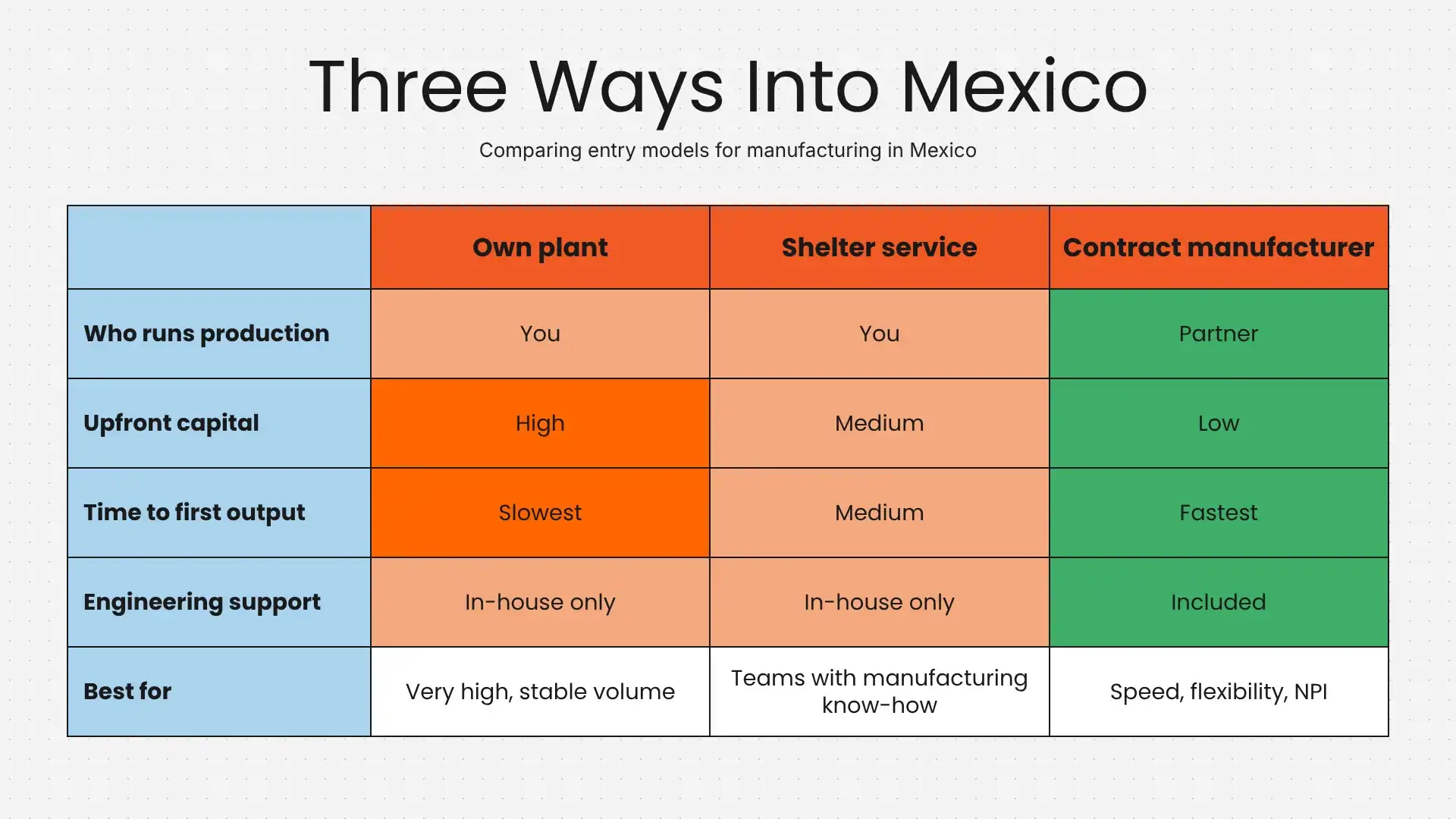
1. Build your own plant
- You own the building, the equipment, the workforce and the legal entity.
Best for: very high, stable volumes and companies with in-house manufacturing teams. - Watch out for: capital cost, permits, hiring and a long runway (often well over a year) before you reach stable output.
2. Use a shelter service
A shelter company provides the legal entity, HR, customs and compliance. You supply the equipment, process and production management.
- Best for: companies that want control of production without setting up a Mexican legal entity.
- Watch out for: you still need to run manufacturing yourself, including engineering, sourcing and quality.
3. Partner with a contract manufacturer (EMS or CDEM)
An electronics manufacturing services (EMS) provider or contract design and electronics manufacturer (CDEM) builds your product in its own facility, using its own teams, equipment and supply chain.
- Best for: brands that want speed to market, engineering support and flexible volumes.
- Watch out for: partner capability varies widely. Check what is actually done in Mexico versus elsewhere.
For most OEMs launching or transferring products below the scale of a dedicated plant, a contract manufacturer is the fastest and lowest-risk route. Our guide to OEM procurement strategy for OEM vs ODM sourcing covers how to structure that relationship.
The average capital project runs “approximately 60 percent over schedule” and “more than 70 percent over budget.”
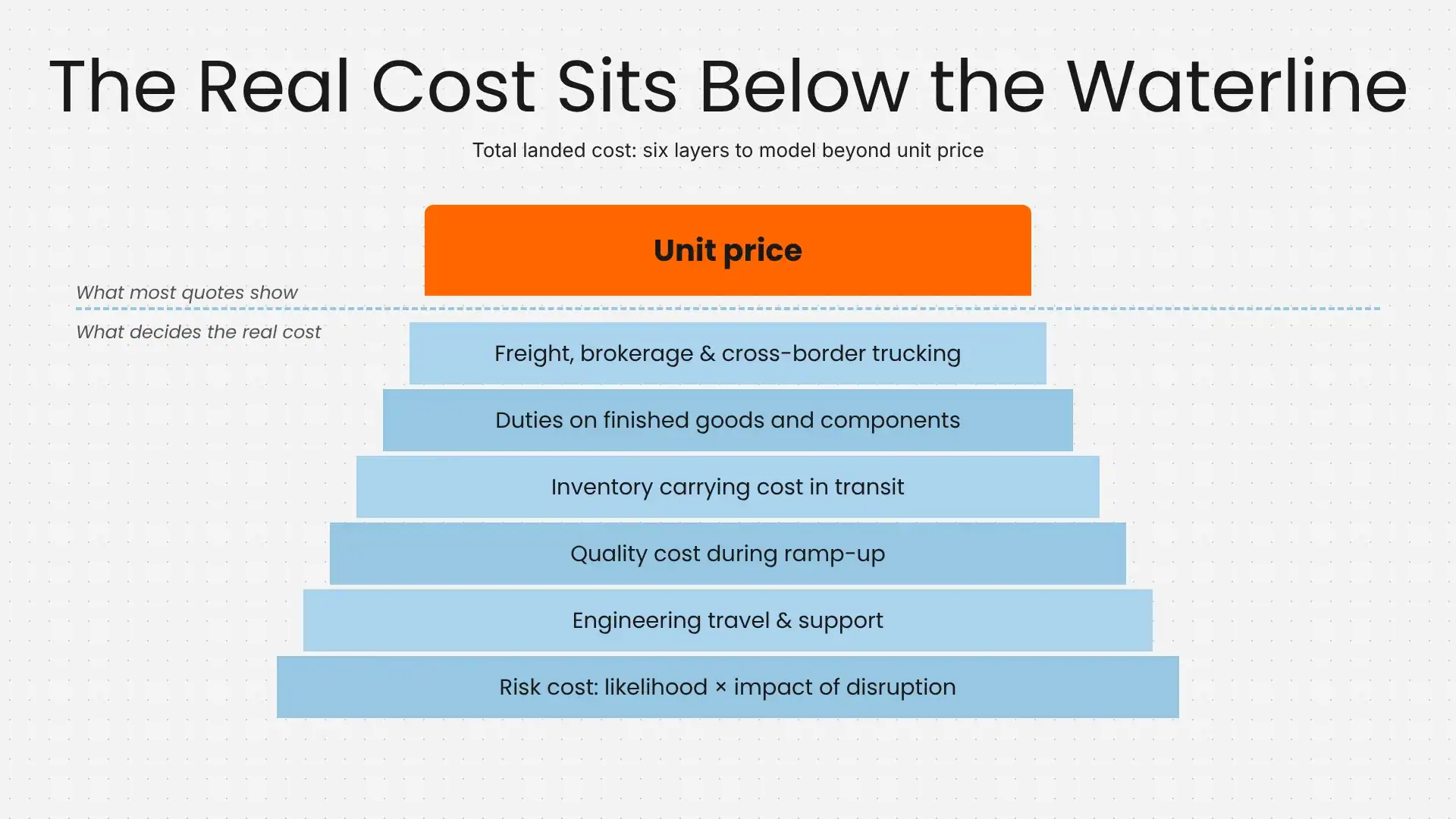
Total landed cost: what to model beyond the unit price
A unit price comparison between Mexico and Asia tells you very little. Model these instead:
- Unit cost (materials, labour, overhead, margin).
- Freight and logistics, including cross-border trucking and brokerage.
- Duties and tariffs, on both the finished product and any imported components.
- Inventory carrying cost, which falls as transit time shrinks.
- Quality cost, including scrap, rework and field returns during ramp-up.
- Engineering and travel, which usually fall with a nearby factory.
- Risk cost, the price of a supply disruption multiplied by its likelihood.
Run the model at three volume levels. Mexico often wins outright on mid-volume, high-mix or time-sensitive products, while very high-volume commodity products may still favour Asian production. Many companies end up with both.
How to choose a contract electronics manufacturer in Mexico
Use these questions to separate real capability from a brochure.
- What is actually built in Mexico? Ask which processes (SMT, PCBA, moulding, final assembly, testing) are running at the Mexican site today, and which are planned.
- Which certifications cover the Mexican facility? Look for ISO 9001 as a minimum, IATF 16949 for automotive and ISO 13485 for medical devices. Check that the certificate names the Mexican site, not just the group.
- How do they buy components? Global purchasing scale protects you from shortages and price spikes. Ask how they handle allocation and long lead-time parts.
- Who does the engineering? DFM, test development and new product introduction (NPI) should be close to production.
- Do they have a transfer playbook? Moving an existing product needs a structured process: documentation, golden samples, first article inspection, parallel builds and sign-off.
- Can they support USMCA qualification? A good partner helps you understand how BOM and process choices affect origin.
- What happens if demand outgrows one site? A multi-region manufacturer can balance production between continents.
For a wider view on choosing between regions, read nearshoring vs offshoring: how to choose your manufacturing footprint.

45% of product launches are delayed by at least one month. “A product launch that meets all internal targets is seldom achieved.” Source: Gartner survey; quote from Adrian Lee, Senior Research Director, Gartner (9 Sep 2019)
Moving a product to Mexico: what a good production transfer looks like
Most companies don’t start fresh in Mexico. They move an existing product from another site. That transfer is where schedules slip and quality wobbles, so it deserves its own plan.
A well-run transfer usually follows five stages:
- Documentation pack. Drawings, BOM, approved vendor list, assembly instructions, test specifications and known issues. If it lives in someone’s head, it won’t transfer.
- Golden samples. Reference units from the current line, so the new site has a physical standard to match.
- Pilot build and first article inspection. A small run to prove the process, followed by measured inspection against the drawing.
- Parallel production. The old and new sites run side by side for a period, protecting supply while the new line ramps up.
- Formal sign-off. Yield, test results and customer approval (such as PPAP for automotive) before the old line is switched off.
Build a buffer stock before the switch. Even a good transfer has a learning curve, and finished goods inventory buys you time to deal with it.
The biggest single risk is component supply. A new site may need new supplier set-ups, new logistics routes and new customs paperwork for the same parts. A manufacturer that already buys those components at group level removes much of that risk.

“We are a strong economy, which is why we continue to be the epicenter of nearshoring in Mexico.” – Samuel García, Governor of Nuevo León, at the Intretech plant inauguration; Mexico News Daily
Risks to plan for
Every manufacturing location carries risks. Mexico’s are well understood, which makes them easier to plan around.
- Trade policy changes. USMCA is now reviewed every year. Keep origin documentation current and model tariff scenarios.
- Currency movement. Peso fluctuations affect local costs. Agree in contracts how currency changes are handled.
- Talent competition. Popular industrial regions compete for skilled technicians and engineers. Ask partners about retention and training.
- Infrastructure demand. Fast-growing industrial parks place pressure on power, water and border crossing capacity. Check how your partner manages supply and logistics resilience.
None of these are reasons to avoid Mexico. They are reasons to choose an experienced partner and keep a second region in your plan.
How Intretech approaches electronics manufacturing in Mexico
Intretech opened its Mexican facility in September 2024, a $60 million investment in Apodaca, Nuevo León, in the Monterrey metropolitan area. The site offers 55,000 m² of floor space and is expected to create around 2,000 jobs over five years. You can read more in our Monterrey facility announcement.
The facility supports OEM and ODM programmes, product development, tooling, PCBA production, industrial automation and product testing. It holds ISO 9001, ISO 14001 and IATF 16949 certification, with a particular focus on automotive, alongside consumer technology, health technology, audio, IoT and air and water purification.
Monterrey is one part of a wider network. Intretech has more than 10,000 people and over 1,500 engineers and managers, with major manufacturing sites in China, Malaysia and Hungary. That means a product can be designed, sourced and built in the regions that make most sense for it, and moved between them as markets change. See our global locations and manufacturing services.
“The U.S. win rate goes from 8% based on FOB or Ex-Works price to 32% based on TCO.”- Harry Moser, Founder & President, Reshoring Initiative; testimony to the US House Small Business Committee (20 Nov 2025)
Frequently asked questions
Is it worth moving electronics manufacturing to Mexico?
For products sold mainly in North America, often yes. Mexico offers shorter lead times, USMCA tariff benefits and a mature industrial base. The case is strongest for mid-volume, high-mix or time-sensitive products, and weaker for very high-volume commodity electronics.
Do products made in Mexico pay US tariffs?
Products that qualify under USMCA rules of origin currently enter the US at preferential rates, usually zero, and sit outside the Section 301 duties introduced in July 2026. Non-qualifying products face standard duties plus a 10% Section 301 duty. Steel and aluminium content may face separate Section 232 duties.
Where in Mexico is electronics manufacturing concentrated?
The main clusters are Guadalajara, Tijuana, Ciudad Juárez, Monterrey and Reynosa. Each has different strengths, from computing and telecoms in Guadalajara to automotive electronics in Juárez and Monterrey.
What is the IMMEX programme?
IMMEX is Mexico’s export manufacturing programme. It lets approved manufacturers import components and equipment temporarily without paying Mexican import duties or VAT, as long as the finished goods are exported.
How do I choose a contract manufacturer in Mexico?
Confirm which processes run at the Mexican site today, check that certifications name that facility, and ask how the partner sources components globally. A clear production transfer process and support with USMCA qualification are also strong signs of a capable partner.
Planning North American production?
Whether you are launching a new product or moving an existing one closer to your customers, our Monterrey team can help you assess the options.
Explore more related content
Nearshoring vs Offshoring: How to Choose Your Manufacturing Footprint and EMS Partner
Nearshoring vs Offshoring: How to Choose Your Manufacturing Footprint and EMS PartnerNearshoring vs offshoring is...

IoT in Smart Agriculture: The Hardware Engineering Decisions That Decide Whether a Sensor Survives the Field
IoT in Smart Agriculture: The Hardware Engineering Decisions That Decide Whether a Sensor Survives the FieldThe top...

How to Choose a Contract Electronics Manufacturer for Agricultural Technology
How to Choose a Contract Electronics Manufacturer for Agricultural Technology"China has re-entered the chat, after not...