

How to Choose a Contract Electronics Manufacturer for Agricultural Technology

“China has re-entered the chat, after not providing any data last year and tanking the entire world’s totals.” — Oxebridge Quality Resources, ISO Survey 2024 Analysis
If you work for an agrotech company, you already know thata building a working prototype isn’t the struggle. Where the process breaks is the jump from a handful of units built in-house or through a local shop to a contract electronics manufacturer that can deliver hundreds or thousands of units, reliably, on a schedule that matches a planting or harvest season rather than a typical consumer product launch. Get that selection wrong, and a bad batch costs a customer an entire growing season. The monetary loss is what hits hard equally.
Most companies still choose a manufacturing partner the way they’d choose a component vendor: lowest quote, shortest lead time, done. That approach works for a resistor. It doesn’t work for a piece of field hardware that has to run unattended for years. Here’s what to evaluate instead.

The core distinction that matters for IP: a contract manufacturer (CEM/EMS) builds to the customer’s own design and the customer retains IP; an ODM designs the product itself and typically licenses or sells a similar design to multiple customers, meaning the design isn’t exclusive to any one buyer.
What a Contract Electronics Manufacturer Actually Does
A contract electronics manufacturer (often shortened to JDM or EMS provider) builds electronic hardware to a customer’s design; sourcing components, assembling PCBs, integrating enclosures, and testing finished units. This differs from an ODM (original design manufacturer), which designs the product itself and licenses or sells a version of it to multiple customers. Agrotech companies with proprietary sensor or control designs generally need a JDM or a Joint design-and-manufacturing partner that will build to their specification and protect their IP, not an ODM selling a shared design.
Manufacturing Certifications and Quality Systems Worth Verifying
ISO 9001 is table stakes; what matters is what it means in practice at a given facility; traceability records, incoming inspection processes, and how non-conformances get reported back to you rather than quietly reworked and shipped.
What ISO 9001 Should Mean in Practice, Not Just on a Certificate
The ISO 9001:2015 standard requires a documented quality management system with defined processes for corrective action but certification alone doesn’t tell you how rigorously it’s applied. Ask for real examples: a recent non-conformance, how it was caught, and what changed as a result. A partner with experience across regulated verticals like automotive or medical devices tends to bring a level of quality discipline that transfers directly to hardware built to survive outdoors, unattended, which is exactly the discipline Intretech’s electronics manufacturing work in those verticals is built around.

In-house manufacturing keeps full control but requires the capital investment and quality-system infrastructure of running a factory, which is exactly the cost/control trade-off the decision flow chart visualizes.
Environmental and Reliability Testing Capability
Agricultural hardware needs to be validated against the conditions it will actually face thermal cycling, IP ingress testing, vibration and shock testing for anything mounted on equipment. Ask whether this testing happens in-house or is outsourced. More importantly, how failures during testing feed back into design revisions rather than getting shipped anyway on a deadline.
Global Manufacturing Footprint and Supply Chain Resilience
A manufacturing partner with facilities across multiple regions gives you options when tariffs shift, component lead times spike, or a single-region disruption threatens a delivery window. For a category with genuine seasonal deadlines, a device that needs to ship before planting season doesn’t get a grace period. That flexibility is the difference between hitting the season and missing it. Intretech’s supply chain management approach exists specifically to manage that kind of regional and component-level risk.

“A supplier with a 10% lower unit cost may create 30–40% higher total costs due to poor quality, long lead times, high defect rates, and expensive air freight to compensate for delays.”
Scalability From Prototype to Volume and Back Down Again
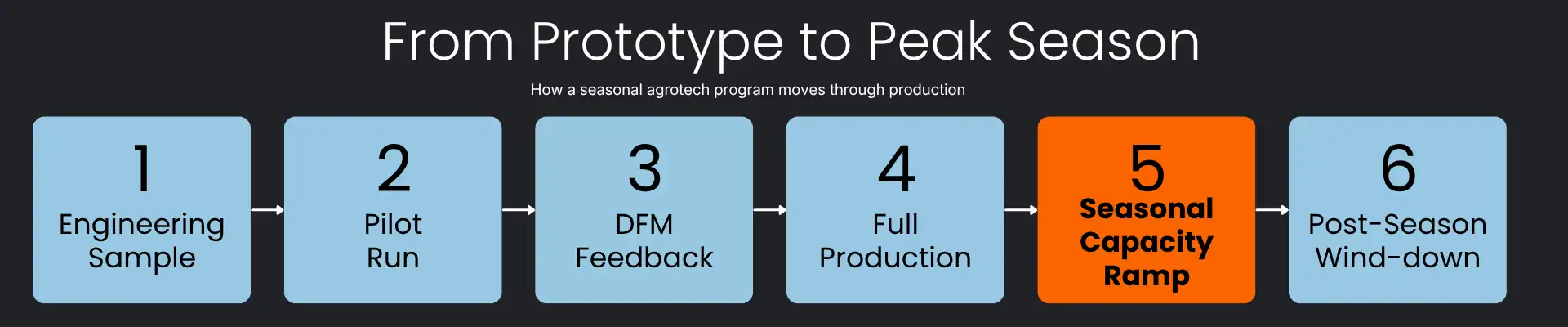
Ask specifically about the New Product Introduction (NPI) process: how a design moves from engineering sample to pilot run to full production, and where design-for-manufacture (DFM) feedback enters that process. Agriculture also has a seasonality problem that consumer electronics doesn’t. Volume needs can spike hard ahead of a planting season and go quiet afterward. A partner should be able to describe concretely how they flex capacity around that pattern, not just quote a standard lead time that assumes flat demand.
In practice, that means asking pointed questions rather than accepting a general capability claim: how much notice does the line need to ramp from pilot volumes to a seasonal peak order, what happens to your production slot if another customer’s peak season overlaps with yours, and is there a contractual mechanism like a rolling forecast or a capacity reservation, that protects your delivery window specifically. A manufacturer that can only answer in general terms hasn’t actually built for seasonal demand before; one that answers with specifics about line changeover time and buffer stock probably has.

Up 76.7% from 837,049 in 2023 but most of that jump is China re-entering the reporting system after a data gap. Adoption outside China has stayed comparatively flat, which is exactly why a certificate alone tells you less than asking how it’s actually applied on the floor.
Component Sourcing and Obsolescence Management
Agricultural equipment stays in the field for years, often longer than the components inside it stay in production. A manufacturing partner should have a documented approach to component lifecycle management and last-time-buy planning, so a five-year-old design doesn’t become unbuildable the first time a key part is discontinued. This is one of the most commonly underweighted criteria in partner selection, because it doesn’t show up as a problem until year three or four.
Cost Transparency and Total Cost of Ownership
Unit price is the easiest number to compare and the least useful one on its own. Tooling amortization, minimum order quantities, testing costs, and how pricing moves at different volume tiers all belong in the comparison, as does the cost of rework or field failures if quality slips. A quote that looks 15% cheaper is not cheaper if it comes from a facility with no environmental testing capability and a two-year-old ISO certification nobody’s audited since.

U.S. farm tractor sales fell 9.86% to 195,857 units in 2025; combine sales fell 35.58% to 3,579 units ; the Creighton University Farm Equipment Sales Index stayed below the neutral-growth line of 50 for 30 consecutive months through February 2026.
IP Protection and Confidentiality
Agrotech hardware often embeds real competitive advantage in sensor calibration, firmware, or mechanical design. Confirm contractually and physically how design files, firmware, and test data are protected, and ask directly about the partner’s other clients in adjacent categories. A manufacturer building for three of your closest competitors isn’t necessarily a problem, but it’s a question worth asking before signing, not after.
Sustainability and Environmental Compliance
Agriculture customers are often more attuned to environmental claims than the average buyer, and increasingly expect suppliers to substantiate them rather than assert them. A manufacturing partner’s own environmental certifications, material sourcing practices, and e-waste handling can become part of your product’s story to end customers or a liability if a claim can’t hold up under scrutiny from a buyer who asks for the paperwork. Ask how the facility manages RoHS and REACH compliance for the specific components in your design, not just as a general policy statement.
CNH Industrial’s agriculture-segment adjusted earnings fell from $1.47 billion (2024) to $772 million (2025), partly attributed to tariffs.
Ask for Evidence, Not Assurances
Every shortlisted manufacturer will say they handle quality, testing, and seasonality well. The evaluation only becomes useful once you ask for evidence rather than assurances:
- a facility walkthrough or video tour,
- two or three reference customers in adjacent hardware categories you can actually call, and where the relationship justifies it
- a small paid pilot run before committing to a full production contract.
A partner confident in their process will offer these without resistance; reluctance to provide any of them is itself a data point worth weighting heavily.
Why Choosing the Right Contract Electronics Manufacturer Matters More in Agriculture
A consumer electronics company that picks the wrong manufacturer can usually absorb a delayed launch or a rework cycle without existential damage. An agrotech company whose hardware misses a planting window, or fails mid-season on equipment a customer is relying on for that year’s harvest, doesn’t get a second chance until next year. The cost of a manufacturing mistake in this category is measured in a customer’s entire growing season, which is exactly why the evaluation above needs to go further than a unit-price comparison.

Under EU rules, RoHS and REACH compliance obligations legally sit with whichever party places the product on the market, usually the OEM/brand owner but the contract manufacturer is typically the party actually holding the material-level data (declarations of conformity, substance data collected from component suppliers) needed to prove it.
FAQ
What is a contract electronics manufacturer?
A contract electronics manufacturer (CEM) builds electronic hardware to a customer’s own design sourcing components, assembling and testing the product rather than designing the product itself. It’s the manufacturing partner a company uses once its own design is ready to scale beyond prototype volumes.
What’s the difference between a contract manufacturer and an ODM?
A contract manufacturer builds to your design and you retain the IP; an ODM (original design manufacturer) designs the product itself, often selling a similar design to multiple customers. Agrotech companies with proprietary hardware generally want a contract manufacturer or a design-and-build partner, not an ODM, to keep control of their design.
How do I choose a contract manufacturer for agricultural technology hardware?
Weight the evaluation toward criteria that matter for outdoor, field-grade hardware specifically: environmental and reliability testing capability, a global footprint that can absorb seasonal volume swings, component obsolescence planning for multi-year product life, and quality certifications backed by real process discipline not just unit price.

IATF 16949 (automotive) builds on ISO 9001 with added requirements specifically for defect prevention and reducing variation and waste across the supply chain.
What certifications should an electronics manufacturing partner have?
ISO 9001 for quality management is the baseline to expect from any serious partner. Beyond that, look for experience in regulated, reliability-critical verticals like automotive or medical devices, since that discipline transfers directly to hardware that has to survive outdoors, unattended, for years.
How much does contract electronics manufacturing cost for a new hardware company?
Cost depends heavily on volume, component complexity, tooling requirements, and testing scope, so there’s no single figure that applies across products. The more useful question during evaluation is total cost of ownership unit price plus tooling amortization, testing, and the cost of failures rather than comparing quotes on unit price alone.
Scaling an agrotech hardware product past the prototype stage? Book a manufacturing evaluation with Intretech to see where your design stands against these criteria.
Explore more related content
Nearshoring vs Offshoring: How to Choose Your Manufacturing Footprint and EMS Partner
Nearshoring vs Offshoring: How to Choose Your Manufacturing Footprint and EMS PartnerNearshoring vs offshoring is...
Electronics Manufacturing in Mexico: A Buyer’s Guide to Nearshoring in 2026
Electronics Manufacturing in Mexico: A Buyer’s Guide to Nearshoring in 2026Electronics manufacturing in Mexico is no...

Robotics Manufacturing: What It Actually Takes to Scale the Robots IFA 2026 Showed Off
Robotics Manufacturing: What It Actually Takes to Scale the Robots IFA 2026 Showed Off Leif Lindner, CEO of IFA...