

IoT in Smart Agriculture:
The Hardware Engineering Decisions That Decide Whether a Sensor Survives the Field

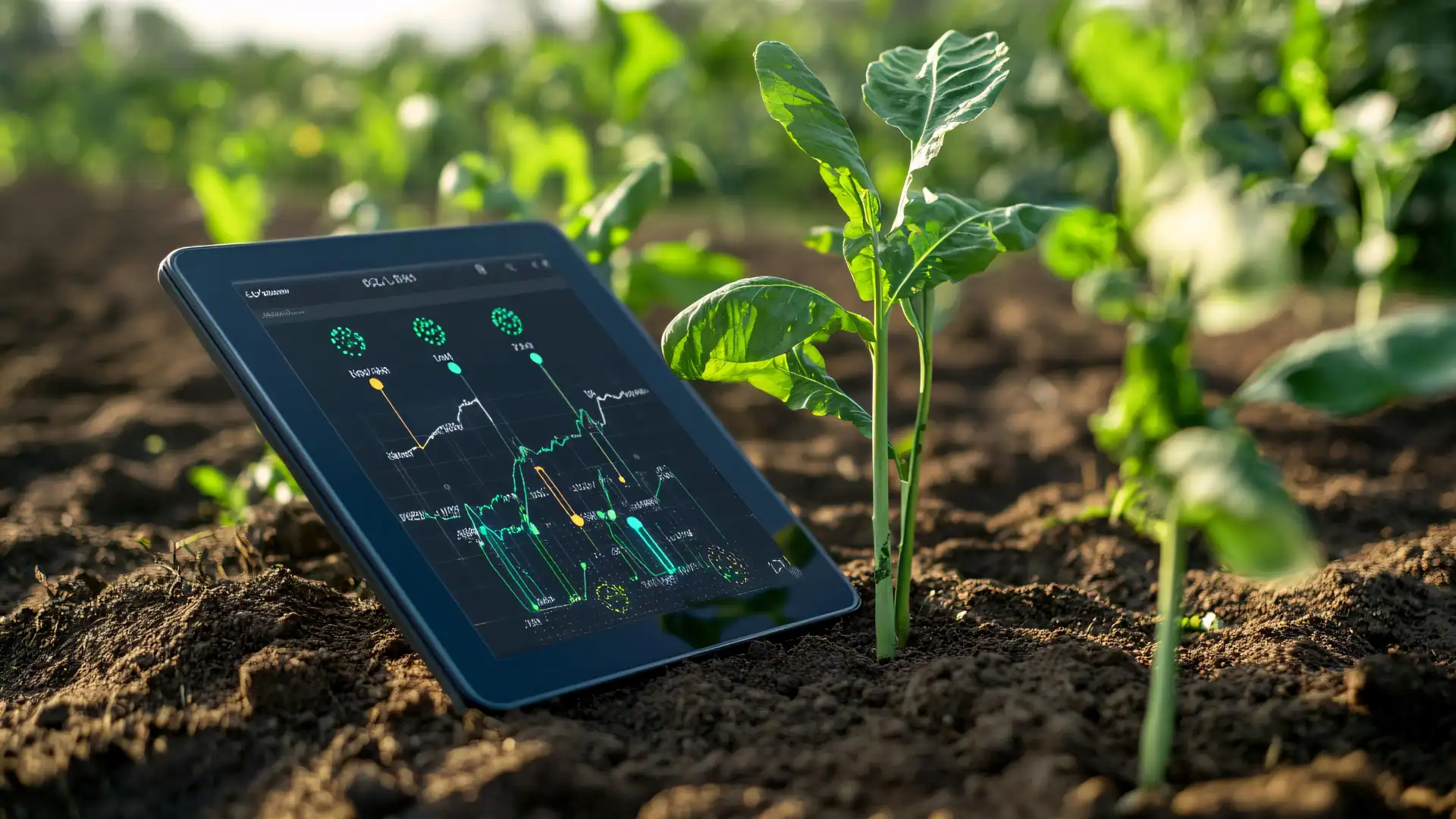
The top reasons farm operators gave for adopting IOT technologies: increasing yields, saving labor time, reducing input costs, reducing operator fatigue, and improving soil or environmental impact.
That distinction matters more in agriculture than in almost any other IoT category, because the deployment conditions are more hostile, more remote, and less forgiving of a bad assumption than consumer or even most industrial IoT. A device that’s mounted on a tractor, buried in soil, or left on a fence post for a full growing season has to survive dust, vibration, moisture, and temperature swings; unattended, for years, on a budget that doesn’t allow for over-engineering. Here’s what actually decides whether it does.
What “IoT in Smart Agriculture” Means at the Hardware Level
At the software layer, IoT in smart agriculture is well understood: sensors collect data, a gateway aggregates it, and a platform turns it into a decision. it tells you when to irrigate, spray and other details like, ‘this zone needs nitrogen’. That part of the stack gets most of the attention because it’s where the visible value shows up.
The part that gets far less attention is what has to be true at the hardware layer for that data to exist reliably in the first place. A yield map is only as good as the sensors that fed it, and a sensor that drifted, died early, or lost connectivity for three weeks during a critical growth stage often produces confidently wrong decisions. Engineering for smart agriculture hardware means treating reliability as the primary spec.
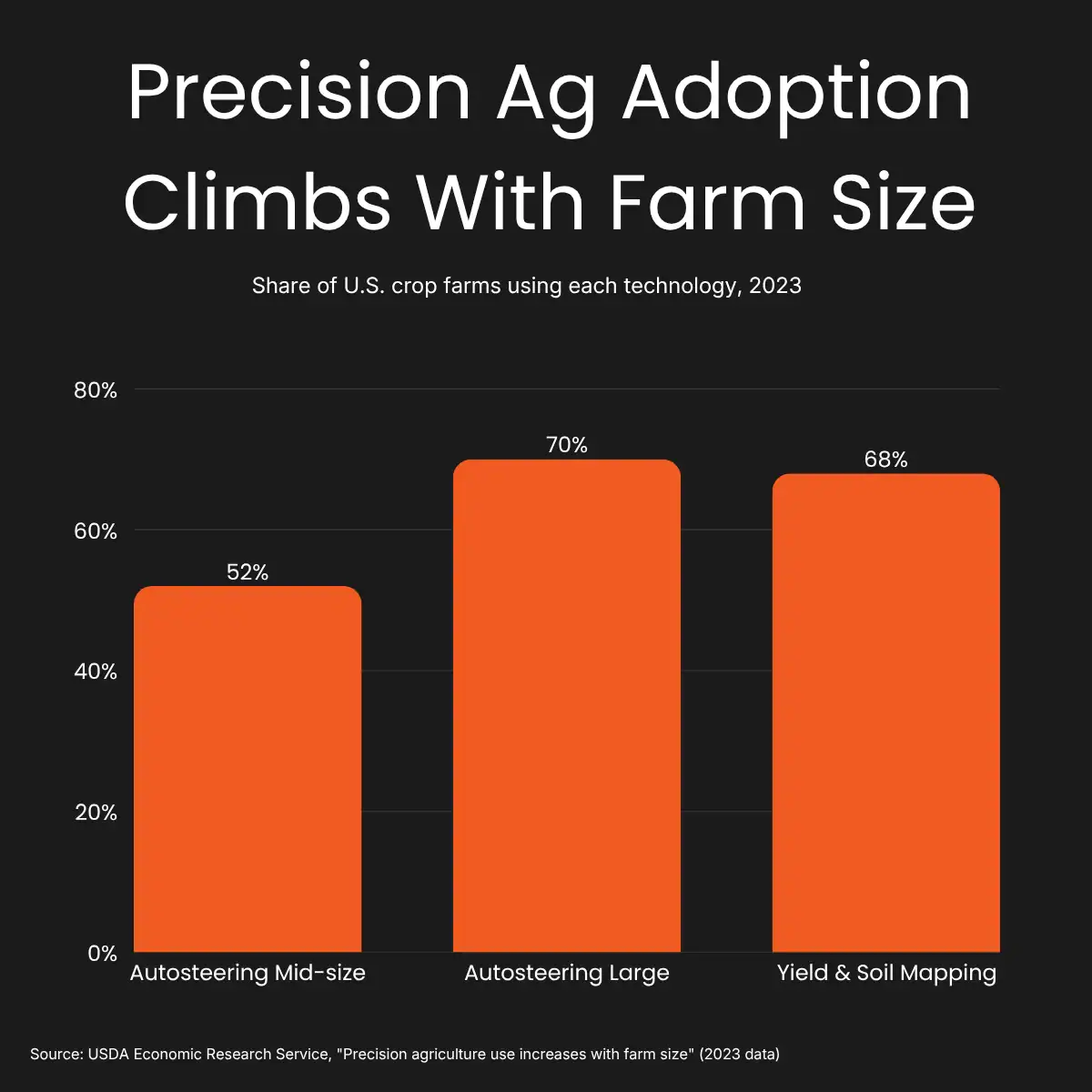
“The adoption rates of precision agriculture technologies increase sharply with farm size, with small family farms… having the lowest rates of use within each technology category.” — USDA Economic Research Service
Ruggedization Is Not Optional, and It’s Not Generic
Farm environments combine dust, moisture, vibration from machinery, UV exposure, and wide temperature swings that consumer-grade and even most industrial IoT enclosures aren’t rated for.
IP Ratings Are a Starting Point
An IP66 or IP67 enclosure is where the conversation starts, not where it ends. Connector selection, gasket material, and PCB conformal coating all need to be specified against the same conditions the enclosure is rated for; a sealed housing with an unsealed connector is not a sealed device. The first field failure is often a corroded connector, not a cracked case.
Vibration and Mounting Matter as Much as the Enclosure
A device fixed to a tractor, sprayer, or irrigation pivot experiences continuous mechanical vibration that a fence-post-mounted sensor never sees. Component selection (avoiding tall electrolytic capacitors prone to fatigue, for instance) and mounting hardware need to be specified for that vibration profile specifically. A design that passed drop testing hasn’t been tested for the failure mode that actually matters here.
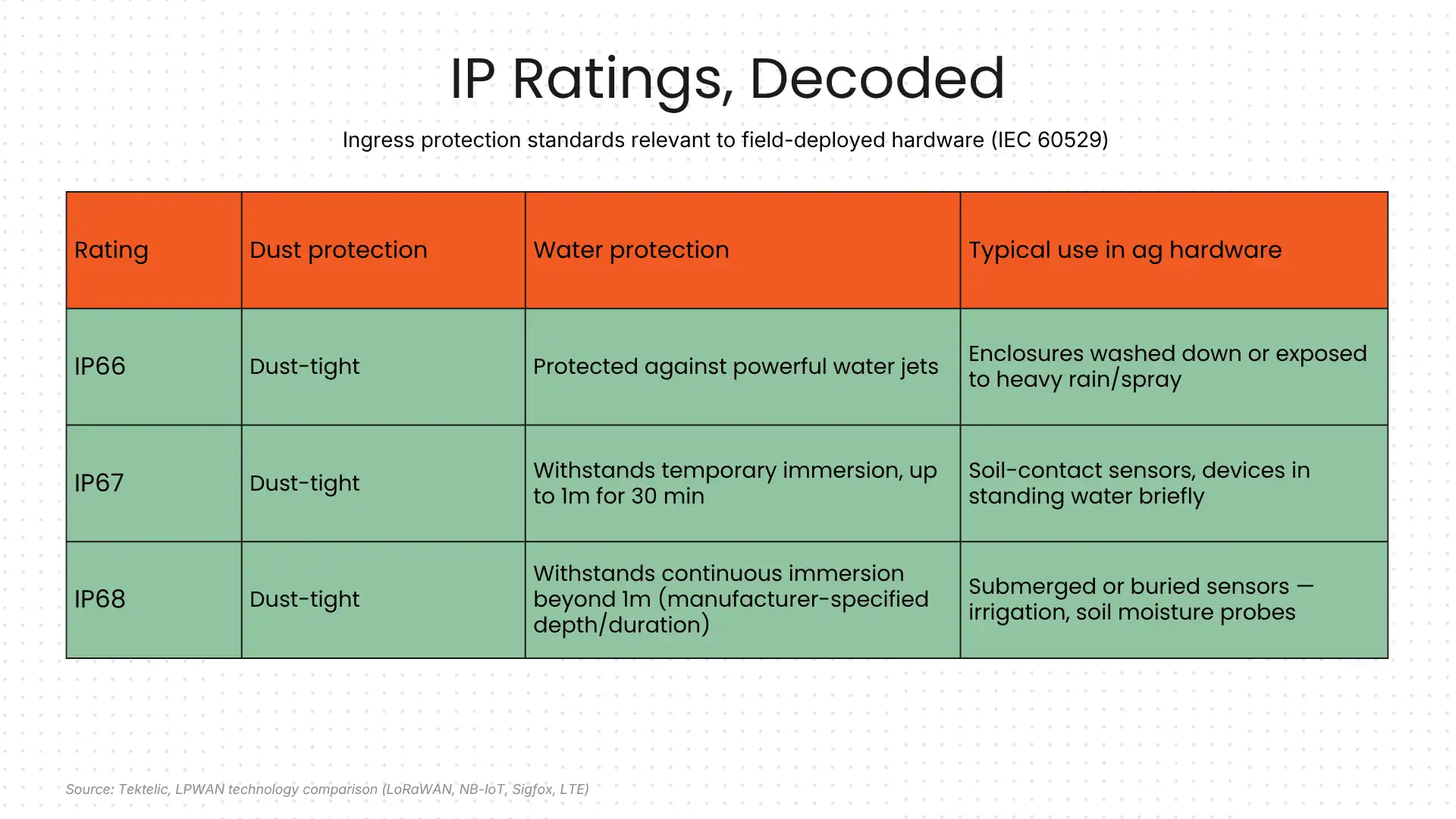
IP ratings are codified under IEC 60529, the international standard for degrees of protection against dust and water ingress. – : IEC 60529 standard overview · IP69K explainer
Power Architecture Decides Whether the Deployment Model Works
A sensor that needs a site visit every six weeks to swap a battery is a standing maintenance cost that erodes the value case too soon.
Modeling the Energy Budget Before the PCB Layout
Getting to multi-year, low-touch deployment means treating the power budget as a first-class constraint from day one, not an afterthought discovered in field trials. Ultra-low-power microcontrollers, aggressive sleep-cycle firmware, and a transmission schedule matched to how often the data actually needs to update all trade off against each other. That trade-off should be modeled before the PCB layout is finalised.
When Solar and Energy Harvesting Make Sense
Where the economics support it, solar or energy-harvesting supplementation extends deployment life significantly but it adds cost, a moving failure point (panel soiling, connector degradation), and a design constraint of its own. It’s worth specifying deliberately. Try not defaulting to it because it sounds appealing in a spec sheet.
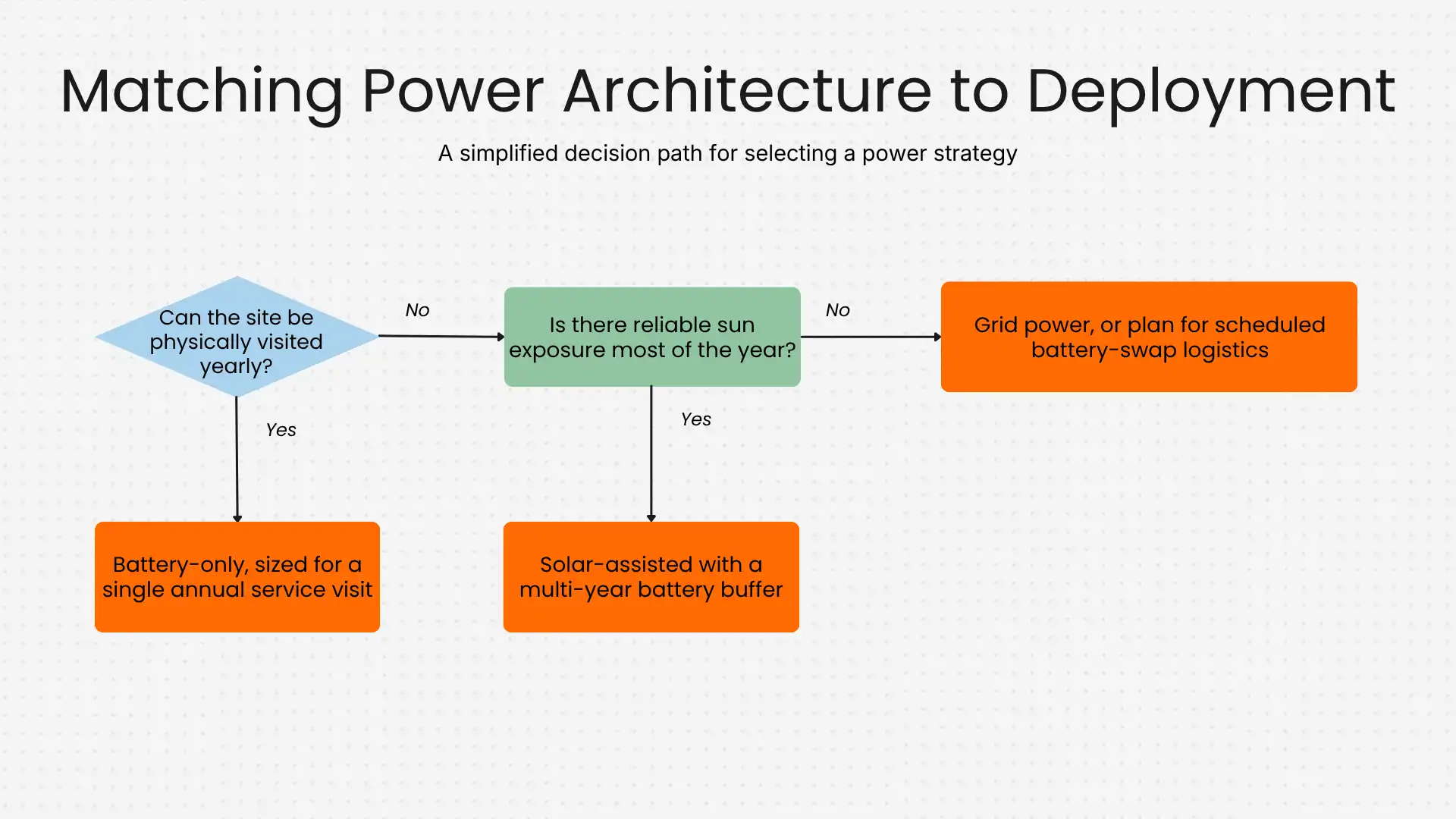
Published field research on solar-supplemented IoT irrigation systems documents solar/energy-harvesting extending deployment life in real installations, though there’s no single industry-wide “% of deployments using solar” figure to cite; this is genuinely still a case-by-case engineering decision, which is exactly the slide’s point.
Connectivity Has to Work Where the Crop Is, Not Where the Cell Tower Is
Rural coverage is inconsistent by definition, which is why LPWAN protocols ( LoRaWAN, NB-IoT, or satellite backup for the most remote deployments) dominate this category over standard cellular or Wi-Fi. Each comes with different range, latency, and power trade-offs, and the right choice depends on farm size, topology, and how time-sensitive the data actually is. A soil moisture reading that updates hourly has very different requirements than an irrigation fault alert that needs to reach someone within minutes.
Calibration Drift Is a Slow, Invisible Failure Mode
Sensor drift doesn’t throw an error. A soil moisture or nutrient sensor that’s 8% off after a season just quietly generates bad agronomic decisions, and nobody notices until the yield data doesn’t match expectations. Designing for long-term accuracy means planning calibration intervals and redundancy where the cost justifies it, and building in firmware-over-the-air update capability so drift correction doesn’t require a truck roll to every device in the field.
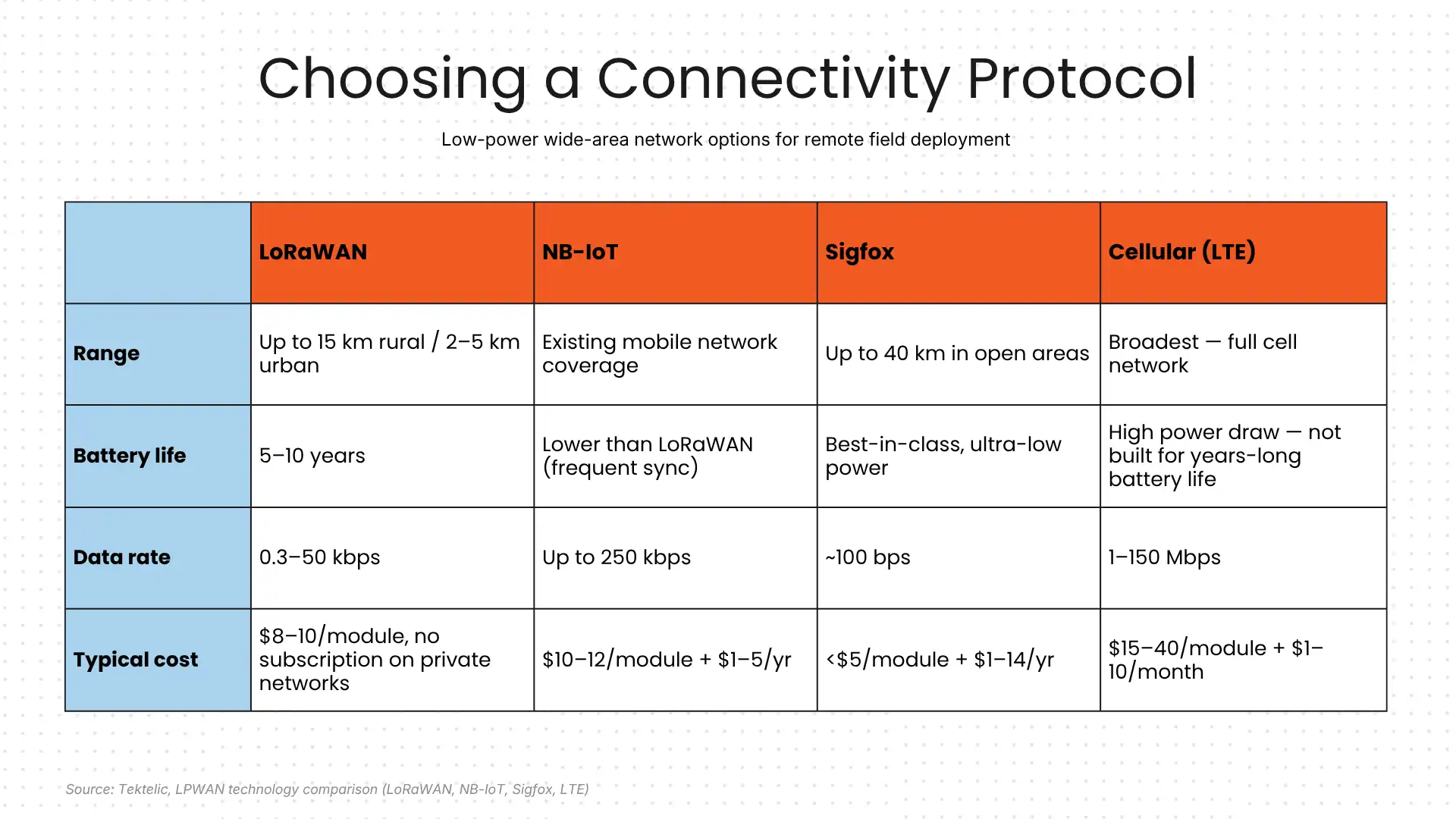
The LoRaWAN ecosystem now spans 650+ certified device types from 334+ member companies, with 125+ million LoRaWAN-connected devices worldwide as of end-2025.
Designing for Manufacture: Making the Engineering Affordable at Volume
A functional prototype and a producible product are different things, and the gap between them is where agrotech hardware budgets usually break. Component selection needs to account for lead time and multi-year sourceability. Agricultural hardware isn’t replaced on a two-year consumer refresh cycle, so the parts inside it need to still be available in year five. A design-for-manufacture (DFM) review before tooling, not after, is what keeps unit costs sane once volumes scale from a few hundred units to tens of thousands.
Compliance Travels With the Market, Not the Manufacturer
CE and UKCA in Europe and the UK, FCC in North America, and IP rating verification wherever the device ships each add lead time if they’re treated as a final-stage checkbox instead of a design input from day one; particularly for devices operating in the electromagnetically noisy environment near heavy farm machinery. It need to be where EMC testing needs to account for interference sources a consumer product would never encounter.
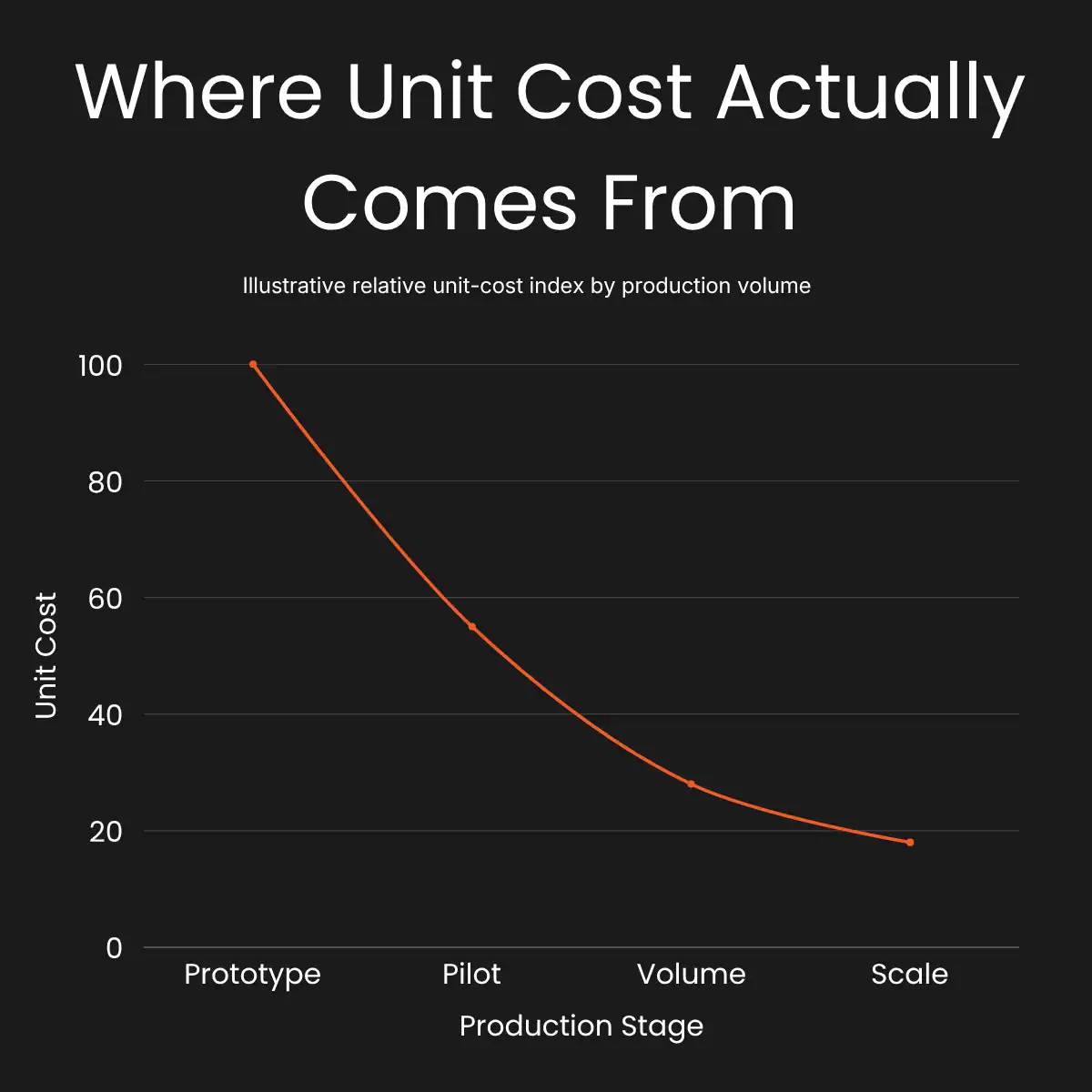
The underlying concept; it’s visualizing is the widely-cited “1-10-100 rule” of quality cost escalation: a defect caught at the design stage costs roughly 1x to fix, the same defect caught in production costs roughly 10x, and the same defect caught after it reaches the field/customer costs roughly 100x. This is a well-established quality-management heuristic
Field Testing Before You Commit to Tooling
A thermal chamber and a vibration table catch a lot, but they don’t catch everything. Condensation cycling from a cold night into a hot, humid morning, insect ingress through a gasket seam that looked fine on the bench, or a firmware assumption that breaks the first time a device loses signal for four consecutive days. Running a pilot batch through at least one full seasonal cycle, in the actual climate the product will ship into, before committing to production tooling is the single highest-leverage step teams skip under launch pressure.
That pilot should be treated as a data-gathering exercise and not a formality:
- Instrument the pilot units to log battery voltage, internal temperature, and connectivity uptime.
- Use that data to revise firmware and, if needed, the physical design before volumes scale.
A firmware fix after 50 units in the field is an update. The same fix after 5,000 units already deployed is a recall.

Running a pilot through a full seasonal cycle before committing to tooling sits between the pilot and full-ramp stages of this standard process.
IoT in Smart Agriculture Is Already at Scale; the Hardware Has to Catch Up
None of these trade-offs are unique to agriculture in isolation. They show up in automotive, industrial, and energy hardware too. Intretech’s design and engineering process and environmental and reliability testing capability were built around exactly this kind of ruggedized, long-lifecycle electronics. The difference in agriculture is that all of these constraints have to be solved simultaneously, on tight margins, for a product nobody is standing next to when it fails.
The adoption numbers show why this is worth getting right now rather than later. According to the USDA’s Economic Research Service, guidance autosteering systems are now used on 70% of large-scale U.S. crop farms. Yield and soil mapping technology is on 68%, up from single-digit adoption in the early 2000s. The market has moved past pilot projects. The hardware now has to hold up at scale.
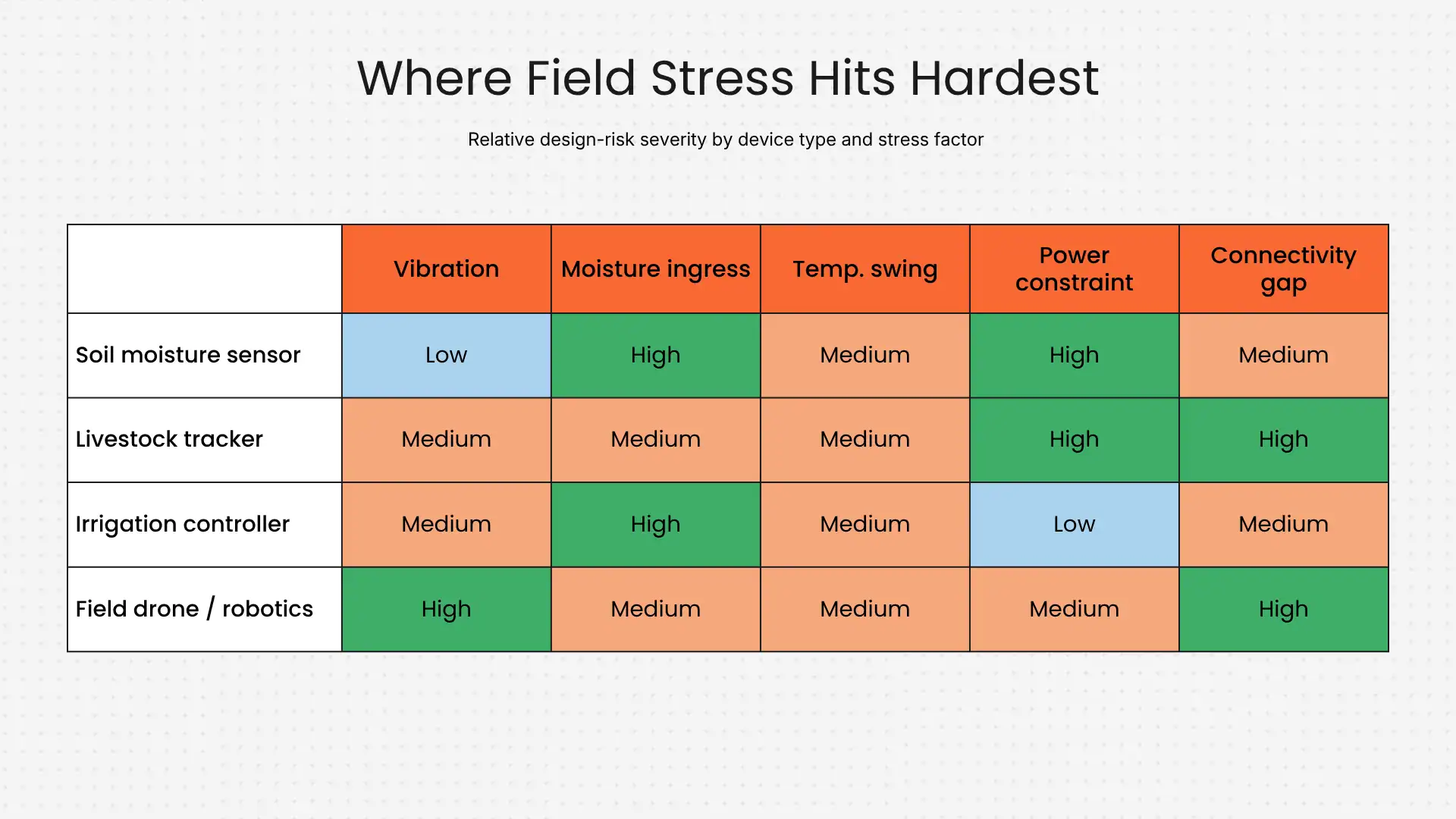
A 2025 review of smart sensors in precision agriculture lists environmental degradation, power constraints, and connectivity gaps as the three most recurring field-reliability challenges across the literature.
FAQ
How does IoT work in smart agriculture?
Sensors in the field (soil, weather, livestock, or equipment-mounted) collect data and transmit it usually over a low-power wide-area network to a gateway, which forwards it to a platform that turns raw readings into a decision like when to irrigate or where to apply nutrients. The value depends entirely on the hardware layer producing accurate, reliable data over time.
Why do agricultural sensors fail in the field even after passing lab testing?
Lab testing rarely replicates the combination of vibration, moisture cycling, UV exposure, and multi-year unattended operation a field deployment involves. A device can pass an IP67 rating and a drop test and still fail from a corroded connector or a battery model that didn’t account for real-world duty cycles.
What’s the difference between consumer IoT and agricultural IoT hardware design?
Consumer IoT is typically indoors, powered or frequently charged, and replaced every one to three years. Agricultural IoT has to survive outdoors, run for years on limited power, and remain serviceable and cost-effective at scale closer in engineering discipline to industrial or automotive hardware than to consumer electronics.
How long should an agricultural IoT sensor last before its battery needs replacing?
There’s no universal number, but well-engineered deployments target multi-year battery life without a site visit, achieved through low-power component selection, sleep-cycle firmware, and sometimes solar supplementation. A design that needs battery changes more than once a season usually points to a power budget that wasn’t modeled early enough.
What connectivity option is best for IoT devices on a farm with poor cell coverage?
LPWAN protocols like LoRaWAN or NB-IoT are generally the best fit for rural, low-coverage environments because they trade data speed for range and power efficiency. Satellite backup is worth considering for the most remote deployments where even LPWAN gateway coverage is impractical.
Ready to design agricultural hardware that survives past the pilot? Talk to Intretech’s engineering team about your next IoT device.
Explore more related content

Inside the GLP-1 Injector Pen Boom: What It Actually Takes to Manufacture a Smart Drug Delivery Device
Inside the GLP-1 Injector Pen Boom: What It Actually Takes to Manufacture a Smart Drug Delivery DeviceFixing a signal...

OEM vs. ODM for Medical Device Manufacturing: Which Model Fits Your Product?
OEM vs. ODM for Medical Device Manufacturing: Which Model Fits Your Product?The medical device OEM/ODM/CDMO market was...

What Is Medical Device Contract Manufacturing? A Buyer’s Guide to Choosing the Right Partner
What Is Medical Device Contract Manufacturing? A Buyer’s Guide to Choosing the Right Partner The global medical device...