

What Is Medical Device Contract Manufacturing?
A Buyer’s Guide to Choosing the Right Partner


The global medical device contract manufacturing market was valued at $84.6B in 2025 and is projected to grow from $93.5B in 2026 to $214.3B by 2033 (12.6% CAGR). Asia Pacific held 41.5% of the market in 2025; Class II devices accounted for 80.1% of the product segment.
Medical device contract manufacturing is what happens when a company that designs a health or wellness product doesn’t build it themselves. Instead, a specialized manufacturing partner handles component sourcing, assembly, testing, and regulatory documentation, so the brand can focus on getting the product cleared and sold. It sounds like a back-office decision. It isn’t. It’s the single choice most likely to determine whether your device clears FDA review on schedule, launches without a recall, and survives a quality audit five years from now. This guide breaks down what medical device contract manufacturing actually covers, and gives you seven concrete criteria for telling a real manufacturing partner apart from a vendor who happens to also make medical parts.
MarketsandMarkets: the global medical device contract manufacturing market is valued at $83.77 billion in 2025 and projected to reach $140.84 billion by 2030, a 10.9% CAGR, with Class III devices and Asia Pacific leading.
What Is Medical Device Contract Manufacturing?
Medical device contract manufacturing is the outsourced production of a medical device from component sourcing through final assembly, functional testing, and packaging carried out by a specialized manufacturer on behalf of the company that owns the device’s design and regulatory clearance. The brand keeps ownership of the design and the regulatory submission; the contract manufacturer executes it at scale, under a quality system built for medical devices rather than general electronics.
That distinction matters more than it sounds like it should. A contract manufacturer that builds consumer electronics can assemble a plastic enclosure and a PCB perfectly well. What it usually can’t do is generate a Device History Record that will survive an FDA inspection, or tell you why a supplier substitution needs a formal change-control review instead of a quick email approval. Medical device work is manufacturing plus a second, parallel discipline: proving, in writing, that every unit was built the way the regulatory submission said it would be.
You’ll also hear the term CDMO (Contract Development and Manufacturing Organization) used in this space, mostly by companies with roots in pharma or biologics. The two terms overlap but aren’t identical more on that below.
What Does a Medical Device Contract Manufacturer Actually Do?
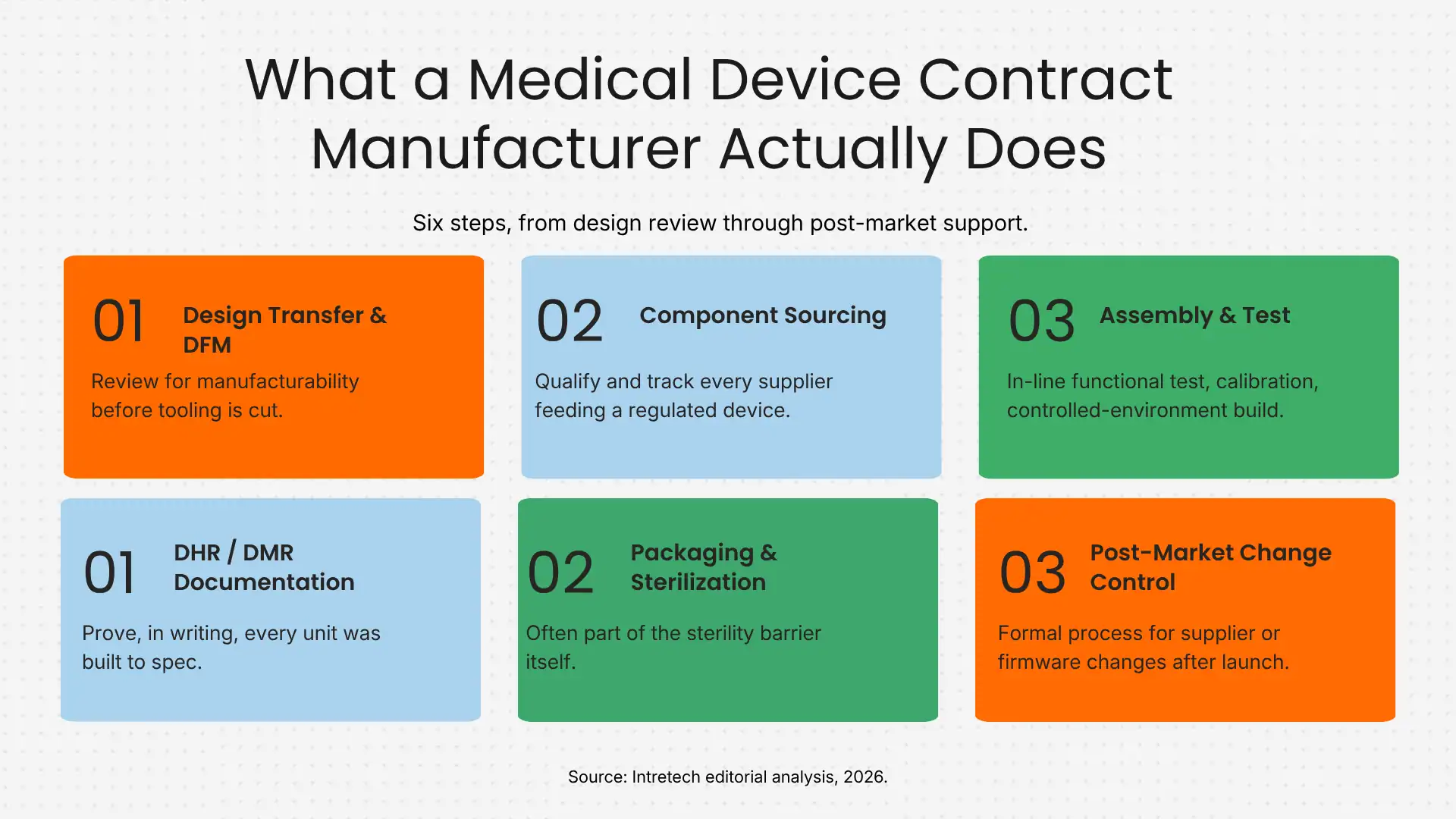
A good partner is involved well before the first unit comes off the line, and stays involved after it ships.
Design Transfer and DFM
Before production starts, the manufacturer reviews the design for manufacturability, tolerances, material choices, assembly sequence and flags anything that will cause yield problems or field failures at volume. This should happen early enough to change the design, not after tooling is already cut.
Component Sourcing and Supplier Qualification
Every component supplier feeding into a regulated device needs to be qualified and tracked, not just price-shopped. A manufacturer with an established supplier base moves faster here than one building a supply chain from scratch for your project.
Assembly, Integration, and Functional Test
This is the part people picture when they hear “manufacturing”, but for a medical device it includes in-line functional testing, calibration, and often clean-room or controlled-environment assembly, depending on device class.
Medical device outsourcing overall is growing even faster than CM alone: $157.8B in 2025 to a projected $421.9B by 2033 (13.4% CAGR).
Regulatory Documentation (DHR, DMR, Traceability)
Every unit needs a Device History Record tying it back to the Device Master Record the specific components, the specific test results, the specific operator and date. This is the paperwork that turns “we made 50,000 units” into “we can prove exactly how each of the 50,000 units was made.”
Packaging, Sterilization Coordination, and Labeling
Packaging for a medical device isn’t cosmetic it’s frequently part of the sterility barrier and the regulatory submission. Labeling errors are one of the most common causes of device recalls.
Post-Market Support and Change Control
Devices change after launch a supplier goes out of business, a component gets an update, a firmware patch ships. A real manufacturing partner has a formal change-control process for handling this without quietly drifting away from what the regulatory filing describes.
Brynn Stanley, Associate Attorney at Gardner Law, on the QMSR transition: “I view the transition to QMSR as an overdue and welcome modernization of FDA’s device quality framework.” She adds that harmonizing with ISO 13485 “brings clarity, consistency, and efficiency to multinational quality systems” and gives manufacturers “an opportunity to streamline compliance and strengthen overall quality culture.
Medical Device Contract Manufacturer vs. CDMO vs. ODM | What’s the Difference?
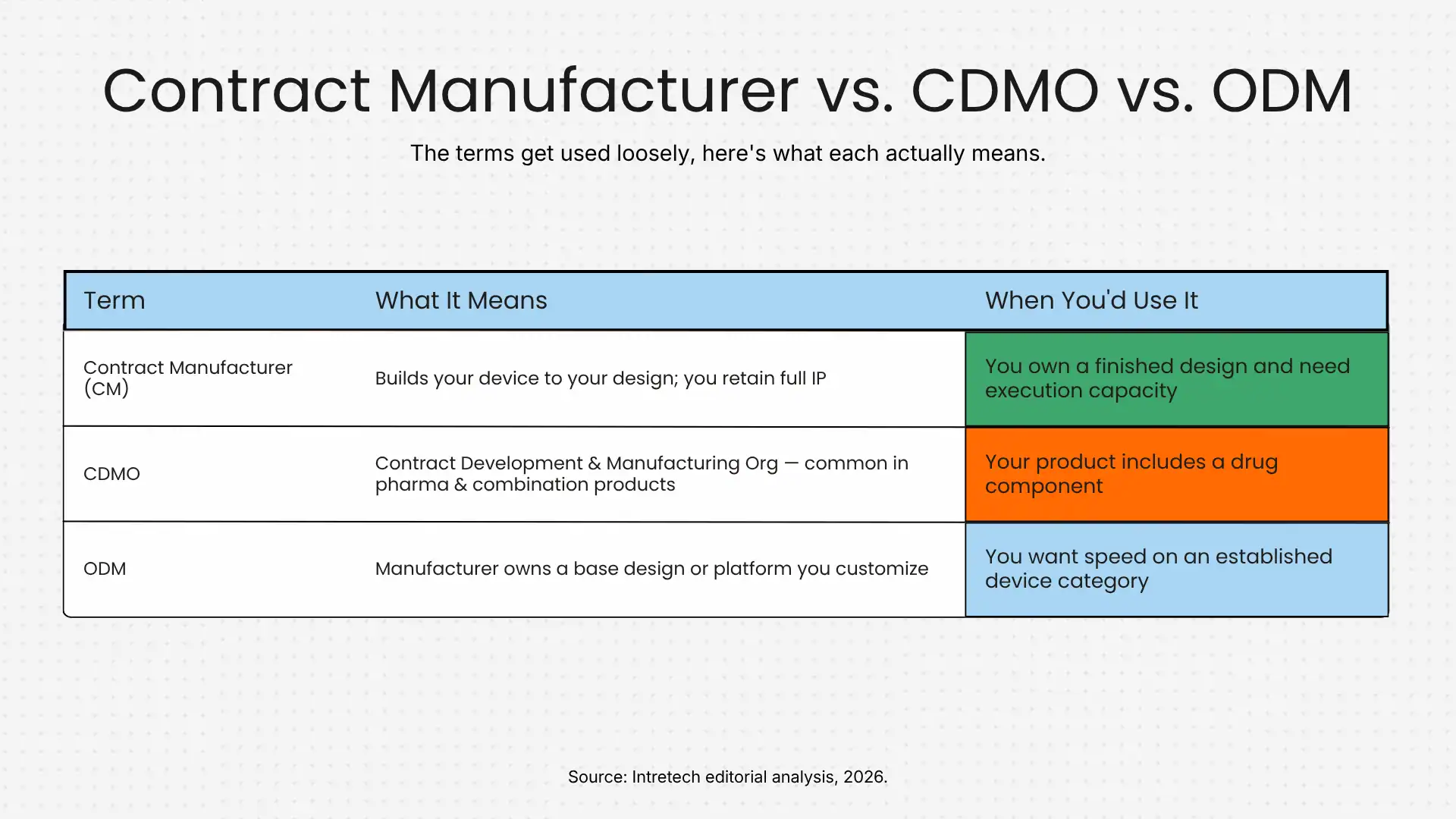
These terms get used loosely, which causes real confusion during vendor selection.
| Term | What it means | When you’d use it |
|---|---|---|
| Contract Manufacturer (CM) | Builds your device to your design; you retain full IP and design ownership | You have a finished or near-finished design and need execution capacity |
| CDMO | Contract Development and Manufacturing Organization more common in pharma, biologics, and drug-device combination products | Your product includes a drug component alongside the device (see our piece on the GLP-1 injector pen boom) |
| ODM (Original Design Manufacturer) | The manufacturer owns a base design or platform that you customize and brand | You want to move fast on an established device category and don’t need a fully custom mechanism |
If you’re trying to decide between the OEM and ODM approach specifically for a medical device, we’ve written a full breakdown of OEM vs. ODM for medical device manufacturing, including who ends up carrying regulatory liability under each model, which is the part most comparison articles skip.
Why This Decision Got Harder in 2026
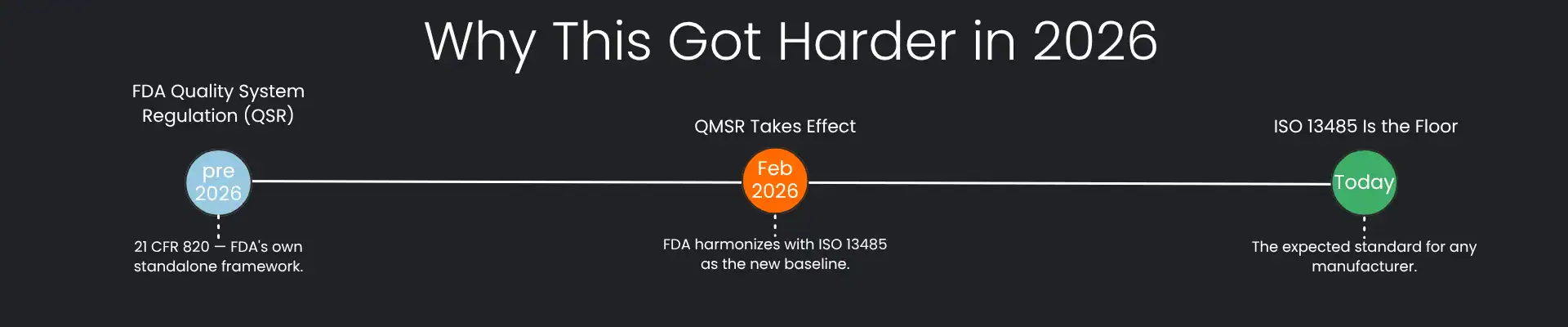
For years, the working assumption in the industry was that any capable electronics contract manufacturer could pick up medical work if the volume was attractive enough. That assumption was already shaky. As of February 2026, it’s flatly wrong.
FDA’s Quality Management System Regulation (QMSR) replaced the old Quality System Regulation and aligned FDA’s requirements directly with ISO 13485, the international quality management standard for medical devices. The practical effect: an ISO 13485-aligned quality system is no longer a nice-to-have a manufacturer can bolt on later. It’s the baseline FDA now expects, and a manufacturer without one is a liability you might be inheriting.
This is the gap that separates a real medical device contract manufacturer from a general electronics shop willing to take the work: pair with manufacturer who is learning it on your project, on your timeline, with your regulatory submission as the test case.
CDRH Director Michelle Tarver, M.D., Ph.D.: “Until the two firms have adequately addressed these issues, all study data from all studies conducted at these testing facilities will be rejected.”
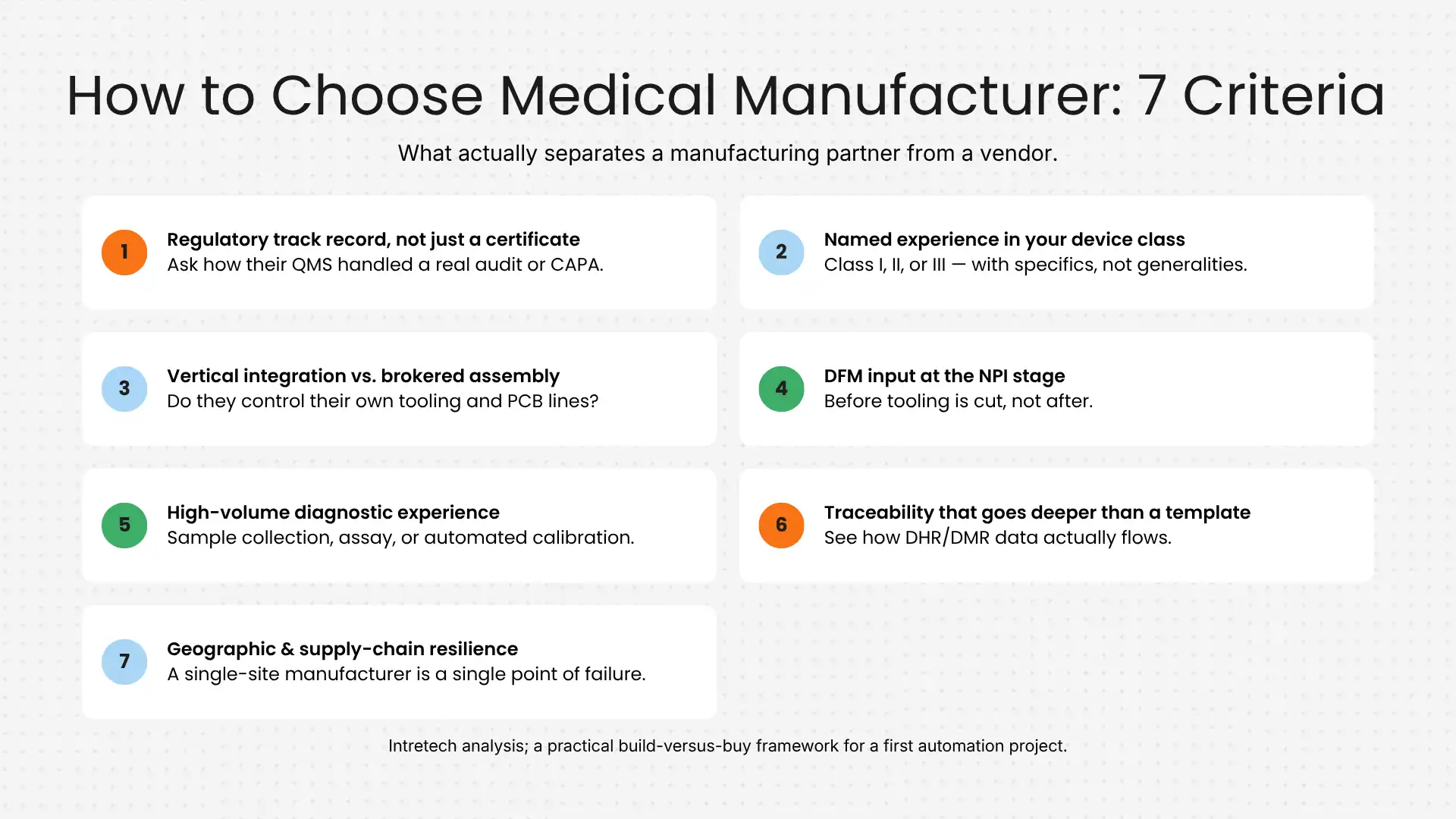
How to Choose a Medical Device Contract Manufacturer: 7 Criteria
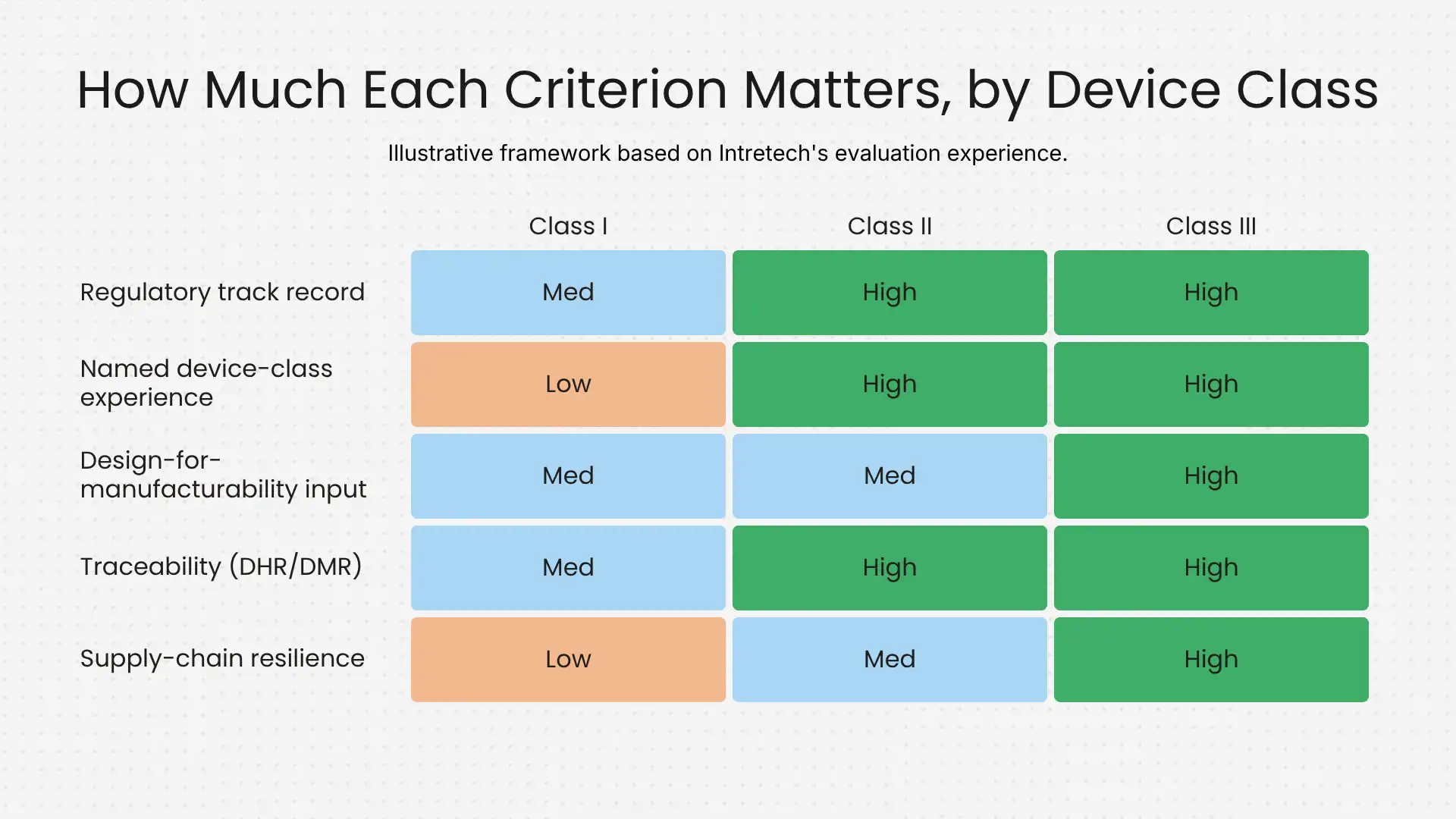
- Regulatory track record, not just a certificate on a wall. ISO 13485 certification and FDA establishment registration are table stakes. Ask how the manufacturer’s quality system actually handled a real audit or a real corrective action, a certificate tells you they passed once; a specific answer tells you they can pass again.
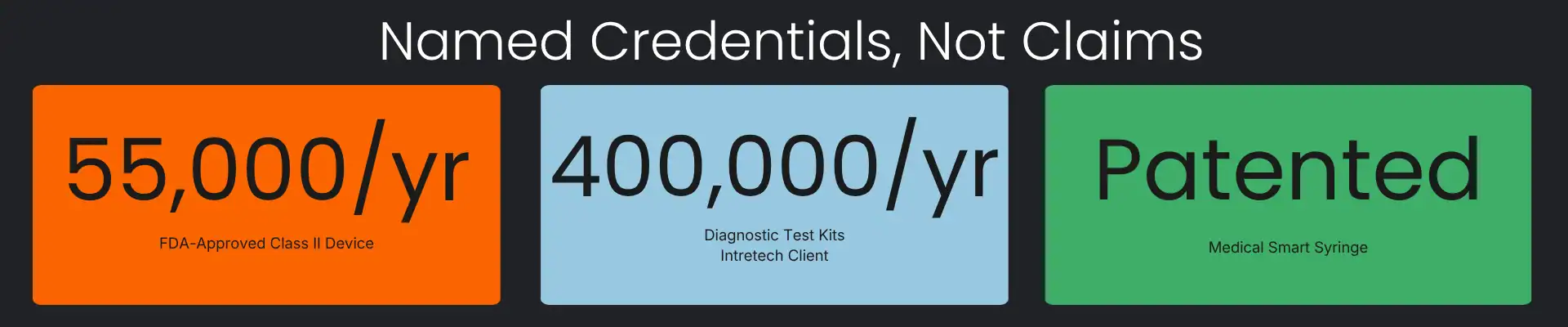
- Named experience in your device class. A manufacturer who can point to real Class I, II, or III work is a different proposition from one who says “we could probably figure that out. Those are the kinds of specifics worth asking any prospective partner for.
- Vertical integration versus brokered assembly. Does the manufacturer control its own tooling, molding, and PCB lines, or is it subcontracting the parts that actually determine your quality and lead time? Vertical integration means fewer handoffs where things go wrong and get lost.
- Design-for-manufacturability input at the NPI stage. If a manufacturer’s first serious feedback on your design arrives after you’ve already committed to tooling, you’re paying for their learning curve.
- High-volume diagnostic and assay experience, where relevant. If your device involves sample collection, an assay, or automated calibration, ask specifically about that experience. Get a proof that this isn’t a first attempt at diagnostic-scale precision.
- Traceability and quality systems that go deeper than a PDF template. Ask to see how DHR and DMR data actually flows through their system, not just that the fields exist.
- Geographic and supply-chain resilience. A single-site manufacturer is a single point of failure. Ask where components actually come from and what the backup plan is if a key supplier disappears.
FDA Commissioner Marty Makary, M.D.: “The FDA has no room for bad actors. Once we discover data integrity issues, we will respond accordingly.”
Red Flags to Watch For
A few signals reliably predict a bad fit:
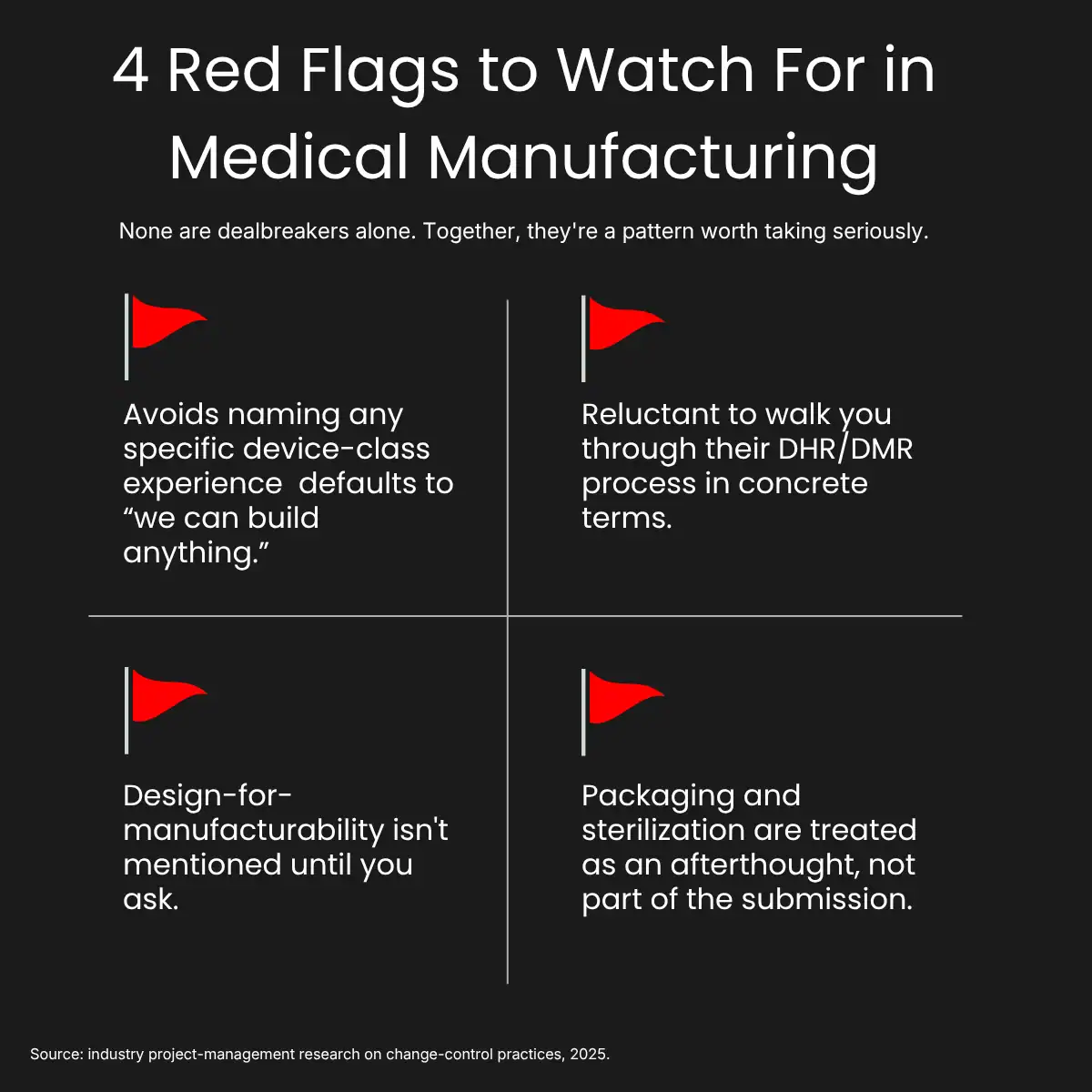
- The manufacturer avoids naming any specific device-class experience and defaults to “we can build anything.”
- They’re reluctant to walk you through their DHR/DMR process in concrete terms.
- Design-for-manufacturability and design transfer aren’t mentioned until you ask.
- Packaging and sterilization are treated as an afterthought rather than part of the regulatory submission.
None of these are dealbreakers on their own. Together, they’re a pattern worth taking seriously before you sign anything.
FAQ
What is medical device contract manufacturing?
It’s the outsourced production of a medical device sourcing, assembly, testing, documentation, and packaging carried out by a specialized manufacturer while the brand retains ownership of the design and regulatory clearance.
How is a medical device contract manufacturer different from a general electronics manufacturer?
A medical device manufacturer operates under a quality management system aligned with ISO 13485 and FDA’s QMSR, and can produce the traceability documentation; DHR and DMR; that a regulatory audit requires. A general electronics manufacturer typically can’t.
Do I need ISO 13485 certification from my manufacturer?
Effectively, yes. Since FDA’s Quality Management System Regulation harmonized US requirements with ISO 13485 in 2026, it’s the accepted baseline for any manufacturer handling regulated medical devices.
How do I choose a medical device contract manufacturer?
Look for named, verifiable experience in your specific device class, a real (not templated) quality and traceability system, vertical integration where it matters, and design input early enough to influence the design itself.
What’s the difference between a contract manufacturer and a CDMO?
A contract manufacturer builds a device to your design. A CDMO (Contract Development and Manufacturing Organization) typically also covers development work and is the more common term when a drug component is involved, as with drug-device combination products.
Choosing between the OEM and ODM manufacturing models is the next decision most teams face; read our breakdown of OEM vs. ODM for medical device manufacturing for how that choice affects who carries regulatory liability. You can also see Intretech’s medical device manufacturing work directly, or explore our full contract manufacturing services.
Ready to talk through your device? Book a free consultation with our team.
Explore more related content
How to Choose a Manufacturing Automation Integrator: A Vetting Framework That Actually Works
How to Choose a Manufacturing Automation Integrator: A Vetting Framework That Actually WorksSearch "how to choose an...

The ROI of Automation in Manufacturing: Real Cost and Payback Benchmarks by Use Case
The ROI of Automation in Manufacturing: Real Cost and Payback Benchmarks by Use CaseSearch "ROI of automation" right...
What Are the Latest Techniques in Manufacturing for Product Designers?
What Are the Latest Techniques in Manufacturing for Product Designers?"70% of manufacturing costs are locked in during...