

Strategic Sourcing in Supply Chain Management


Most procurement teams think they’re doing strategic sourcing. They’re not. They’re doing strategic price negotiation – and dressing it up with a nicer name.
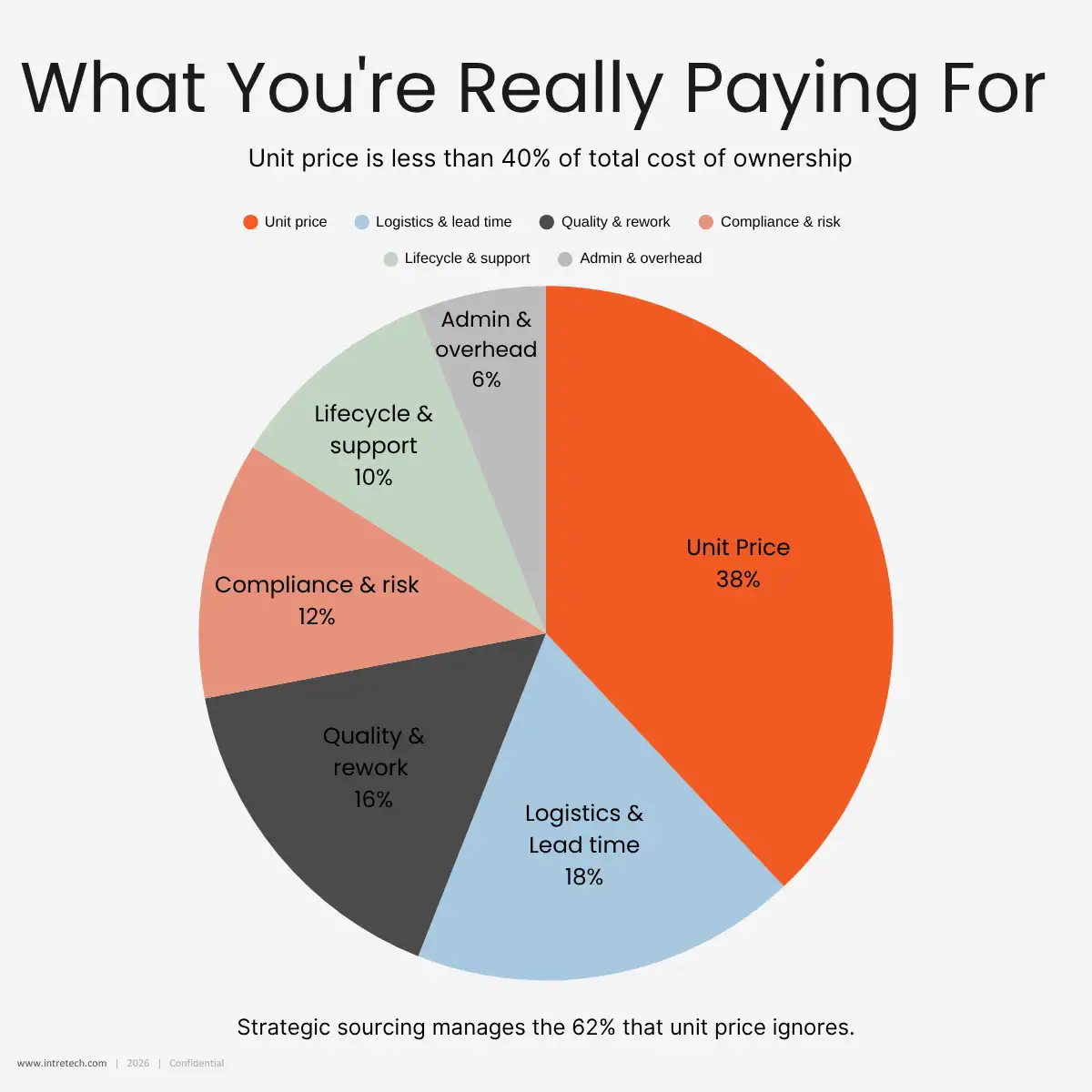
Here’s the difference: real strategic sourcing doesn’t start with a price target. It starts with a question most teams never ask “what does this supplier relationship actually cost us, end to end?” That’s the total cost of ownership (TCO), and it changes everything.
Get this right, and procurement stops being a cost centre your CFO tolerates and becomes a lever your CEO actually talks about. It builds repeatable processes for sourcing events, supplier governance, and continuous improvement. For more on Intretech’s approach, see Strategic Sourcing and Strategic Global Sourcing.
The short version, if you’re busy
- Strategic sourcing is about total value – cost, quality, risk, and service, not unit price. If you’re optimising unit price, you’re optimising the wrong thing.
- It follows a repeatable process: assess spend and needs, analyse the market, run a sourcing event, contract, then manage suppliers.
- Most of the long-term gains come from supplier performance management – the part most teams phone in.
“40–80% of a company’s total cost is wrapped up in external spend with suppliers.”
— Strategic Sourcing Software Statistics 2025
So what actually is strategic sourcing?
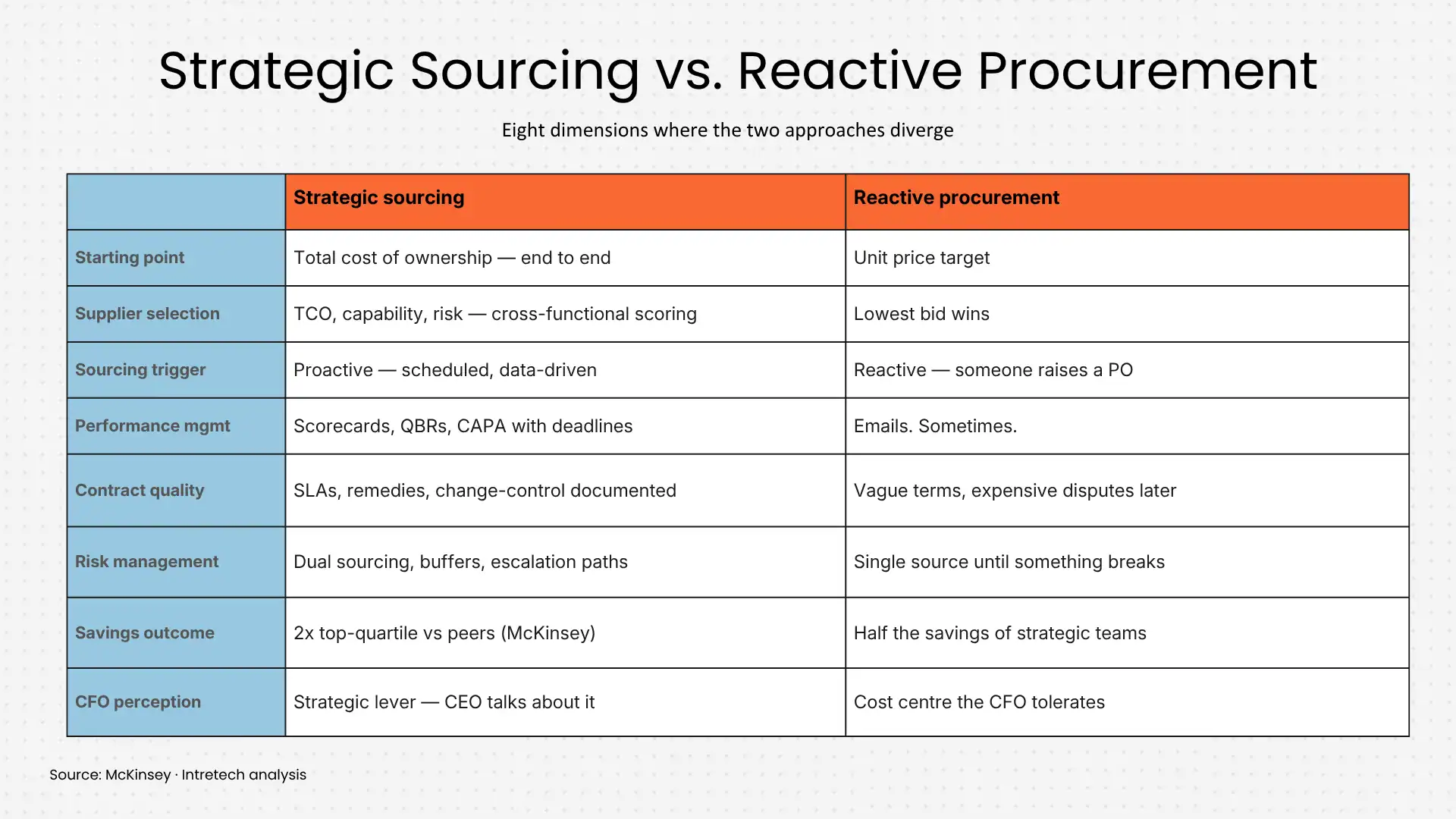
It’s a structured approach to procurement that prioritises long-term value and measurable outcomes. Instead of buying reactively, someone raises a purchase request, you find a supplier, you argue about price – teams segment spend, evaluate supply markets, and choose suppliers based on TCO, capability, and risk.
TCO looks beyond price to include lead times, logistics, quality costs, compliance, and lifecycle support. That broader view is what stops teams making “low-price, high-problem” supplier decisions – the kind that look great on a savings report until a quality failure costs you three times what you thought you saved.
Why does it actually matter?
Because the alternative is expensive. Strategic sourcing strengthens supply continuity while lowering total cost and tightening supplier accountability. It also makes sourcing decisions easier to defend – because selection criteria, trade-offs, and approvals are documented, not tribal knowledge in someone’s head.
The data backs this up. McKinsey found that top-quartile procurement functions generate twice the annual savings of their lower-performing counterparts. (Source: mckinsey.com)
Twice. That’s not marginal. That’s the gap between a procurement team that adds value and one that just processes purchase orders.
“Strategic sourcing and leveraging spend has been cited as the #1 priority by 56% of procurement executives.”
— Procurement Statistics 2025 (Zeiv.ai / HICX Voice of the Supplier Survey 2024) Zeiv
The process, step by step
Most sourcing failures don’t happen in negotiation. They happen three steps before it – in poorly defined requirements and half-baked market analysis. Get the foundation right.
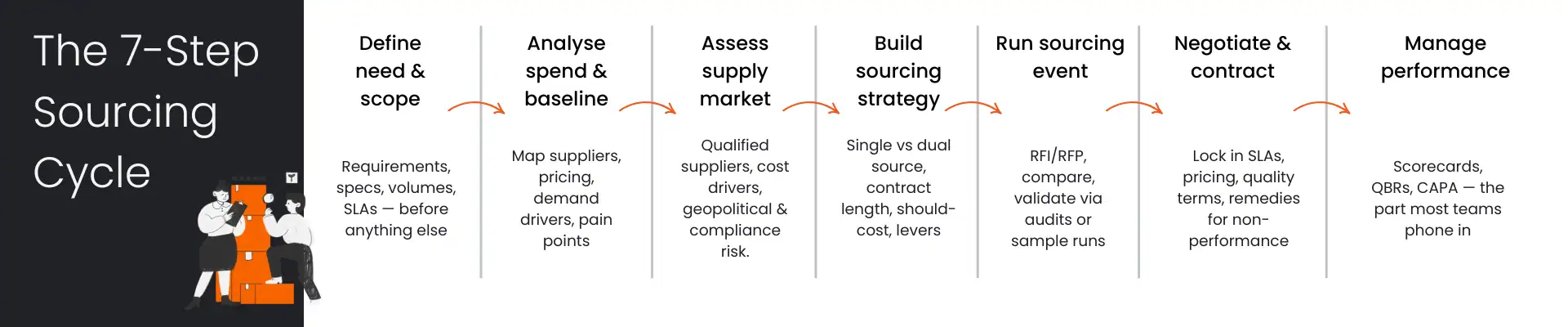
- Define the need and scope. Clarify requirements, specs, volumes, service levels, and stakeholders before anything else. If suppliers can’t compare apples to apples, your RFP responses are useless.
- Analyse spend and baseline performance. Map current suppliers, pricing, demand drivers, and pain points – quality, OTIF, lead time variability. You can’t improve what you haven’t measured.
- Assess the supply market. Identify qualified suppliers, capacity constraints, cost drivers, and risks (geopolitical, financial, compliance). Know the landscape before you walk into it.
- Build the sourcing strategy. Decide on single vs. dual sourcing, contract length, should-cost approach, and negotiation levers. Have a plan, not just a hope.
- Run the sourcing event. Issue RFI/RFP, compare offers, and validate claims with references, audits, or sample runs. Suppliers will tell you what you want to hear – make them prove it.
- Negotiate and contract. Lock in pricing mechanisms, SLAs, quality terms, and clear remedies for non-performance. Vague contracts create expensive disputes.
- Manage supplier performance. Track KPIs, run QBRs, and execute corrective actions – or re-source when needed. The contract is the beginning, not the finish line.
What strategies actually work?
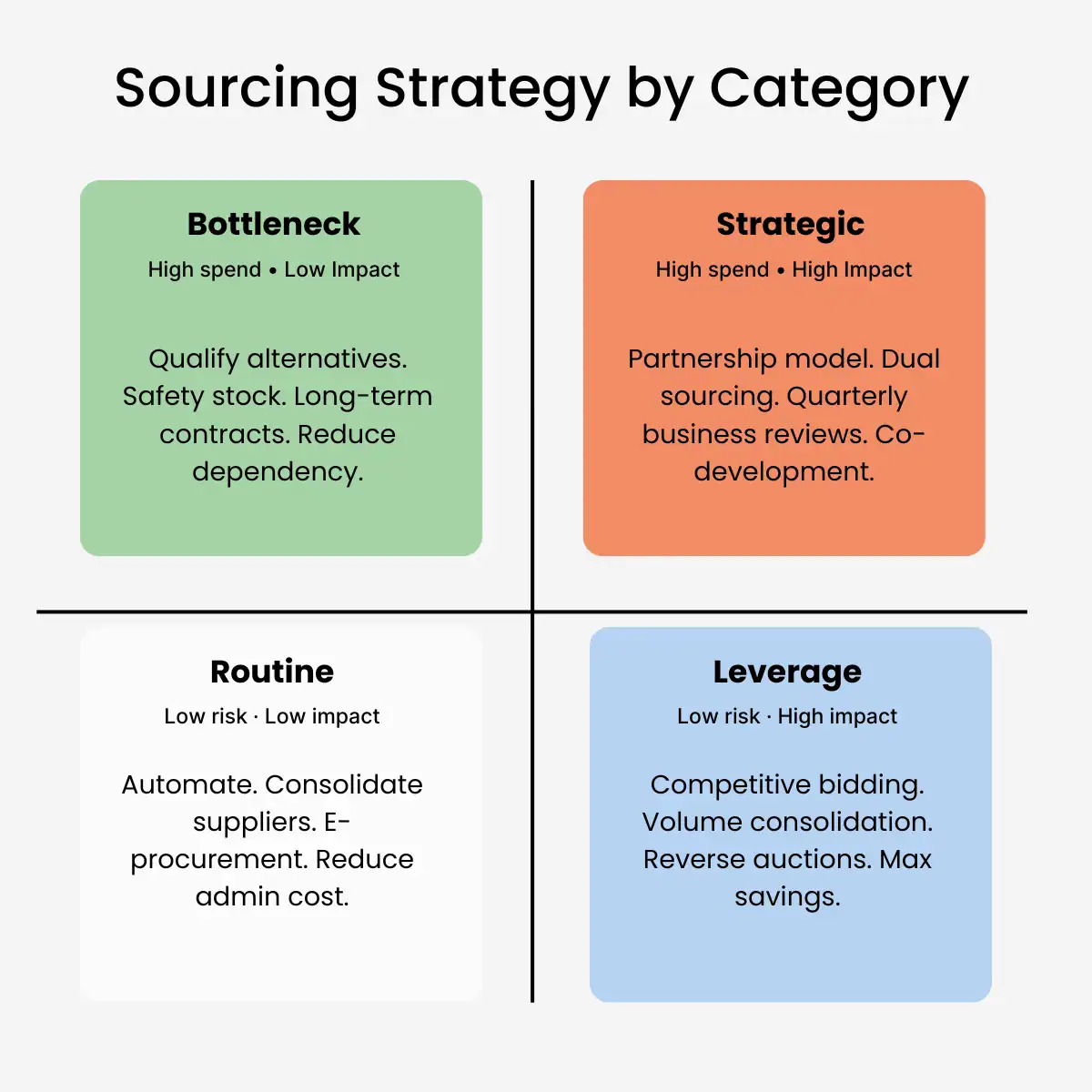
There’s no universal answer – and anyone telling you otherwise is selling something you shouldn’t be buying. The right strategy depends on category risk, supplier power, and how costly a disruption would be. For critical categories, resilience (qualified alternates, inventory buffers, escalation paths) can outweigh the lowest bid.
What does work consistently:
- Cross-functional scoring – procurement, engineering, quality, operations, finance. Don’t let one function own a decision that affects everyone.
- TCO comparison, not unit price. Every time.
- Measurable SLAs (quality PPM, OTIF, lead time) reviewed on a cadence. Not reviewed once at contract signing and forgotten.
- A documented negotiation plan: targets, walk-aways, and concessions. Improvised negotiation is expensive.
- Periodic market revalidation for high-spend or high-risk categories. Markets change. Your sourcing decisions should too.
“65% of procurement organisations cite digital transformation as their most important initiative going forward.”
— ProcureAbility State of Procurement H2 2025
How global sourcing changes the equation
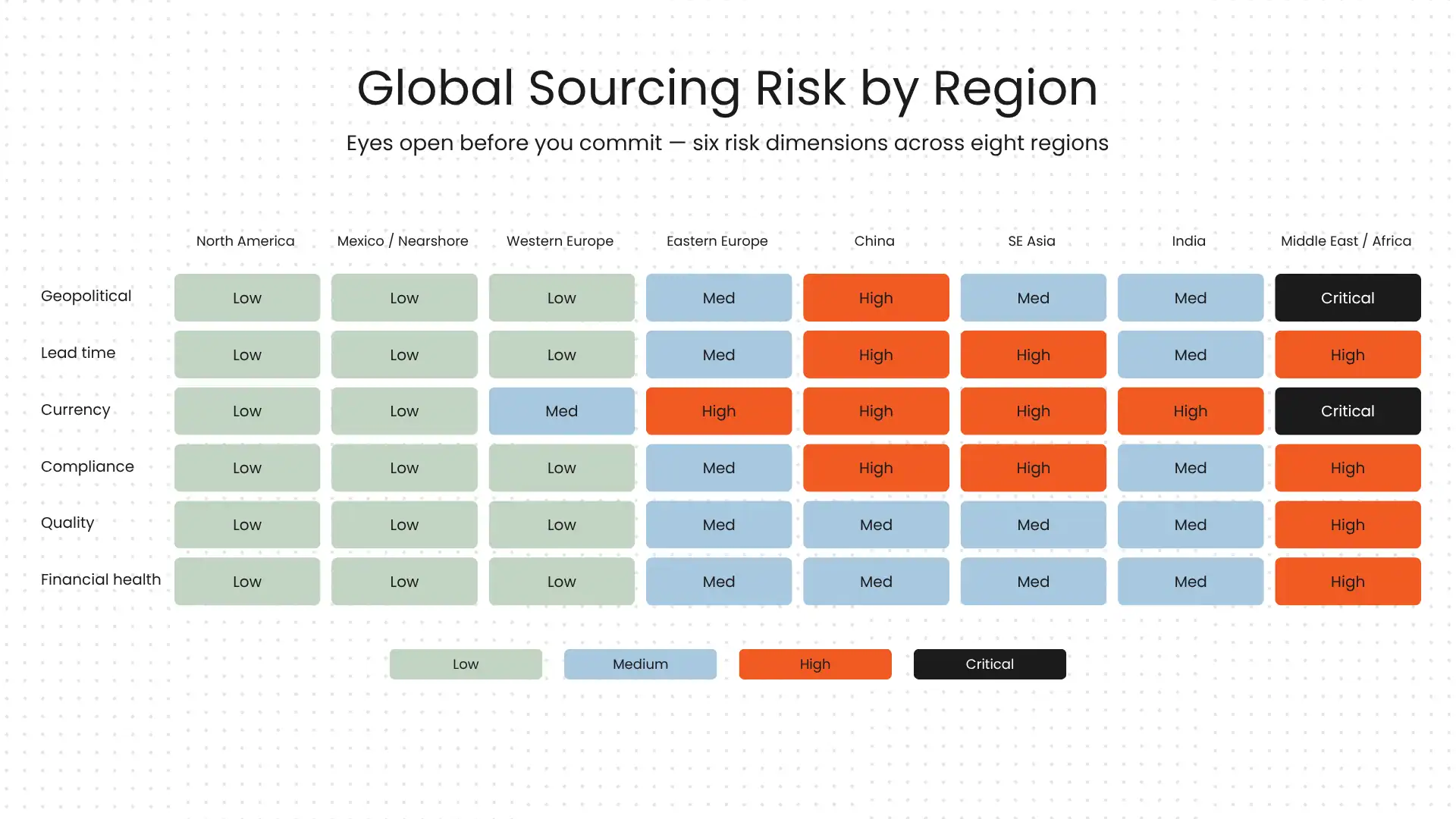
Global strategic sourcing expands your supplier pool and can significantly improve cost or capability access. It can also turn a manageable supply chain into an unmanageable one if you’re not deliberate.
The process works best when your strategy includes landed cost modelling (not just ex-works price), Incoterms clarity, and contingency planning for when things go sideways – because they will.
Common failure points: currency exposure you didn’t hedge, customs compliance that turns into delays, time-zone friction that slows down problem resolution, and longer replenishment cycles that amplify any demand forecast error. Eyes open before you commit. More detail at Strategic Global Sourcing.
“While global sourcing remains a key feature of modern supply chains, its vulnerabilities have accelerated the need for building resilience and the push toward nearshoring — bringing manufacturing and sourcing closer to home.”
— Melanie Nuce-Hilton, SVP Community Engagement, GS1 US
Energy sourcing: the category most teams underestimate
Energy strategic sourcing isn’t just about getting a cheaper tariff. It’s about price stability, risk management, and increasingly, sustainability commitments that your customers and investors are now asking about.
Done properly, it combines long-term contracts, diversified suppliers, and efficiency projects to reduce market volatility exposure.
- Evaluate fixed vs. indexed pricing and hedging options – don’t just default to whatever your current supplier offers at renewal.
- Consider renewables (PPAs, green tariffs) alongside reliability requirements. The two aren’t mutually exclusive.
- Track usage and run efficiency initiatives. Permanently reducing demand beats negotiating a better price on the same consumption.
Post-award supplier management: where most teams drop the ball
You’ve done the sourcing. You’ve signed the contract. Most procurement teams at this point move on to the next fire. That’s the mistake.
Supplier management turns a signed contract into consistent delivery, quality, and continuous improvement. The goal is to prevent surprises – by monitoring performance and resolving issues before they become crises.
- Set scorecards and review them in regular business reviews. QBRs aren’t optional for critical suppliers.
- Use CAPA (corrective and preventive action) for recurring quality or delivery issues. Not emails. Documented actions with deadlines.
- Maintain clear escalation paths and change-control documentation. “We never agreed to that” is a conversation you want to avoid.
“66% of procurement leaders believe growing regulatory and ESG demands will heavily influence strategic sourcing decisions in the next 3–5 years.”
— KPMG procurement survey, cited in Focal Point 2025 Procurement Trends
The tools that actually move the needle
Technology helps teams move faster, compare options consistently, and keep decisions auditable. The best tools depend on category complexity and sourcing frequency.
- E-sourcing tools for RFPs, bid comparisons, and auctions where appropriate – not every category benefits from a reverse auction, but some do.
- Spend analytics to find consolidation opportunities and maverick spend you didn’t know existed.
- Supplier risk and performance tools for ongoing monitoring. Don’t wait for a supplier failure to discover they were financially distressed.
KPIs that actually mean something
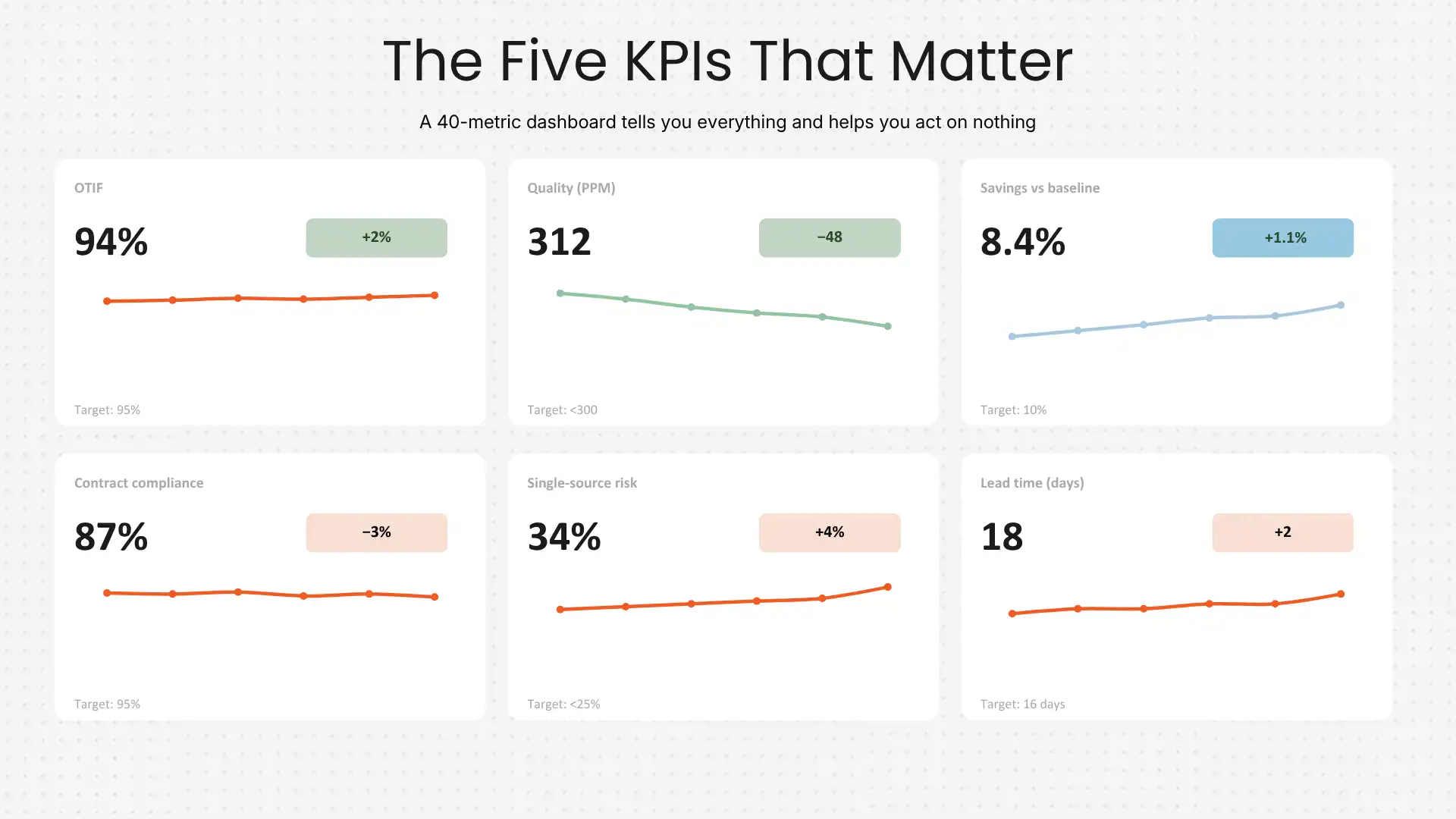
A 40-metric sourcing dashboard tells you everything and helps you act on nothing. Pick a small set of well-defined metrics that connect supplier performance to actual business outcomes.
- Total cost savings – validated against baseline and demand changes. Not the savings your category manager self-reported.
- OTIF (on-time, in-full delivery) – the single metric that shows whether your supply chain actually works.
- Quality – PPM/defect rate, returns, audit findings.
- Contract compliance – are suppliers adhering to agreed price and terms?
- Risk indicators – single-source exposure, supplier financial health. Flags before they become crises.
The challenges nobody talks about openly
Most sourcing failures trace back to the same three root causes: unclear requirements, weak stakeholder alignment, or under-resourced supplier management. None of them are procurement’s fault alone – but procurement usually owns the fallout.
- Stakeholder misalignment: agree on specs and decision criteria before issuing an RFP. Re-work after bid responses is expensive and avoidable.
- Supplier underperformance: tighten SLAs, track scorecards, and use CAPA with real deadlines. Performance conversations without consequences are just complaints.
- Market volatility: use pricing mechanisms (indexed pricing, volume flexibility), dual sourcing for critical categories, and contingency plans. Hope is not a risk management strategy.
“60% of procurement leaders report that manual supplier performance monitoring causes critical visibility gaps.”
— CIPS 2023, cited in Procbay supplier performance research 2025
Where this is all heading
Strategic sourcing is moving toward faster cycles, deeper risk visibility, and more data-driven negotiation. AI-assisted spend analytics, real-time supplier risk monitoring, and digital sourcing platforms are compressing timelines that used to take weeks.
But the fundamentals haven’t changed. Teams that combine category expertise with good data and genuine supplier collaboration respond better when supply conditions change – and supply conditions always change.
The tools are getting better. The discipline still has to come from the people using them.
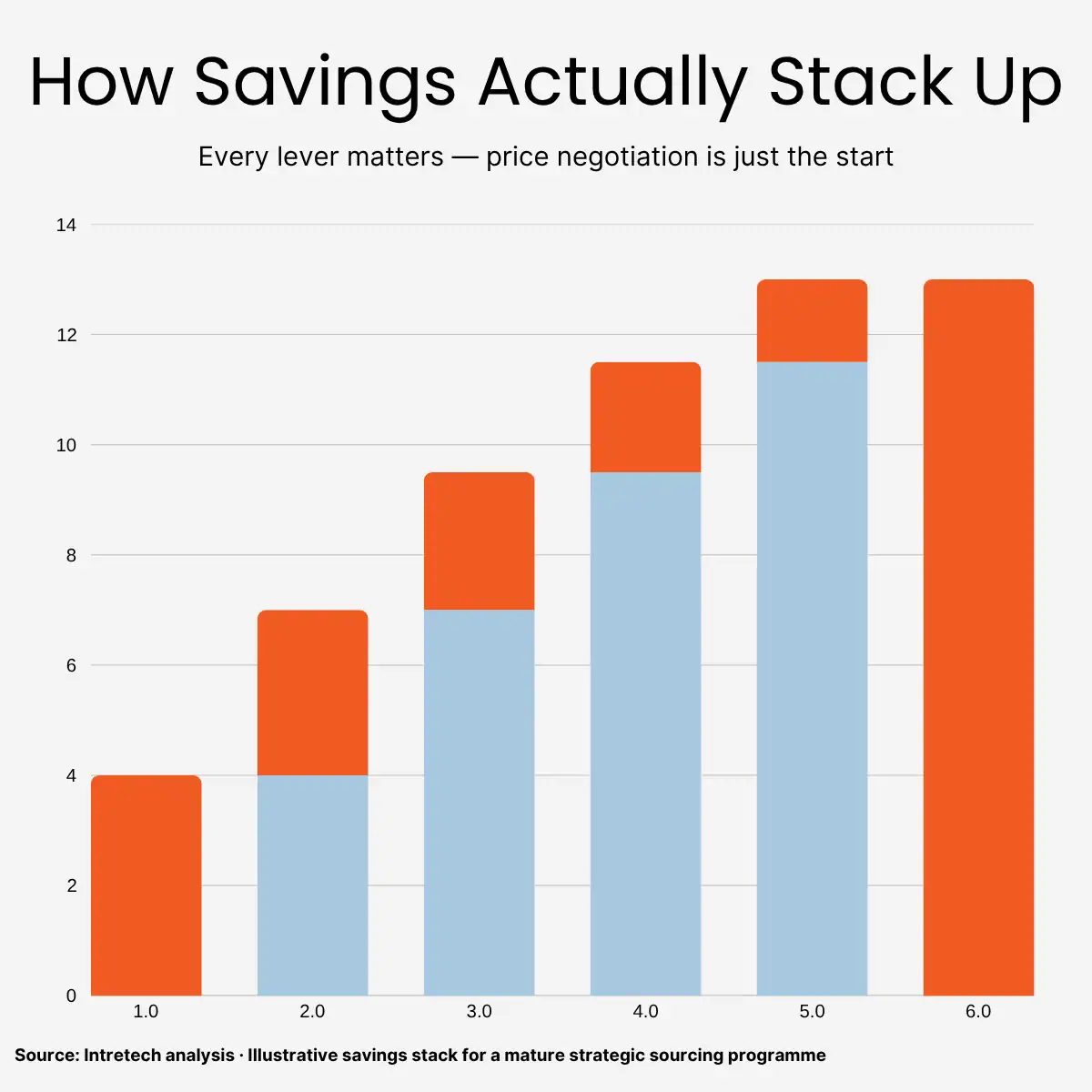
“Strategic sourcing can realise a reduction of 10–25% in product and service costs.”
— Strategic Sourcing Software Statistics 2025
Frequently asked questions
What’s the difference between strategic sourcing and procurement?
Procurement is the broader function of buying goods and services. Strategic sourcing is the structured method used to select suppliers and manage value over time. Think of strategic sourcing as one of the core disciplines inside procurement – the one that determines whether you’re getting good value, not just getting things bought.
Is strategic sourcing only about cost savings?
No – and this misconception is what keeps a lot of procurement functions stuck in tactical mode. Savings matter, obviously. But strategic sourcing also targets quality, delivery reliability, risk reduction, and supplier innovation. Cost is one output of a good sourcing process, not the goal.
How often should you revisit sourcing decisions?
Revisit high-spend or high-risk categories on a regular cadence – often annually or every 1–3 years. And sooner when demand, supply markets, or supplier performance changes meaningfully. Markets don’t wait for your three-year review cycle.
When does global sourcing make sense?
When capabilities, capacity, or cost advantages genuinely outweigh the added complexity in logistics, compliance, and lead times. The key word is genuinely – model it with landed costs and a real risk assessment, not assumptions based on ex-works price. A lot of global sourcing decisions look great on a spreadsheet and fall apart in practice.
Explore more related content

Key Steps in the Strategic Sourcing Process
Key Steps in the Strategic Sourcing ProcessMost companies don't have a strategic sourcing process. They have a...
Understanding the Role of Joint Design Manufacturing in Supply Chain Optimization
Understanding the Role of Joint Design Manufacturing in Supply Chain OptimizationOEM is the safe answer. ODM is the...

Strategic Global Sourcing: How Companies Move from Cost Saving to Competitive Advantage
Strategic Global Sourcing: How Companies Move from Cost Saving to Competitive AdvantageSupply chain disruptions now...