

OEM vs. ODM for Medical Device Manufacturing:
Which Model Fits Your Product?

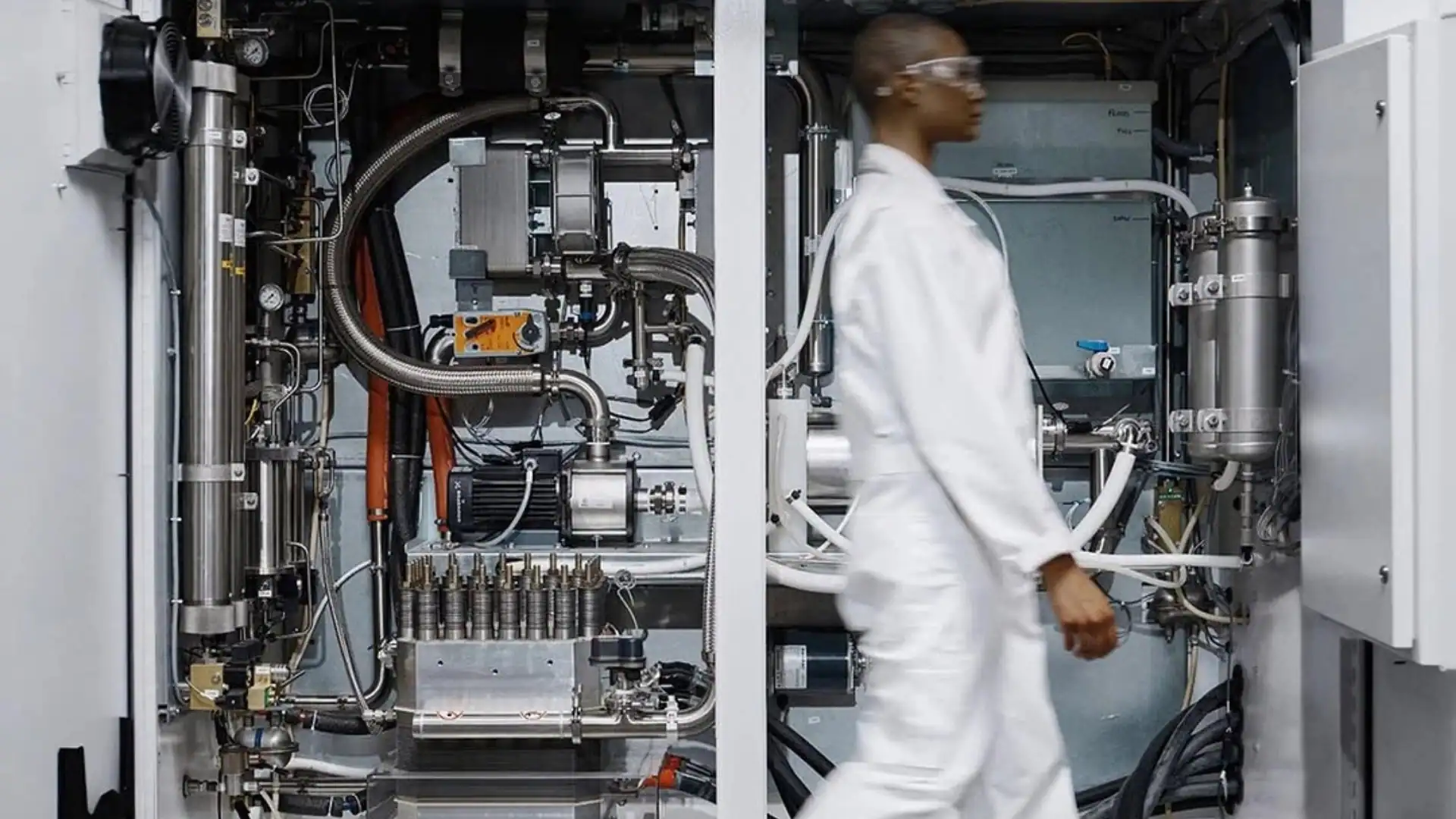
The medical device OEM/ODM/CDMO market was valued at $115.4B in 2024 and is projected to reach $191.8B by 2031 (7.5% CAGR).
OEM vs ODM medical device manufacturing is usually framed as a cost or speed question. It shouldn’t be. In consumer electronics, picking the wrong model mostly costs you money and time. In medical devices, it can determine who’s legally on the hook when something goes wrong after launch. This piece lays out what OEM and ODM actually mean in a regulated device context, why the stakes are higher here than in general contract manufacturing, and which model fits which kind of product.

OEM vs. ODM, Quickly Defined
OEM (Original Equipment Manufacturer, in the sense most people mean it): you own the full design. The manufacturer builds exactly to your specification, your bill of materials, your tolerances. You control every design decision; the manufacturer controls execution.
ODM (Original Design Manufacturer): the manufacturer owns a base design or platform. You customize it from branding, minor feature changes, sometimes packaging and bring it to market faster than starting from a blank page.

The medical device CDMO segment specifically is projected to grow from $148.8B in 2026 to $352.6B by 2033 (13.1% CAGR) — nearly double the pace of the OEM/ODM market overall.
This is a deeper, medical-specific version of a question we’ve written about before in a general sourcing context; see our earlier piece on OEM vs. ODM sourcing strategy for the broader procurement lens. Medical devices add a wrinkle that generic sourcing guides don’t cover: regulatory liability.
Why This Choice Is Riskier in Medical Devices Than in Consumer Electronics
Here’s the part most OEM-vs-ODM comparisons skip entirely: under FDA and international frameworks, someone has to be named as the legal manufacturer of record, the entity that owns the regulatory submission and carries post-market surveillance obligations. In a straightforward OEM arrangement, that’s unambiguous: it’s you.
In an ODM arrangement, it can get blurry fast. If the platform manufacturer designed the base device, do they hold any regulatory responsibility, or does all of it transfer to the brand the moment it’s rebranded and sold? The honest answer is: it depends entirely on how the contract is written, and a lot of ODM agreements in the medical space are written by people who’ve only ever done this for consumer goods.
This isn’t a theoretical concern. FDA’s 2026 Quality Management System Regulation (QMSR), which harmonizes US requirements with ISO 13485, puts more explicit weight on documented quality ownership across the supply chain including in outsourced design scenarios. If your ODM contract doesn’t spell out exactly who owns design history documentation, who approves changes, and who’s named on the regulatory filing, you’re exposed in a way a consumer electronics ODM deal never would be.
Instead of approaching with “avoid ODM in medical devices.” mindset, try “don’t sign an ODM agreement for a medical device without a manufacturing partner and legal counsel who’ve actually done this before.”

Anshul Agarwal, Supply Chain and Manufacturing Practice Lead, ZS: on how CDMO/contract-manufacturer selection is shifting so that raw capacity matters less than “contractor reputation for quality, compliance, and ability to quickly resolve manufacturing problems.”
When OEM Makes Sense
OEM is the right call when:
- The mechanism itself is your differentiation. If your device includes patented or novel IP, you want full design ownership and full control of the Design History File.
- Your regulatory pathway depends on specific, documented design decisions. If your 510(k) or PMA submission hinges on particular engineering choices, you need full visibility and control over how those choices are implemented at scale.
- You need complete control of the Bill of Materials and Design History File, whether for competitive, regulatory, or investor-diligence reasons.

When ODM Makes Sense
ODM tends to work well when:
- Speed to market matters more than mechanical novelty. If you’re entering an established device category, adapting a proven platform can shave months off development.
- The category has high-volume, well-understood manufacturing requirements. Diagnostic and sample-collection categories are a good example. Look for the kind of platform-level manufacturing maturity that makes an adapted, rather than from-scratch, approach viable for similar high-volume diagnostic products.
- You’re validating market demand before committing to a fully custom design. An ODM platform lets you get a real product in front of real customers faster, then decide whether full customization is worth the investment.
Whichever way you lean, the contract; not the manufacturing process, is where regulatory risk actually gets decided. Get a manufacturing partner and legal counsel who will spell out design ownership and change-control rights in writing, before you’re locked in.

Questions to Ask Before You Sign Either Agreement
Whichever way you’re leaning, these are the questions that actually surface the risk, most standard vendor questionnaires don’t ask them, make sure you do:
- Who is named as the legal manufacturer on the regulatory filing, in writing? Not “who does the work”; who is legally on record.
- Who owns the Design History File, and what happens to your access to it if you switch manufacturers later? This matters most in ODM arrangements, where the platform IP sits with the manufacturer.
- What’s the change-control process, and who has to approve a component substitution? If the answer is vague, that’s the answer.
- If this is an ODM platform, how many other brands are running on the same base design, and does that create any conflict with your exclusivity or competitive positioning?
- What does the transition path look like if you want to move from ODM to a fully custom OEM design later? A manufacturer confident in their platform will have a clear answer.
- How is quality data (DHR, DMR, complaint records) shared with you, and how quickly, if you need it for an audit or a recall investigation?
Get these answered before you sign.
Medtech outsourcing overall reached $89B in 2024 (+9.2% YoY), with 64 CDMO-related M&A deals tracked that year.
Can You Switch Between Models Later?
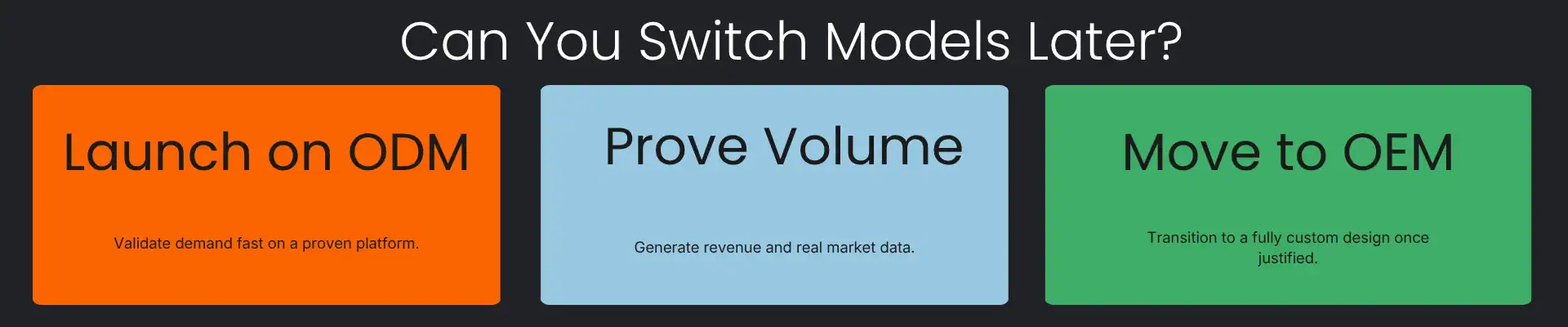
Yes, and it’s a common path. Plenty of companies start with an ODM platform to get to market fast, prove demand, and generate revenue, then transition to a fully custom OEM design once volume justifies the investment, or bring design ownership fully in-house as the product matures. The manufacturers worth working with will tell you upfront whether that transition path exists with their platform, rather than letting you discover the limits of it two years in.

FAQ
What’s the difference between OEM and ODM in medical device manufacturing?
In an OEM arrangement, you own the full design and the manufacturer builds to your spec. In an ODM arrangement, the manufacturer owns a base platform that you customize and brand, trading some design control for speed to market.
Who is the “legal manufacturer” of record if I use an ODM?
It depends entirely on how the contract is written. Regulatory responsibility doesn’t automatically transfer with branding; your agreement needs to explicitly assign design history ownership, change-control rights, and regulatory filing responsibility.
Can a startup use an ODM model for a Class II device?
Yes, provided the contract clearly assigns regulatory ownership and the ODM partner has real experience in that device class.
Does ODM cost less than OEM?
Usually, yes, upfront development costs are spread across the platform’s other customers. But factor in the cost of limited customization and the regulatory diligence needed to get the contract right; the total cost gap is often smaller than it first appears.
Can I switch from ODM to OEM later?
In many cases, yes. It’s a common path: launch on a platform to validate demand, then move to a fully custom design once volume and investment justify it. Confirm this transition path with your manufacturer before committing to either model.
Does it matter whether a component failure happens under an OEM or ODM agreement?
Yes, and this is where a poorly written ODM contract causes real damage. If a component fails post-launch, the question should be who’s contractually and regulatorily obligated to lead the corrective action, notify the relevant authority, and bear the cost. Under OEM, that’s unambiguous. Under ODM, it needs to be spelled out in the agreement itself, because the platform manufacturer and the brand may both have a legitimate claim to or reason to avoid that responsibility.
For the broader question of what medical device contract manufacturing covers before you even get to the OEM/ODM decision, see What Is Medical Device Contract Manufacturing? You can also review Intretech’s medical device manufacturing work directly.
Not sure which model fits your product? Talk to our team about your specific device and regulatory pathway.
Explore more related content
Nearshoring vs Offshoring: How to Choose Your Manufacturing Footprint and EMS Partner
Nearshoring vs Offshoring: How to Choose Your Manufacturing Footprint and EMS PartnerNearshoring vs offshoring is...
Electronics Manufacturing in Mexico: A Buyer’s Guide to Nearshoring in 2026
Electronics Manufacturing in Mexico: A Buyer’s Guide to Nearshoring in 2026Electronics manufacturing in Mexico is no...

Robotics Manufacturing: What It Actually Takes to Scale the Robots IFA 2026 Showed Off
Robotics Manufacturing: What It Actually Takes to Scale the Robots IFA 2026 Showed Off Leif Lindner, CEO of IFA...
Follow us on
© Intretech Ltd. 2026. All Rights Reserved | 闽ICP备11015268号-1
 闽公网安备35020502001002号