

Inside the GLP-1 Injector Pen Boom: What It Actually Takes to Manufacture a Smart Drug Delivery Device


Fixing a signal integrity issue during schematic design costs 10x less than fixing it post-layout, and 100x less than after production. Source: Siemens (Mentor Graphics) PCB Cost of Change Analysis
Every headline about the GLP-1 boom is about the drug. Ozempic, Wegovy, Mounjaro, the molecules get the coverage. The device that actually gets the drug into a patient’s body, safely, at the right dose, week after week, barely gets mentioned.
That’s a mistake, because the pen is not a footnote to the drug, it’s a regulated medical device in its own right, and building one well is a genuinely hard manufacturing problem. Here’s what a drug delivery device manufacturer is actually solving for, and why device capacity, not drug formulation may be the real bottleneck in this market over the next few years.
Why Every MedTech Company Suddenly Wants an Injector Pen
The scale of the GLP-1 market explains the rush. According to Grand View Research, the global GLP-1 receptor agonist market was valued at $66.4 billion in 2025 and is projected to reach $185.3 billion by 2033, growing at a compound annual rate of 12.4% (Grand View Research, GLP-1 Receptor Agonist Market Report). That figure covers the drug market broadly, not delivery devices specifically but every one of those doses has to go into a patient through something, and demand for pen-based delivery devices tracks the drug market closely.
That’s pulled a wave of pharma, biotech, and even consumer health brands into a category they’ve never had to manufacture at before: precision, patient-operated drug delivery devices. Most of them are learning, mid-launch, that formulating the molecule was the easier half of the problem.

Novo Nordisk’s Clayton, NC fill-finish facility: $4.1B. Novo Holdings’ Catalent acquisition: $16.5B. Eli Lilly’s Indiana API plant: $5.3B; its Medicine Foundry: $4.5B.
What Is a Drug Delivery Device, Technically?
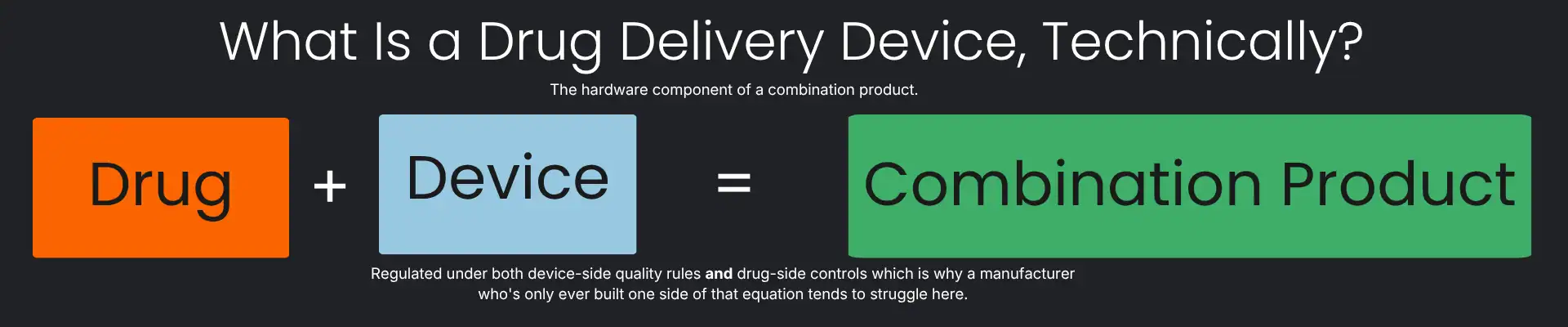
A drug delivery device is the hardware component of a combination product, a regulated product that pairs a drug or biologic with a device to deliver it. Auto-injectors, pen injectors, and pre-filled syringes with dosing mechanisms all fall into this category. Because they combine a drug and a device, they’re regulated as combination products, which means they inherit regulatory requirements from both sides: drug-side controls on top of device-side quality and manufacturing rules.
That dual regulatory identity is exactly why a manufacturer who’s only ever built one side of that equation, pure electronics, or pure pharma packaging, tends to struggle here. Building the pen requires medical device manufacturing discipline; getting it approved requires understanding how that discipline interacts with drug regulation.
Lilly’s tirzepatide (Mounjaro/Zepbound) was on the FDA shortage list for 22 months, ending October 2024. Semaglutide was on the list from 2022 until the shortage was declared resolved in February 2025.
What It Actually Takes to Manufacture a Smart Injector Pen
Precision Mechanical Assembly
An injector pen’s dose mechanism springs, plungers, dose-setting dials; operates on tolerances measured in fractions of a millimeter. Get it slightly wrong and a patient either under-doses or experiences a painful, inconsistent injection. This is precision mechanical engineering wearing a healthcare label.
Electronics Integration for “Smart” Pens
A growing share of new injector pens are “smart”; logging dose timing, connecting via Bluetooth to an adherence app, or flagging a missed dose. That means integrating electronics into a device that also has to survive drops, temperature swings, and repeated patient handling, without compromising the mechanical dosing accuracy underneath it.
The Combination Product Regulatory Pathway
Because these devices are combination products, they typically require human factors and usability testing beyond what a standard medical device needs, regulators want direct evidence that ordinary patients, not just trained clinicians, can use the device correctly and safely at home.

Sterile and Biocompatible Materials Handling
Every material that contacts the drug or the patient’s skin needs biocompatibility documentation, and the drug-contact path needs to hold sterility through the device’s full shelf life; a materials and process-control challenge that’s easy to underestimate if your prior experience is in general electronics.
Serialization and Traceability at Scale
At the volumes this market is running millions of units a year for a successful drug. Every pen needs to be traceable back to its batch, its components, and its test results, because a manufacturing defect at this scale isn’t a minor recall; it’s a public health event.

“U.S.-based production is a major step forward in our global expansion and reinforces our position as the leader in providing end-to-end drug delivery solutions.” Said at the opening of SHL’s new $220M, 360,000-sq-ft autoinjector plant in North Charleston, SC
The Manufacturing Bottleneck Nobody’s Talking About
Here’s the part of this story that gets almost no coverage: the industry is racing to formulate the next GLP-1 molecule, secure the next indication, win the next pricing negotiation and largely assuming device manufacturing capacity will simply be there when they need it. It won’t be, automatically. Precision spring mechanisms, medical-grade cartridge glass, and biocompatible seals all depend on specialized, tooling-intensive supply chains. Standing up a new precision assembly line, qualifying the component suppliers behind it, and validating the process isn’t something that happens in the weeks between a regulatory approval and a planned launch date. It’s a project measured in quarters, and it needs to start well before the drug itself clears its final regulatory hurdle.
The companies that get this right are treating device manufacturing capacity as a strategic constraint to plan around from day one of formulation. By the time a molecule clears its regulatory pathway, the device that delivers it needs to already have a manufacturing partner, a qualified supply chain, and a scale-up plan in place. Waiting until approval to start that conversation is how launches slip by months, and why some of the biggest names in this market have publicly struggled with supply constraints that had more to do with the pen than the drug inside it.

SHL Medical‘s own production ramp: currently ~300 million autoinjectors/year, projected to reach 750–850 million by 2028. The company holds roughly 25% of the global autoinjector market, and GLP-1 drugs are expected to account for nearly a third of its revenue and close to half of its production volume by 2027.
What to Ask a Prospective Device Manufacturer Before You Commit
If you’re evaluating manufacturing partners for a drug delivery device, a few questions separate genuine capability from an optimistic sales pitch:
- Have they built a patient-operated dosing mechanism before, and can they name it? Precision mechanical assembly for a one-off industrial part is a different skill set from a mechanism a patient will operate, unsupervised, at home.
- Do they have direct experience with combination product regulatory pathways, including human factors and usability testing or only standard medical device experience?
- What’s their actual lead time to scale from pilot volumes to millions of units a year, and where in that path have they hit supply constraints before?
- If you want a connected, “smart” version of the device, do they have in-house electronics integration, or would that be subcontracted to a third party you’d need to manage separately?
- How do they handle biocompatibility and sterility documentation for materials that contact the drug itself, not just the device housing?
A manufacturer who answers these with specifics; named devices, named constraints, named timelines is a fundamentally safer bet than one who answers in generalities.

Bill Coyle, Global Head of Biopharma, ZS: on Novo’s “confidence in future supply” and its “ability to supply [GLP-1s] next year and hopefully going forward,” and his recommendation that future entrants take “a little more risk in upfront investment” in manufacturing earlier in development.
FAQ
What is a drug delivery device? It’s the hardware component of a combination product; an auto-injector, pen injector, or similar mechanism that delivers a drug or biologic to a patient. Because it pairs a device with a drug, it’s regulated as a combination product, inheriting requirements from both device and drug regulatory frameworks.
How are smart injector pens manufactured?
Through precision mechanical assembly of the dosing mechanism, integration of electronics for dose logging or connectivity, biocompatible and sterile materials handling for any drug-contact surfaces, and serialized, traceable production at scale.
What regulations apply to GLP-1 injector pens?
As combination products, they’re subject to FDA’s combination product framework, which layers device-side quality and manufacturing requirements on top of drug-side controls, along with human factors and usability testing specific to patient self-administration.
Why is injector pen manufacturing capacity becoming a bottleneck?
Precision components like spring mechanisms, medical-grade glass, and biocompatible seals depend on specialized, capacity-constrained supply chains. Drug approval timelines are moving faster than most device supply chains can scale, and few companies plan device manufacturing capacity as early as they plan drug development.
Can a contract manufacturer build a connected/smart injector pen?
Yes, provided they have real experience with both the mechanical precision the dosing mechanism demands and the regulatory pathway for combination products, not just general electronics assembly experience applied to a new form factor.
Why are so many injector pens becoming “connected” or app-linked?
Adherence is the biggest predictor of whether a GLP-1 treatment actually works for a patient over time, and missed or mistimed doses are hard for a clinician to track without some form of digital record. Dose-logging and app connectivity give both the patient and the prescriber visibility they didn’t have with a purely mechanical pen, which is why it’s moved from a nice-to-have feature to something new entrants increasingly build in from the start.
If you’re earlier in the decision process, our guides on what medical device contract manufacturing covers and OEM vs. ODM for medical device manufacturing are good starting points. You can also see Intretech’s medical device manufacturing work directly.
Planning a drug delivery device and want to talk device manufacturing capacity early? Talk to our team before your regulatory pathway is finalized, not after.
Explore more related content
Nearshoring vs Offshoring: How to Choose Your Manufacturing Footprint and EMS Partner
Nearshoring vs Offshoring: How to Choose Your Manufacturing Footprint and EMS PartnerNearshoring vs offshoring is...
Electronics Manufacturing in Mexico: A Buyer’s Guide to Nearshoring in 2026
Electronics Manufacturing in Mexico: A Buyer’s Guide to Nearshoring in 2026Electronics manufacturing in Mexico is no...

Robotics Manufacturing: What It Actually Takes to Scale the Robots IFA 2026 Showed Off
Robotics Manufacturing: What It Actually Takes to Scale the Robots IFA 2026 Showed Off Leif Lindner, CEO of IFA...