

Physical AI vs Traditional Automation:
How to Know Which One Your Production Line Actually Needs

Every automation vendor selling into manufacturing right now has an incentive to tell you physical AI is the answer. Some of them are right. A lot of them are selling a software update with a new name attached, to a manufacturer whose actual problem would be solved more cheaply by a robot that’s been reliable for a decade.
This isn’t an argument against physical AI it’s a genuinely useful category, and we’ve written elsewhere about what physical AI actually is and where it’s already delivering real ROI. This is an argument for asking the right question before you buy anything: not “should we have physical AI,” but “which problem, on which line, actually needs it.”
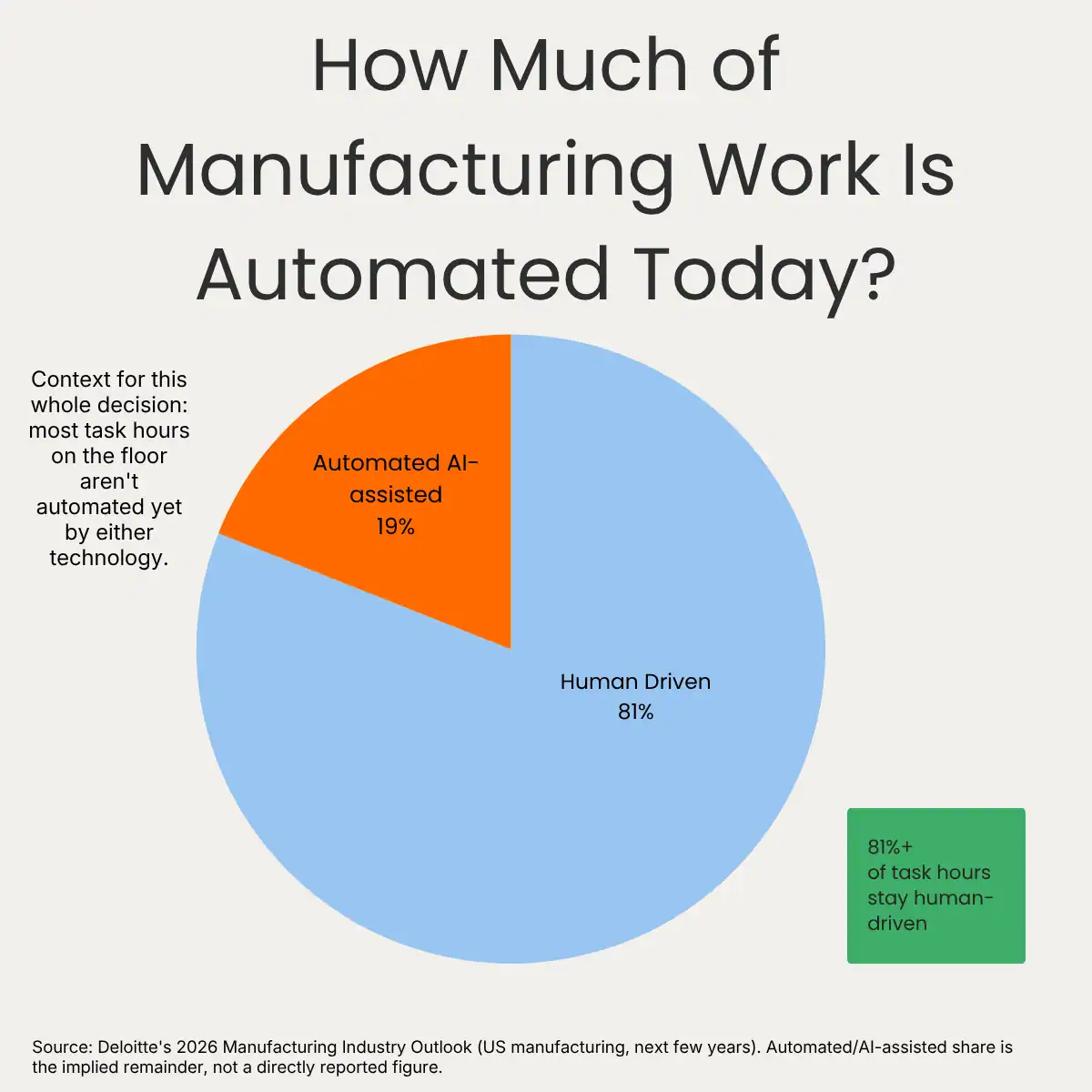
“More than 81% of task hours in manufacturing are expected to remain human-driven.” Source: Deloitte’s 2026 Manufacturing Industry Outlook (US manufacturing).
What’s the Real Difference?
Traditional automation runs on fixed programming. It executes the same motion, the same sequence, the same check, exactly the same way every time which makes it fast, cheap per unit, and extremely reliable for stable, high-volume work. It also makes it brittle: the moment a part is out of position or a product variant changes, it stops or fails.
Physical AI adds perception and decision-making on top of similar hardware cameras, sensors, and models that let the system handle variation it wasn’t explicitly programmed for. That flexibility comes at a cost: more expensive per unit deployed, more setup and training data required, and depending on the vendor and application less predictable failure behaviour, because the system is making judgment calls rather than following a fixed script.
Neither is “better.” They’re suited to different problems, and most manufacturers running mixed production actually need some of both.
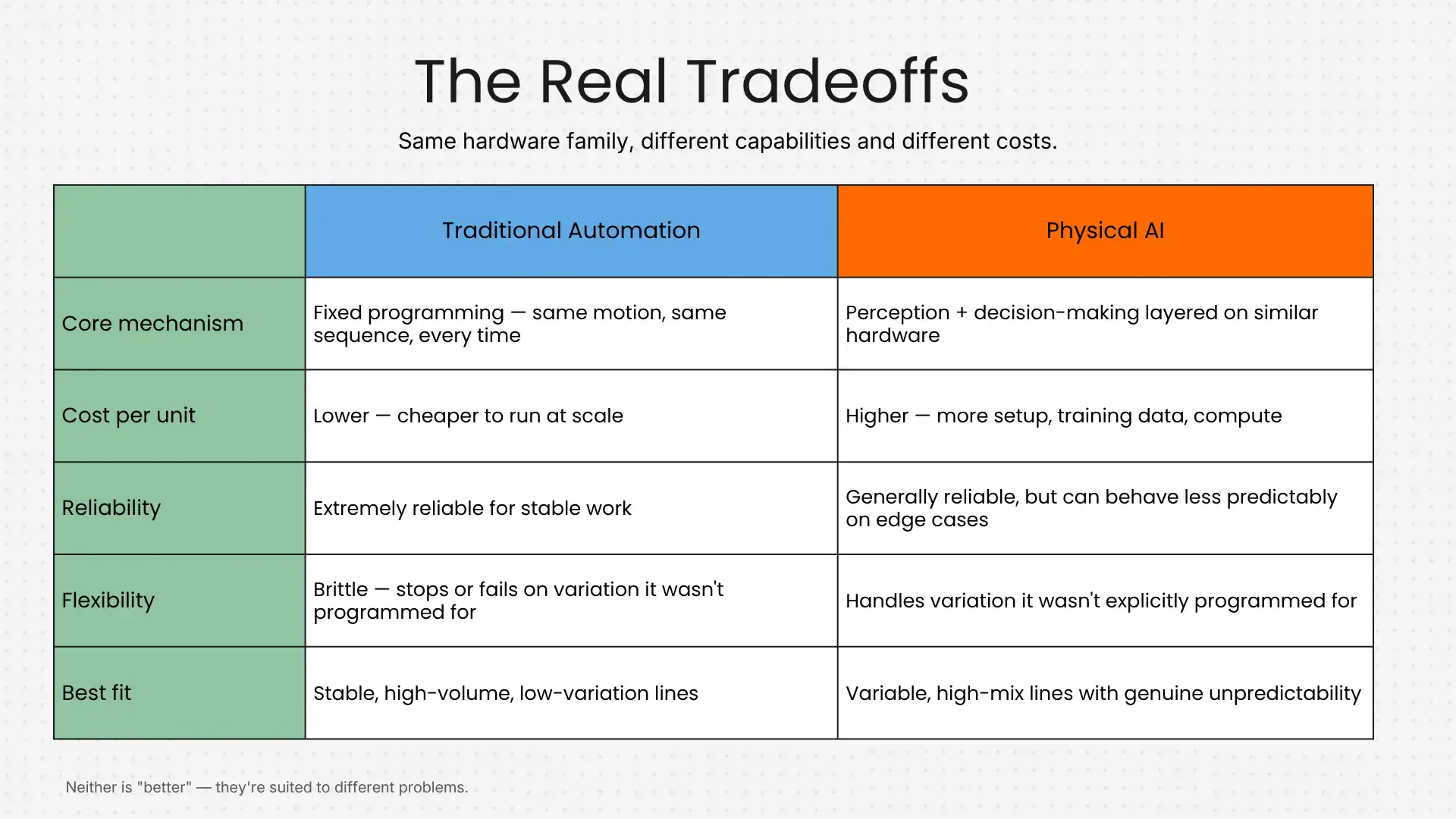
“Neither is ‘better.’ They’re suited to different problems, and most manufacturers running mixed production actually need some of both.”
When Traditional Automation Is Still the Right Call
If your line runs a single product, or a small number of stable variants, at high volume, with parts that arrive consistently positioned and consistently specified, traditional automation almost always wins on cost per unit and reliability. It’s a mature technology with decades of deployment history, predictable maintenance needs, and no dependency on AI model performance that can degrade unexpectedly on edge cases.
This is also, bluntly, most manufacturing. High-mix, high-variability production gets the headlines, but a huge share of factory floors run stable, well-understood processes where the honest answer to “do we need physical AI” is no not this year, and possibly not for this line at all.
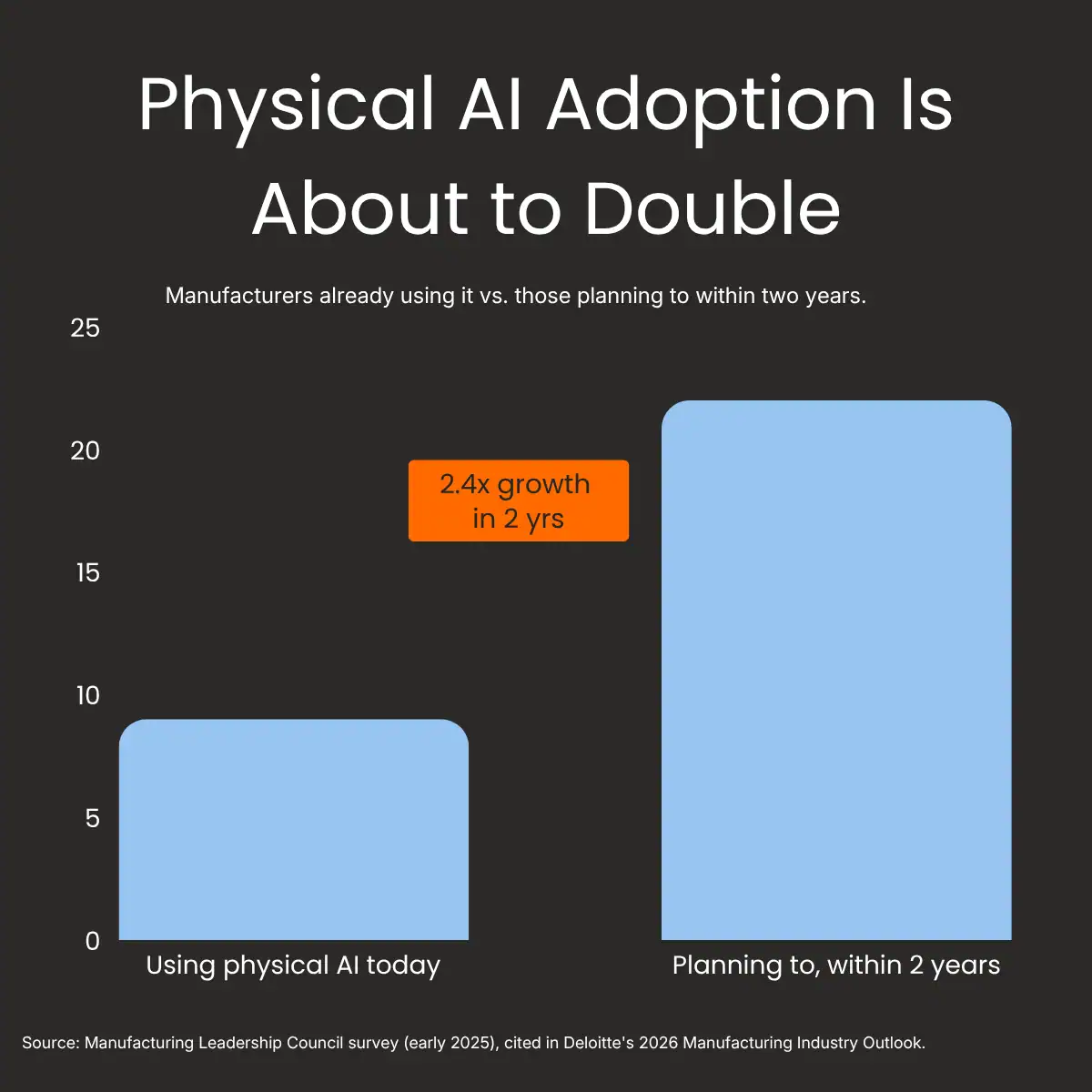
“22% of manufacturers plan to use physical AI within two years — more than double today’s 9%.” Source: Manufacturing Leadership Council survey (early 2025), cited in Deloitte’s 2026 Manufacturing Industry Outlook
When Physical AI Actually Earns Its Keep
The cases where physical AI’s cost premium is worth paying share a common pattern: variability that traditional automation can’t absorb, and a cost of failure high enough to justify a more expensive, more adaptive system.
That shows up most clearly in three situations: quality inspection on products with tight tolerances and frequent design changes, where the cost of a missed defect (a recall, a warranty claim) dwarfs the cost of a smarter inspection station; mixed-product assembly lines with frequent changeovers, where reprogramming fixed automation for every variant eats the labor savings you were trying to capture; and logistics or material handling in facilities where the floor layout genuinely changes often enough that fixed conveyors and rails become a liability rather than an asset.
Reshoring decisions add a fourth: if you’re moving production somewhere with higher labor costs specifically to shorten supply chains, and the domestic facility needs to run lower-volume, higher-mix work than the overseas operation it’s replacing, physical AI’s flexibility is often what makes the reshoring math work at all not a nice-to-have, but the thing that closes the ROI gap against local labor cost. Deloitte’s 2026 manufacturing industry outlook points to exactly this pattern: reshoring commitments are accelerating, but executives consistently cite automation and workforce readiness as the deciding factors in whether those commitments actually pay off.
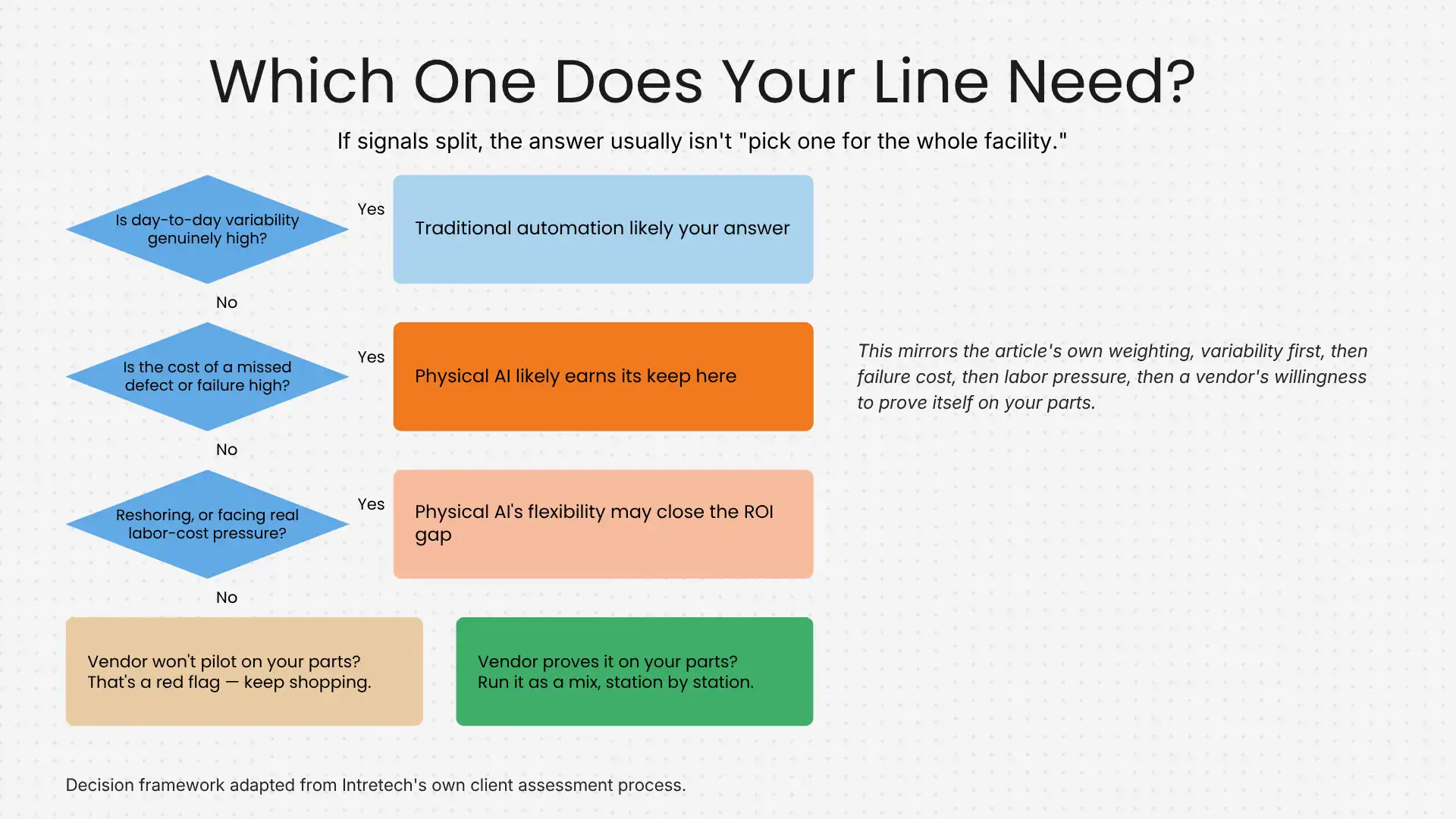
Four questions, roughly in order of how much weight they should carry.”
The Decision Framework
How much genuine variability does the line handle, day to day? Not theoretical variability actual, measured changeover frequency and part variation. High variability points toward physical AI; low variability points toward traditional automation.
What does a failure actually cost? A missed defect that triggers a recall is a different order of magnitude from a missed defect that triggers a routine return. The higher the cost of failure, the more a system that generalises well is worth its premium.
What’s your realistic maintenance and support capacity? Physical AI systems generally need more ongoing tuning and monitoring than fixed automation. If your team is stretched thin already, that’s a real cost to factor in, not a footnote.
Can the vendor prove it on your parts, not their demo parts? This is the single most useful filter. Any credible integrator should be willing to run a bounded pilot on your actual production conditions before you commit to a full rollout. Reluctance to do that is a signal worth taking seriously.
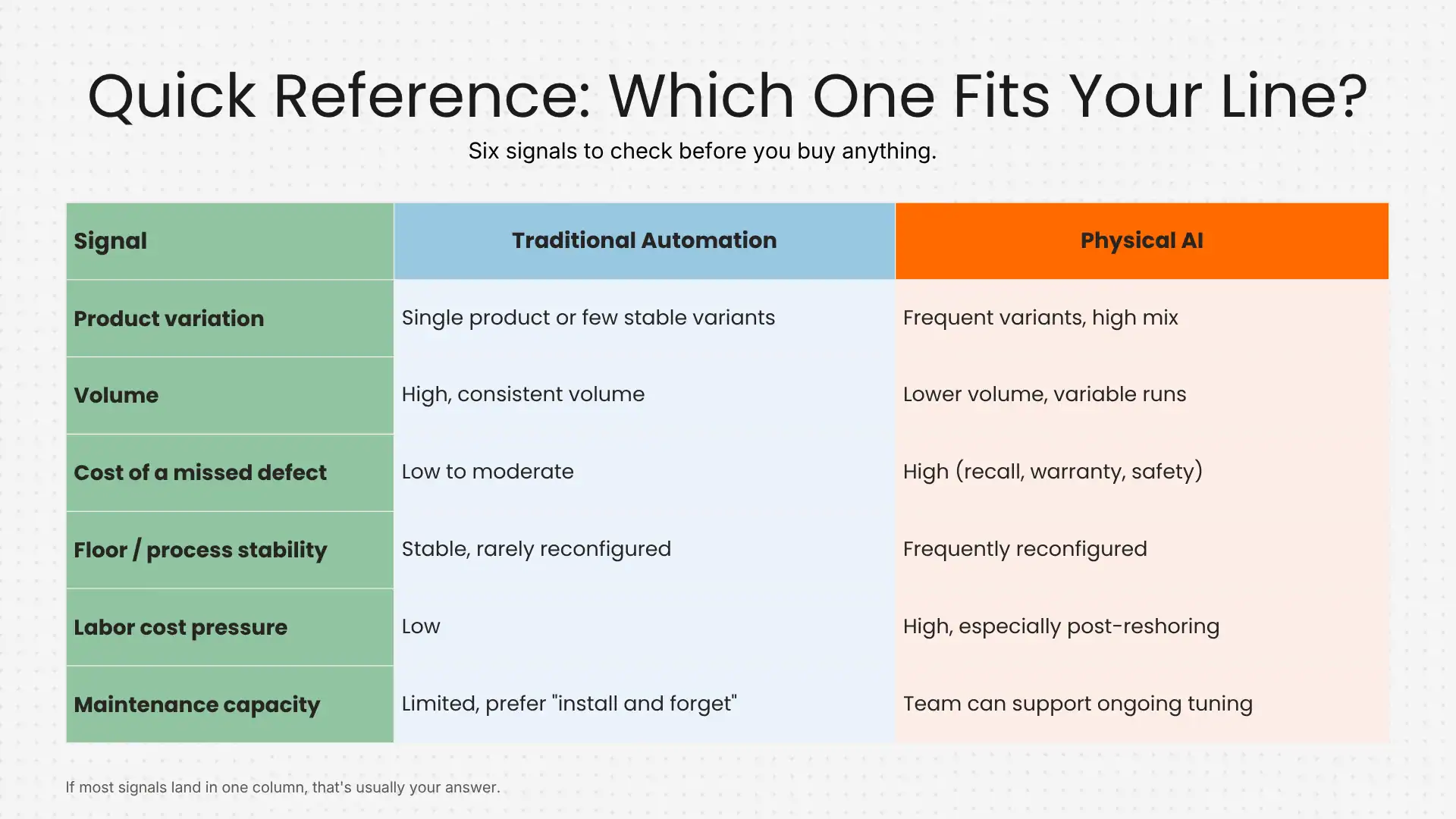
Quick Reference: Which One Fits Your Line
| Signal | Points toward Traditional Automation | Points toward Physical AI |
| Product variation | Single product or few stable variants | Frequent variants, high mix |
| Volume | High, consistent volume | Lower volume, variable runs |
| Cost of a missed defect | Low to moderate | High (recall, warranty, safety) |
| Floor/process stability | Stable, rarely reconfigured | Frequently reconfigured |
| Labor cost pressure | Low | High, especially post-reshoring |
| Maintenance capacity | Limited, prefer “install and forget” | Team can support ongoing tuning |
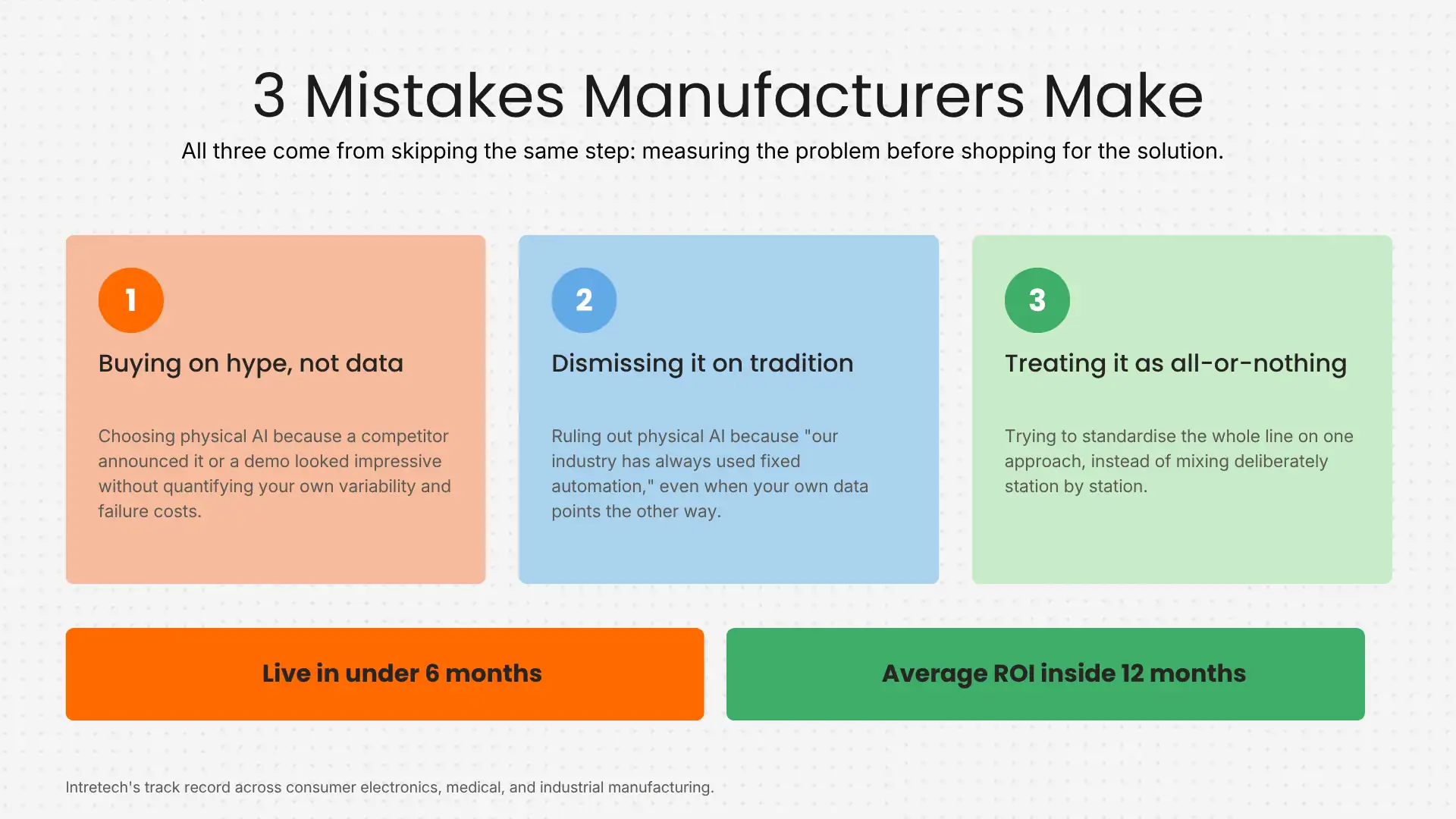
All three come from skipping the same step: measuring the problem before shopping for the solution./h6>
Common Mistakes Manufacturers Make Choosing Between Them
The most common mistake isn’t picking the wrong technology it’s picking based on the wrong signal. Buying physical AI because a competitor announced it, or because a vendor’s demo looked impressive, without first quantifying your own variability and failure costs, is how projects end up over-budget and underused.
The second most common mistake runs the other way: dismissing physical AI entirely because “our industry has always used fixed automation,” even when the actual production data — changeover frequency, defect costs, labor availability points toward a case that would justify it. Both mistakes come from skipping the same step: measuring the problem before shopping for the solution.
The third, and most expensive, is treating this as an all-or-nothing decision. Most functioning production lines end up running a mix fixed automation for the stable, high-volume parts of the process, and physical AI for the specific stations where variability or failure cost justifies it. Trying to standardise the whole line on one approach usually costs more than mixing deliberately.
Intretech works through exactly this assessment with manufacturers before recommending anything, across consumer electronics, medical, and industrial production building and deploying whichever mix of automation actually fits, live in under six months, with an average ROI inside twelve. If you want a straight answer on where your line sits, book a free consultation with our engineering team including if the honest answer is that you don’t need physical AI yet.
Fixing a signal integrity issue during schematic design costs 10x less than fixing it post-layout, and 100x less than after production. Source: Siemens (Mentor Graphics) PCB Cost of Change Analysis
Frequently Asked Questions
Is physical AI always better than traditional automation?
No. Physical AI carries a cost premium that’s only justified by genuine production variability or a high cost of failure. For stable, high-volume, low-variation lines, traditional automation typically remains more cost-effective and reliable.
What factors determine ROI on automation investment?
The main factors are production variability, the cost of failure or defects, labor cost trends (including reshoring pressure), and how quickly the technology can be piloted and validated on your actual production conditions rather than a vendor demo.
Can physical AI and traditional automation work together on the same line?
Yes, and in practice this is the most common setup fixed automation handling stable, high-volume steps, with physical AI deployed specifically at stations where variability or failure cost justifies the additional expense.
How do I know if my production line is ready for physical AI?
Start by measuring actual changeover frequency, part variation, and the real cost of a missed defect or failure on that line. If those numbers are high, physical AI is worth evaluating. If the line runs stable, high-volume, low-variation work, it likely isn’t yet.
What’s the first step to evaluating automation options for my factory?
Quantify the problem before evaluating vendors: variability, failure cost, and maintenance capacity. Then pilot any proposed system on your actual parts and production conditions before committing to a full rollout.
Explore more related content
5 Physical AI Use Cases Already Live on Manufacturing Lines (And What They Actually Cost)
5 Physical AI Use Cases Already Live on Manufacturing Lines (And What They Actually Cost)Most content about physical...
What Is Physical AI? A Manufacturer’s Guide to the 2026 Shift From Automation to Autonomy
What Is Physical AI? A Manufacturer's Guide to the 2026 Shift From Automation to AutonomyEvery few years,...
7 Key Benefits of AI in Manufacturing That Will Revolutionize Your Business
7 Key Benefits of AI in Manufacturing That Will Revolutionize Your Business Does AI actually work in manufacturing? We...
Follow us on
© Intretech Ltd. 2026. All Rights Reserved | 闽ICP备11015268号-1
 闽公网安备35020502001002号