

5 Physical AI Use Cases Already Live on Manufacturing Lines (And What They Actually Cost)

Most content about physical AI reads like a keynote speech: big claims, no numbers, nothing you could take into a capital expenditure meeting. That’s not particularly useful if you’re the person who actually has to justify the spend.
So here are five physical AI applications already running in production environments today, what they cost relative to traditional automation, and where the ROI case is real versus where it’s still mostly marketing. If you want the fuller explainer on what physical AI actually is before diving into applications, start with our guide to physical AI in manufacturing.
1. Autonomous Mobile Robots for Line-Side Logistics
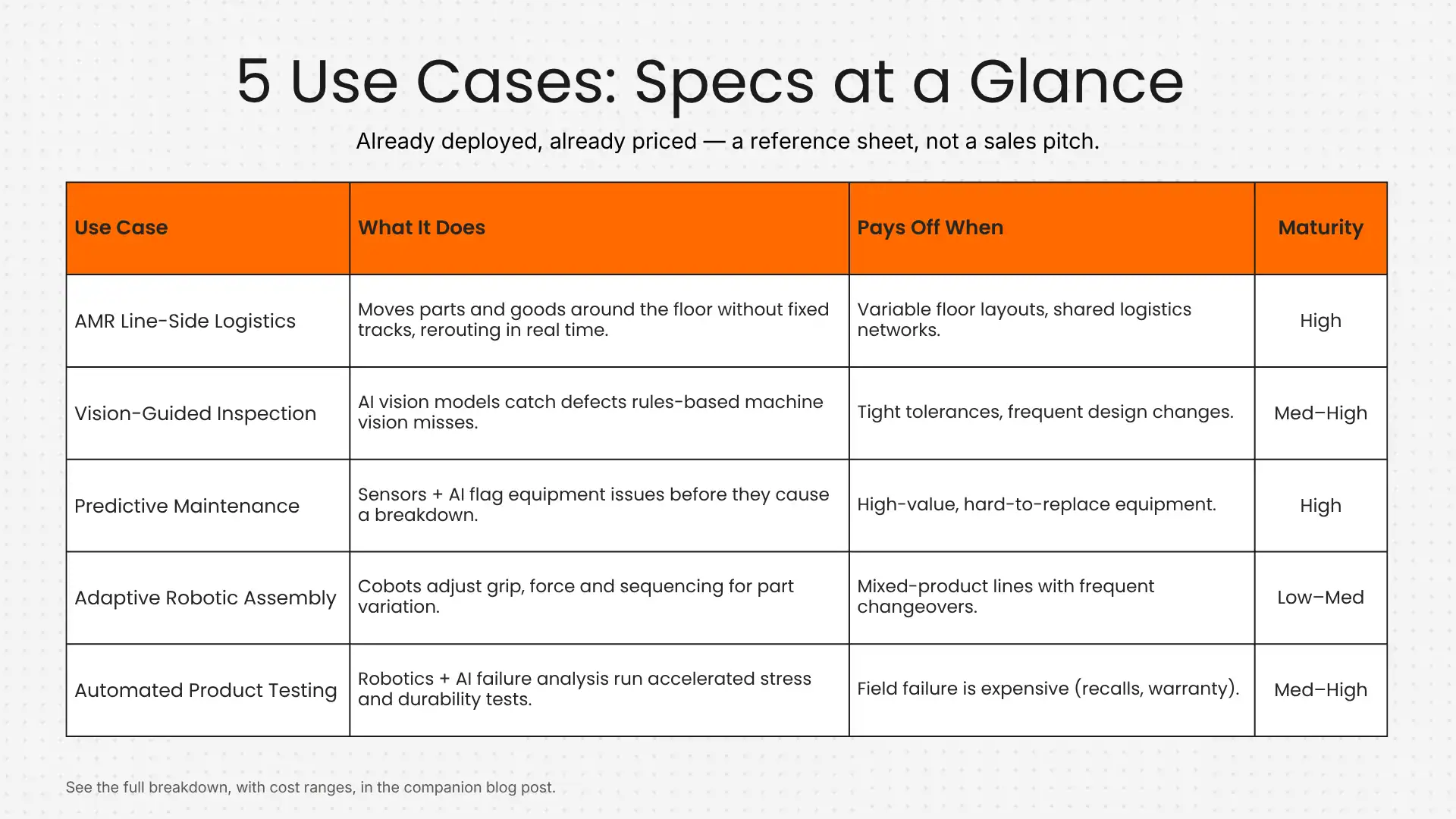
Autonomous mobile robots (AMRs) move parts, sub-assemblies, and finished goods around a factory floor without fixed tracks or rails, using onboard sensors and AI-driven navigation to reroute around obstacles and changing floor layouts in real time.
This is the most mature and lowest-risk physical AI application on this list, which is exactly why it’s the most widely deployed. Unlike older automated guided vehicles that needed magnetic strips or predefined paths, AMRs adapt to a factory that changes week to week new pallet positions, temporary obstructions, seasonal layout shifts. Global industrial robot installations, AMRs included, passed 500,000 units annually for the fourth consecutive year running, with the installed base now valued at $16.7 billion, according to the International Federation of Robotics a scale that reflects how far this has moved past pilot projects.
Where it pays off: facilities with variable floor layouts, multiple product lines sharing the same logistics network, or frequent line reconfigurations.
Where it doesn’t: a single, fixed, high-volume line where a simple conveyor already does the job more cheaply.
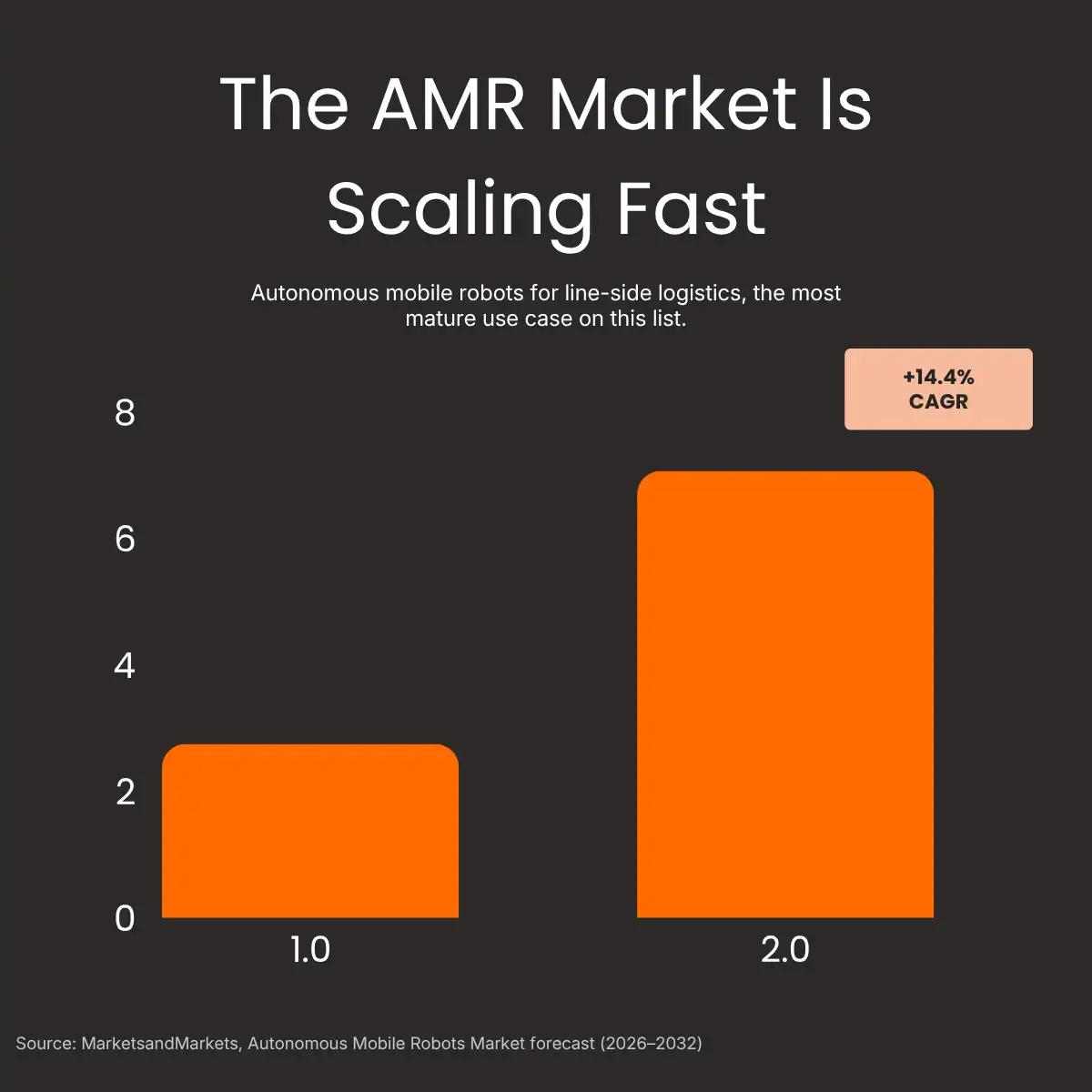
“The global AMR market itself is projected to grow from $2.75B in 2026 to $7.07B by 2032, a 14.4% CAGR.” Source: MarketsandMarkets, Autonomous Mobile Robots Market report.
2. Vision-Guided Robotic Quality Inspection
Camera-equipped robotic arms paired with AI vision models can now catch defects that traditional rules-based machine vision misses surface flaws, assembly errors, and inconsistencies that don’t fit a pre-programmed “acceptable” template.
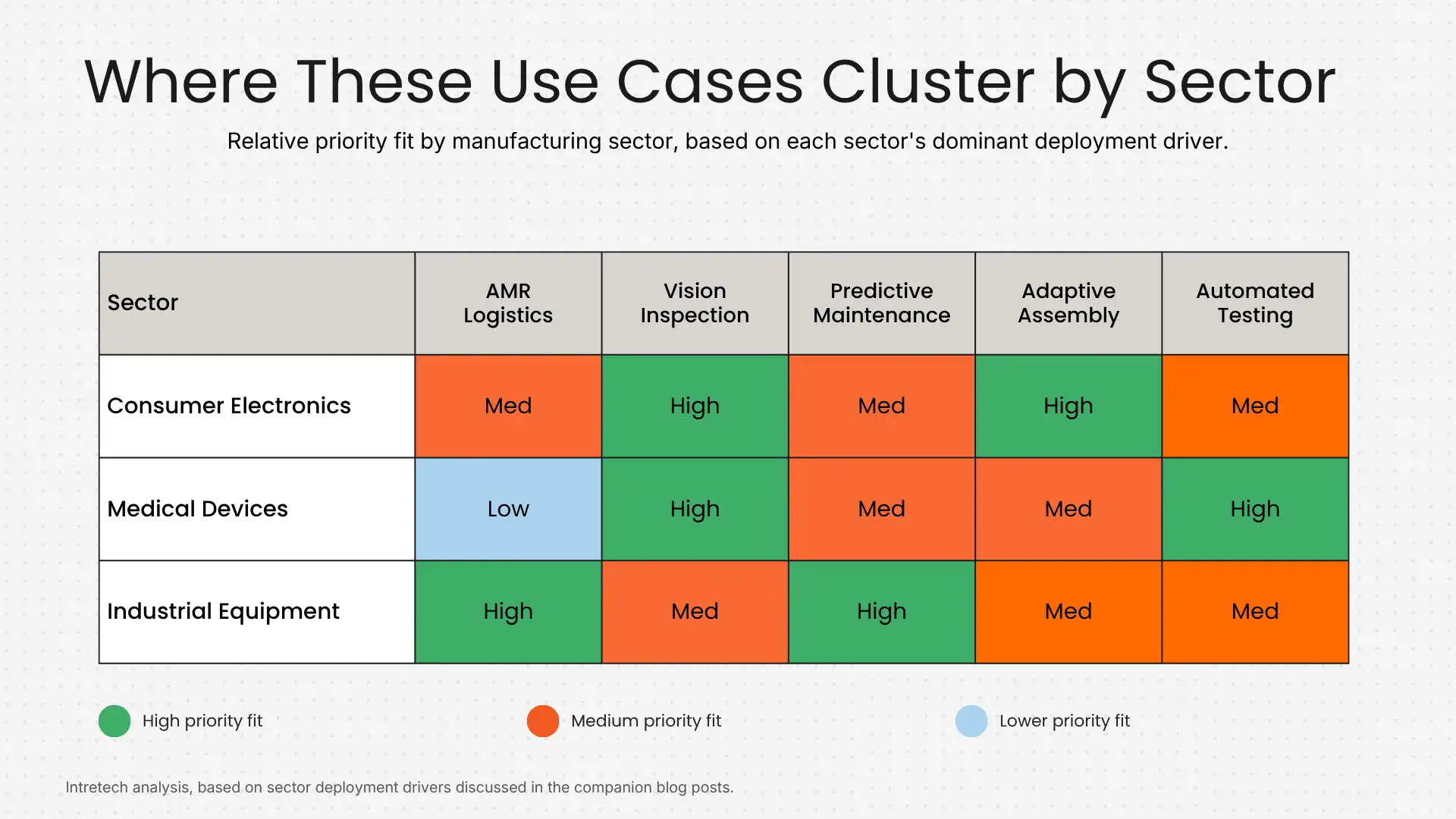
This matters most in consumer electronics and medical device manufacturing, where tolerances are tight and a single missed defect can mean a costly recall rather than a minor return. Traditional machine vision systems are excellent at catching the defects they were explicitly trained to look for and blind to everything else. AI-driven vision systems generalise better, at the cost of needing more setup data and, typically, a higher unit cost per inspection station.
Where it pays off: high-tolerance products, frequent design changes, or product families with many variants running through the same inspection point.
Where it doesn’t: simple pass/fail checks on a stable, unchanging product — traditional vision systems still do this more cheaply and just as reliably.
3. Predictive Maintenance Powered by Physical AI Sensors
Sensor arrays feeding AI models can now flag equipment issues bearing wear, motor strain, thermal anomalies — before they cause a breakdown, rather than after. This is arguably where physical AI’s ROI case is easiest to prove, because the comparison is direct: cost of the sensor and monitoring system versus cost of unplanned downtime.
For manufacturers running expensive, hard-to-replace machinery, especially in industrial equipment production, this use case tends to pay for itself fastest of anything on this list, because unplanned downtime is one of the few automation costs that’s trivially easy to quantify in a boardroom.
Where it pays off: high-value equipment where downtime is expensive and replacement lead times are long.
Where it doesn’t: low-cost, easily replaceable equipment where the monitoring system costs more than simply keeping a spare on hand.
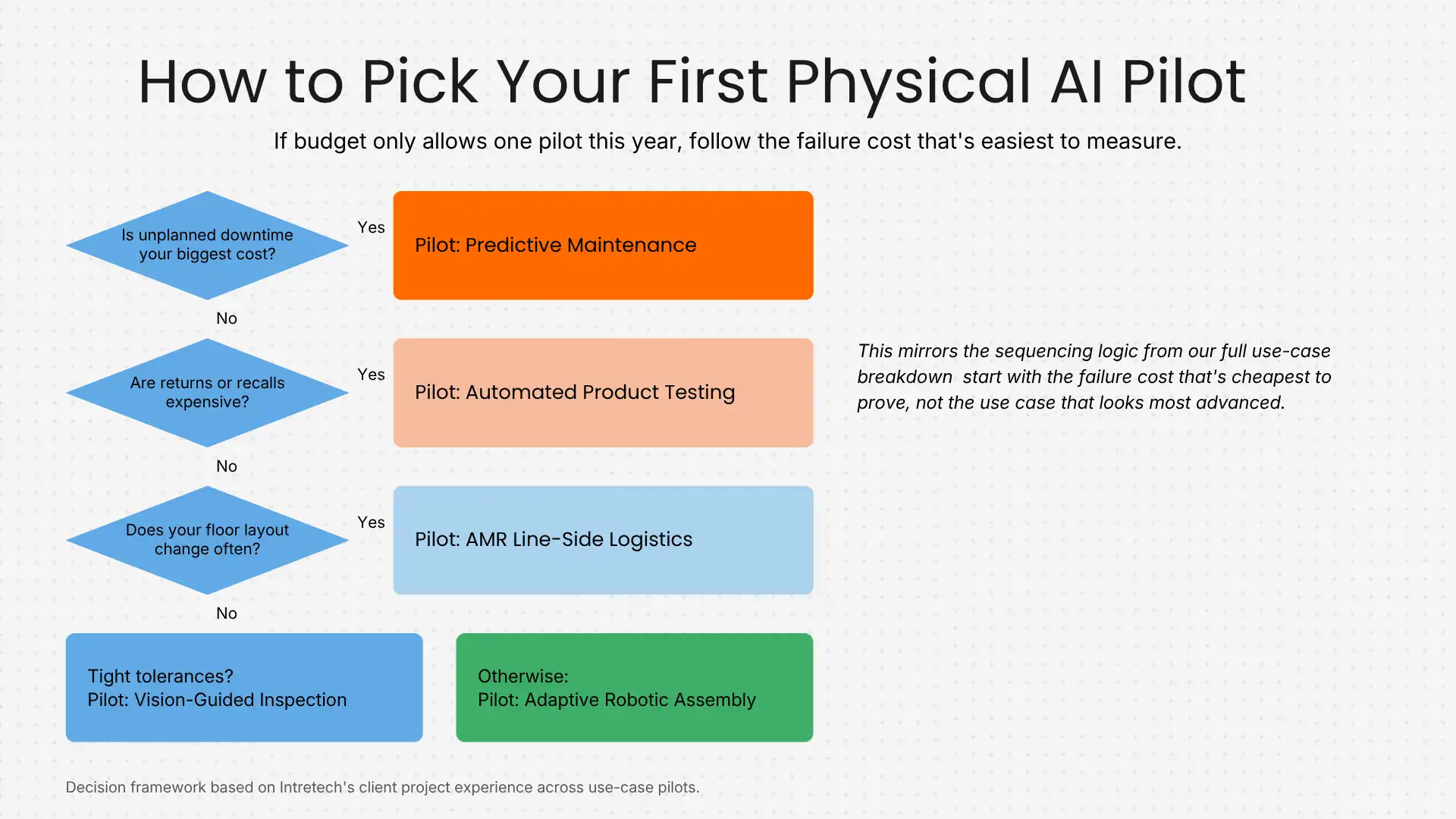
“Resist the temptation to pilot the most technically impressive option… they’re rarely where the fastest, most defensible ROI is sitting.”
4. Adaptive Robotic Assembly (Cobots With Autonomy)
Collaborative robots, cobots, that work alongside human operators have been common for years. What’s new in 2026 is autonomy layered on top: cobots that can adjust grip, force, and sequencing in response to slight part variation, rather than requiring every part to be presented in an identical fixed position.
This is the use case with the widest range of maturity depending on vendor and application some adaptive cobot systems are genuinely production-ready; others are closer to advanced pilots. It’s worth being specifically skeptical here and asking for a demonstration on your actual parts, not a vendor’s showcase parts, before committing budget.
Where it pays off: mixed-product assembly lines with moderate part variation and frequent changeovers.
Where it doesn’t: single-product, high-volume assembly where fixed-position robotics is already cheaper and proven.
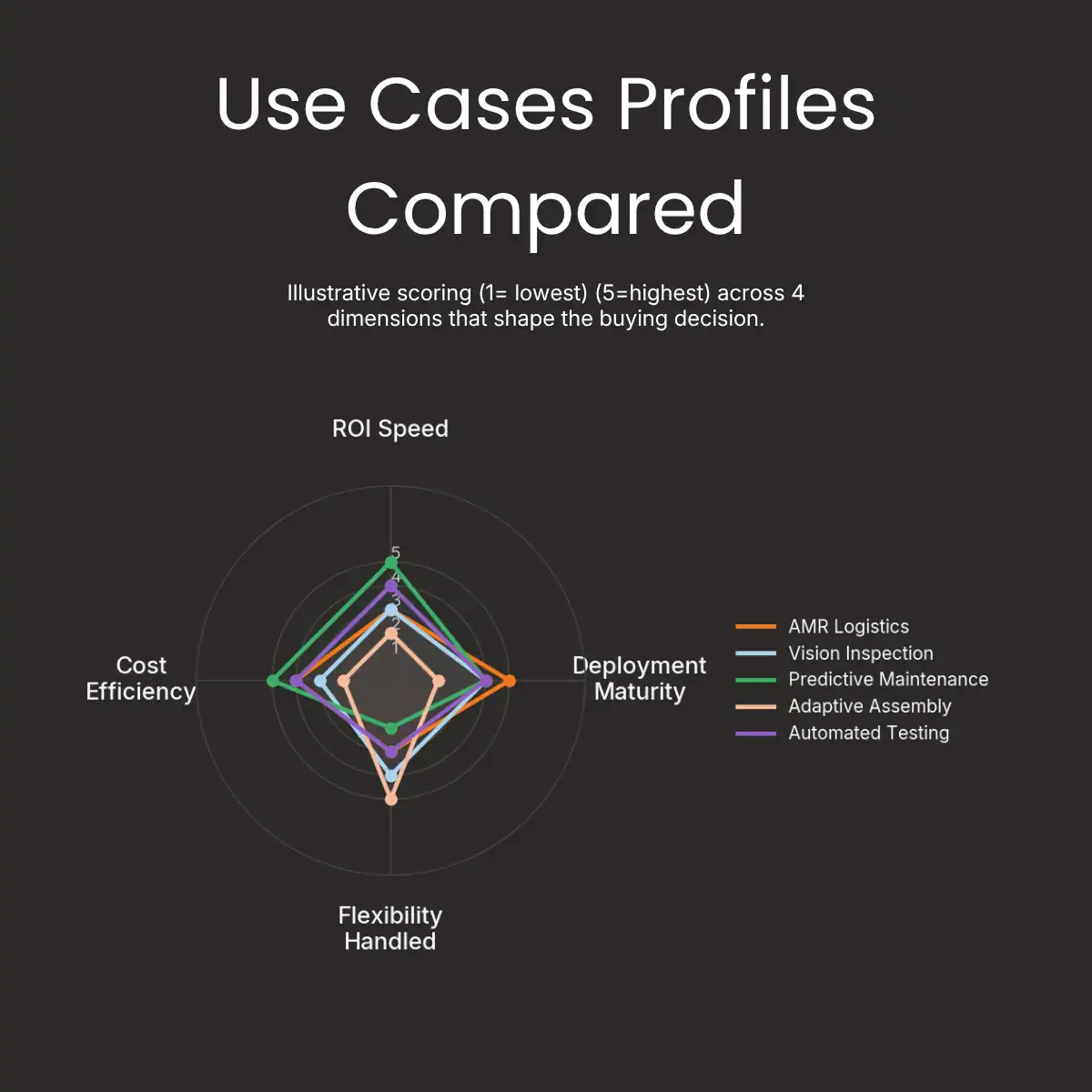
These aren’t neck-and-neck, each use case trades off speed, cost, and flexibility differently.
5. Automated Product Testing and Robustness Analysis
This is the use case we know best, because it’s core to what Intretech builds. Automated testing rigs combining robotics with AI-driven failure analysis can run products through accelerated stress, drop, and durability testing far faster than manual testing, while flagging failure patterns a human tester might miss across thousands of test cycles.
In practice, this kind of automated testing has helped reduce costs associated with product returns by up to 25% for manufacturers we’ve worked with, by catching robustness issues before products ship rather than after they’ve reached customers. For consumer electronics and medical device manufacturers in particular, where post-launch defect costs are severe, this is often the single highest-ROI physical AI application on this list and one of the least discussed.
Where it pays off: any product where field failure is expensive recalls, warranty costs, reputational damage.
Where it doesn’t: low-consequence products where the cost of a field failure is genuinely lower than the cost of automated testing infrastructure.
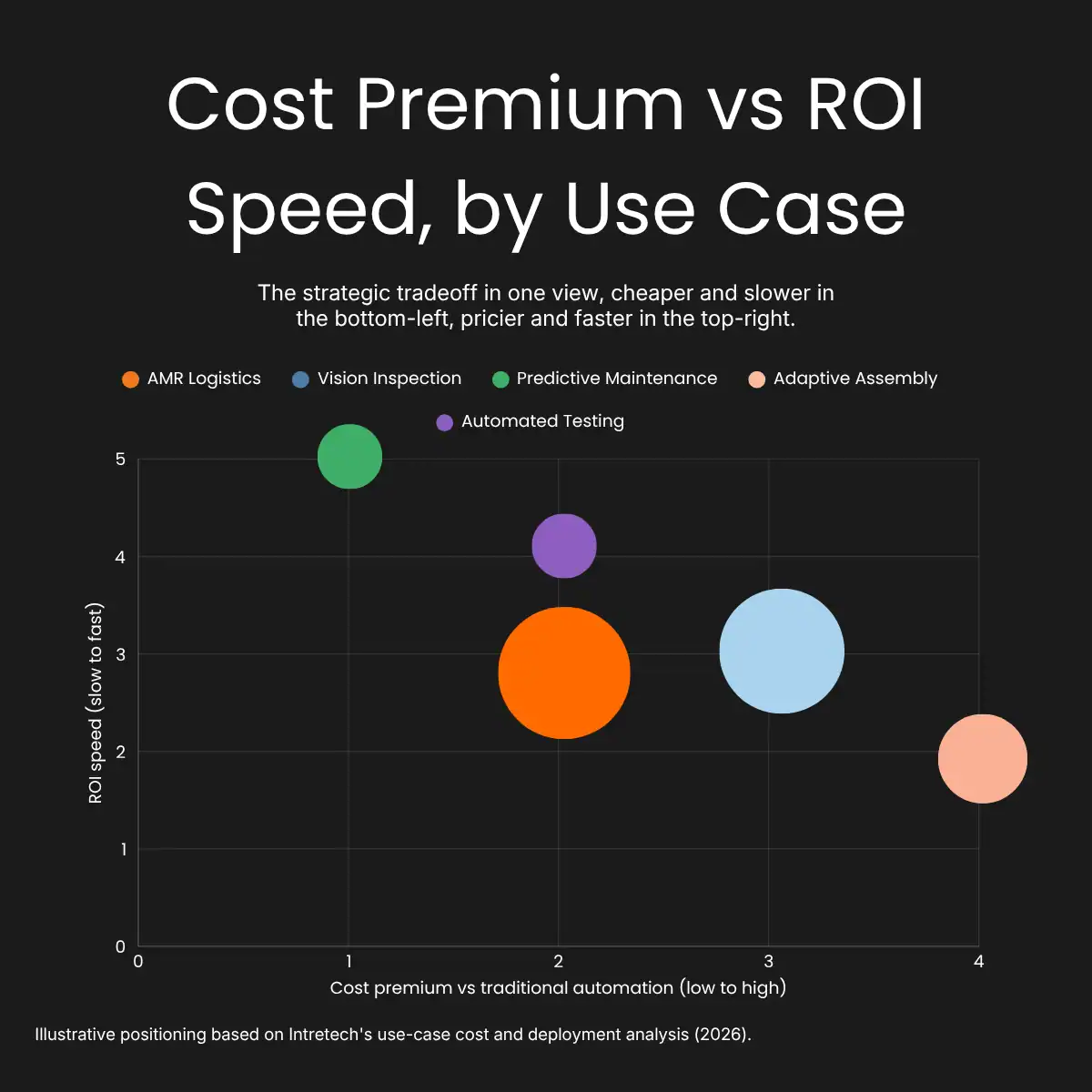
“None of these five applications are speculative research projects, they’re deployed, working, and priced.”
What This Means for Your ROI Timeline
None of these five applications are speculative research projects they’re deployed, working, and priced. But the ROI timeline varies sharply by use case: predictive maintenance and automated testing tend to pay back fastest because the failure cost they prevent is easy to quantify; adaptive assembly and vision-guided inspection take longer to prove out because the comparison against existing methods is less clean-cut.
If you’re weighing which of these fits your production line first, the honest starting point usually isn’t “which is most advanced” — it’s “which failure or cost is most expensive for us right now.” We’ve laid out a fuller framework for making that call in our guide to choosing between physical AI and traditional automation.
A practical way to sequence this, if budget only allows one pilot this year: start with whichever use case maps to your single most expensive, most measurable failure mode. If unplanned downtime is your biggest line item, pilot predictive maintenance first. If product returns or recalls are the bigger cost, start with automated testing. Resist the temptation to pilot the most technically impressive option, adaptive assembly and humanoid-adjacent applications tend to attract the most attention internally, but they’re rarely where the fastest, most defensible ROI is sitting.
Intretech builds and deploys automation lines, including the testing and robustness systems described above, in under six months, with an average client ROI inside twelve. If you want a straight assessment of which of these five use cases would actually move the needle on your line, book a free consultation with our engineering team.
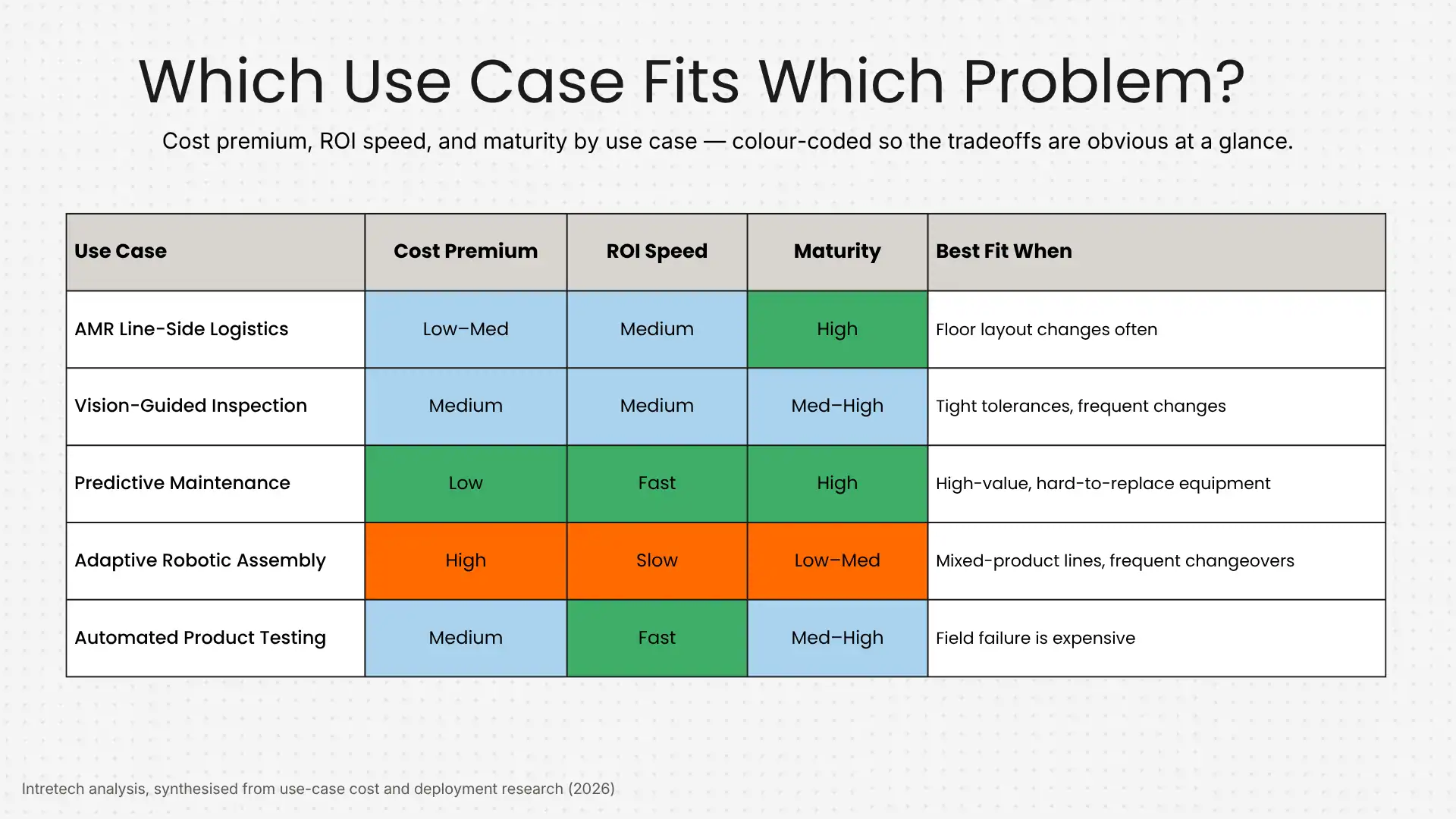
“Predictive maintenance and automated testing tend to pay back fastest because the failure cost they prevent is easy to quantify; adaptive assembly and vision-guided inspection take longer to prove out.”
Frequently Asked Questions
What is a real-world example of physical AI in manufacturing?
Autonomous mobile robots handling factory logistics and vision-guided robotic quality inspection are two of the most widely deployed physical AI applications running in production today, alongside predictive maintenance sensors and adaptive robotic assembly.
How much does physical AI cost to implement on a production line?
Cost varies significantly by application and scale, but physical AI systems generally carry a premium over comparable traditional automation. The premium is easiest to justify in high-variability or high-consequence-of-failure environments, and hardest to justify on stable, low-risk, high-volume lines.
Can physical AI reduce product returns or defects?
Yes — automated testing and robustness analysis systems that combine robotics with AI-driven failure detection have been shown to reduce costs associated with product returns by up to 25% by catching defects before shipment rather than after.
Do you need to replace existing automation to add physical AI?
Usually not. Most physical AI deployments add perception and decision-making capability to automation infrastructure that’s already in place, rather than requiring a full line replacement.
How long does it take to see ROI from physical AI systems?
It depends heavily on the use case. Predictive maintenance and automated testing tend to show the fastest, most quantifiable returns because they prevent costs — downtime, recalls — that are easy to measure. Other applications, like adaptive assembly, typically take longer to prove out.
Explore more related content
Edge AI Hardware: The Engineering Trade-Offs Behind IFA 2026’s Biggest Trend
Edge AI Hardware: The Engineering Trade-Offs Behind IFA 2026's Biggest TrendGlobal edge AI hardware market at $33.3B...

Physical AI vs Traditional Automation: How to Know Which One Your Production Line Actually Needs
Physical AI vs Traditional Automation: How to Know Which One Your Production Line Actually NeedsEvery automation...
What Is Physical AI? A Manufacturer’s Guide to the 2026 Shift From Automation to Autonomy
What Is Physical AI? A Manufacturer's Guide to the 2026 Shift From Automation to AutonomyEvery few years,...