

Why Air Quality Devices Are the Fastest-Growing Smart Home Category in 2025


H6: “96% of Europe’s urban population is exposed to fine particulate matter (PM2.5) above the new WHO guideline levels.” — EEA, 2024
Smart homes used to be about turning lights on with your voice and asking a speaker about the weather. In 2025, the most interesting smart devices are quietly counting particles, sniffing VOCs, and nudging your air towards “healthy” instead of “hazardous”.
Welcome to the rise of smart air quality devices: sensors, purifiers, humidifiers, and AC units that don’t just move air, they understand it.
For manufacturers and brands in the smart home ecosystem, the category is not assummed to be a nice add-on anymore. This is where consumer demand, public health, and regulation all intersect.
“Smart home penetration reached 44% globally in 2024 and is expected to cross 60% by 2027.” — Statista Smart Home Report
The Problem in the Air: Why Everyone Is Suddenly Worried About “Invisible” Pollution
If the subject of indoor air felt niche a few years ago, the data has caught up and ruined the illusion.
The World Health Organization estimates that household air pollution from cooking fuels and indoor sources still accounts for millions of premature deaths globally each year.In Europe, the European Environment Agency reported that 96% of the EU’s urban population is exposed to fine particulate matter (PM2.5) at levels above WHO guidelines. A recent review of indoor air exposures and airway health notes that air pollution is implicated in roughly one in five deaths worldwide, and that research on indoor exposures is now a growing priority for respiratory health.
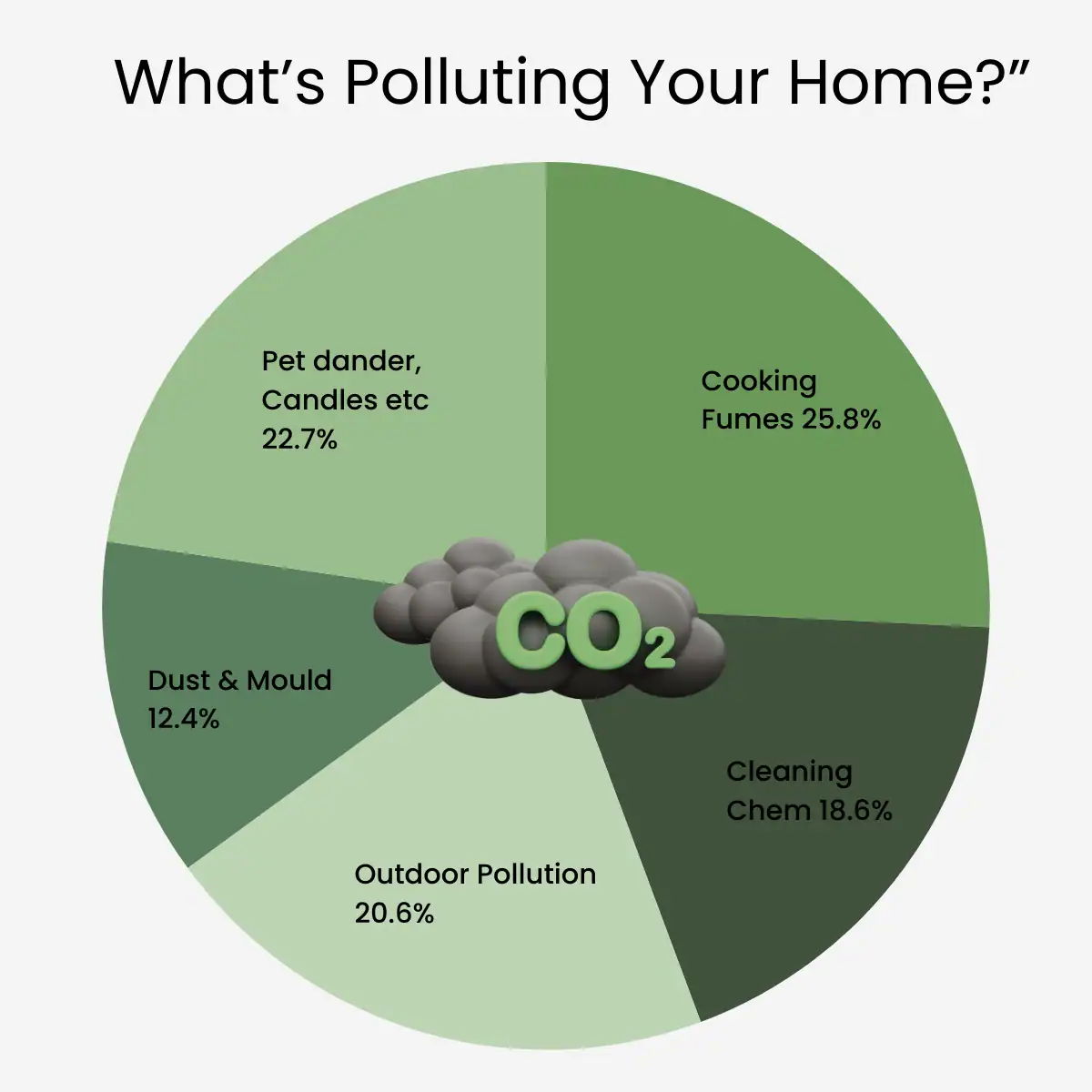
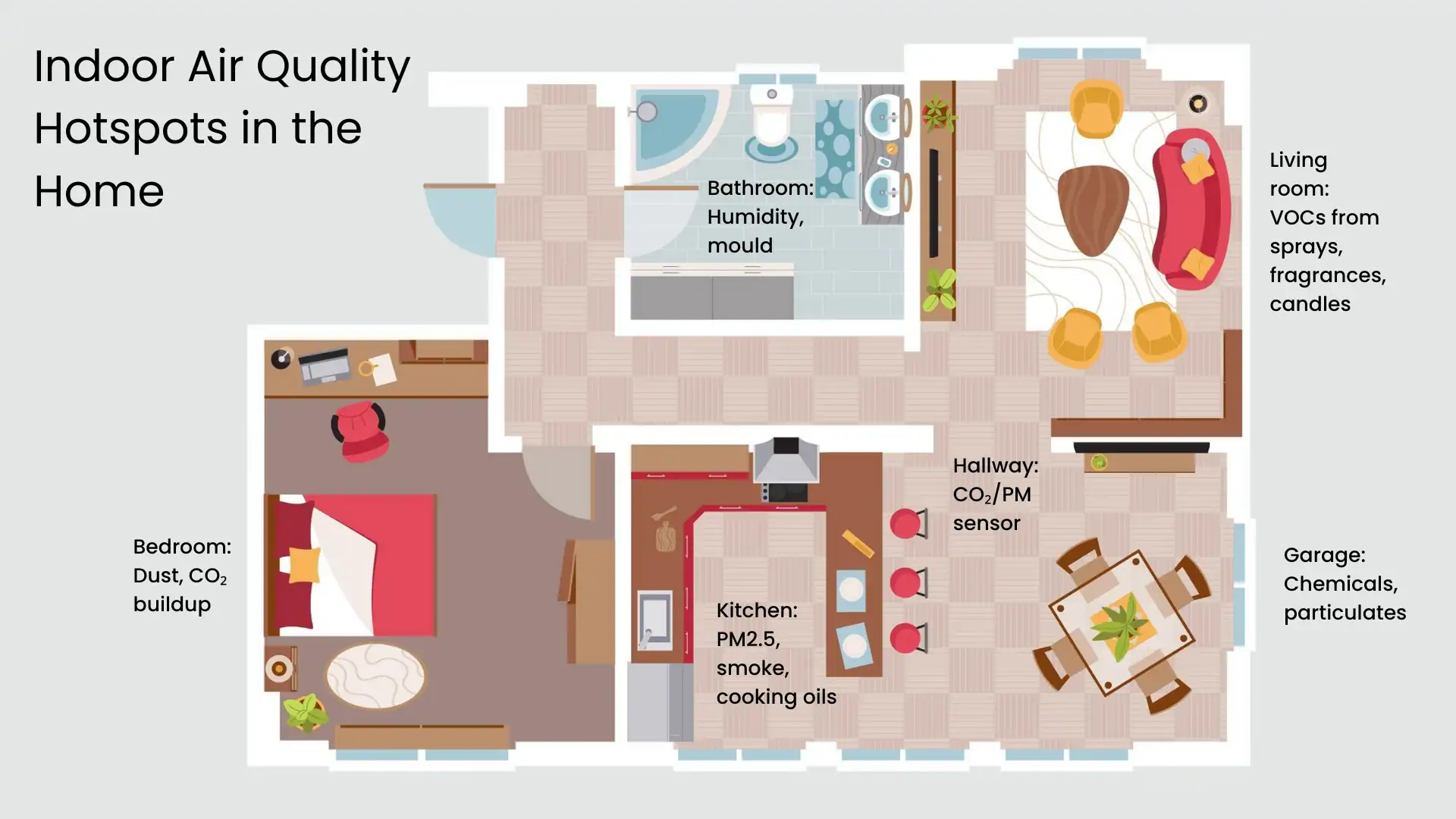
In other words: people are realising their “safe space” at home is often anything but. Cooking, candles, cleaning products, wood burners, cheap incense, pet dander, outdoor pollution drifting inside – they all add up.
Add to that:
- More time indoors,
- Increased awareness through media and social networks, and
- Post-pandemic sensitivity to anything related to air or respiratory health
…and you get a perfect environment, pun intended, for “indoor air pollution solutions” to trend.
“The global smart air purifier market is projected to grow at 14.1% CAGR from 2024 to 2030.” — Grand View Research, 2024
Market Data: Demand for Smart Air Quality Devices Is Surging
This isn’t just a “vibe”; the numbers are very real.
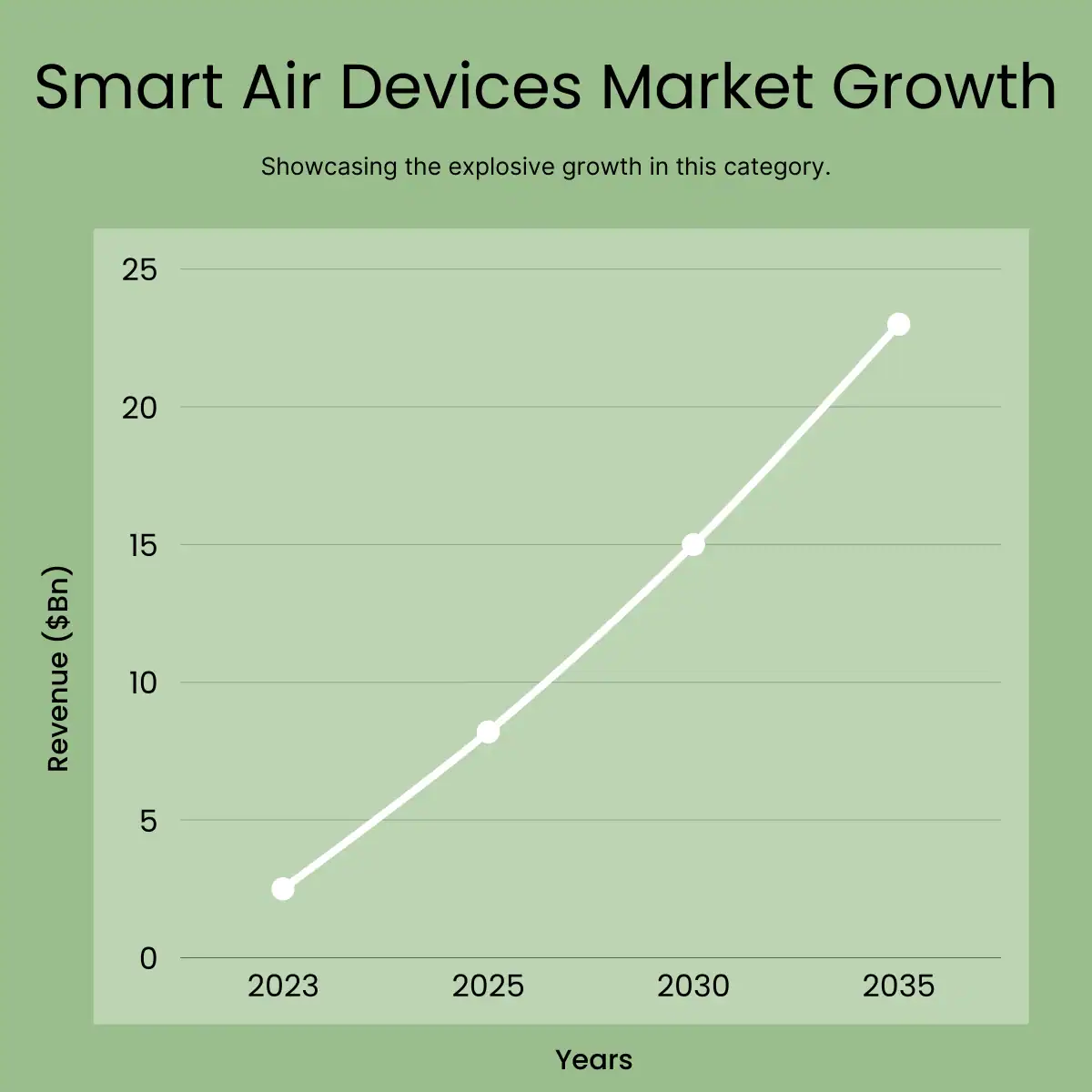
- The global smart air purifier market was valued at about USD 2.53 billion in 2023 and is expected to grow at a CAGR of ~14.1% from 2024 to 2030.
- Another long-term forecast pegs the smart air purifier market at USD 8.2 billion in 2025, rising to over USD 23 billion by 2035 about 11% CAGR.
- By itself, the market for home air quality sensors was valued at around USD 1.6 billion in 2023 and is likely to reach about USD 5.5 billion by 2032, growing at a nearly 15 percent per year rate.
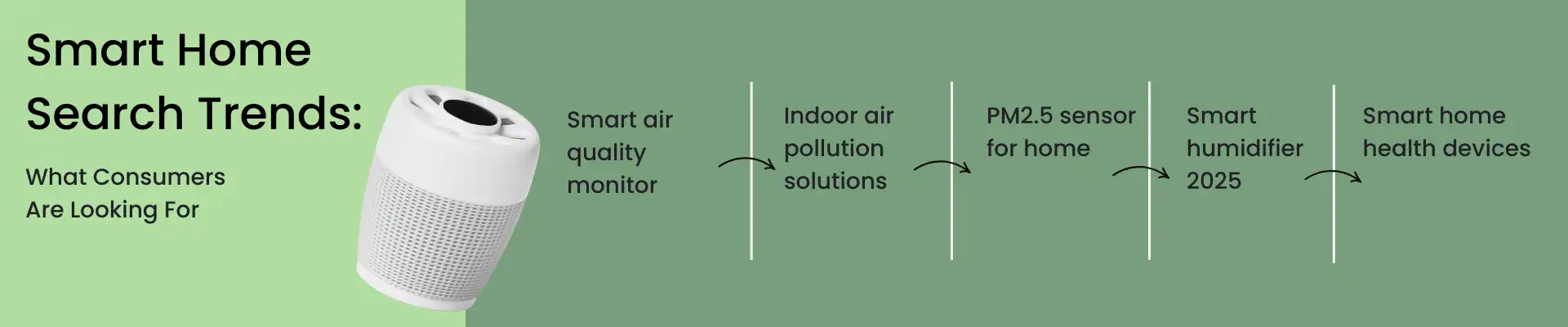
- Recent trend analysis puts “smart air quality monitor” consistently ahead in global search interest over both “indoor air quality sensor” and “portable air quality detector”.
- Consumers are searching for smart air quality monitors, smart purifiers, and integrated solutions.
“Health-driven smart home products are now growing 2x faster than convenience-driven devices.” — McKinsey ConsumerTech Pulse, 2025
What Counts as a Smart Air Quality Device in 2025?
In practice, this category now spans three overlapping product families:
1. Smart Air Quality Sensors & Monitors
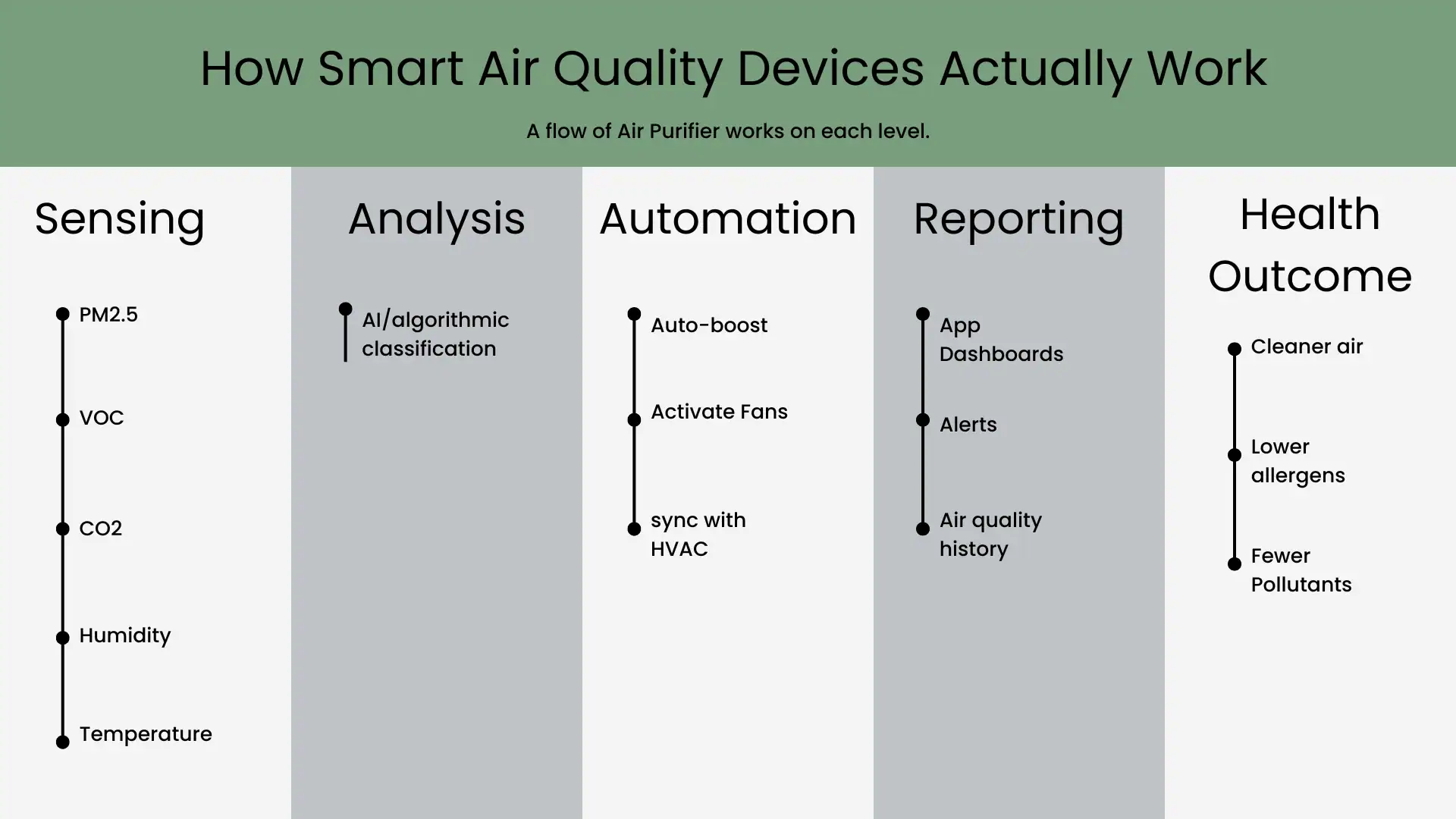
These tiny contraptions monitor such pollutants as particulate matter (PM2.5/PM10), VOCs, CO₂, temperature, and humidity. According to recent market research, the smart air quality sensor market was estimated at US$2.3 billion in 2024 and is expected to grow at a CAGR of 12.6% through 2033.
Why they matter:
- They make the invisible visible through dashboards, alerts and trends.
- They integrate with platforms like SmartThings, Alexa, Google Home, and Matter.
- They usually trigger automations: turn on purifiers, open vents, boost extraction fans.
2. Smart Air Purifiers
This is where sensors meet heavy lifting. Smart purifiers combine HEPA, activated carbon and sometimes ionisation or UV with connectivity and on-board sensing.Recent market reports highlight several drivers: concerns about airborne disease, urban pollution, and a shift from one-off devices to ecosystems with app control and filter subscriptions.
Smart purifiers now:
- Automatically detect poor air quality and ramp up without user input.
- Report filter life, energy consumption, and pollutant levels in real time.
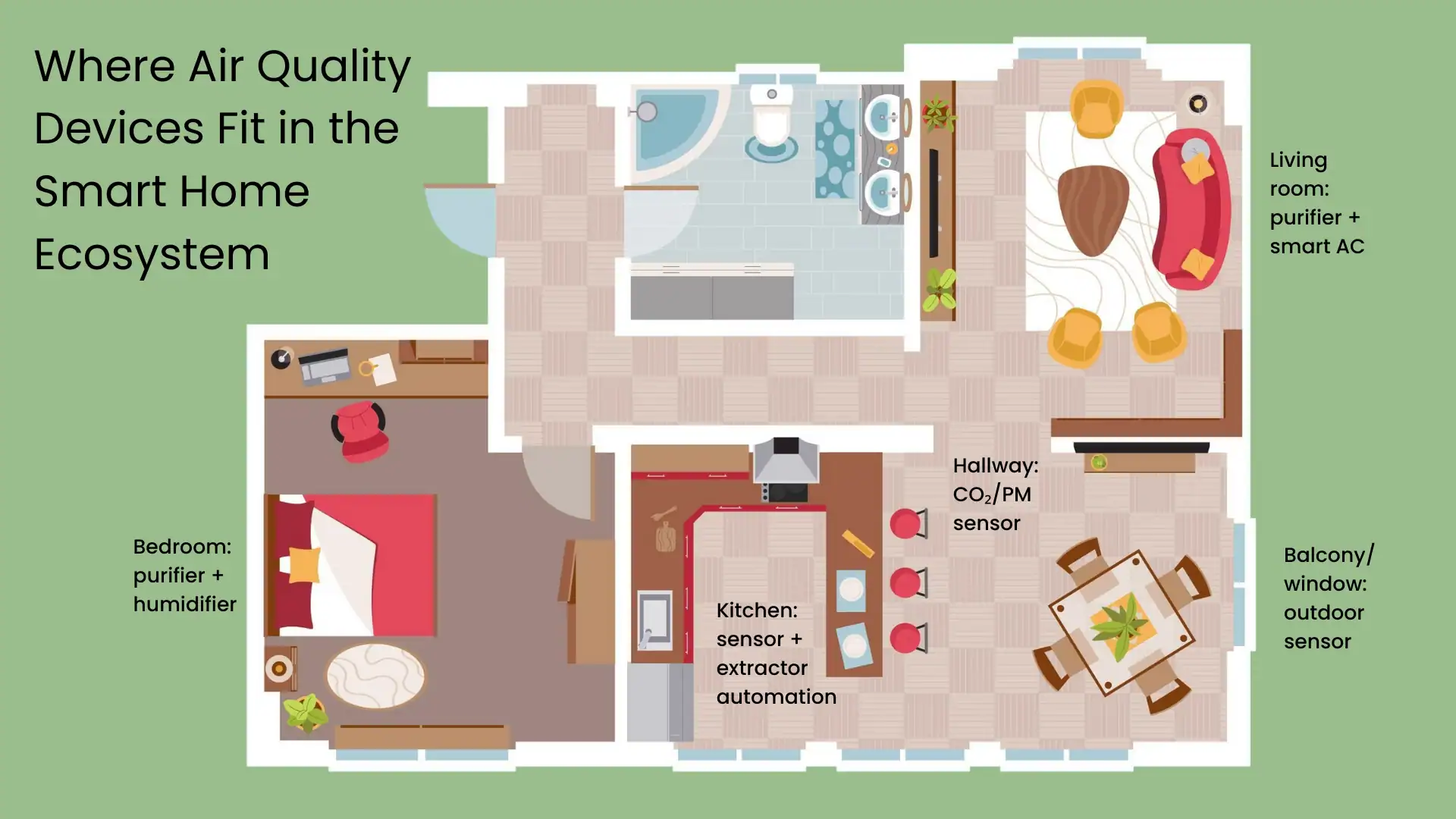
- Work in multi-room networks so that the whole home becomes an orchestrated system, not a collection of stand-alone units.
“Health-driven smart home products are now growing 2x faster than convenience-driven devices.” — McKinsey ConsumerTech Pulse, 2025
3. Smart Humidifiers, AC Units & Hybrid “Comfort + Health” Devices
The line between climate control and air health is rapidly blurring. Samsung’s SmartThings roadmap adds ambient sensing ; presence, activity and environmental context ; across appliances, allowing things like TVs and fridges to cooperate with air cleaners and HVAC based on what’s happening in the room.
At IFA 2025, Hisense launched an AI-driven air conditioner with integrated ionization and air purification that uses sensors to automatically adjust cooling, humidity, and air quality. What that means for consumers is fewer boxes and more “all-in-one” environmental health systems. For manufacturers, it means air quality features are quickly becoming standard, not premium.
Why Air Quality Devices Are Outpacing Other Smart Home Categories
Plenty of smart home gadgets are fun. Not many can say they’re a health investment.Here’s why air quality devices are gaining faster traction than yet another smart bulb:Naturally, health is a stronger trigger than convenience.
Turning a light on with your phone is nice; reducing asthma triggers or smoke exposure is compelling. In the UK, for example, recent analysis linked domestic wood and coal burning to 2,500 deaths per year and significant healthcare costs.
They align with the regulation and ESG narratives.Indoor and outdoor air quality standards are being tightened by governments and agencies alike. The evolving air quality directive from the EU and the guidelines from WHO push awareness into mainstream press and policy.
“The future of the smart home is autonomous; devices adjusting before the user even asks.”
— CES 2025 Keynote
They fit very well into ecosystems. Platforms such as Matter, SmartThings, HomeKit, and Google Home have made it easier to connect sensors to actuators – “IF CO₂ is high, THEN open the window actuator and boost the purifier.” Smart manufacturers that design with this in mind become the darlings of such platforms.
The Tech Under the Hood: Why This Space Is a Playground for Innovation
Smart air quality devices are a candy shop from the point of view of manufacturing and engineering:
Sensor fusion: PM, VOC, CO₂, Temperature, Humidity, and presence sensors combined provide more relevant output for effective decisions.
AI and edge computing: Devices that learn patterns-cooking, cleaning, occupancy-and adapt proactively rather than simply reacting to thresholds.
Connectivity: Wi-Fi, Thread, Zigbee, Bluetooth LE, and Matter support enable seamless app experiences and multi-device orchestration.
Industrial design: Products are to be aesthetic enough for living rooms; airflow should be optimized for performance, but quiet enough for bedrooms.
“40% of home appliance brands surveyed plan to integrate air quality sensing into existing product categories by 2027.” — GfK Appliance Innovation Report, 2025
This category lets you flex for OEMs and contract manufacturers by:
- Electronics design and sensor integration
- Firmware and connectivity firmware stacks
- Plastics, filtration, motor control, and acoustics
- Compliance with safety, EMC, and increasingly air quality performance standards
What this means for smart home brands and manufacturers:
If you’re building-or thinking of building-in the smart home space, air quality devices should be at the forefront of your roadmap, not buried in “future ideas”.
Strategically, they offer:
- Clear value propositions include better sleep, fewer symptoms, healthier families, and cleaner homes.
- Recurring revenue models: filter subscriptions, maintenance plans, integrated service apps.
Searches for ‘smart air quality monitor’ have grown faster than any other smart home segment since 2023.” — Google Trends 2024
From Gadget to Guardian: The Future of Air-Smart Homes
The smart home started out as a collection of toys. In 2025, it’s starting to look a lot more like an environmental health system, always measuring, always adjusting, always on. Smart air quality devices are at the core of this transition:
Sensors that never blink, Purifiers that fire up before you notice the smell, ACs and humidifiers that silently shape comfort and health. Homes with intelligent air quality solutions will go from “early adopter flex” to the baseline expectation for families, urban dwellers, and health-conscious consumers in a world where air pollution remains one of the most serious environmental health risks.
For the brands and manufacturers that move early, the opportunity is clear: Don’t just make devices that live in the home. Make devices that help the home and the people inside it; breathe better.
Explore more related content

Digital Product Passports for Small Appliances & Air Purifiers
Digital Product Passports for Small Appliances & Air Purifiers: A 2025–2027 Manufacturer Playbook From the Oxera...
Smart Air Purifiers vs. Low-IAQ Fan Boxes: Inside the Rise of Sensor-Driven Clean Air
Smart Air Purifiers vs. Low-IAQ Fan Boxes: Inside the Rise of Sensor-Driven Clean Air“People now spend approximately...

Poor PCB Design, Poor Gameplay: EMI and SI in Gaming Hardware
Poor PCB Design, Poor Gameplay: EMI and SI in Gaming HardwareFixing a signal integrity issue during schematic design...