

Understanding the Role of Joint Design Manufacturing in Supply Chain Optimization

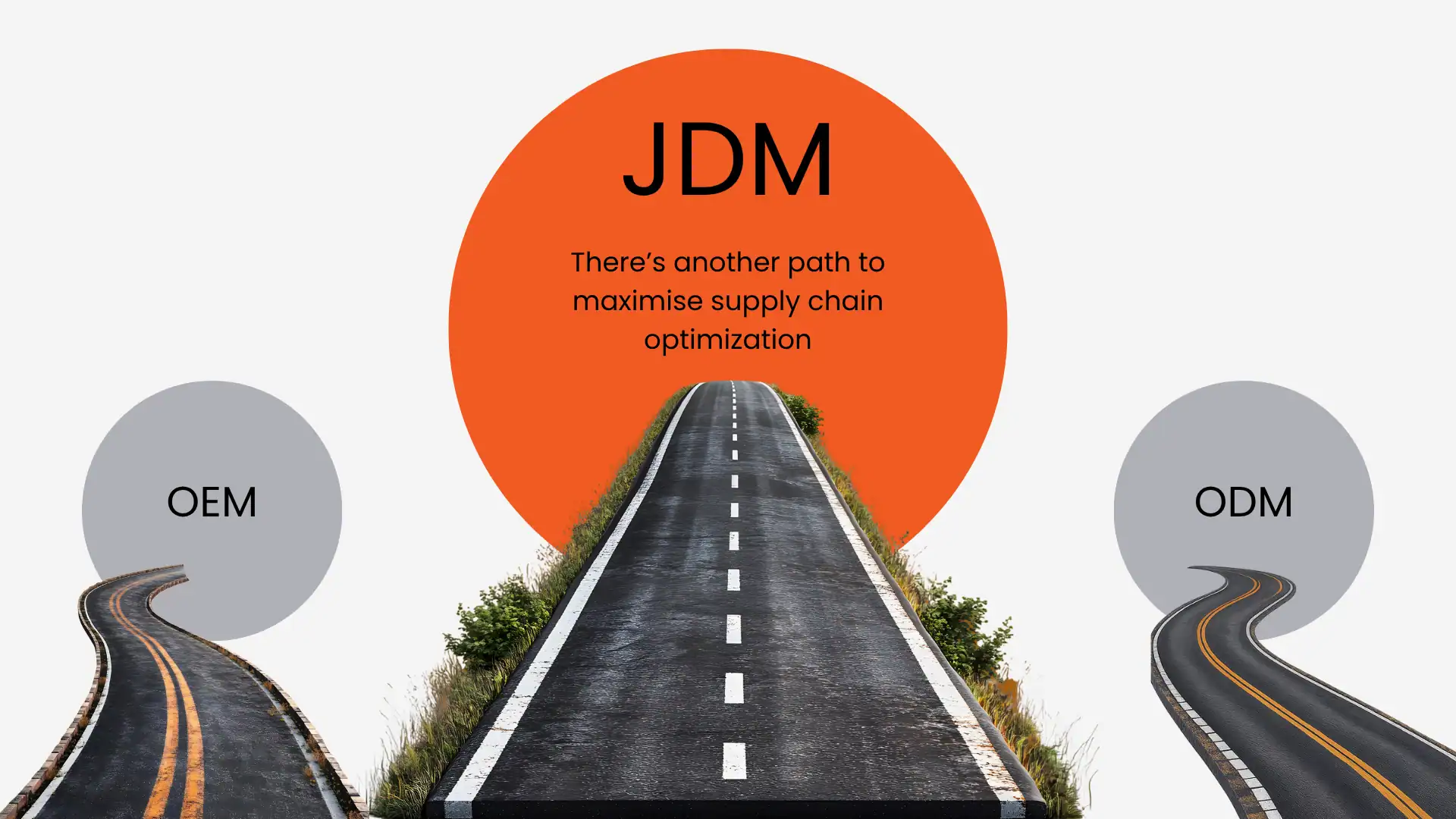
OEM is the safe answer. ODM is the cheap answer. JDM is the answer most companies should be picking and almost none of them do, because nobody sells it as hard.
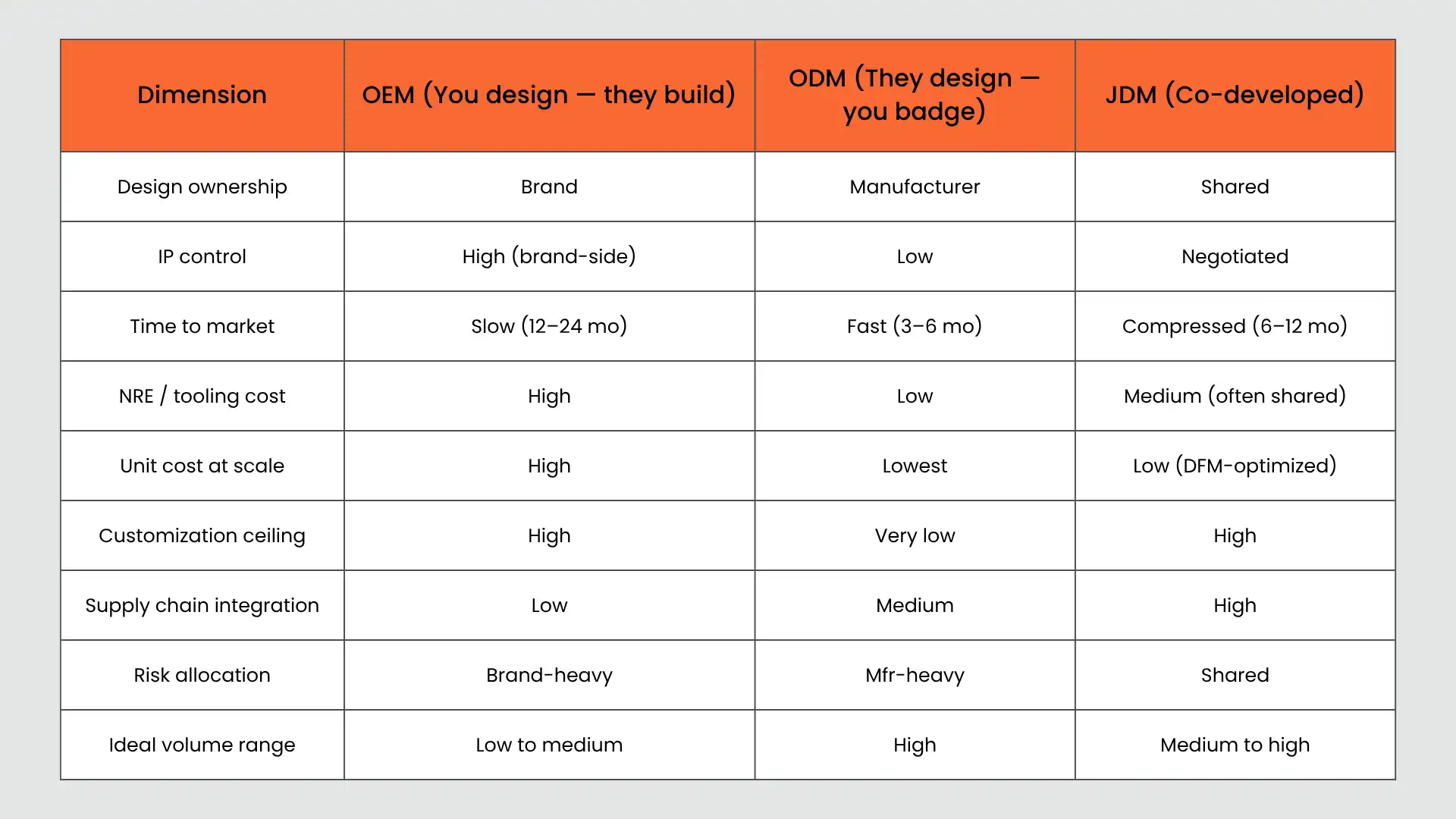
There’s a reason. Joint Design Manufacturing doesn’t fit neatly into a procurement RFP. It doesn’t have a clean line item on a CFO’s spreadsheet. It requires both sides to share things they’re trained not to share – IP, roadmaps, cost structures, internal failure data. So most companies default to OEM (we design, you build) or ODM (you design, we badge). And quietly wonder why their products take eighteen months to launch and then ship with margin compressed to nothing.
The contrarian truth that the supply chain advantages everyone claims they want speed, agility, integration, resilience are mostly unreachable from inside an OEM or ODM relationship. JDM is the only model where they’re actually on the table. The catch is that you have to know how to run it.
Let’s get into what that means.
“The line between contract manufacturing and joint development has blurred to the point where the binary OEM/ODM framing actively misleads strategic buyers.” — IPC, Outlook for the Global EMS Industry
What Joint Design Manufacturing actually is
Joint Design Manufacturing (JDM) is a hybrid model where the brand and the manufacturing partner co-develop the product from the earliest stages of design. The brand brings the customer insight, the use case, and the commercial proposition. The manufacturer brings the engineering depth, the process knowledge, and the supply chain. Both sides have skin in the design.
That last part is what trips people up.
In OEM, the manufacturer is a vendor. In ODM, the manufacturer is a catalog. In JDM joint design manufacturing, the manufacturer is a partner and partners sometimes argue with you. They tell you your spec is over-engineered and push back when your industrial designer specs a finish that adds eighteen weeks of lead time for no functional benefit. They challenge assumptions you didn’t know you had.
If you can’t handle that level of pushback then maybe JDM isn’t for you. Stick with ODM. The product will be average but you’ll sleep fine.
Why supply chain optimization matters more than ever
Manufacturing economics have changed. Component lead times that used to be predictable are now volatile. Tariffs shift quarterly. Logistics costs that were rounding errors are now line items. The geographies that were “just cheaper” are now politically complicated.
In that environment, supply chain optimization isn’t a back-office concern. It’s a margin lever and a survival mechanism. The companies that figured this out during 2020-2023 came out the other side with stronger relationships, better forecasting, and the kind of supplier flexibility their competitors are still trying to negotiate.
Joint Design Manufacturing is one of the few models that bakes supply chain logic into the product before tooling is cut. Most JDM partners design with their own factory floor in mind which means components, tolerances, and assembly steps that match their actual capability rather than aspirational sourcing assumptions. That alone removes a category of post-launch surprises that haunt OEM relationships.
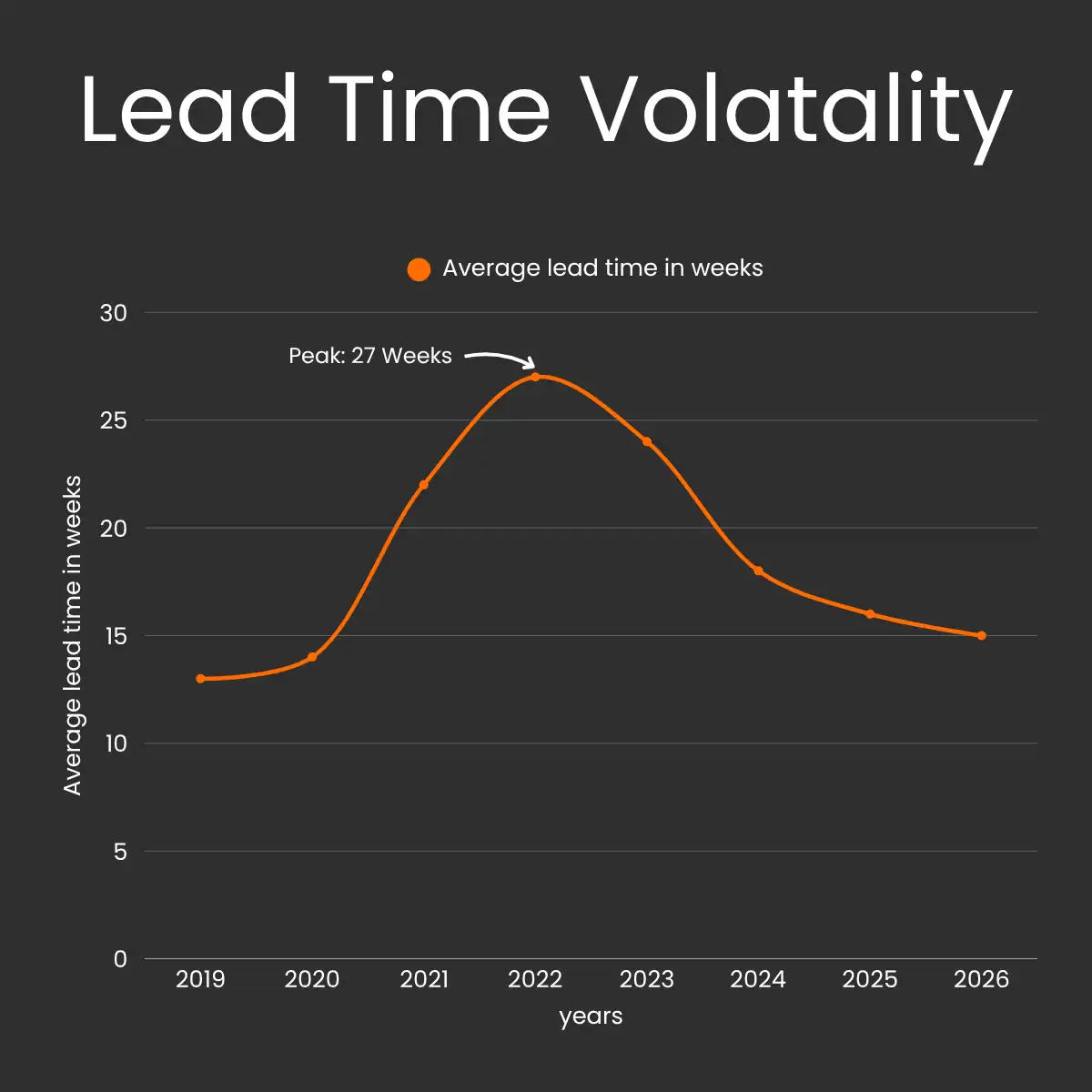
Average semiconductor lead times peaked at 27 weeks in mid-2022, more than double the pre-pandemic baseline of 13 weeks. Even after partial normalization, lead time volatility remains roughly 2x its 2019 variance. — Susquehanna Financial Group, monthly chip lead time tracker
The Product Development Lifecycle
Stages of the product development lifecycle
The product development lifecycle is usually drawn as a clean linear flow: concept → design → engineering → prototyping → tooling → production → launch → end of life. Anyone who’s actually shipped hardware knows the diagram is a polite fiction. Real product development is a series of overlapping loops, with the loops getting more expensive every time you have to run them.
The product lifecycle management literature lays out the stages cleanly enough. The honest version goes something like this:
- Concept — somebody sketches something on a napkin and convinces leadership it’ll print money.
- Industrial design — the napkin becomes a render that looks beautiful and ignores manufacturing physics.
- Engineering — somebody finally tells the truth about what’s actually buildable.
- Prototyping — the truth gets validated, expensively.
- Design for manufacturing (DFM) — what should have happened at stage two.
- Tooling — the moment everything becomes irreversible.
- Pilot production — the first time you find out what you actually built.
- Mass production — where margin lives or dies.
- Sustaining engineering — the work nobody plans for and everyone has to do.
Hardware programs that engage manufacturing partners during early design compress development timelines by 20–30% on average compared to programs that engage manufacturers post-spec.
Role of JDM in each stage
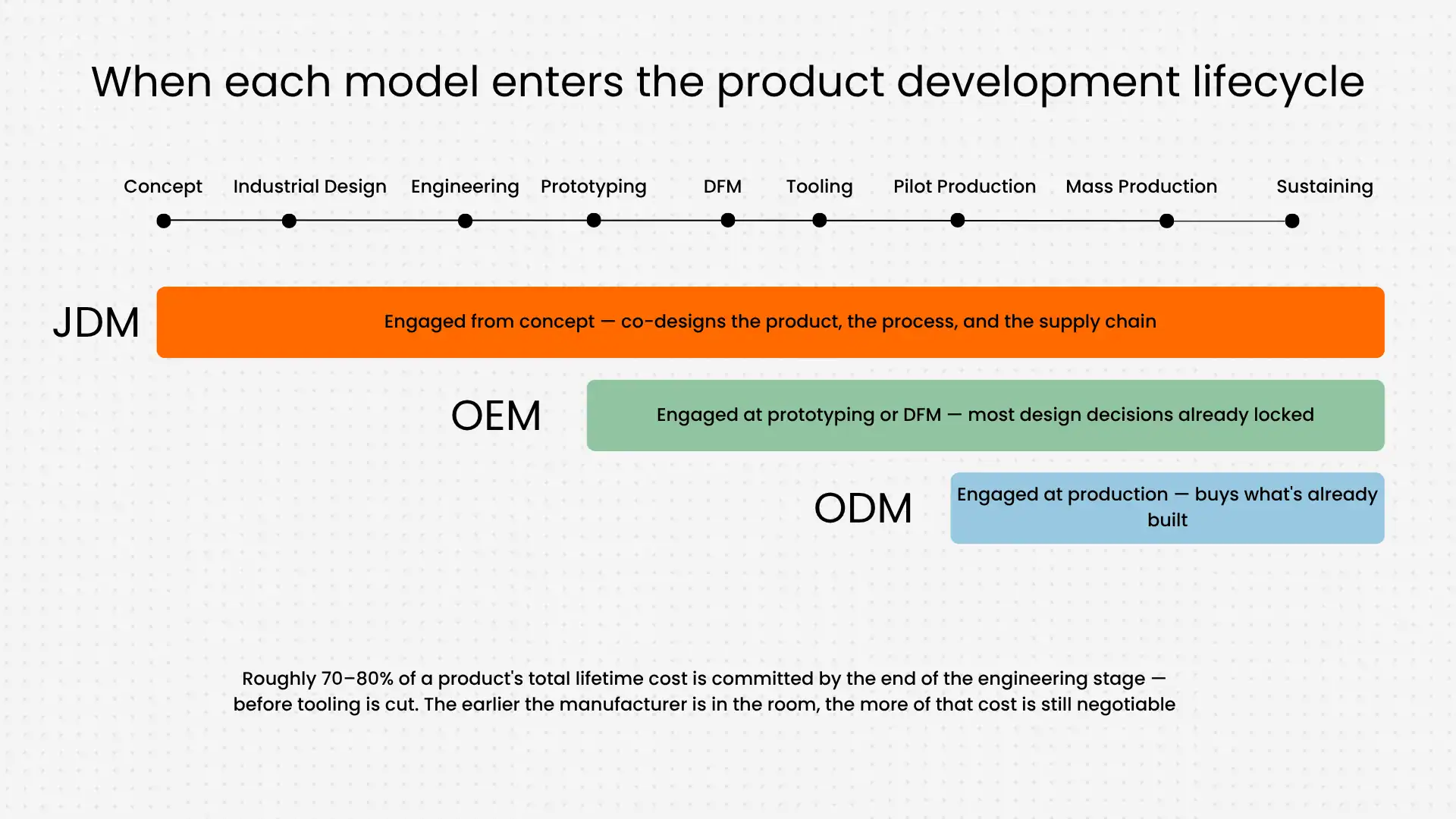
Here’s where JDM earns its keep. In the OEM model, the manufacturer typically enters around stage four or five. By which point most of the bad decisions are already locked in. In ODM, the brand enters at stage seven, getting whatever’s already on the shelf. In JDM, both parties are at the whiteboard from stage one.
That changes everything. Industrial design happens with knowledge of factory tooling capability. Engineering happens with input on which components the manufacturer can actually procure at scale. DFM stops being a painful retrofit and becomes the design language itself. Prototyping uses processes that are representative of mass production, not lab-grade approximations.
The result is fewer loops, faster cycles, and far less of the late-stage rework that quietly destroys hardware launch budgets. Industry observers have repeatedly noted that hardware programs run as JDM tend to compress development timelines by months – sometimes by a third, compared to comparable OEM programs.
Collaborative Engineering and Cross-Functional Teams
Building effective cross-functional teams
Cross-functional teams are one of those concepts everyone agrees are good and almost nobody implements well. The problem isn’t the idea. Issue is incentives.
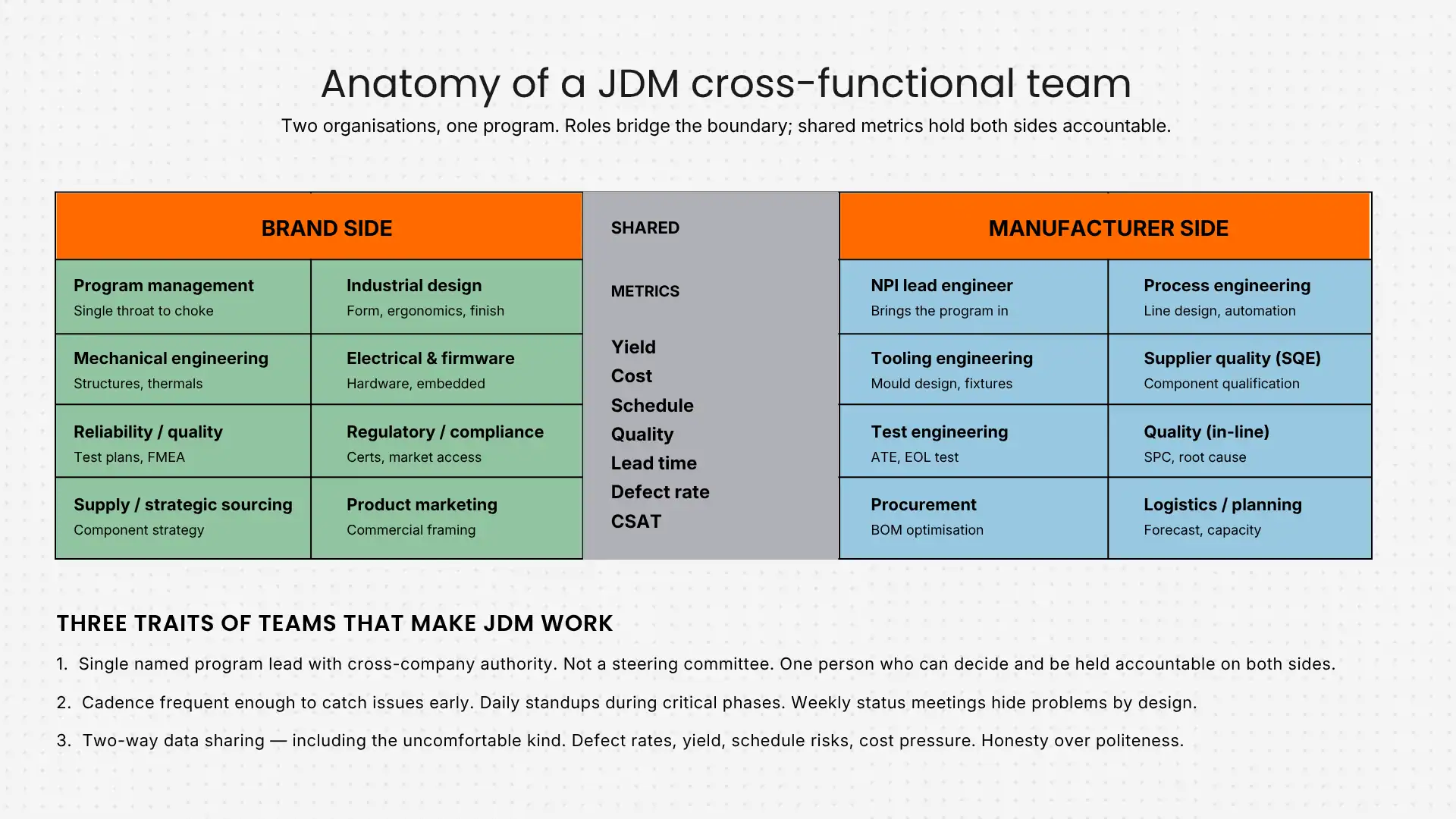
A cross-functional team that includes engineering, operations, supply chain, marketing, and finance but where each person reports to a different functional leader with different KPIs isn’t really a team. It’s a forum. Real cross-functional teams have shared metrics, shared accountability, and the authority to make decisions without escalating every disagreement.
In JDM, this gets harder because the team spans two companies. Now you’re not just bridging functions. You’re bridging cultures, time zones, and competing commercial interests.
The teams that make it work share three traits: they have a single, named program lead with cross-company authority. They meet on a cadence that’s frequent enough to catch issues early. Daily standups during critical phases, not weekly status updates. And they share data both ways, including the uncomfortable kind. Defect rates. Yield problems. Schedule risks. Cost pressures.
The collaborative engineering literature is full of beautiful frameworks for how this should work. The reality is messier. Teams that win at it are the ones that prioritise honesty over politeness.
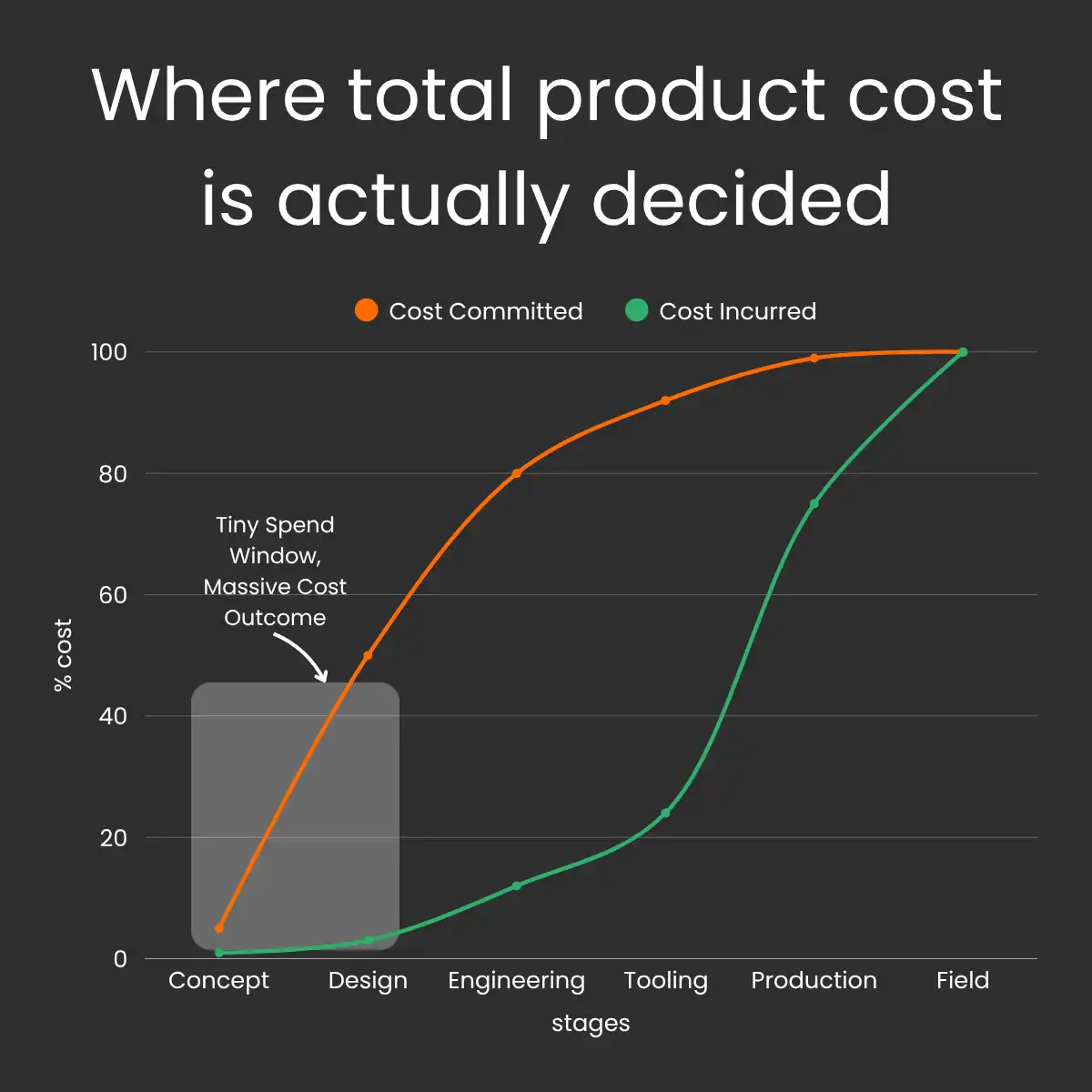
“Decisions made in the early stages of product development determine 70 to 80 percent of a product’s life-cycle costs, even though only a small fraction of total spend has occurred at that point.” — Geoffrey Boothroyd, Product Design for Manufacture and Assembly
The impact of collaborative engineering on JDM
Collaborative engineering is the engine that makes JDM work. Without it, you have a contract manufacturer with extra meetings.
Done properly, it produces engineering decisions that wouldn’t have come from either side alone. The brand’s industrial designer and the manufacturer’s process engineer together find a way to achieve the desired aesthetic with a tooling cost half what either would have specified independently. Reliability engineer and the manufacturer’s quality team co-develop a test protocol that catches a failure mode neither would have anticipated. The supply chain team identifies a component substitution that’s not on the brand’s preferred parts list but is six weeks shorter on lead time and 30% cheaper.
These wins don’t happen in OEM relationships, because the manufacturer isn’t allowed to question the spec. They don’t happen in ODM relationships, because the brand isn’t in the room when the spec is being written. But they happen in JDM, when they happen at all, because both sides are at the same table arguing in good faith.
Prototyping Services in JDM
Why prototyping matters in product lifecycle management
The conventional wisdom treats prototyping as a phase. Build a prototype, test it, iterate, freeze the design, move on.
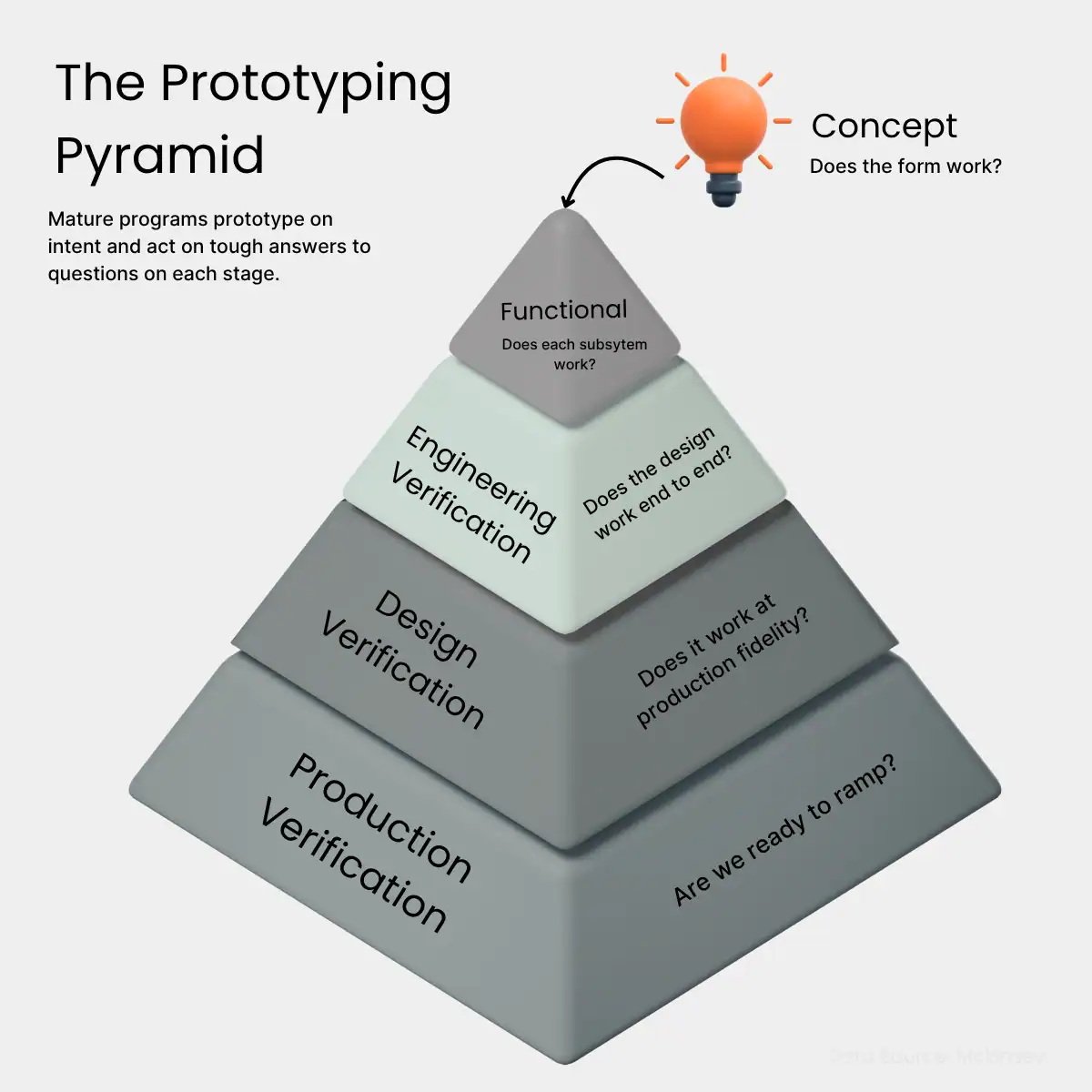
Wrong frame. Prototyping is a capability, not a phase. Mature hardware programs prototype continuously. Early renders, functional mock-ups, engineering verification builds, design verification builds, pilot production, even sustaining engineering. Each one answers a different question, and skipping any of them means making a bet you didn’t realise you were making.
The companies that ship great hardware aren’t the ones who prototype more. They’re the ones who prototype with intent and knowing exactly what question each build is designed to answer, and being willing to act on the answer even when it’s inconvenient.
“A team is a small number of people with complementary skills committed to a common purpose, performance goals, and approach for which they hold themselves mutually accountable.” — Jon Katzenbach & Douglas Smith, “The Discipline of Teams,” Harvard Business Review
Types of prototyping services used in JDM
A serious JDM partner offers a layered set of prototyping services that mirror the development lifecycle:
- Concept prototypes — fast, often 3D-printed, built to test form and ergonomics. Days to build, not weeks.
- Functional prototypes — partially representative of the final product, used to validate critical subsystems. Mechanical fits, thermal behavior, electrical performance.
- Engineering verification (EV) builds — small batches built using near-final components and processes, used to validate the full design end-to-end.
- Design verification (DV) builds — slightly larger batches built on production-intent tooling, used to validate that the design works at production fidelity.
- Production verification (PV) builds — typically the first builds on full production tooling, used to validate ramp readiness.
The advantage of running these inside a JDM partnership is that the same team that designed the product is running the builds, interpreting the results, and feeding them back into the design. There’s no translation loss, no finger-pointing, no “we built what you specified” defenses. The data goes from prototype to design change in days, not weeks.
Manufacturing Efficiency and Optimization
Key strategies for manufacturing efficiency
Manufacturing efficiency isn’t a single strategy. It’s the cumulative result of dozens of decisions, most of which were made before the first unit ever rolls off the line.
The strategies that actually move the needle:
- Design for manufacturability (DFM) baked in from concept, not bolted on at engineering verification.
- Component standardization across product families to leverage volume and reduce qualification overhead.
- Process simplification — fewer assembly steps, fewer touch points, fewer opportunities for human error.
- Automation where it earns its keep — and not where it’s bought because the CFO wants to point at robots.
- Yield improvement through real-time monitoring and rapid root-cause analysis on the line.
- Lean inventory management that doesn’t crumble when a single supplier hiccups.
Most of these strategies are obvious. Implementing them is the hard part. And implementing them is much harder when the team that designed the product isn’t the team that builds it.
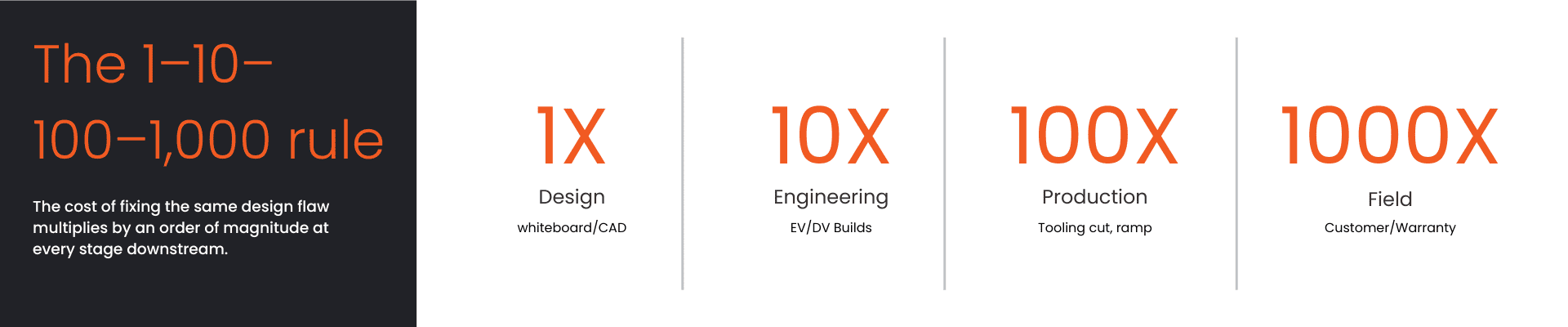
“For every dollar spent fixing a problem in design, ten will be spent fixing it in development, and a hundred fixing it in production.” — Barry Boehm, Software Engineering Economics
How JDM contributes to manufacturing optimization
This is where JDM has a structural advantage that OEM and ODM models can’t match.
In an OEM relationship, manufacturing optimization happens after the design is locked. The manufacturer can squeeze cycle times, optimize layouts, and improve yields but only within the constraints handed to them. If the design has a poorly placed fastener that adds three seconds to assembly, three seconds it stays. The brand has neither the data nor the incentive to redesign it.
In a JDM relationship, that fastener gets called out during the design phase, redesigned before tooling, and the three seconds never exist. Multiply that across hundreds of design decisions and the difference compounds into measurable margin.
There’s a temptation to over-optimize early. JDM partners worth their fee will push back on this too. No point engineering out the last 0.5% of cycle time on a product that hasn’t proven its market. The contrarian read on manufacturing optimization. Optimize for the right thing at the right time. Speed-to-market early, cost reduction at maturity, end-of-life efficiency last.
Supply Chain Integration Through JDM
Benefits of integrated supply chains
The benefits of integrated supply chains are well-documented and routinely oversold. Faster cycle times. Lower inventory. Better forecasting. Reduced bullwhip effects. Improved supplier relationships. All true. All achievable. None automatic.
The honest version: supply chain integration is mostly about incentives, not systems. You can spend millions on integrated platforms and gain nothing if your suppliers’ commercial incentives are still pointed at extracting margin from you. Or you can run integration on shared spreadsheets and email if both sides genuinely benefit from working together.
JDM tilts the incentives in the right direction. The manufacturer isn’t optimizing margin against the brand. They’re optimizing margin with the brand, because the relationship is structured around joint outcomes. That changes the kind of conversations that happen. Forecasts get shared honestly. Risks get surfaced early. Cost pressures get discussed instead of hidden.
In a longitudinal study of 200+ hardware startups, the strongest single predictor of on-time launch was the number of functional prototype iterations completed before tooling commitment — outperforming factors like funding level, team size, and supplier choice. — Bolt VC / Saviv portfolio research
Examples of supply chain integration in practice
Look at any consumer electronics company that’s launched hardware on a tight schedule with predictable margins, and you’ll find some version of JDM behind the scenes even when the public framing is OEM. The reason is structural. You can’t run a six-month design-to-shelf timeline without the manufacturer being deep in the design phase. The math doesn’t work.
In medical devices, JDM is increasingly the model of choice for newer entrants who don’t have decades of in-house manufacturing capability but need regulatory-grade quality systems. The partnership model lets them leverage the manufacturer’s existing certifications, process controls, and supply chain qualifications instead of building them from scratch.
In industrial IoT, JDM is solving a different problem. The product lifecycles are long, the volumes are modest by consumer standards, and the engineering complexity is high. OEM is too expensive at low volumes. ODM doesn’t offer the customization customers need. JDM threads the needle.
The companies that get this right end up with supply chain integration that doesn’t just survive disruption – it absorbs it. Component shortage? The JDM partner finds an alternative before the brand even knows there’s a problem. Tariff change? The partner has manufacturing options across multiple regions and the conversation is about which to use, not whether to scramble.
What JDM does for supply chain optimization
Joint Design Manufacturing isn’t a procurement decision. It’s a product strategy decision with procurement consequences. The supply chain optimization benefits – faster cycles, fewer surprises, integrated forecasting, structural resilience are downstream of the design-stage collaboration that defines the model.
The companies that do JDM well treat it as a long-term partnership, not a vendor contract. They share more than the contracting templates suggest. They argue, in good faith, about specs and tradeoffs. They build cross-company teams with shared metrics. They prototype continuously. They optimize for the right thing at the right time. And they end up with supply chains that look, from the outside, like they’ve been engineered with unfair levels of foresight.
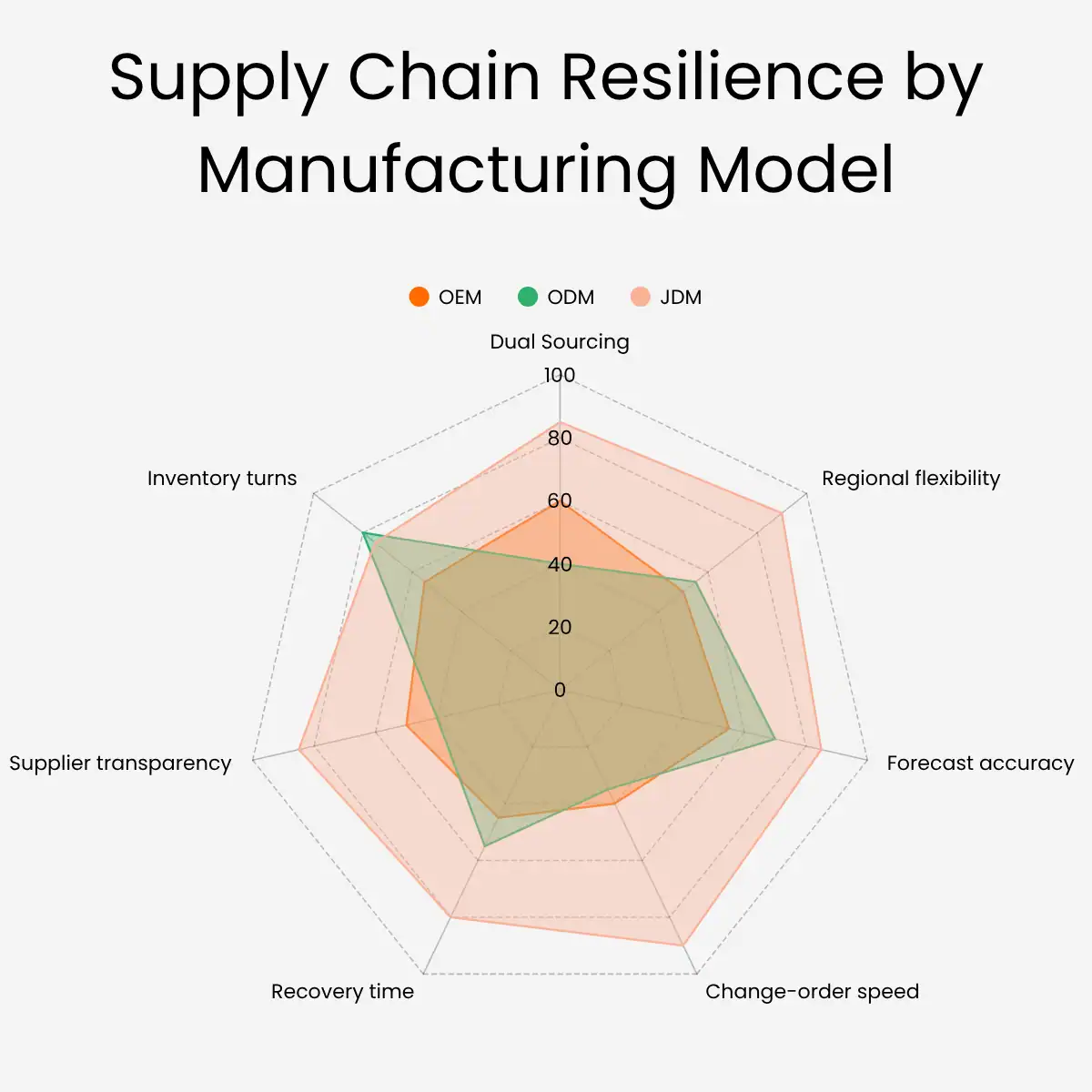
Companies with deeply integrated supplier relationships recover from disruption events 2 to 3 times faster than those operating arms-length contracts. The gap is widest in component shortages and geopolitical disruptions. — McKinsey Global Institute, Risk, Resilience, and Rebalancing in Global Value Chains (2020)
Future trends and considerations
Three trends are reshaping JDM right now.
The first is regionalization. Tariffs, geopolitics, and pandemic-era supply shocks have pushed brands toward partners who can build in multiple regions – not because cost arbitrage is dead, but because optionality has become the more valuable currency. JDM partners with footprints across Asia, Eastern Europe, and the Americas are increasingly the only ones in the conversation for serious programs.
The second is sustainability. Material sourcing, circular design, and end-of-life recovery are moving from CSR talking points to active design constraints. JDM is structurally better suited to this than OEM or ODM, because sustainability decisions are mostly design decisions, and JDM is the only model where the design conversation is genuinely shared.
The third is software-hardware convergence. Increasingly, the product is the software running on the hardware, and the hardware roadmap has to flex around software cycles. JDM partners with mature software-hardware integration capability are pulling ahead. The ones still operating as pure mechanical and electrical houses are slowly becoming irrelevant for the most interesting programs.
The takeaway is unromantic but useful. If you’re building hardware in 2026 and beyond, the question isn’t whether JDM is a good idea. It’s whether you’ve found a partner mature enough to do it properly, and whether your own organization is honest enough to meet them halfway.
Most aren’t. Which is exactly why the ones that are will keep eating everyone else’s lunch.
Explore more related content

USMCA Rules of Origin: A Practical Guide for Electronics OEMs (2026 Update)
USMCA Rules of Origin: A Practical Guide for Electronics OEMs (2026 Update) USMCA rules of origin used to be a...
Nearshoring vs Offshoring: How to Choose Your Manufacturing Footprint and EMS Partner
Nearshoring vs Offshoring: How to Choose Your Manufacturing Footprint and EMS PartnerNearshoring vs offshoring is...
Electronics Manufacturing in Mexico: A Buyer’s Guide to Nearshoring in 2026
Electronics Manufacturing in Mexico: A Buyer’s Guide to Nearshoring in 2026Electronics manufacturing in Mexico is no...
Follow us on
© Intretech Ltd. 2026. All Rights Reserved | 闽ICP备11015268号-1
 闽公网安备35020502001002号
Follow us on
© Intretech Ltd. 2026. All Rights Reserved | 闽ICP备11015268号-1
闽公网安备35020502001002号