

How to Choose the Right EMS Partner:
A Complete Guide for OEMs and Electronics Manufacturers


Electronics manufacturing services have become a central element of the global electronics supply chain, enabling OEMs to reduce costs, streamline production, and accelerate innovation.
Modern electronics manufacturing is a bit like Formula 1. The design matters, sure. But the team behind the machine? That’s what wins the race.
The right EMS partner can accelerate your time-to-market, stabilise your supply chain, and unlock engineering expertise you may not have internally. The wrong one can turn manufacturing into a constant operational headache.
Electronics Manufacturing Services (EMS) started as a simple outsourcing model. Today it’s something far more strategic. EMS providers now manage PCB assembly, component sourcing, global logistics, supply chain risk monitoring, and even engineering collaboration across the product lifecycle.
Choosing the right partner isn’t just a procurement decision. It’s a strategic one. This guide breaks down how the EMS industry works, what capabilities matter most, and how OEMs can evaluate partners with confidence.
This guide walks you through everything you need to know – from understanding the EMS business model to evaluating specific capabilities, supply chain risk tools, and supplier risk mitigation strategies so you can make a confident, informed decision.
What Is an EMS Partner? Definition and Role
Let’s start with the basics.
An electronic manufacturing services (EMS) partner is a company that provides outsourced electronics manufacturing services to original equipment manufacturers (OEMs). Rather than investing in their own production facilities, OEM customers contract with EMS providers to handle the physical manufacturing of their electronic products.
once you start working in the industry, the terminology gets messy fast. OEM, EMS, CEM, ODM, JDM – they get thrown around interchangeably, even though they mean different things.
Here’s the quick breakdown:
- OEM (Original Equipment Manufacturer): Designs and brands the product but outsources manufacturing.
- EMS (Electronics Manufacturing Services): Manufactures products to OEM specifications. Also known as CEM (Contract Electronics Manufacturer).
- ODM (Original Design Manufacturer): Designs and manufactures the product, which the OEM then rebrands.
- CMO (Contract Manufacturing Organization): Often used in medical or industrial contexts; similar to EMS.
- JDM (Joint Design Manufacturer): A collaborative model where the OEM and manufacturer work together to design the product. The OEM contributes product vision and requirements, while the manufacturer provides engineering expertise, design optimisation, and production know-how.
In practical terms, EMS electronics companies turn your design files into physical products at scale.
The best EMS electronic manufacturing partners do far more than just production. They support design for manufacturability, sourcing strategies, quality assurance, and long-term supply chain planning.
Which is why the relationship should feel less like outsourcing and more like a collaboration.
“Electronics Manufacturing Services providers account for approximately 42% of all electronics assembly worldwide.” – Business Wire
The EMS Industry Landscape
The EMS Industry Landscape
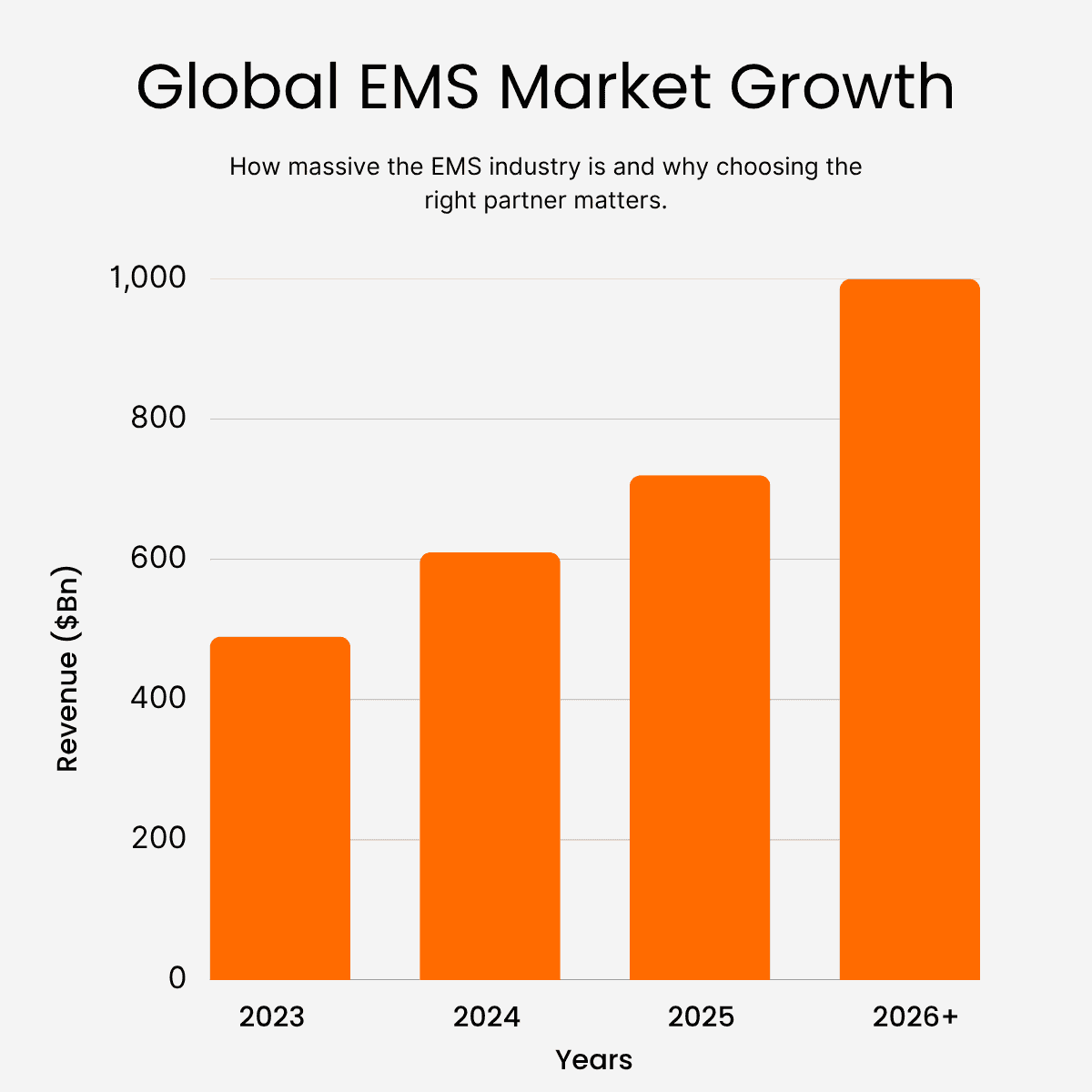
The EMS industry has quietly become one of the most important pillars of the global electronics manufacturing industry. Worth hundreds of billions of dollars annually, it supports everything from consumer electronics and industrial equipment to medical devices and aerospace systems.
In the electronic manufacturing services USA market alone, millions of workers and contributes trillions in economic value. The electronic manufacturing market includes massive global players – Foxconn, Flex, Jabil, Intretech, Celestica – alongside specialised regional providers serving niche industries.
But the industry is shifting.
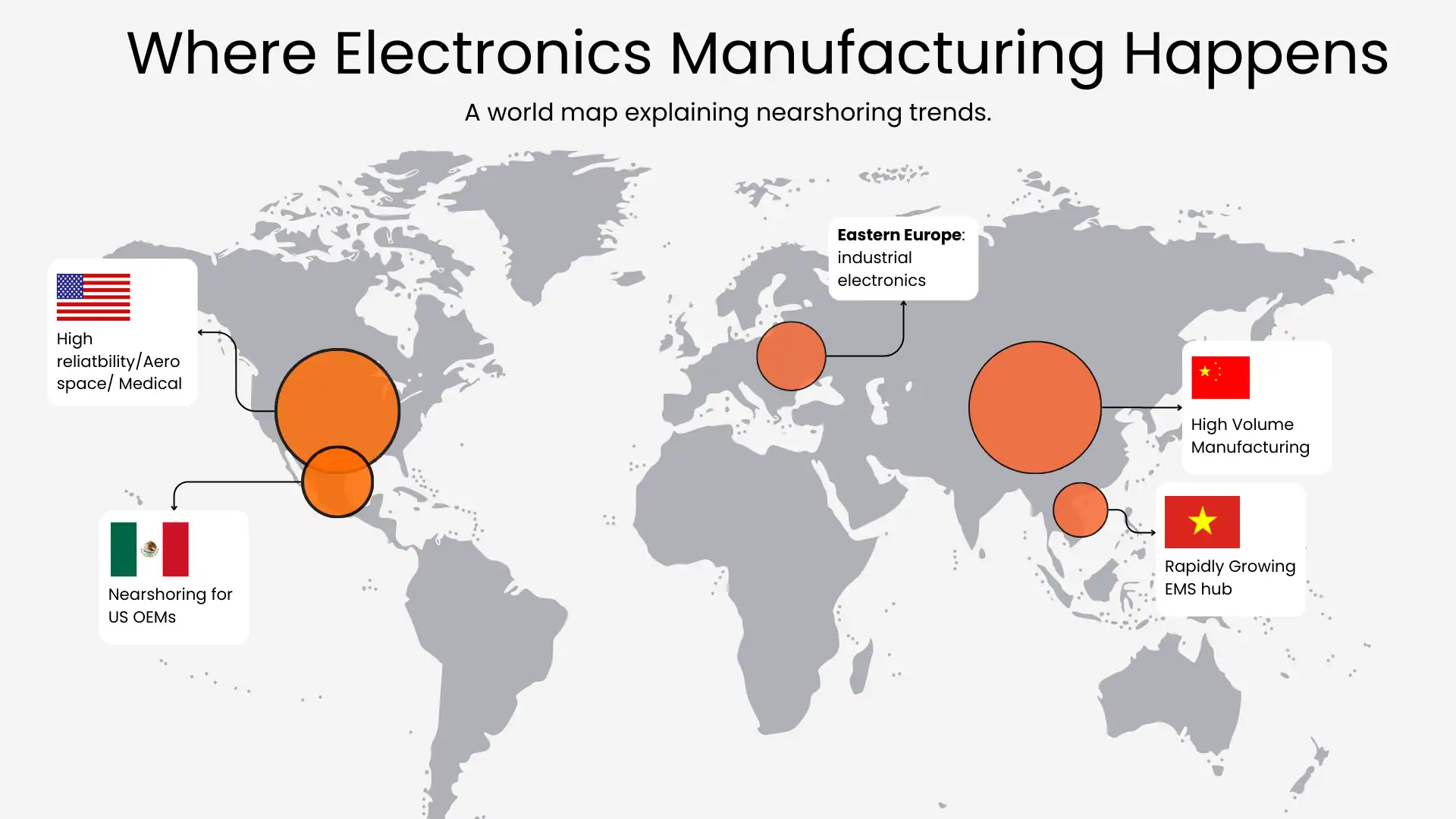
Several key trends are reshaping the EMS landscape today. Nearshoring and reshoring are growing rapidly, as OEMs de-risk their global supply chains by bringing production closer to home. Automation adoption is accelerating across EMS facilities, reducing labor dependency while improving quality. And the rise of electronics manufacturing services in the USA reflects a broader push for supply chain resilience after the disruptions of the last several years.
For OEMs selecting an EMS partner, understanding where that partner sits in this landscape – their size, regional footprint, customer mix, and market segment focus – is critical context for evaluating fit.
“The global Electronics Manufacturing Services (EMS) market reached roughly $626–654 billion in 2024 and is projected to exceed $1.1 trillion within the next decade.”
Core Services Your EMS Partner Should Offer
Not all EMS providers are created equal.
Some EMS providers specialise in high-volume production. Others focus on complex, low-volume assemblies. Some act as true partners across the lifecycle, while others are essentially contract factories.
So what should you expect from a strong EMS manufacturing company?
At minimum, a capable EMS contract manufacturing partner should offer:
- EMS Production & Assembly: Full PCB assembly, SMT (Surface Mount Technology), through-hole, and box build.
- EMS Contract Manufacturing: Turnkey and consignment models for varying levels of OEM involvement.
- Component Sourcing & Procurement: Direct access to electronic manufacturing suppliers and component brokers.
- Testing & Quality Assurance: ICT, functional testing, AOI, and X-ray inspection capabilities.
- Design for Manufacturability (DFM) Support: Engineering collaboration during the design phase to optimize for production.
- Logistics & Fulfillment: Order management, warehousing, and direct-to-customer shipping capabilities.
The strongest electronic manufacturing services companies can support you from prototype through full-scale production.
If your partner only appears once the design is finished, that’s not really a partnership.
That’s just production.
Contract Manufacturing & PCB Assembly Capabilities
For most OEMs, the real work of an EMS relationship happens in electronic contract manufacturing.
This is where designs become actual hardware.
Many companies evaluating electronic contract manufacturing companies start with one core capability: PCB assembly.
That includes:
- PCB contract manufacturing
- Contract PCB assembly
- Contract manufacturing PCB assembly
- PCBA contract manufacturer services
All of these essentially describe the same process: assembling components onto printed circuit boards to create functional electronics.
But strong industrial electronics contract manufacturing goes further than that.
When evaluating a partner’s contract manufacturing electronic assembly capabilities, look at:
- SMT line capacity and equipment generation (newer equipment = better accuracy and throughput).
- Support for both prototype runs and high-volume production without sacrificing quality.
- Certifications relevant to your industry (ISO 9001, AS9100 for aerospace, ISO 13485 for medical, ITAR for defense).
- Industrial electronics contract manufacturing experience if you serve industrial, automotive, or infrastructure markets.
- Contract electronics design support, including layout review, DFM guidance, and component library management.
Electronic contract manufacturing companies that specialize in complex assemblies will also offer electronic contract assembly services for cable harnesses, mechanical integration, and system-level build. This end-to-end capability is a major differentiator when you’re looking for a partner who can handle your full product – not just the board.
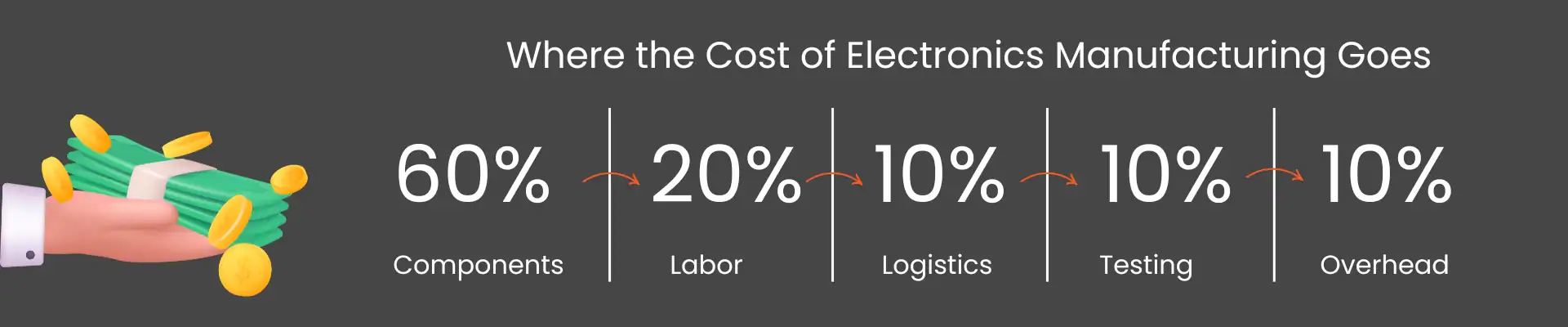
Modern electronic products can contain thousands of components sourced from suppliers across multiple countries, making supply chain coordination a critical capability for EMS providers.
Supply Chain Management in Electronics Manufacturing
One of the most underappreciated capabilities of a strong EMS partner is supply chain management. The electronic supply chain is complex, volatile, and increasingly global – and your EMS partner sits right at the intersection of all of it.
Supply chain management in the electronics industry involves managing the flow of electronic components from raw material suppliers through manufacturers to OEM customers. The impact of supply chain issues on the electronics market has been well documented: component shortages, long lead times, and price volatility can halt production, delay product launches, and erode margins.
A capable EMS partner should provide visibility into the electronics supply network – knowing where components are sourced, which electronic manufacturing suppliers they work with, and how they manage allocation during shortages. This is particularly important in the consumer electronics supply chain and global electronics industrial supply chains, where demand swings are sharp and lead times are long.
Key supply chain questions to ask your EMS partner:
- Do they have direct relationships with authorized distributors, or do they rely heavily on the spot market?
- How do they manage component obsolescence and last-time buys?
- What is their approach to consumer electronics SCM and buffer stock management?
- Can they provide real-time supply chain visibility through digital tools or dashboards?
- How do they handle single-source or sole-source components in the electronic components supply chain?
The best EMS partners treat electronic supply chain management as a proactive discipline, not a reactive one. They’re constantly monitoring the electronics supply network, building relationships with alternative suppliers, and using data to anticipate shortages before they become production stops.
“The complexity of global supply chains means that managing risk is no longer optional – t is a strategic necessity.”
— Gartner Supply Chain Research
Supply Chain Risk Management: What to Expect from Your EMS Partner
Supply chain risk management has become a board-level priority for most electronics OEMs. A sophisticated EMS partner doesn’t just manufacture your products – they actively help you identify, assess, and mitigate the risks embedded in your supply chain.
Supply chain risk management solutions encompass a wide range of tools and services, from supply chain risk assessment software and supply chain risk monitoring tools to specialized supply chain risk management services delivered by dedicated teams. Leading EMS companies invest in SCRM software and supply chain risk management tools that give OEMs real-time visibility into risk exposure across their supply base.
When evaluating your EMS partner’s risk management capabilities, look for:
- Supply Chain Risk Assessment Tools: Do they have digital platforms or dashboards that flag at-risk components, geopolitical disruptions, or supplier financial instability?
- Supply Chain Risk Solutions: Are there proactive programs in place for dual-sourcing, buffer stock, or supply diversification?
- Customizable Analytics: Some partners offer supply chain risk management solutions with customizable dashboards and analytics, enabling OEMs to monitor KPIs specific to their business.
- Logistics and Risk Management: Integration of logistics risk – including carrier reliability, customs exposure, and freight disruptions into their broader risk framework.
- Risk Management in Logistics and Transport: Coverage of last-mile and international transport risks, not just manufacturing risks.
The most forward-thinking EMS partners will also provide best supply chain risk management software recommendations and integrate SCRM software directly into their operational workflows – giving OEMs visibility without requiring them to build internal capabilities from scratch.
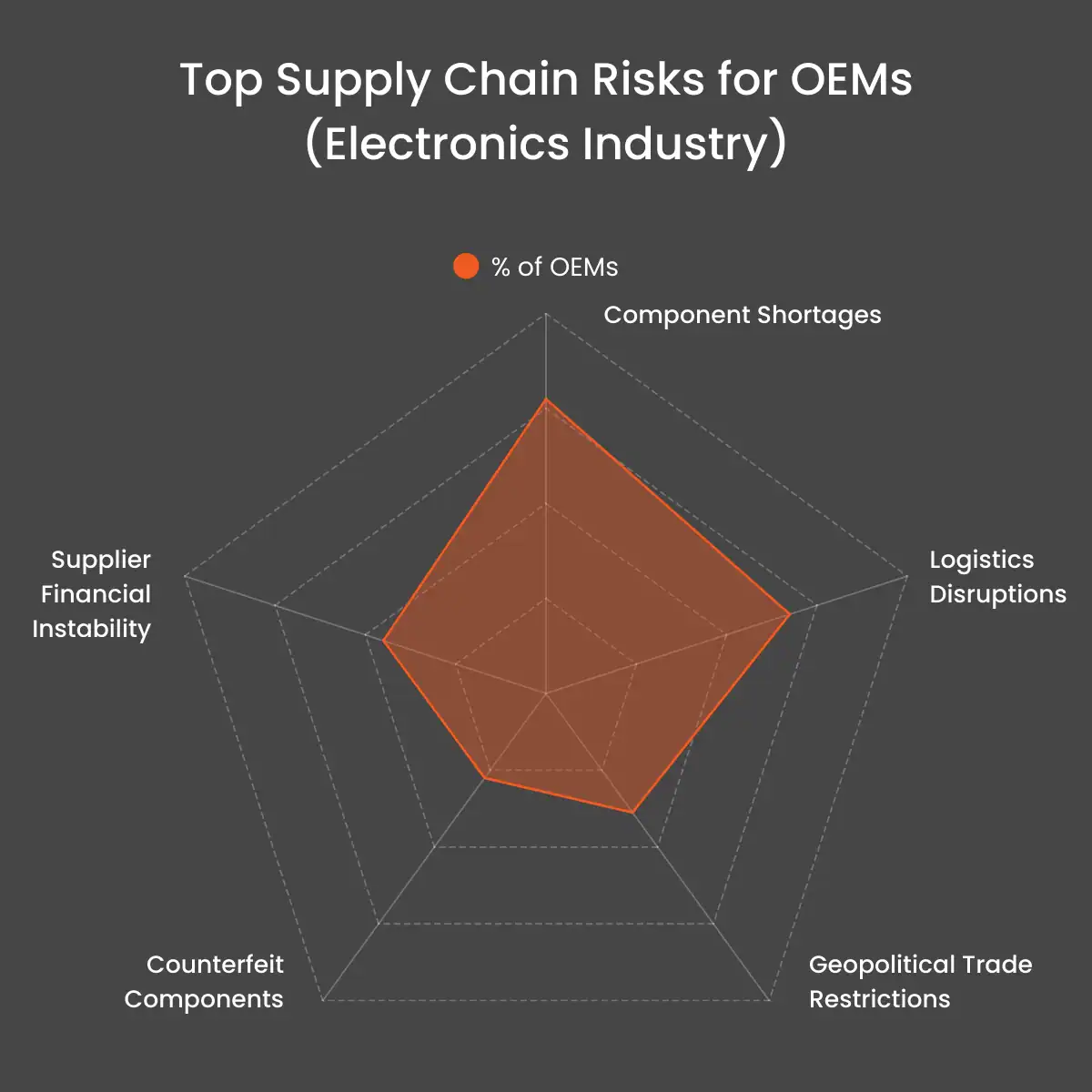
“Supply chains that are resilient are those that can adapt quickly to disruptions and recover faster than competitors.”
— Deloitte Global Supply Chain Insights
Supplier Risk Mitigation: Best Practices and Strategies
Supplier risk is one of the most significant and persistent challenges in electronics manufacturing. From single-source components to geopolitically concentrated manufacturing regions, the risks are real – and your EMS partner needs to have a clear strategy for managing them.
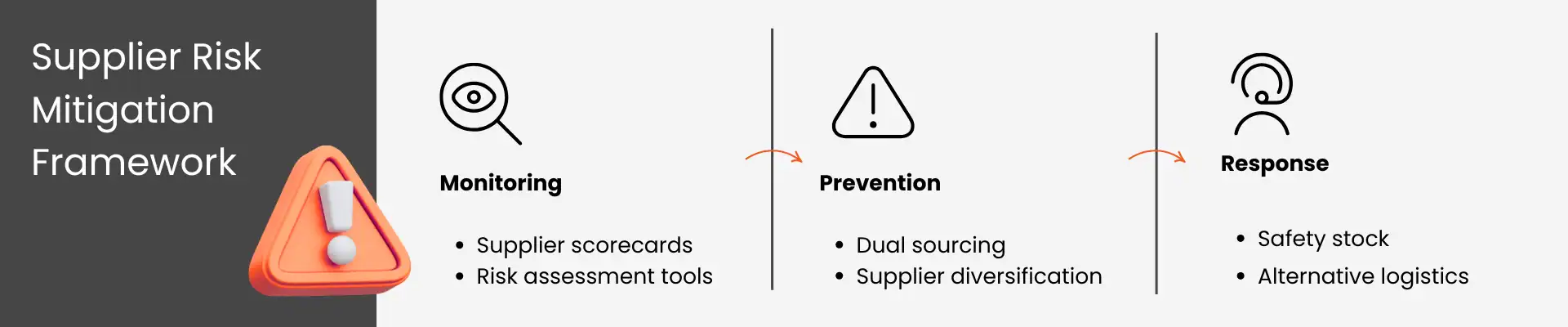
Effective supplier risk mitigation starts with supplier risk management in procurement – evaluating and qualifying suppliers before they enter your supply chain, not after a problem has already occurred. This includes financial health checks, on-site audits, quality certifications review, and geographic concentration analysis.
Supplier risk mitigation strategies that your EMS partner should have in place include:
- Dual and Multi-Sourcing: Qualifying secondary and tertiary suppliers for critical components to prevent single-source dependencies.
- Supplier Scorecards: Ongoing performance tracking that measures delivery, quality, and responsiveness – supplier risk management best practices at their most practical.
- Geopolitical Risk Monitoring: Awareness of supply chain risk management strategies against high supplier power, including tariff exposure, trade restrictions, and regional instability.
- Risk Mitigation Investments: Understanding the role of risk mitigation investments in modern supply chain strategies – including safety stock, strategic inventory, and supplier development programs.
- Supplier Development Programs: Active collaboration with key suppliers to improve their processes, financial stability, and capacity planning.
- Corrective Action Processes: Documented supplier risk mitigation workflows that kick in immediately when a supplier performance issue is detected.
A strong EMS partner will also incorporate supply chain risk tools that integrate supplier risk data into their ERP and MRP systems – allowing them to trigger automatic alerts when risk thresholds are breached and take proactive steps before a supply disruption becomes a production halt.
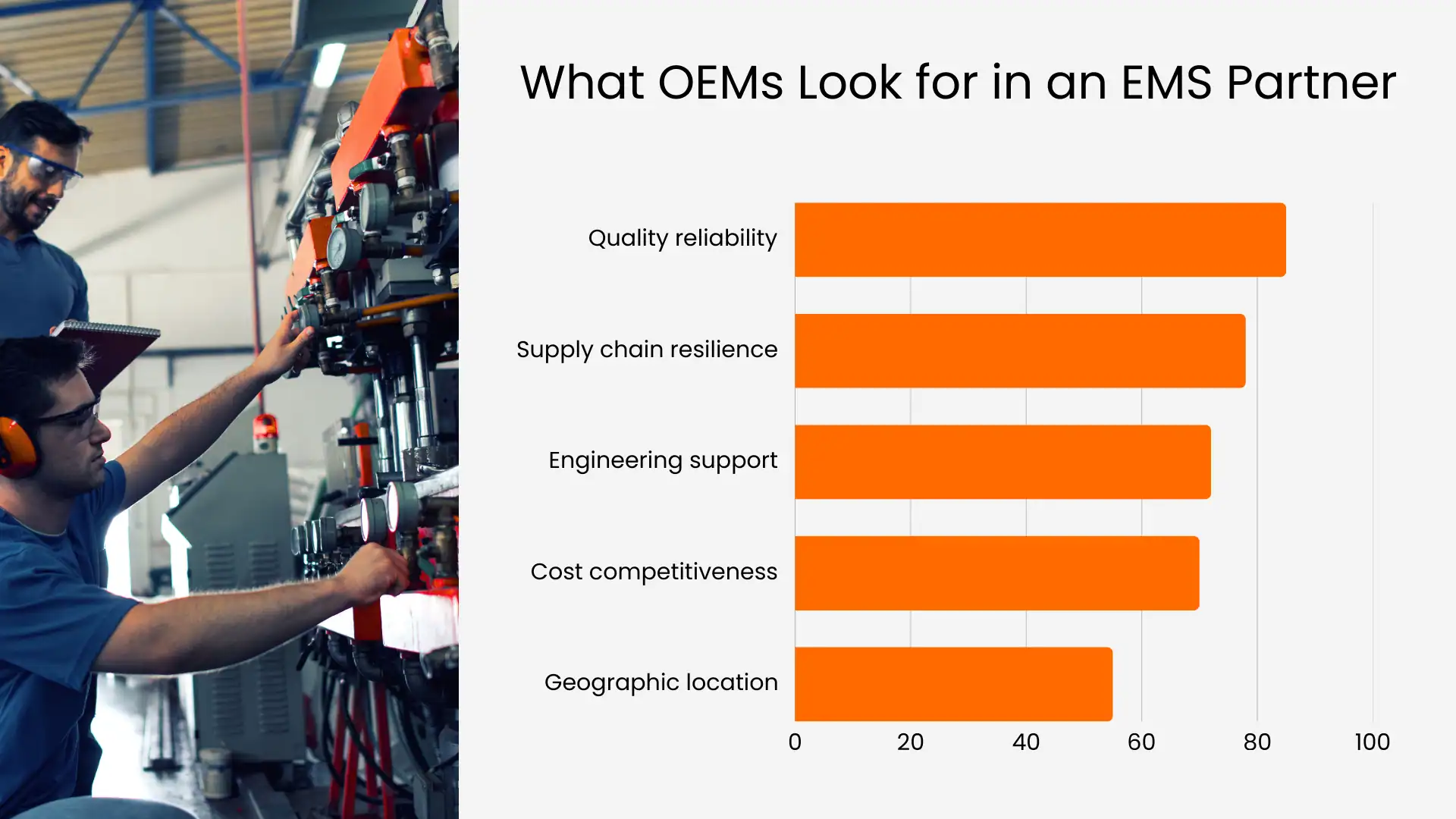
“Manufacturing partnerships allow companies to scale innovation while maintaining operational efficiency.”
— World Economic Forum, Advanced Manufacturing Report
How to Evaluate and Select Your EMS Partner
Choosing an EMS supplier is a strategic decision with long-term implications. A poorly matched EMS partner can create quality issues, cost overruns, supply disruptions, and communication breakdowns. A well-matched one becomes an extension of your own organization.
Here’s a practical framework for evaluating and selecting your electronic manufacturing services provider:
1. Define Your Requirements First
Before issuing an RFQ, document your volume range, complexity profile, certification requirements, target markets, and supply chain priorities. An EMS electronics company that’s great for high-volume consumer products may be a poor fit for low-volume, high-complexity industrial electronics.
2. Assess Technical Capabilities
Visit the facility. Evaluate equipment, process controls, and engineering depth. A genuine EMS electronic manufacturing service partner will welcome facility tours and engineering discussions – not just sales presentations.
3. Evaluate Supply Chain Strength
Ask detailed questions about their electronic manufacturing supplier network, component sourcing strategy, and supply chain risk management tools. A strong EMS provider for global operations will have robust answers – and ideally, references from customers who have navigated shortages successfully with their support.
4. Review Quality Systems
Request quality metrics: defect rates, on-time delivery performance, customer return rates, and audit results. For OEM customers in regulated industries, verify that the EMS manufacturing company holds appropriate certifications and has documented quality management processes.
5. Assess Communication and Transparency
How does the EMS production team communicate production status, issues, and changes? Do they offer online portals, regular business reviews, or dedicated account management? Transparency in communication is often the single biggest differentiator between a good and a great EMS partner.
6. Evaluate Cultural and Strategic Fit
Your EMS partner will be deeply embedded in your operations. Make sure their values, communication style, and long-term vision align with yours. The best EMS business relationships are partnerships – built on mutual investment in each other’s success.

“The most successful companies in the future will be those that integrate suppliers into their strategic thinking.”
— Michael Porter, Harvard Business School
Your EMS Partner Is a Strategic Asset
In the modern electronics industry, the question is no longer whether to use an EMS partner – it’s how to choose the right one. With global supply chains under constant pressure, component markets becoming increasingly volatile, and OEM customers demanding faster time-to-market, your EMS provider is one of the most consequential business relationships you’ll manage.
The right EMS partner brings more than manufacturing capacity – they bring supply chain intelligence, risk management expertise, engineering collaboration, and the operational discipline to scale with you. They help you navigate supplier risk mitigation, monitor your electronics supply network, and keep production running even when the market throws disruptions your way.
Use this guide as your evaluation framework. Ask hard questions, visit facilities, and look beyond price – because the cost of choosing the wrong EMS partner will always be higher than the cost of choosing the right one from the start.
Ready to Find Your EMS Partner?
If you’re evaluating EMS providers for your next product or looking to improve your existing manufacturing relationships, start with a clear internal brief – volume, complexity, certifications, supply chain priorities, then use the framework above to shortlist partners who can genuinely support your growth.
The right EMS partner isn’t just a vendor. They’re a competitive advantage.
If you’d like to explore how Intretech can support your electronics manufacturing, supply chain strategy, or product scaling, contact our team to start the conversation.
Explore more related content

The JDM Advantage: Build It Together or Pay for It Later
The JDM Advantage: Build It Together or Pay for It LaterJoint design manufacturing is how leading manufacturers build...

Strategic Global Sourcing: How Companies Move from Cost Saving to Competitive Advantage
Strategic Global Sourcing: How Companies Move from Cost Saving to Competitive AdvantageSupply chain disruptions now...

Critical Minerals, Critical Thinking: Building Resilient Electronics Supply Chains
Critical Minerals, Critical Thinking: Building Resilient Electronics Supply ChainsThe global economy is expected to...