

Manufacturing ERP in 2026:
Just Buying a Software or Investing in an Operational Fit?


Most ERP buying guides are written by people who’ve never set foot on a shop floor. This one isn’t. Here’s a no-fluff breakdown of what actually matters when selecting an ERP for a manufacturing operation and what the vendors don’t put in their brochures
The Software That Runs the Factory Floor
Let’s be blunt: most manufacturers are still running their operations on a patchwork of spreadsheets, legacy systems held together by institutional memory and the one guy named Dave who knows where all the skeletons are buried. That’s not a business — that’s a liability waiting to file a warranty claim.
Manufacturing ERP software exists to fix that. Enterprise Resource Planning systems designed for manufacturers bring production planning, inventory management, procurement, quality control, and financial reporting under one roof. They create the connective tissue between a sales order and a finished pallet walking out the dock door.
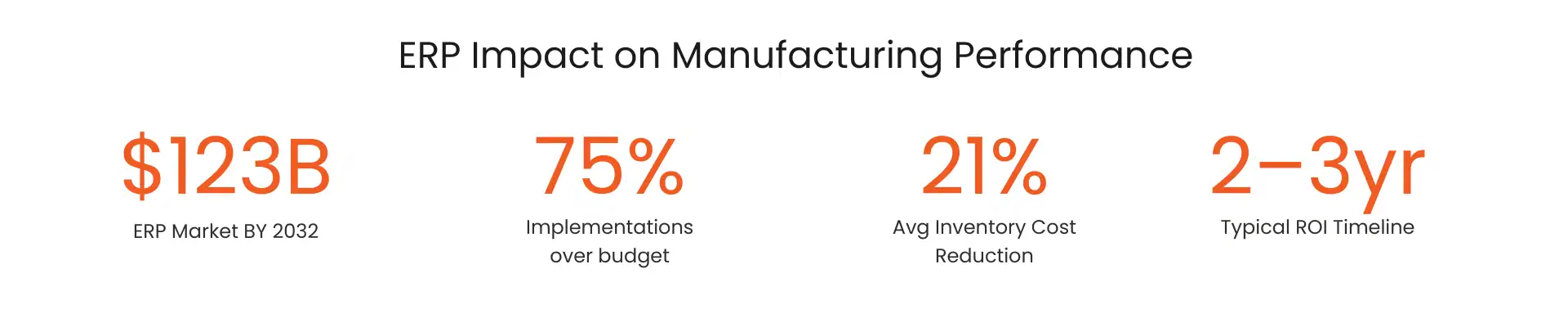
The global ERP software market was valued at $50.6 billion in 2023 and is projected to reach over $123 billion by 2032, according to Grand View Research. That’s not a trend. That’s a stampede.
But here’s the thing no one tells you: buying ERP is easy. Buying the right ERP — the one that actually fits how your facility operates, not how a software demo pretends it operates — is brutally hard. This guide exists to close that gap.
Why ERP Is Non-Negotiable in Manufacturing
Some industries can coast on disconnected systems. Manufacturing is not one of them. When your procurement team doesn’t know what your production scheduler promised, and your production scheduler doesn’t know what your warehouse actually holds, you get expedited freight, blown margins, and a customer service inbox that needs its own IT department.
ERP for the manufacturing industry solves the data silo problem at the root. According to a McKinsey Operations report, manufacturers with integrated digital operations platforms see up to a 30% reduction in conversion costs and a 20% improvement in OEE (Overall Equipment Effectiveness). That’s not pocket change. That’s the difference between your operation and your competitor’s.
Manufacturing enterprise resource planning isn’t just about digitization — it’s about operational intelligence. The plant managers who’ve made the transition describe it the same way: it’s the first time they actually knew what was happening in their facility in real time.
REALITY CHECK: A 2024 Panorama Consulting survey found that 75% of ERP implementations run over budget or over schedule — and the number one culprit wasn’t the software. It was poor requirements definition at the start. Read that twice before you open a vendor demo
Key Features to Look for in Manufacturing ERP Software
Here’s where most buying guides go wrong: they give you a list of 47 features and call it a day. We’re going to do something more useful — tell you which features actually move the needle and which ones are just checkbox theater for the sales pitch.
Core ERP Modules for Manufacturing
Think of these as the non-negotiables. If a vendor is light on any of these, walk away — politely, but firmly.
1. Inventory Management
Real-time stock visibility across locations, lot tracking, safety stock alerts, and cycle count support. If your ERP can’t tell you exactly what you have and where, it’s a spreadsheet with better graphics. The Aberdeen Group found that best-in-class manufacturers achieve 98%+ inventory accuracy — and virtually all of them credit ERP-driven cycle counting programs.
2. Production Planning & Scheduling
MRP/MPS capability, work order management, capacity planning, and shop floor scheduling — the heartbeat of any manufacturing ERP system. A capable system should let you run MRP simulations without a consultant on speed dial. Gartner’s Supply Chain Planning research consistently identifies real-time production visibility as the single highest-ROI ERP capability for manufacturers.
3. Quality Control
Non-conformance tracking, inspection plans, SPC integration, and supplier quality management. One recall event costs more than a decade of QC software subscriptions. Modern manufacturing ERP systems embed QC at every transaction — receiving inspection, in-process checks, final audit, and customer returns. If your vendor treats quality as a bolt-on module, that’s a red flag worth remembering.
4. Bills of Materials (BOM)
Multi-level BOM management, engineering change orders, and revision control. Your BOM is your product’s DNA — treat it like it. Engineering change orders without ERP discipline are how you end up building products to last year’s spec.
5. Procurement & Supply Chain
Vendor management, purchase order automation, lead time tracking, and three-way match for AP. The bridge between your suppliers and your shop floor. Without it, you’re flying blind on half your cost structure.
6. Costing & Financial Integration
Standard, actual, and job costing capabilities with real-time margin visibility. Know your true cost per unit — before the invoice, not after. If your ERP can’t tell you whether you made money on Job #8847 before you ship it, that’s a problem you can’t spreadsheet your way out of.
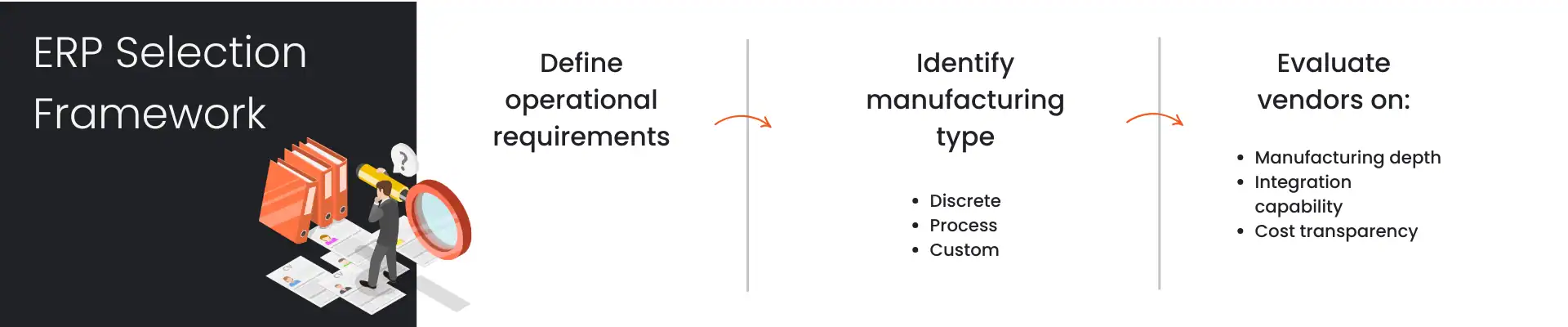
PRO TIP: Don’t let a discrete manufacturing ERP vendor tell you they can ‘configure’ their system to handle formula management. That’s like asking a plumber to rewire your electrical panel. Technically possible. Practically horrifying. For process manufacturing, the system needs to be built for it.
Industry-Specific Functionality: One Size Fits Nobody
Here’s the dirty secret of ERP vendors: most of them sell a horizontal platform and call it a manufacturing solution after adding a few shop floor widgets. That’s fine for some businesses. For others, it’s a disaster dressed as a software license.
Custom Manufacturing ERP Features
If you do custom, configure-to-order, or engineer-to-order manufacturing, your ERP needs to handle project-based costing, customer-specific BOMs, and quote-to-cash workflows. Standard ERP products built for repetitive manufacturing will fight you every step of the way.
Custom manufacturing ERP software should also support revision-controlled engineering documentation, direct integration with CAD/PDM systems, and milestone-based production scheduling. If a vendor can’t demo all three, they’re probably not your people.
Process Manufacturing ERP Solutions
Process manufacturers — think food & beverage, chemicals, pharmaceuticals, coatings — have a completely different set of requirements. The key differentiators for process manufacturing ERP include:
- Formula and recipe management with yield tracking
- Catch weight and variable quantity support
- Regulatory compliance features (FDA 21 CFR Part 11, FSMA, GMP)
- Batch record management and genealogy tracing
Shelf life, expiry date, and FEFO (First Expired, First Out) inventory logic - Co-product and by-product costing
Evaluating ERP Solutions for Manufacturing
Assessing Business Needs and Goals First
Before you talk to a single vendor, document your current-state pain points and your future-state requirements. Not the IT department’s requirements. Not finance’s wishlist. The operational requirements — from the production supervisors, the warehouse leads, the quality techs. They’re the ones who will either make your ERP sing or quietly find workarounds until the whole thing becomes shelf software.
Build a requirements matrix. Weight the must-haves separately from the nice-to-haves. If you can’t articulate why you need a feature, you probably don’t need it.
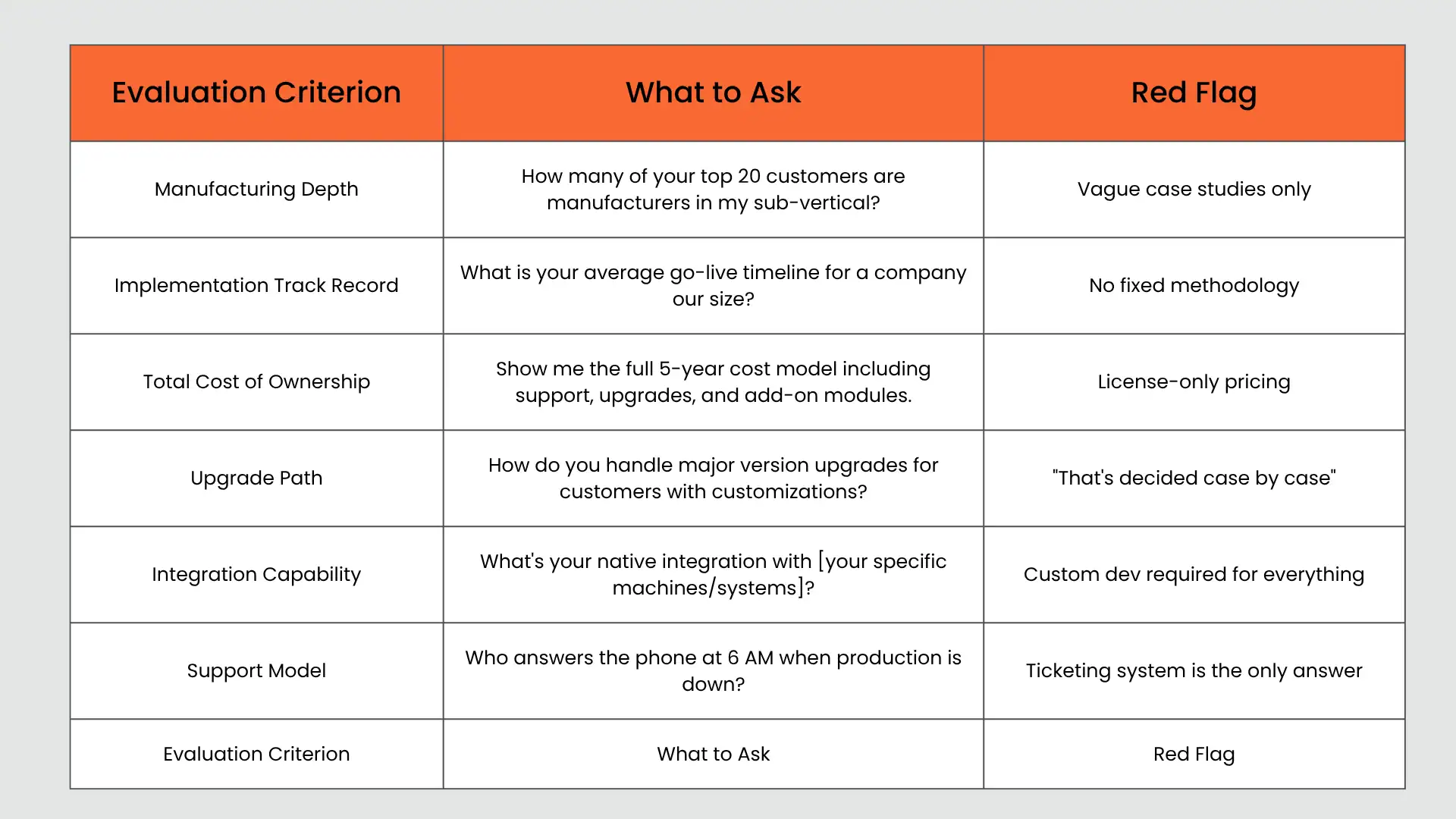
Vendor Comparison: What the Demos Won’t Show You
Every ERP vendor demo is optimized, scripted, and performed on the cleanest dataset you’ve ever seen. Your job during evaluation is to break it. Give them your messiest scenario. Ask them to handle your most unusual production workflow. Request references from companies in your industry, not a success story from a completely different vertical.
Top ERP Systems for Manufacturing: A Candid Look
We won’t rank them — rankings are marketing dressed as journalism. Instead, here’s an honest characterization of the major players.
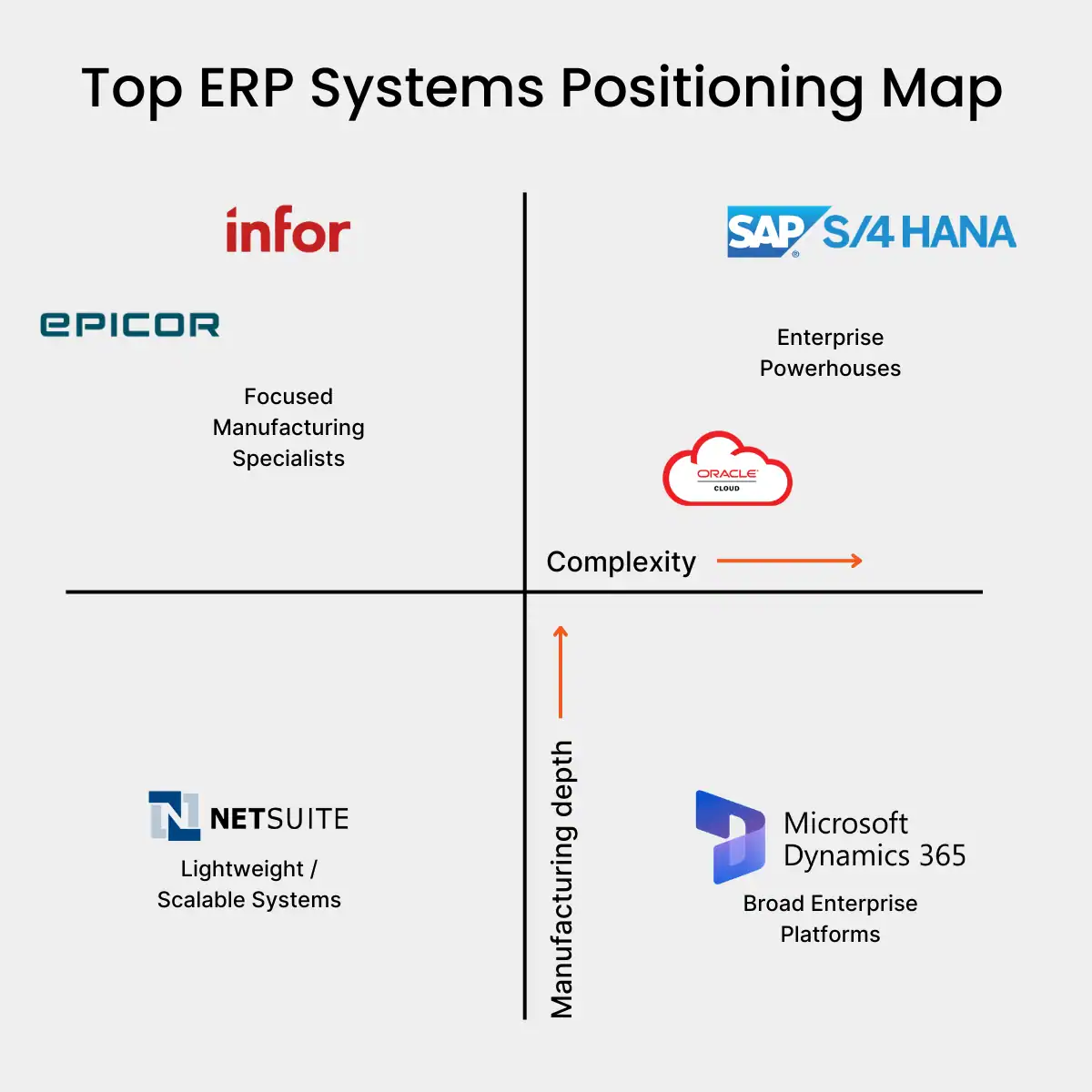
SAP S/4HANA is the enterprise standard. Extraordinarily capable. Extraordinarily complex. Best for large manufacturers with dedicated IT teams and patience measured in years, not months. (sap.com)
Oracle Cloud Manufacturing is SAP’s closest competitor for enterprise-scale deployments. Strong IoT integration roadmap. Prepare for a significant implementation investment.
NetSuite Manufacturing is the mid-market workhorse. Excellent financials with solid work order and inventory capabilities. Best for discrete manufacturers who need to scale without enterprise-level headaches. (netsuite.com)
Epicor Kinetic is purpose-built for manufacturers, particularly in industrial and automotive supply chains. Strong shop floor execution. Less flashy than SAP, more functional for most mid-size operations.
Infor CloudSuite Industrial deserves more attention than it gets. Deep manufacturing functionality with strong multi-site capability. Excellent for complex discrete and mixed-mode environments.
“The best ERP is the one your team will actually use correctly, consistently, two years after go-live.”
Implementation Considerations: Where Projects Go to Die
You can buy the best manufacturing ERP in the world and still make a mess of it. Implementation is where 75% of horror stories are born — not in the software, but in the execution.
ERP Implementation Steps
1. Scope & Requirements Definition
Document every business process that will touch the ERP before anyone writes a contract. Include your exceptions and edge cases. Vendors sell you on the 80% — the 20% is where implementations stall.
2. Data Cleansing & Migration Planning
Your data is dirtier than you think. Bad data in a new ERP is worse than bad data in a legacy system because it moves faster and touches more processes. Allocate real time here — not an afterthought Friday afternoon sprint.
3. Configuration & Customization (With Restraint)
Configure to fit your business. Customize only when there is no other option. Every customization is a future upgrade tax. Respect the standard functionality — it exists because someone else already learned that lesson the hard way.
4. Testing — All of It
Unit testing, integration testing, UAT, parallel runs. Test your worst-case scenarios, not just your typical order flow. The system that fails at month-end close will find you at the worst possible moment.
5. Training & Change Management
This is the most under-resourced phase in virtually every ERP project. Train people in the context of their actual job, not generic system walkthroughs. Change management is not a soft skill — it’s the difference between adoption and abandonment.
6. Go-Live & Hypercare
Plan for a hypercare period of 30–90 days post-go-live with dedicated support resources. Every major ERP deployment has go-live turbulence. The difference between a success story and a war story is how the team responds to it.
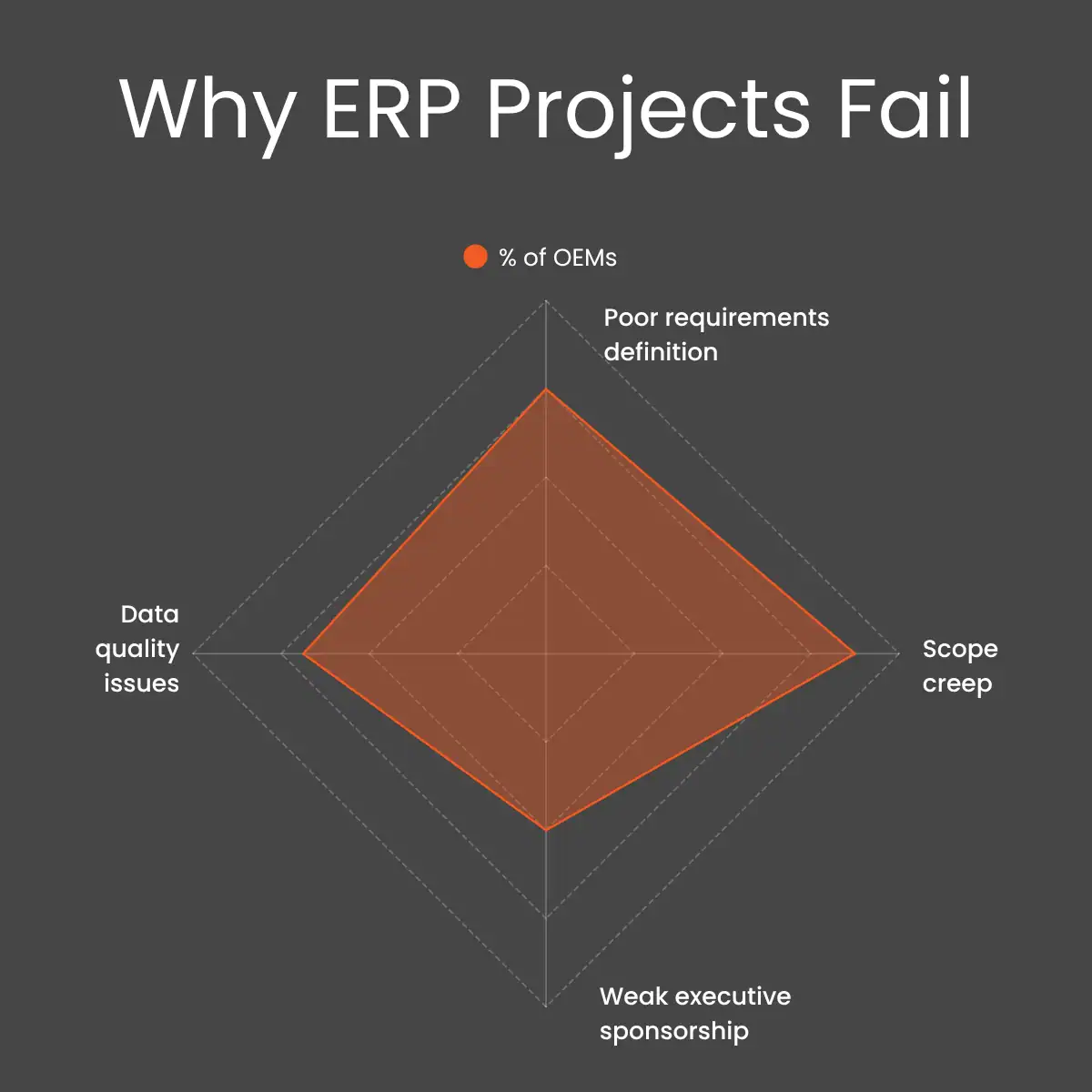
COMMON CHALLENGE: Based on Panorama Consulting’s 2024 ERP Report, the top failure drivers are: insufficient executive sponsorship, scope creep without budget adjustment, underestimating data migration complexity, and choosing the go-live date based on fiscal year timing rather than operational readiness. Nothing like launching a new ERP three weeks before your biggest shipping season because the CFO wanted it done by December 31st.
Best Practices for Successful ERP Deployment
- Assign a dedicated internal project manager — not a part-time volunteer
- Establish a formal steering committee with decision-making authority
- Freeze major business process changes during implementation
- Build a realistic contingency budget (typically 20–30% of software cost)
- Define success metrics before go-live, not after
- Plan for parallel operations during cutover — not just a hard switch
- Engage super-users in every department and empower them before launch
Future-Proofing Your ERP Choice
The ERP you choose today needs to still make sense in 2030. That’s not a guarantee you can get from a vendor, but it’s a standard you can apply to your evaluation.
Scalability and Cloud-Based Solutions
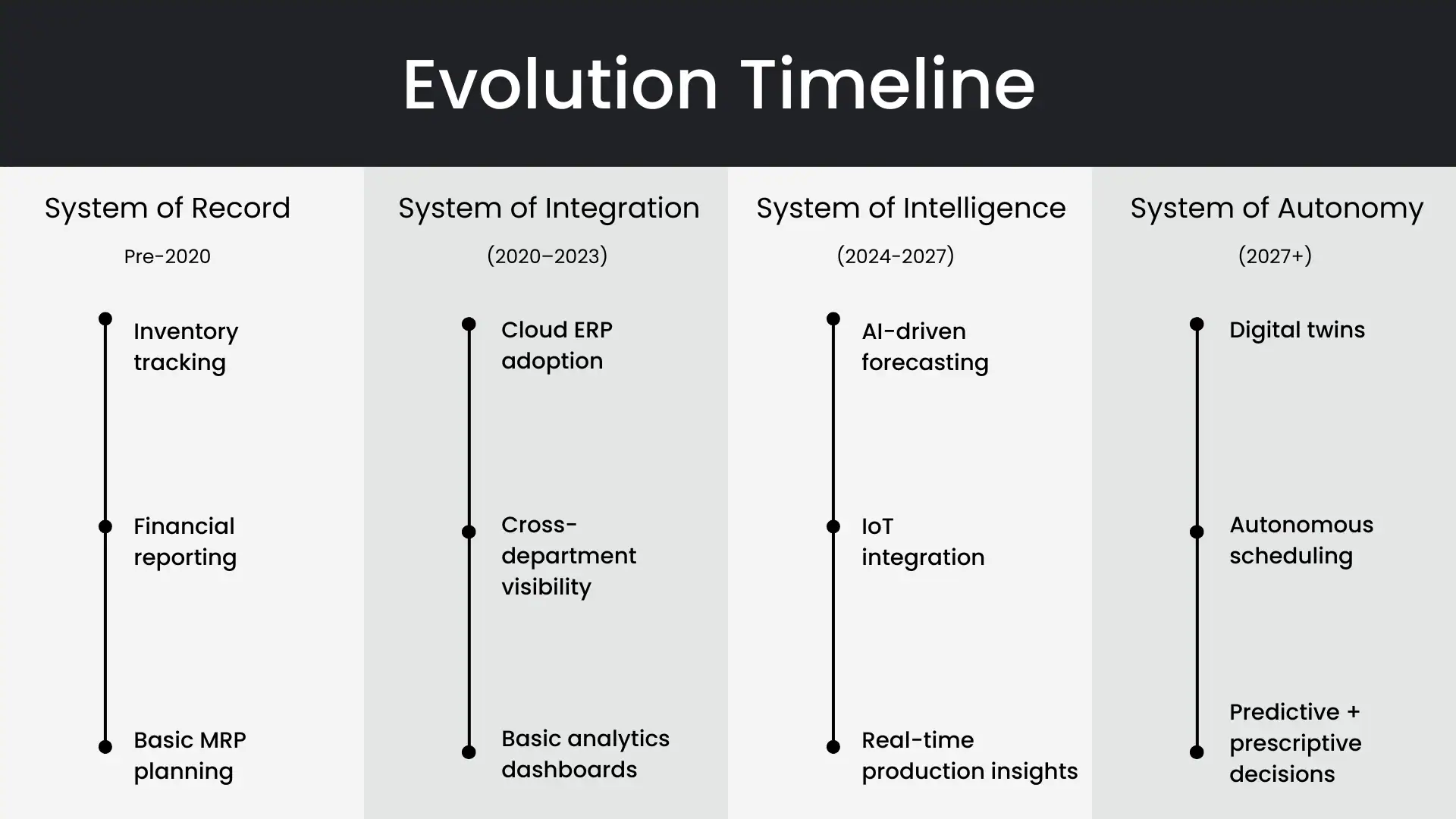
Cloud ERP for manufacturing has crossed the tipping point. According to IDC’s 2024 Manufacturing Cloud Report, over 60% of net-new ERP deployments in manufacturing are now cloud or SaaS-based. The shift isn’t just about infrastructure cost — it’s about continuous updates, elastic scalability, and anywhere-access for a workforce that increasingly operates across distributed facilities.
Cloud ERP eliminates the upgrade nightmare. With a traditional on-premise system, major version upgrades are $500K+ projects. With cloud ERP, you’re always on the current version. That alignment of incentives is something on-premise models never had.
Technology Trends in ERP for Manufacturing
AI-Driven Demand Forecasting. Modern ERP platforms are embedding machine learning into demand planning, moving from statistical forecasting to models that incorporate external signals — weather, market trends, supplier lead times — in real time. Gartner projects that by 2027, AI-embedded supply chain planning will be the default, not a premium feature.
IoT Integration and Shop Floor Intelligence. The gap between the ERP system and the physical machine is closing. OPC-UA connected machines feeding real-time production data into ERP is no longer a pilot project — it’s a competitive baseline in industries like automotive and aerospace components.
Digital Twins. Manufacturers using digital twin models linked to their ERP can simulate production scenarios, run capacity analyses, and test schedule changes without touching the live environment. The technology is here; adoption is still in its early majority phase.
Sustainability Reporting Integration. With the SEC’s climate disclosure rules and EU CSRD requirements landing on manufacturers’ desks, ERP systems that can’t track and report Scope 1, 2, and 3 emissions at the product level will become a compliance liability. Pick a platform with an ESG roadmap, not just a checkbox.
The best ERP for manufacturing isn’t the one with the most features, the biggest brand name, or the lowest license cost. It’s the one that fits your operation, gets adopted by your team, and still serves you well when your production volume is three times what it is today. Hold vendors to that standard.
Making the Right Call for ERP in Production
Here’s the summary, minus the soft-focus closing paragraph most guides give you:
Manufacturing ERP software is not a technology decision. It’s an operational strategy decision that happens to involve technology. Get the strategy right first — understand your business processes deeply, document your requirements honestly, and evaluate vendors against your actual operation — and the technology choice becomes significantly easier.
The manufacturers who struggle with ERP are almost always the ones who let vendors define their requirements for them. The ones who succeed are the ones who walked into the evaluation process knowing exactly what they needed, what they could compromise on, and what was absolutely non-negotiable.
Now close this tab and go document your business requirements. We’ll be here when you need us.
SOURCES & REFERENCES
- Grand View Research — ERP Software Market Size Report, 2024
- Panorama Consulting — 2024 ERP Report: Lessons from 1,000+ Implementations
- Gartner — Supply Chain Planning Systems Research, 2024
- McKinsey & Company — Operations & Digital Manufacturing Insights
- Deloitte — Industry 4.0: Aligning Manufacturing Transformation
- Aberdeen Group — Supply Chain Management Research, Manufacturing Inventory Accuracy Benchmarks
- IDC — Manufacturing Cloud ERP Adoption Report, 2024
- NetSuite — What Is Manufacturing ERP Software? A Complete Guide
- Infor — What is Manufacturing ERP Software?
Explore more related content
USMCA Rules of Origin: A Practical Guide for Electronics OEMs (2026 Update)
USMCA Rules of Origin: A Practical Guide for Electronics OEMs (2026 Update) USMCA rules of origin used to be a...
Nearshoring vs Offshoring: How to Choose Your Manufacturing Footprint and EMS Partner
Nearshoring vs Offshoring: How to Choose Your Manufacturing Footprint and EMS PartnerNearshoring vs offshoring is...
Electronics Manufacturing in Mexico: A Buyer’s Guide to Nearshoring in 2026
Electronics Manufacturing in Mexico: A Buyer’s Guide to Nearshoring in 2026Electronics manufacturing in Mexico is no...