

7 Key Benefits of AI in Manufacturing That Will Revolutionize Your Business


Does AI actually work in manufacturing? We cut through the hype and look at what’s delivering real results.
Let’s get something out of the way first: most manufacturers aren’t falling behind because they lack ambition. They’re falling behind because they’re running 21st-century operations on 20th-century logic.
Spreadsheets tracking downtime. Supervisors walking the floor to spot bottlenecks. Quality checks done by eye. Maintenance schedules based on gut feel rather than actual machine data. Sound familiar?
Here’s what that costs you: unplanned downtime alone drains manufacturers of an estimated $50 billion every year, according to Deloitte. And that’s just one line item. Throw in scrap waste, rework, overstaffing in the wrong areas, and supply chain misalignment — and you’ve got a profitability problem that traditional process improvement can’t fully fix.
Artificial intelligence in manufacturing isn’t hype. It’s already working — quietly, measurably, and in ways your competitors may already be deploying. This post breaks down the seven benefits of AI in manufacturing that are actually moving the needle, what they look like in practice, and what it means for manufacturers who haven’t acted yet.
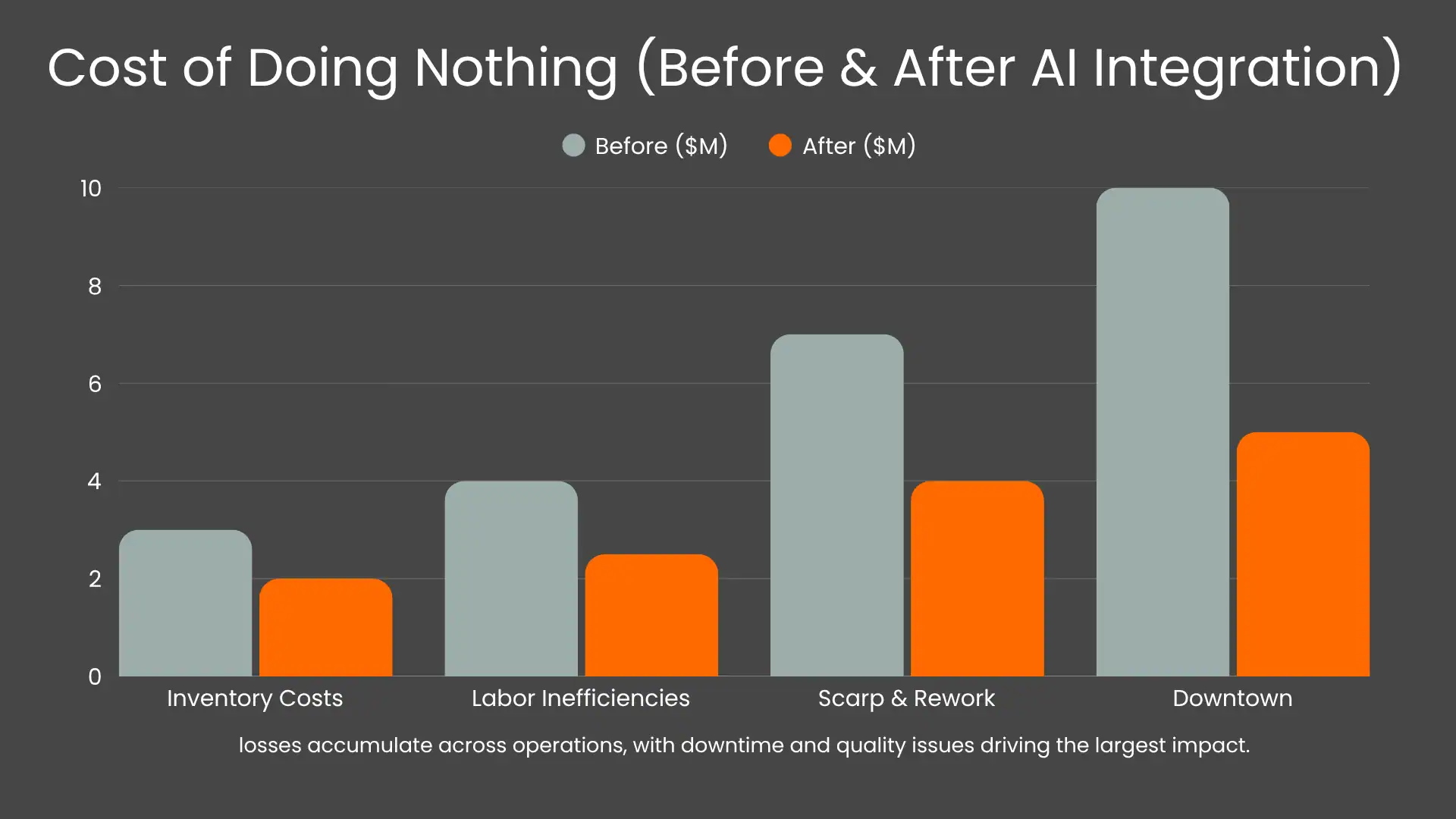
“The biggest risk is not failing to adopt AI; it’s underestimating the cost of staying the same.” — McKinsey
Overview of AI in Industrial Automation
What is AI in Production?
AI in production refers to the use of machine learning algorithms, computer vision, robotics, and predictive analytics to make manufacturing processes faster, smarter, and more autonomous. It’s not about replacing your workforce wholesale — that’s a lazy take. It’s about giving your operations the ability to learn, adapt, and self-correct in ways that humans, at scale, simply can’t keep up with.
Think of it this way: your most experienced plant manager has 20 years of pattern recognition built up in their head. AI can codify those patterns across every machine, every shift, every facility — simultaneously — and act on them in milliseconds.
That’s not a threat to your people. That’s leverage.
Machine Learning in Manufacturing
Machine learning (ML) is the engine driving most of what’s valuable in AI for manufacturing today. ML models ingest operational data — sensor readings, production logs, defect reports, equipment performance metrics — and identify patterns that predict outcomes.
What kind of outcomes? Things like: which machine is going to fail next week, which product batches are trending toward defect thresholds, which supplier delays are likely to cascade into line stoppages. The more data these models see, the sharper their predictions get.
The result is an operation that gets smarter over time, not just more efficient on paper.

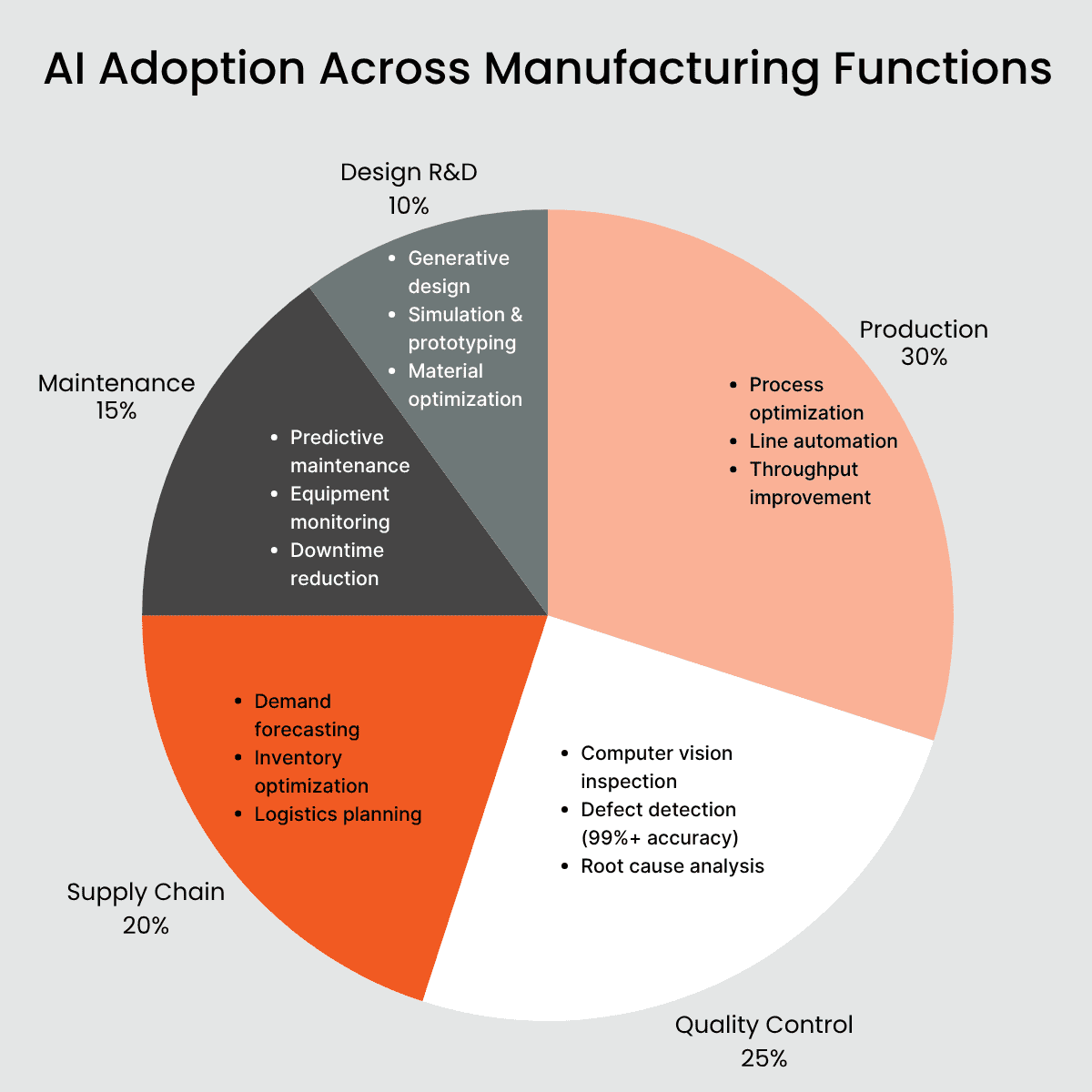
By 2025, over 70% of manufacturers are expected to adopt AI in at least one core function.” — McKinsey
Benefits of Artificial Intelligence in Manufacturing
1. Automation of Routine Tasks
Here’s the uncomfortable truth about manual processes: they’re not just slow — they’re a drain on the people doing them. Repetitive, low-judgment tasks sap skilled workers of the bandwidth they should be spending on actual problem-solving.
AI-driven automation handles the repetitive heavy lifting: parts sorting, quality inspections, data entry, inventory updates, packaging, and logistics coordination. Modern industrial robots powered by computer vision can now differentiate between product variations, adjust grip pressure on the fly, and operate without stopping for shift changes.
The payoff is real. Manufacturers deploying AI-powered automation consistently report 30–40% reductions in labor costs for routine task execution — and more importantly, they redirect skilled workers toward higher-value work.
This isn’t automation as elimination. It’s automation as elevation.
2. Improvement in Production Speed
Speed in manufacturing isn’t just about running machines faster. It’s about removing the hidden delays — the bottlenecks that don’t show up on a production report but quietly strangle throughput.
AI in industrial automation identifies those chokepoints before they become crises. Real-time process monitoring tracks output velocity across every stage of the line. When a slowdown emerges — a machine running below optimal RPM, a workstation creating a queue — AI systems flag it instantly and, in many cases, reroute workflow automatically.
BMW reported a 25% reduction in production time after integrating AI-driven process optimization into its manufacturing lines. That’s not a marginal gain. That’s a structural advantage.
Fast production also means faster go-to-market. In industries where product cycles are shortening, speed isn’t a nice-to-have — it’s a competitive moat.
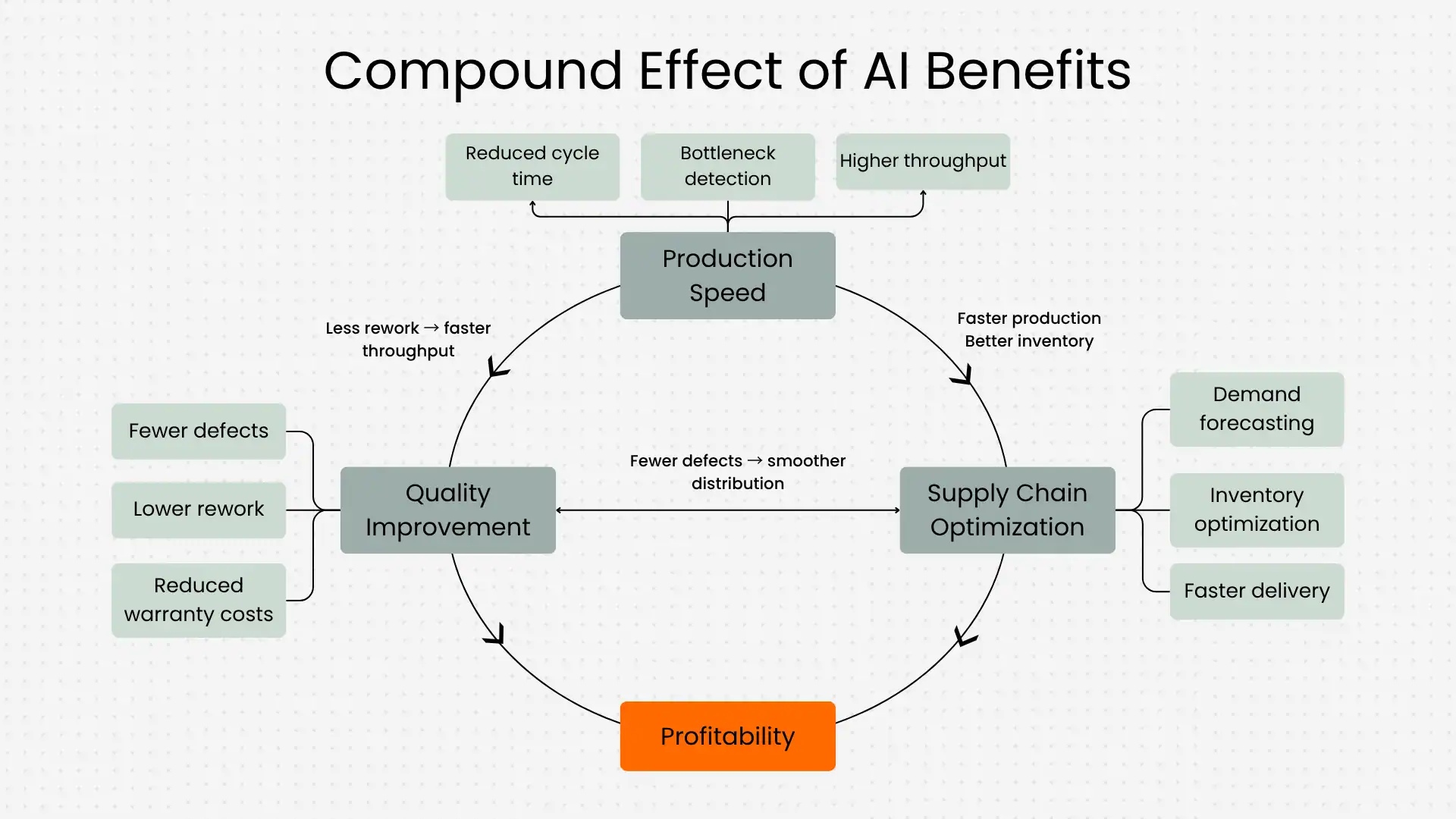
Quality is not inspected in, it is built into the process through data and intelligence.” — W. Edwards Deming
3. Reduction of Human Error
Let’s be real: humans are inconsistent. Not because people aren’t skilled or motivated — but because fatigue, distraction, and process variation are unavoidable at scale. One missed inspection, one miscalibrated measurement, one overlooked parameter can result in a batch recall that costs more than an entire quarter’s margin.
AI doesn’t get tired. It doesn’t have an off day.
AI-powered quality control systems using computer vision can inspect thousands of units per hour with sub-millimeter precision — catching defects that a human eye, even under ideal conditions, would miss. The best systems flag anomalies, log them with imagery, and trace them back to the specific machine or process parameter that caused them.
Manufacturers using AI for quality inspection report defect detection accuracy above 99% — compared to the industry average of 80–85% for manual inspection. That gap is the difference between a warranty claim and a brand reputation.
4. Enhanced Safety Measures
Manufacturing is still one of the most dangerous industries to work in. The U.S. Bureau of Labor Statistics recorded over 340,000 workplace injuries in manufacturing in a recent year. Most of them were preventable.
AI changes the safety equation by predicting risk rather than reacting to it. Computer vision systems monitor floors for unsafe behaviors — workers in restricted zones, improper PPE, near-miss events — and trigger alerts before incidents occur. Predictive analytics flag equipment that’s approaching failure before it creates a hazardous situation.
Wearables integrated with AI platforms can monitor worker fatigue, heat stress, and ergonomic risk in real time, enabling supervisors to intervene before a 12-hour shift becomes a liability.
Safety isn’t just a moral obligation. It’s a financial one — OSHA estimates that workplace injuries cost U.S. employers $170 billion annually. AI is the most scalable investment available to reduce that exposure.
The safest factory is one that predicts risk before it happens.” — WEF
AI Tools for Manufacturing
5. Real-Time Data Analysis
Here’s where most manufacturers are leaving serious money on the table: they’re collecting data, but they’re not acting on it fast enough to matter.
Production data that gets reviewed in a weekly report is historical. It tells you what happened. Real-time AI analytics tell you what’s happening right now — and what’s about to happen if you don’t intervene.
AI-powered dashboards aggregate data from IoT sensors, ERP systems, MES platforms, and supply chain feeds, then surface insights that are actually actionable. Not just charts — recommendations. “This machine’s vibration signature suggests bearing wear — schedule maintenance in the next 72 hours.” “Your current production rate creates a 94% probability of missing the Tuesday shipment — here are three ways to close the gap.”
That’s the difference between data and intelligence. Manufacturers who close that gap make better decisions faster — and that compounds over time.
6. Innovations in Design and Fabrication
AI isn’t just optimizing existing manufacturing processes — it’s changing how products get designed in the first place.
Generative AI tools for design allow engineers to input performance requirements and constraints, then let algorithms generate hundreds of optimized design iterations in hours. What used to take weeks of CAD work and prototyping now takes days. The output? Lighter components, more structurally efficient geometries, designs that are inherently easier to manufacture at scale.
Airbus used AI-generated design to create a partition for the A320 that was 45% lighter than its predecessor while maintaining full structural integrity. That kind of result isn’t achievable through conventional design iteration alone.
In fabrication, AI-driven CNC systems and additive manufacturing platforms continuously self-calibrate to maintain tolerances, reducing scrap and improving surface finish consistency. The machine learns from every run and gets better.
AI-driven supply chain optimization is another dimension of this — using AI to dynamically route procurement, adjust production schedules, and reduce inventory holding costs based on real-time demand signals.
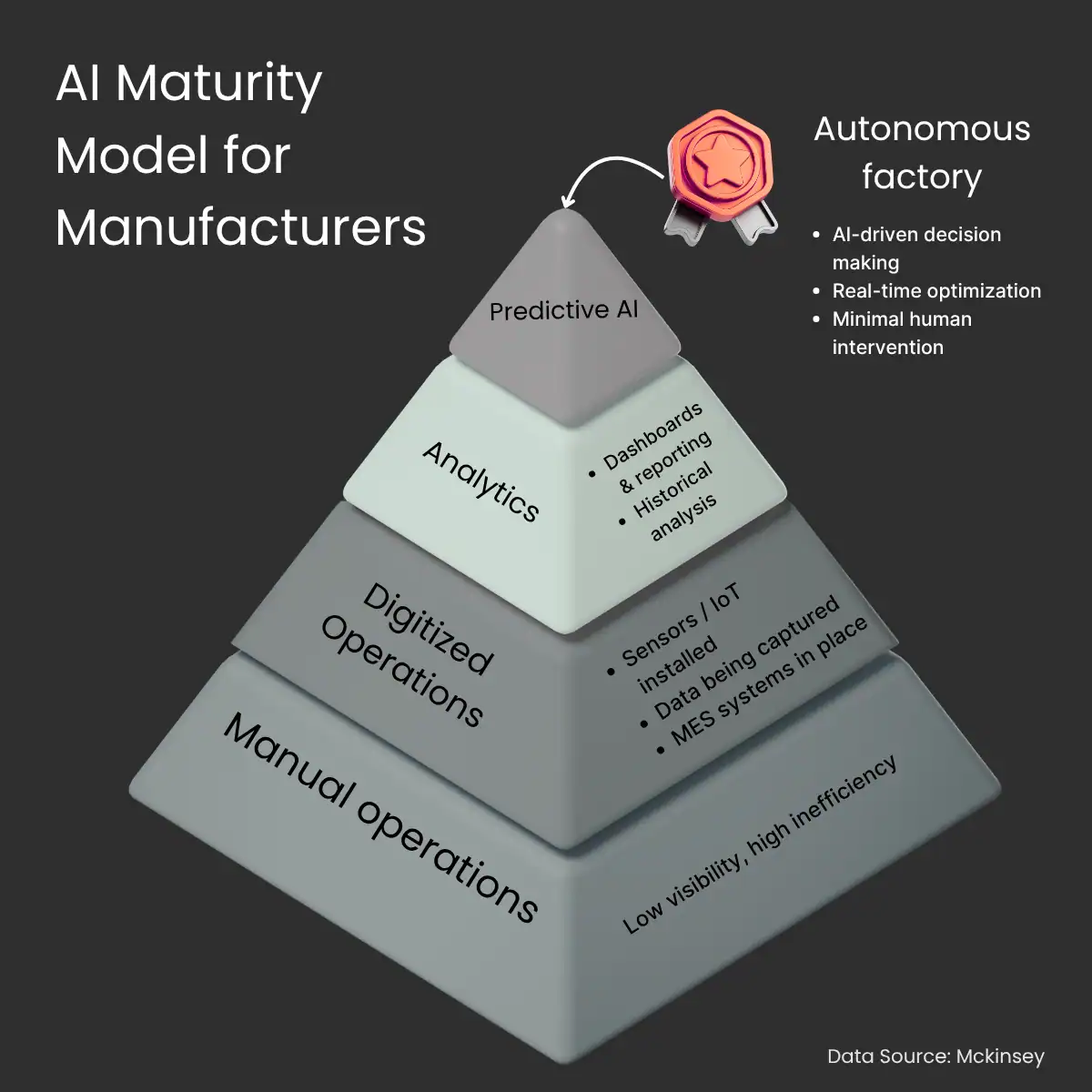
Most manufacturers remain in early stages of digital maturity, with fewer than 30% scaling AI across operations.
Case Studies: AI in Manufacturing Examples
Successful Applications of AI
Predictive Maintenance at Siemens
Siemens deployed AI-powered predictive maintenance across its Amberg electronics plant — one of the most automated manufacturing facilities in the world. The result: a 99.9988% quality rate, with AI flagging potential equipment failures weeks in advance. Unplanned downtime dropped significantly. The plant runs more than 75% autonomously.
Quality Control at BMW
BMW’s AI vision inspection systems scan every vehicle body for defects down to 0.1mm — something no human inspection line can replicate at production speed. The system has reduced paint and body defects by over 90% in facilities where it’s deployed.
Supply Chain Optimization at Procter & Gamble
P&G uses AI-driven supply chain optimization to dynamically adjust production planning based on demand signals from retail partners. The result: significant reduction in overproduction, lower inventory write-offs, and faster response to demand shifts — a particularly critical capability during the supply chain disruptions of recent years.
Generative Design at General Motors
GM partnered with Autodesk to use generative AI design to redesign a seat bracket. The new component was 40% lighter and 20% stronger than the original — and consolidated eight separate parts into one, simplifying assembly.
These aren’t pilot programs. These are at-scale deployments delivering measurable ROI. The question is no longer whether AI works in manufacturing. The question is how far behind you can afford to fall.
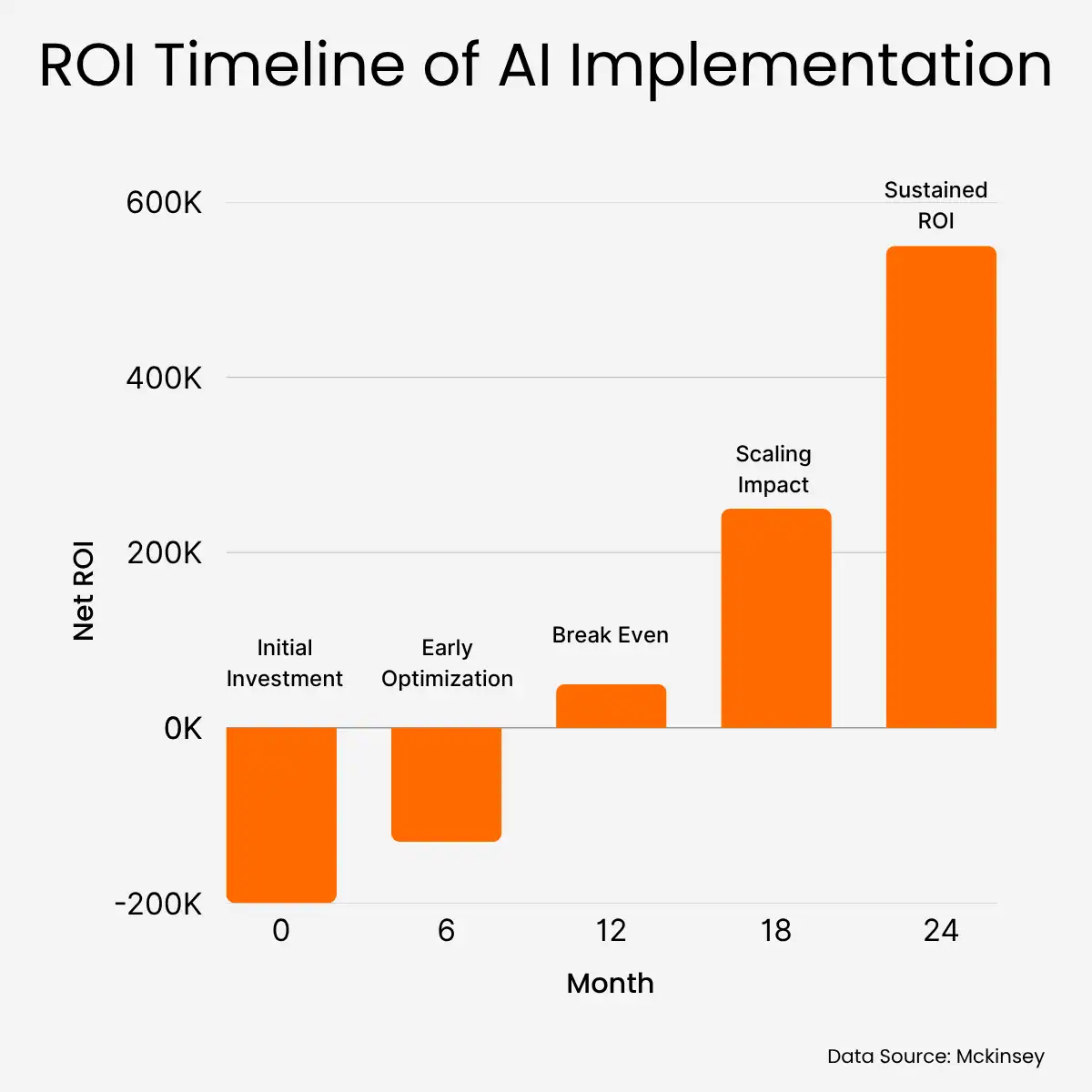
AI initiatives in manufacturing typically reach break-even within 6–18 months.
Conclusion
How Does AI Shape the Future of Manufacturing?
Here’s what the future of artificial intelligence in manufacturing actually looks like — not the sci-fi version, but the version that’s already being built on factory floors today.
Factories that predict their own failures before they happen. Production lines that self-optimize in real time based on live demand data. Quality systems that catch defects before they leave the line. Supply chains that adjust dynamically to disruption without a human firefighting every exception.
The manufacturers who will dominate the next decade aren’t the ones with the most capital or the biggest workforce. They’re the ones who treat AI not as a technology project, but as an operational strategy.
The seven benefits of AI in manufacturing outlined here — automation of routine tasks, production speed, error reduction, enhanced safety, real-time data analysis, design innovation, and supply chain optimization — aren’t independent wins. They’re interconnected. Each one compounds the others. And together, they represent a structural shift in what’s possible.
The window for early-mover advantage is still open. But it’s closing.
If your competitors are already running AI-optimized production lines and you’re still reviewing defect data in a Monday morning meeting, the gap isn’t just operational — it’s existential. The benefits of AI in manufacturing are no longer theoretical. They’re the new baseline.
The only real question is: where do you start?
Explore more related content
Edge AI Hardware: The Engineering Trade-Offs Behind IFA 2026’s Biggest Trend
Edge AI Hardware: The Engineering Trade-Offs Behind IFA 2026's Biggest TrendGlobal edge AI hardware market at $33.3B...

IoT in Smart Agriculture: The Hardware Engineering Decisions That Decide Whether a Sensor Survives the Field
IoT in Smart Agriculture: The Hardware Engineering Decisions That Decide Whether a Sensor Survives the FieldThe top...
How to Choose a Contract Electronics Manufacturer for Agricultural Technology
How to Choose a Contract Electronics Manufacturer for Agricultural Technology"China has re-entered the chat, after not...